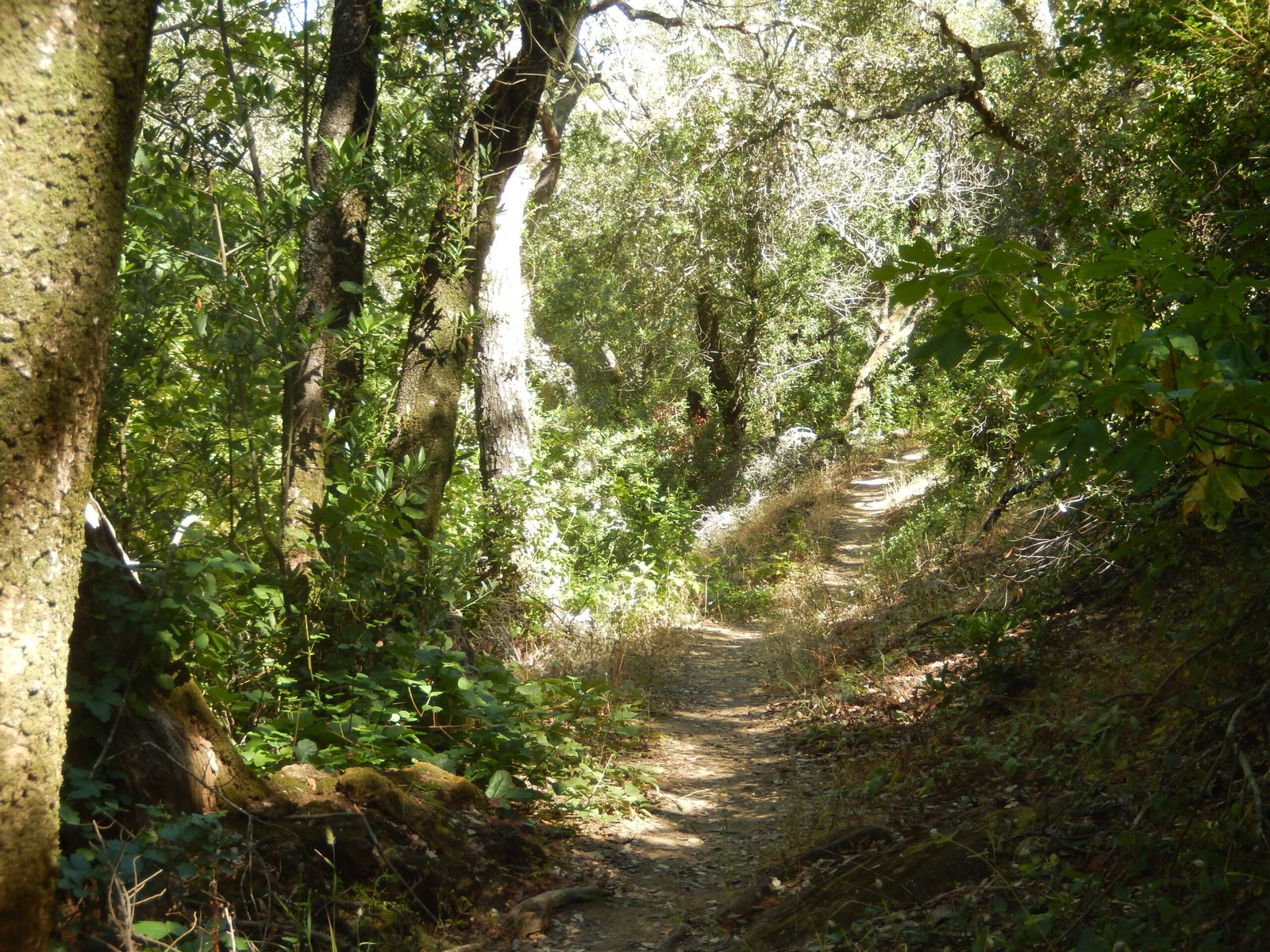
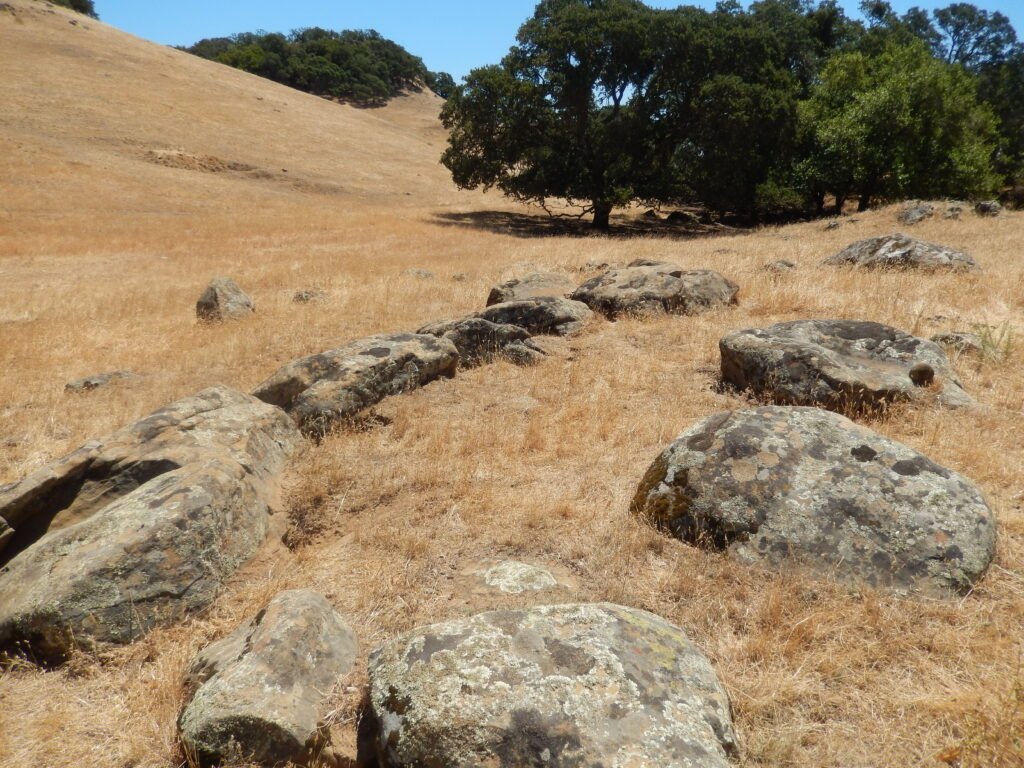
Native Americans were immersed in their natural environments to an extent that can be hard for most Californian suburbanites to fully appreciate. More than 500 autonomous tribal groups once lived in this state. Most had only a few hundred people, and most folks lived in a particular valley. They migrated seasonally within a home territory, returning to the same summer camps and winter villages as the generations before them had, so they felt that they were at the center of the world. The areas around their villages were familiar, and each useful tree or patch of land was worked and reworked. This circle of stones (below) was part of an Ohlone village in the mountains above Livermore.
The anthropologist George Foster described the delight of a Yuki (a tribe north of Clear Lake) upon returning to his home ground. He said that the rocks and trees knew him and were glad to have him back. Many First Californians’ myths, tales, and sacred events were tied to oddly shaped rocks, certain mountain peaks, springs, and bends in rivers. Many associated them with activities of their ancestors and mythic animals. Since tribes had lived in the same areas for countless generations, their physical landscape was full of associations with their predecessors and animals.
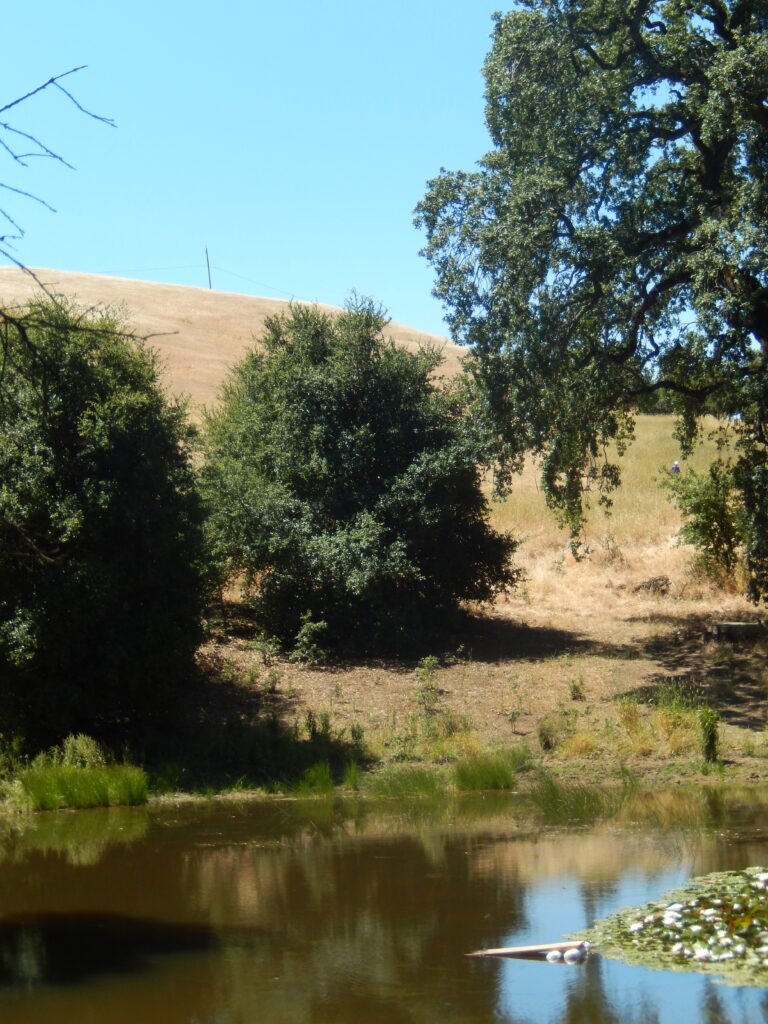
The 19th century adventurer and pioneering anthropologist Stephen Powers wrote that the Mattole of northwestern California and several other tribes deeply knew their territories. Their boundaries were marked by certain trees, canyons, boulders, trees, and springs, each of which had its own proper name. Mothers taught them to their children in a kind of sing-song. Over and over, they rehearsed them, describing them minutely and by name. A Pomo elder named Lucy Smith said that her mom told her that animals and natural landscapes’ features were her relatives and that all must live together. A Pit River (in the Alturas region) man called Bill said, “Everything is living, even the rocks, even that bench you are sitting on.”
So animals were as prominent in ideas about the universe as they were in Native American societies outside California, including the Cherokee. The Wiyot (on the northwestern California coast) told about the Pleiades. Paruthvi (Bright) had a harpoon for killing seals and sealions, and Kuchachkoshihl (the Pleides) wanted it. Paruthvi refused to sell it and kept it hidden in his house. So Kuchachkoshihl gathered his friends, formed a plan to steal his harpoon, and crept up to his home in the night. Frog slipped inside and crawled up on the beams above the fire, while Mouse gnawed at a board in the wall opposite where the harpoon was stashed. Kuchachkoshihl then reached through the house’s wall, grabbed the harpoon, and ran. He hopped into a canoe on the beach and paddled off. The people inside the home ran after him, jumped into another canoe, and gave chase. Every night, they streak across the sky, Kuchachkoshihl ahead and Paruthvi’s party in pursuit but never reaching them. For the Wiyot, the stars were not distant astral bodies that fuse and radiate atomic matter. Instead, they were living beings engaged in ongoing dramas that mirrored people’s daily lives and the characteristics of animals in their communities.
According to the Maidu (in northeastern California), Sun and Moon were sister and brother who did not rise at first. Many different animals were sent to try to make them leave the ground, but failed because Sun and Moon’s house was of solid stone and far away in the east. Gopher and Angle-Worm then went. The latter made a small hole from outside to inside, and Gopher followed, carrying a bag of fleas. The insects made life so miserable for Sun and Moon that they decided to leave the house. The sister was afraid to travel at night, so her brother offered to go then, and became the Moon. The sister traveled by day, and became the Sun. This and the Wintu myth treated astronomical relationships like domestic affairs. First Californians lived in a highly domestic world, where major life experiences took place in a village and within a family. So the village, family, and animals provided metaphors to interpret the workings of the universe.
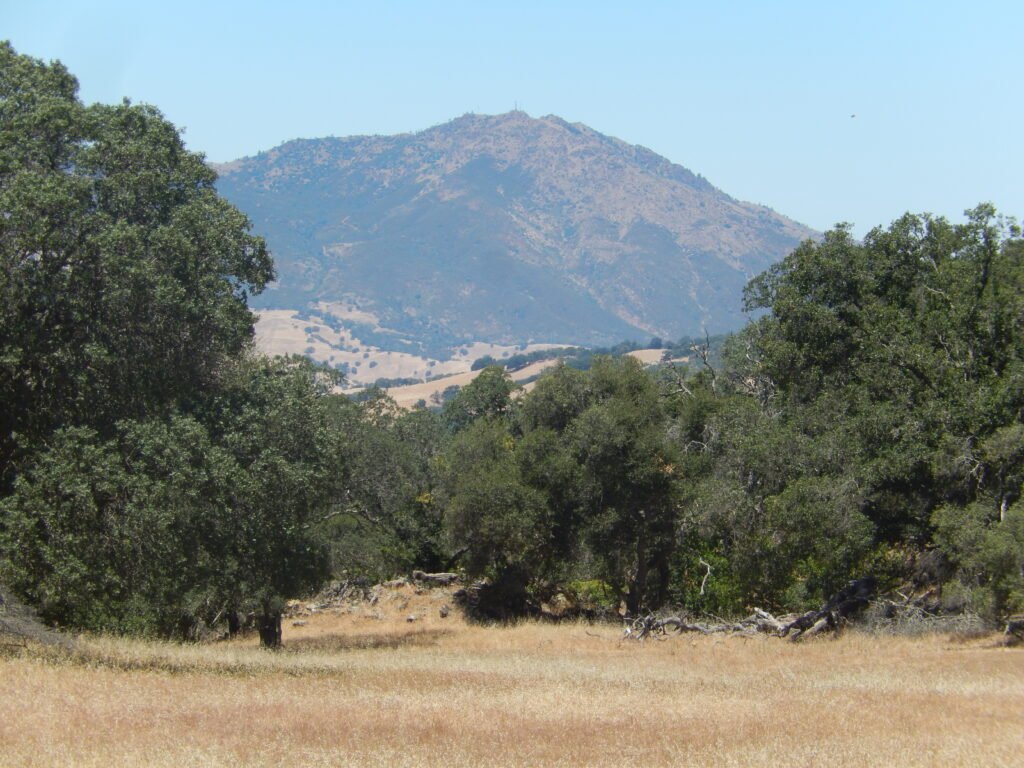
Brushy Peak (below) is within sight of the Ohlone village above Livermore. The hill is still considered so sacred that people are not allowed to hike to its summit; they can only walk around it. An unusually high number and variety of artifacts have been found there, so it was likely a meeting place for locals and Yokut tribes in the Central Valley, which is just beyond the mountain range in the photo.
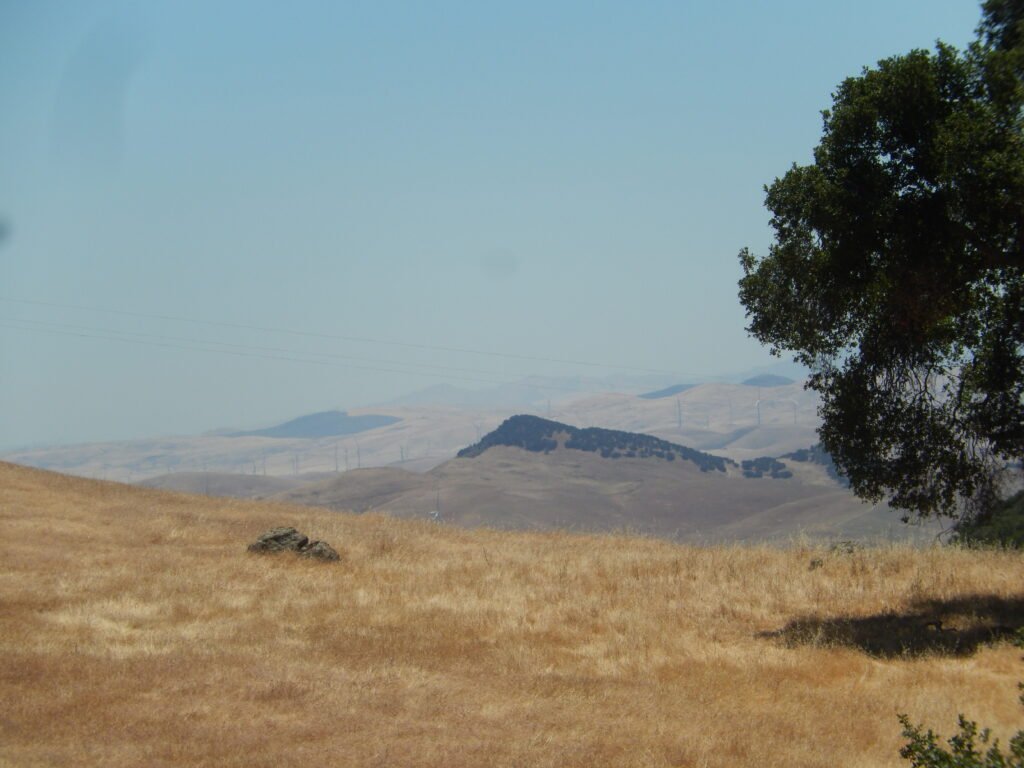
Brushy Peak was prominent for people arriving from the Central Valley on their way to Mt. Diablo, which is behind me in the above photo (the one below looks in the opposite direction from the other end of the village). Many Ohlone, Miwok, and local Yokut thought it was the center of the world, where creation happened. They thus gathered there to trade. So Brushy Peak and the Ohlone village over Livermore were in one of the SF Bay Area’s most cosmopolitan places.
Ohlone and Miwok built more than 400 shell mounds around the bay. They were created over several centuries and combined shells, ancestors’ remains, earth, and rock. Some ultimately had diameters of 300 feet or more and heights of over 30 feet. First Californians conducted religious rituals and sent smoke signals from them. Like the natural environments around villages, they were intimately associated with people’s predecessors. Their bodies were covered with layers of earth, rock, and shell. Communities on both sides of the bay could see each other’s smoke signals from them. Marriages and trading occurred by them, where ancestors could have been invoked as witnesses. Nearly all were leveled and paved over in the 19th and 20th centuries.
Ironically, most people developing AI models at companies in Silicon Valley and San Francisco know little about the cultural richness of the ones who have walked on the same ground for a much longer period. The vast majority are technologists and scientists who haven’t been nearly as interested in cultural studies as their own disciplines and businesses, and they underappreciate how alive the surroundings here once seemed. The great-great granddaughter of Jose Guzman, who was one of the main Ohlone sources of information for anthropologists in the early 20th century, including Alfred Kroeber, told me that their language courses only include members of their tribe. Using the language meaningfully requires more than knowing how to conjugate words. People have traditionally been immersed in natural landscapes and tight-knit communities in which all entities have ethical relationships with each other.
And these relationships have included all the senses rather than focusing on vision and sound, as most AI models do. Aromas and motion also blended into experiences. Many cultures around the world have emphasized senses besides vision and sound. A lot of traditional African societies stress motion. Data centers will probably never have the capacity to store and process so much more data, perhaps unless they can be launched into space, but a lot of physicists say that that will never happen, partly because it would be extremely hard to cool them.
So the developers of AI systems can learn a lot from walking in the hills and shores of their own geographic area, opening their senses and minds to how First Californians have processed the same places, and learning to appreciate them in new ways. Instead of presuming that their models will represent humanity’s full diversity, they can walk with people in many other cultures and engage in dialogs with them.