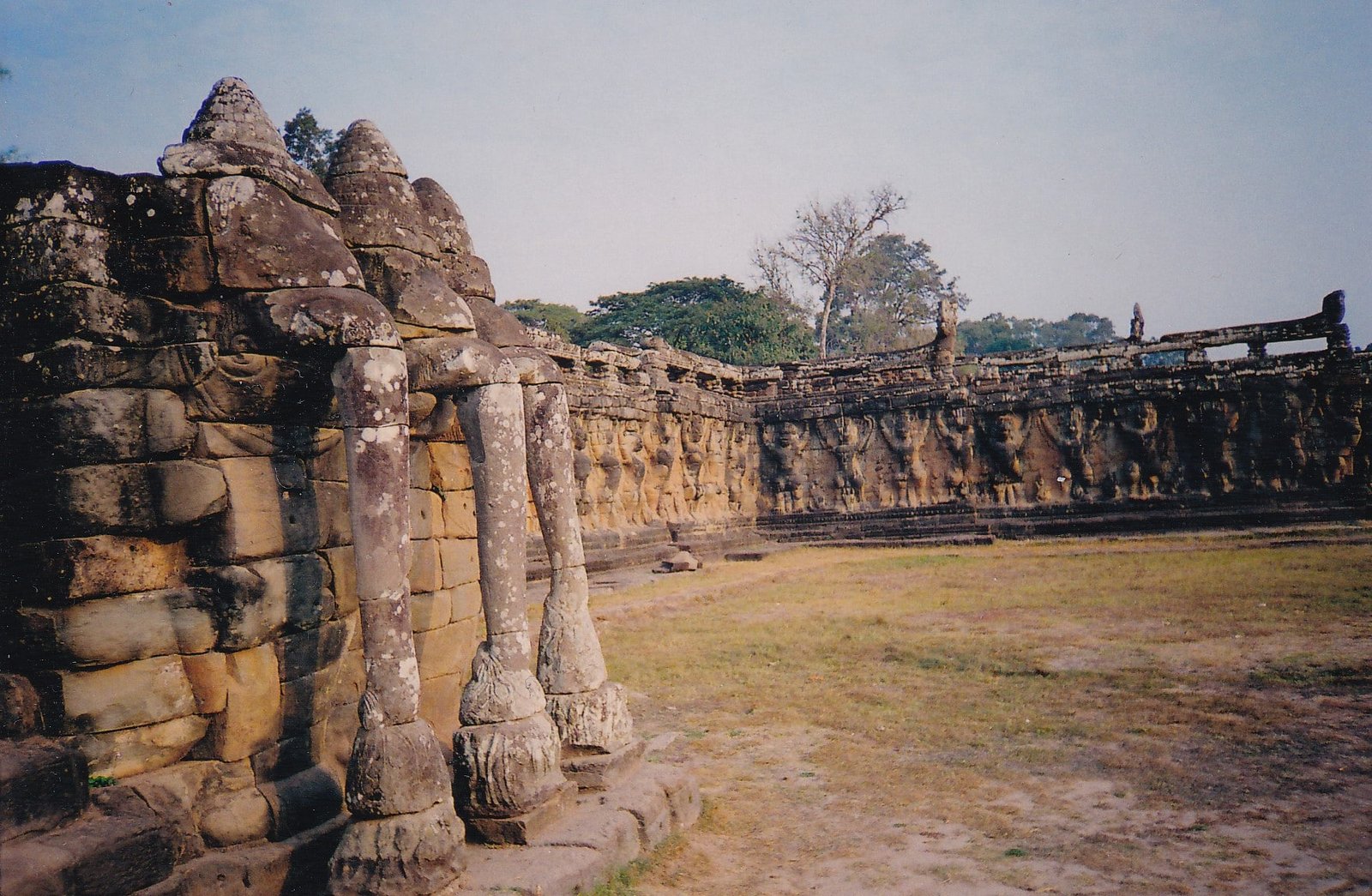
Angkor was one of the world’s largest cities in the Middle Ages, and its center was as lively as you’d expect such a place to be. I found the area around the Khmer royal palace at Angkor one of the best places to imagine life in the Khmer Empire during its zenith.
The palace and the parade ground sprawl next to the Bayon, and they combine into one of the best places to imagine what the glory days were like. What was there before Jayavarman VII beefed up the area in the early 13th century, when Europeans were building the great Gothic cathedrals, was already dazzling. A temple called Baphuon shone next to the royal compound; it was the largest monument in Angkor when it was built in the 11th century. The top soared about 150 feet, and it was probably plated with gold leaf or copper leaf (it was called the Tower of Bronze after the Bayon was built, which was called the Golden Tower). The tropical sun beaming on it must have made it seem like a dynamo of cosmic energies.
Just beyond Baphuon is a huge parade ground (1,800 by 656 feet), which stretches between the royal palace (on the left) and a group of ancient official buildings. The Khmers displayed themselves here in full splendor. Religious festivals enlivened the calendar, and crowds assembled to watch parades, fireworks, and elephant and boar fights. Khmers also imported polo from India.
Royal processions from the palace included soldiers, musicians, drummers, and people carrying banners. A group of 300–500 dancing women wearing flowers in their hair and holding burning tapers joined them. The female palace guards also promenaded, and they toted lances and shields. Dignitaries on elephants rode in front of the king, and they were surrounded by more red parasols than a Chinese political envoy named Zhou Daguan could count when he lived in Angkor in 1296 and 1297. The king’s wives, concubines, and servants rode next; some sat on horses and elephants while others reclined in palanquins and carts. More than 100 gold filigreed parasols sheltered them. The king came last, standing on an elephant and brandishing the sacred sword under more than 20 gold filigreed white parasols with handles made of gold. Soldiers and more pachyderms surrounded him.
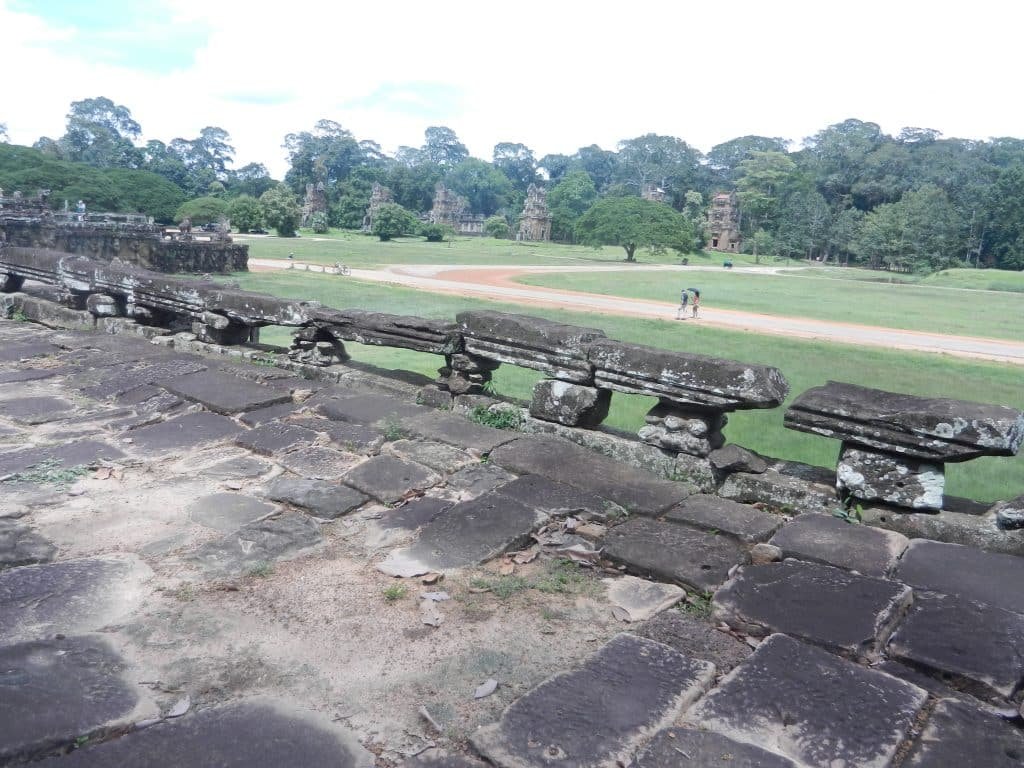
A late 12th century stone terrace extends in front of the palace, forming a fitting frame for these spectacles (the above photo is from its top, looking across the parade ground).
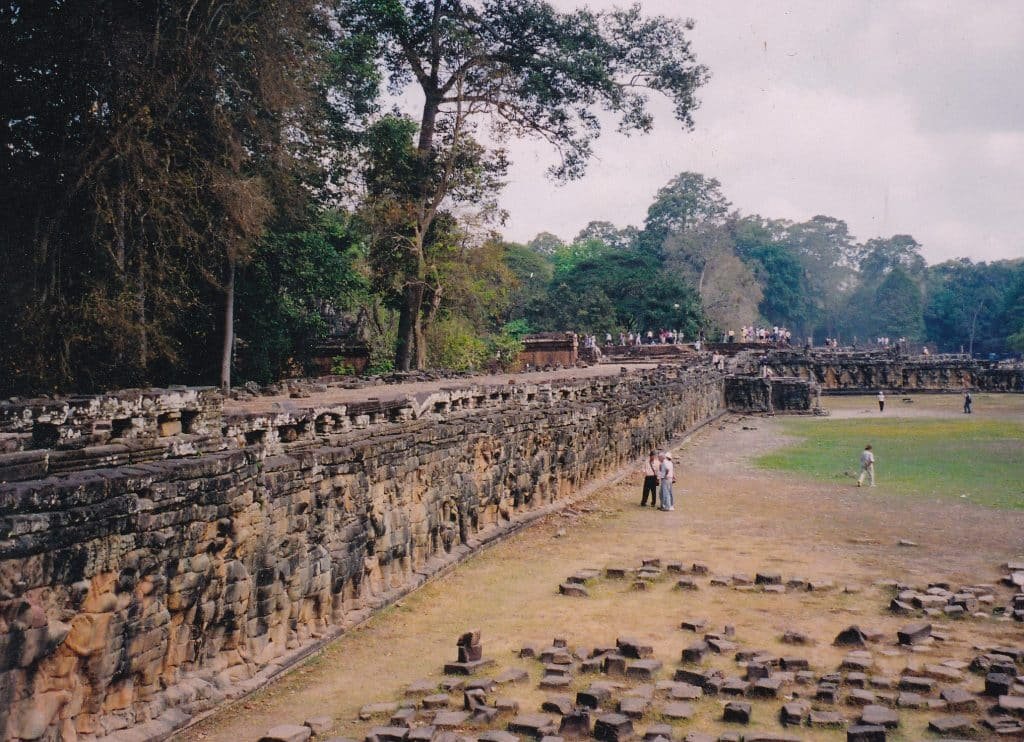
It is almost 1,000 feet long, and its height varies from 10 to 15 feet.
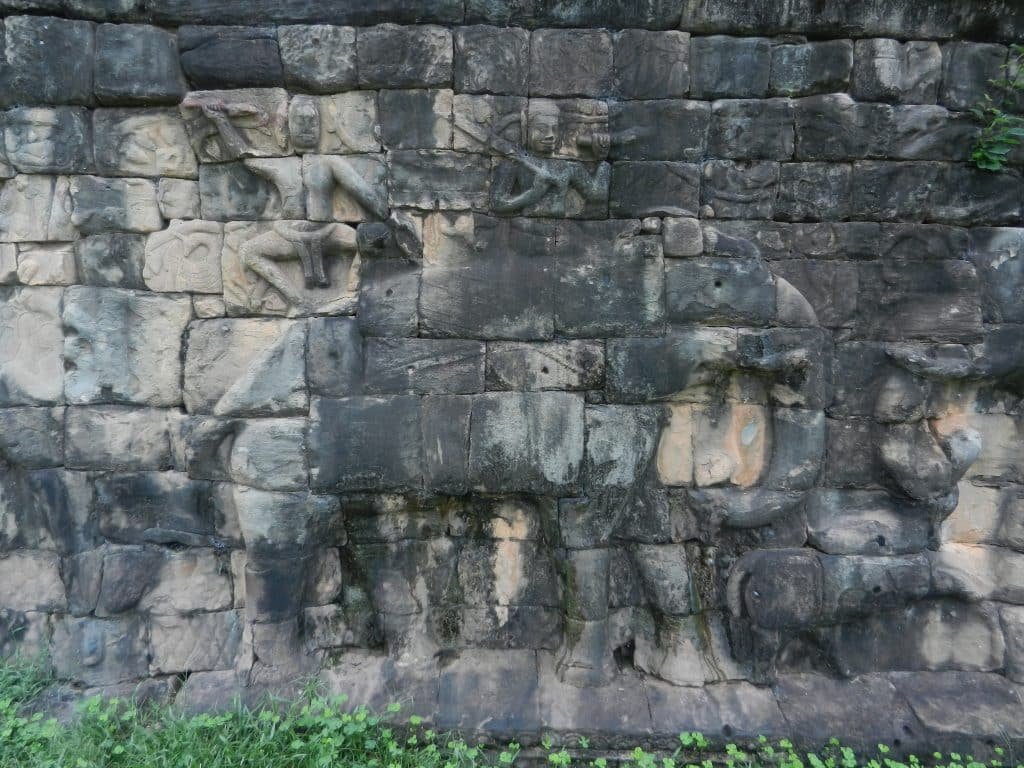
Carvings of nearly life-size elephants in hunting scenes fill it with regal energy.
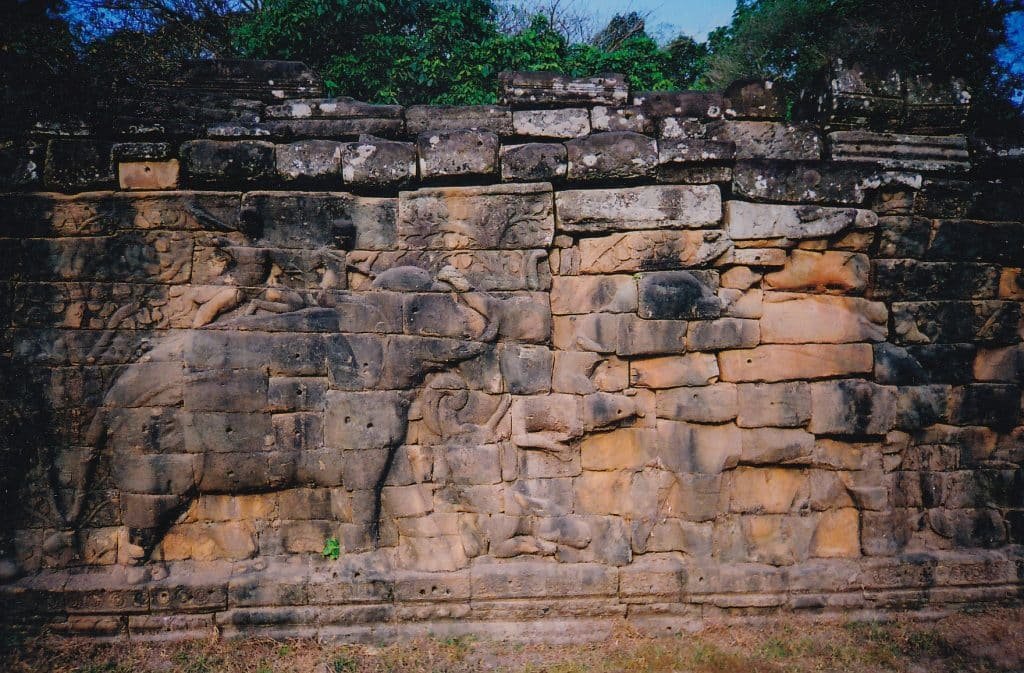
Men positioned on their backs chase tigers, buffaloes, and boars. This wall, called the Elephant Terrace, was probably the base of royal reception pavilions where the king and courtiers watched the festivals.
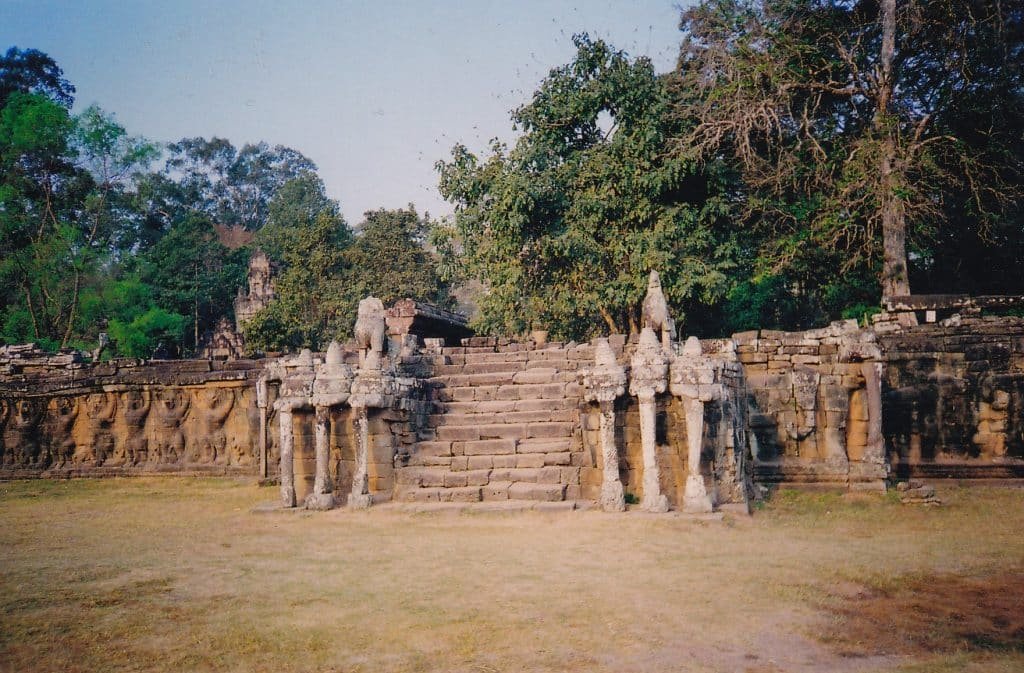
The palace was the largest in Southeast Asia. A laterite wall about 1,900 feet long, 800 feet wide, and 15 feet high surrounded it (its shorter side faces the parade ground). A grand stairway with elephants carved on each side still leads from the parade ground to the Universal King’s house (below). The three elephant heads on each side repeat the same motif on the gate towers on the city’s outer walls. Elephants were associated with royal majesty and the coming of the monsoons. Visitors got a strong message that they were at the center of the world’s order.
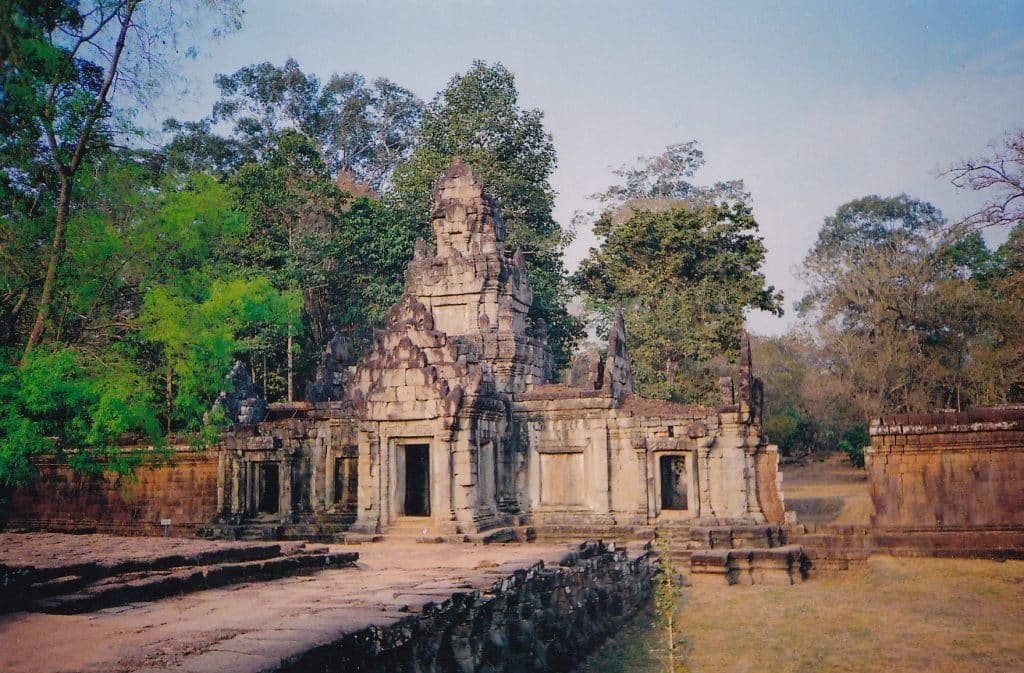
Below, you can see a gatehouse that stands just behind the elephant terrace. Its elegance adds to the regal atmosphere.
A multi-tiered pyramid called Phimeanakas punctuates the middle of the palace’s compound (below). A Khmer legend said that the king slept with a courtesan in a room on the pyramid’s summit every night.
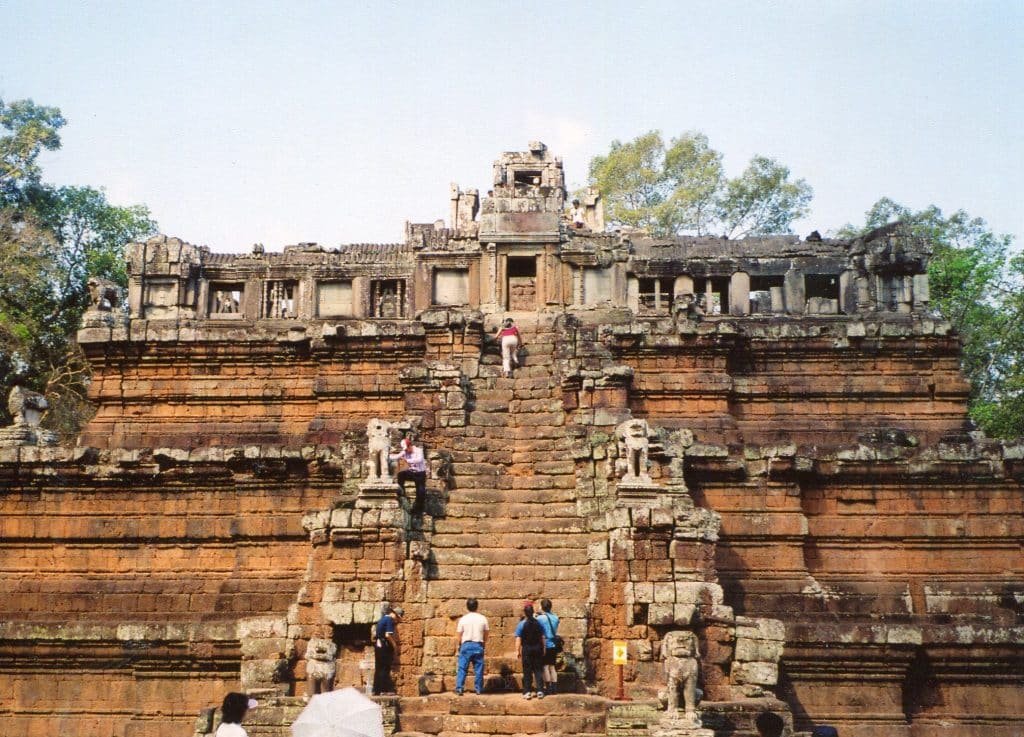
She represented a naga princess who transformed into a beautiful woman. Some Khmers and Chinese residents believed that this ritual fertilized the kingdom because it was a meeting of the ruler’s celestial power with earthly energies. But if it was enacted on this pyramid, it wasn’t a casual fling. The room at the top is about 50 feet above the ground, and the steep stairs render the climb and descent a bit dangerous. I found it surprisingly small. There’s no area for frivolities, but only enough space to lie down (I’m in the room’s center in the below photo).
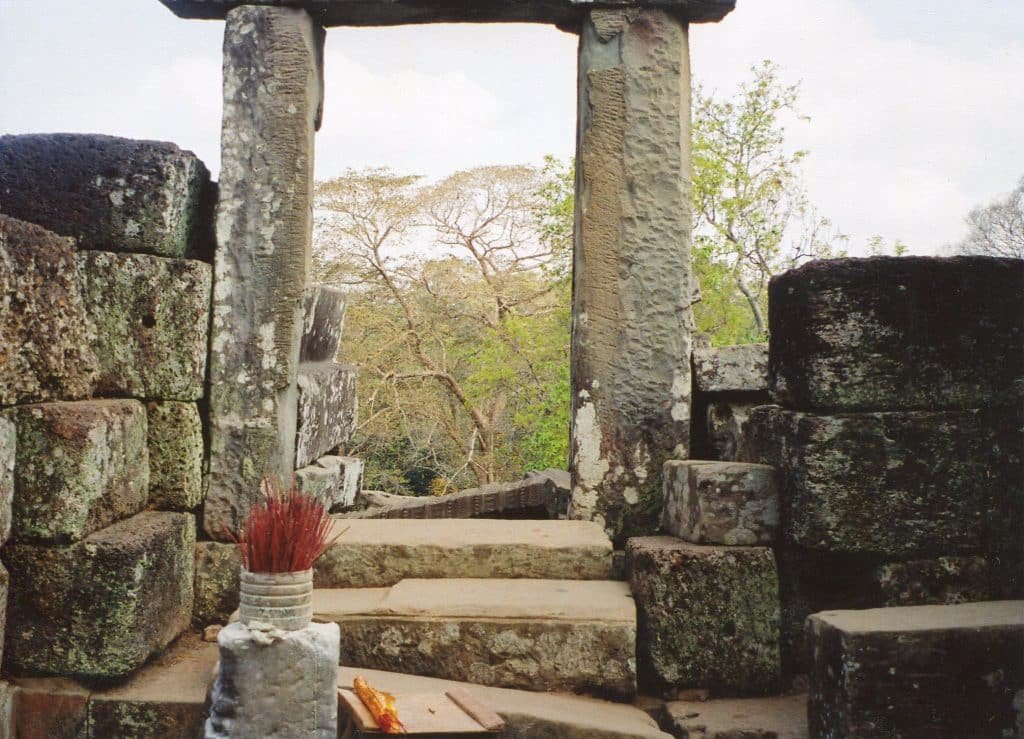
If the legend was true, a royal rendezvous must have been conducted with the formality of a state ritual. The ceremony might have only occurred in folk tales, but the building formed an august center of the palace ground.
Some people might have taken this tale seriously, since many Southeast Asian societies held myths about a high-caste Hindu man and a local naga princess begetting their royal dynasty. Funan did too. The Khmers might have made the old story more splendid by associating this monument with it.
Other remnants of the palace’s past glory also tantalized me. Five enormous pools once gleamed within its walls. Historians think that they might have been used for both ritual cleanings and pleasure.
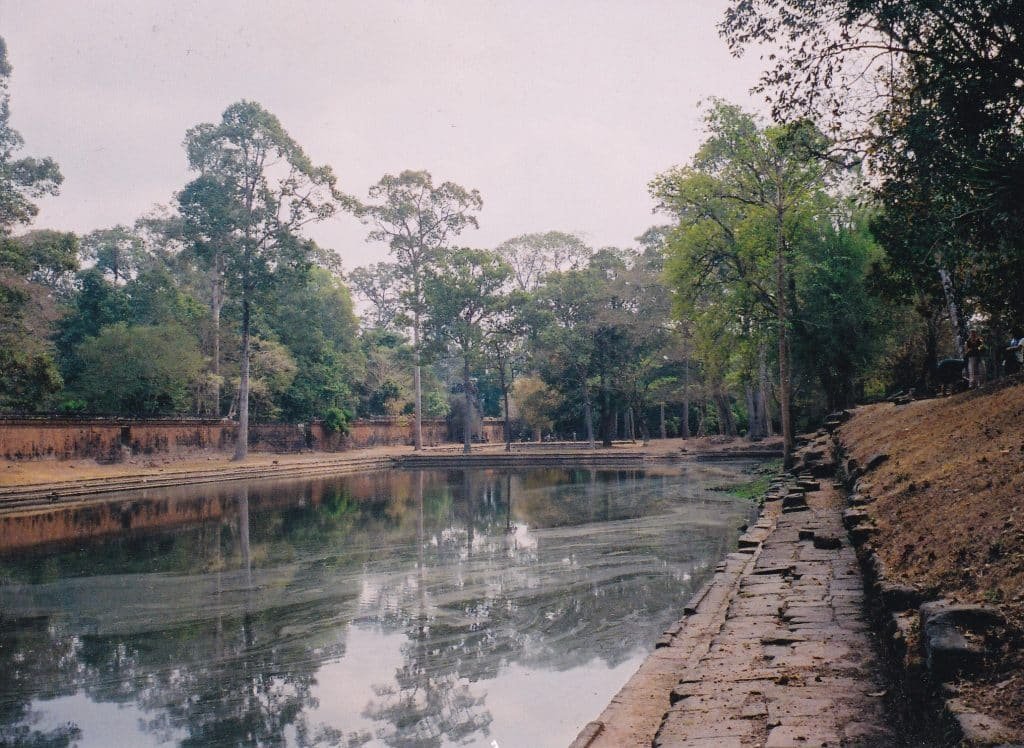
As many as 3,000–5,000 female servants, including concubines, are supposed to have lived within the compound. If they frolicked in the waters, they might have made kings and courtiers imagine devatas.
I trampled through the area, imagining how Khmer royalty lived. A terrace with friezes of birds rose between two of the pools. Perhaps dancers and orchestras with tinkling gongs performed on it. Long rectangular foundations of royal apartments and storerooms spread between the pools. Spaces in the palace alternated between commanding halls and open areas with sparkling water (so little remains today that only diehard fans of Khmer history or art would find them worth their time).
But court life seems to have been stilted. The king gave audience twice a day when Zhou Daguan lived in Angkor. Servants blew into conch shells to signal the ruler’s arrival, and he appeared in a golden window. Two women pulled a curtain back to reveal him as he held the sacred sword, and all in attendance had to put their hands together and bow to the ground. They could only raise their heads after the horns stopped.
Even Zhou Daguan was impressed with the rooms, and he hailed from mighty China. They had enormous pillars and beams that were carved and painted, and they alternated with long corridors and high towers.
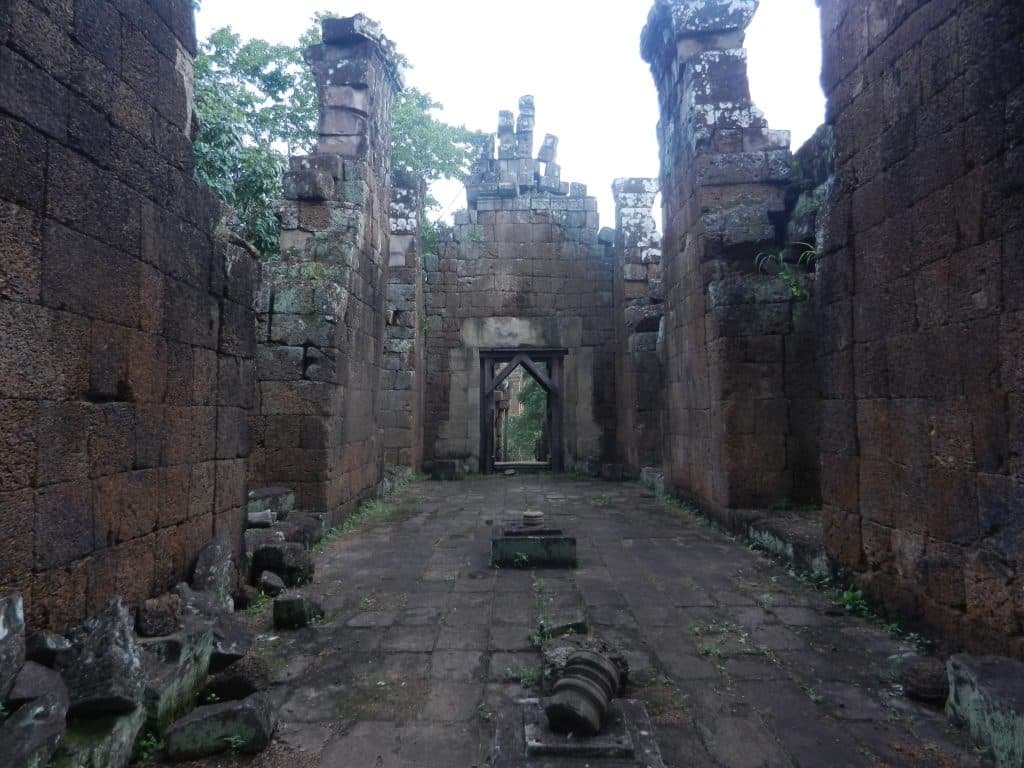
I found the buildings on the other side of the parade ground as engrossing as the palace. Twelve laterite towers line it, and two long single-story buildings called khleangs stand behind them. Inscriptions from the time say that dignitaries stayed in the khleangs while visiting the capital. I found these structures stately. Their walls are high and thick, with a central room and a long, narrow chamber branching from each side.
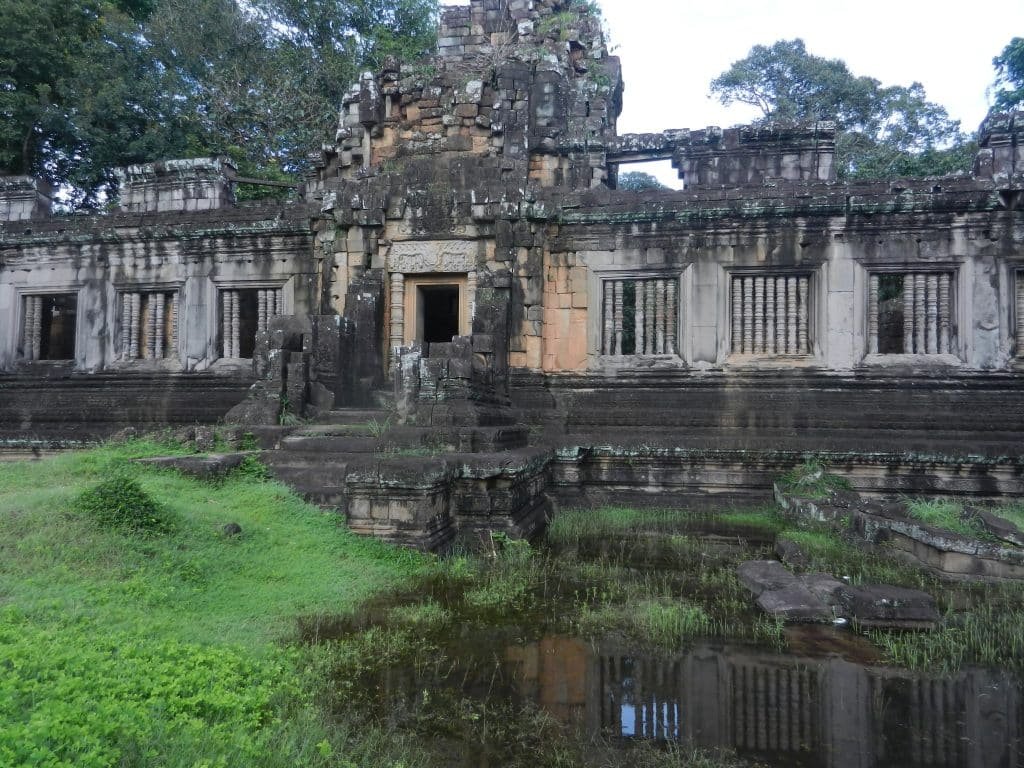
The buildings are formal and symmetrical, so they were fitting places for distinguished guests (above and below).
Different theories have been proposed for the towers’ functions.
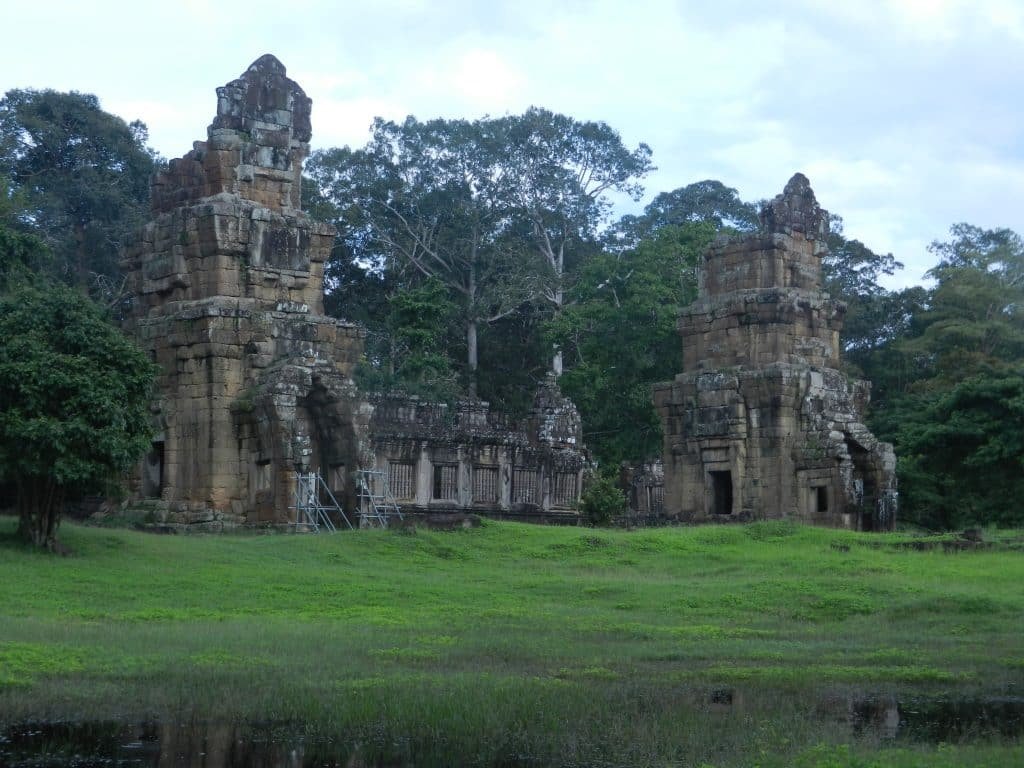
People might have watched processions from their tops, or acrobats might have walked on tightropes between them. Zhou Daguan said that when two people had a public dispute, each sat in a tower and emerged one to four days later. The one who was wrong was always sick. All three explanations sound far-fetched to me because none seems like a sufficient reason for building them. Twelve was a sacred number in Hindu cosmology. Did each tower represent a god? Whatever their purposes were, the towers and khleangs complemented the elephant terrace and palace. The buildings surrounded parades with aloof majesty.
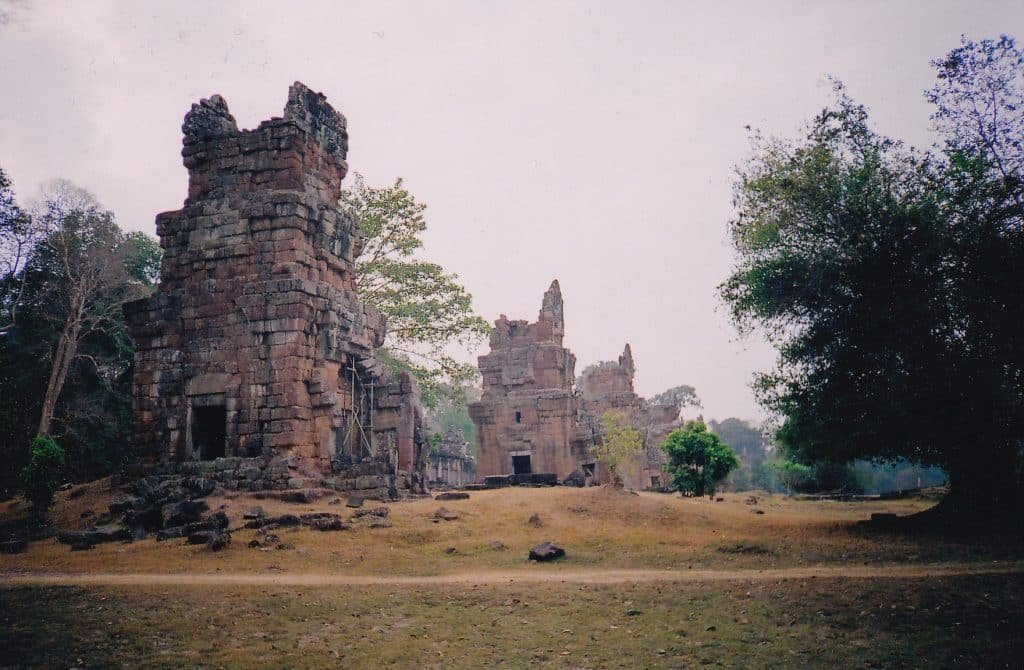
Only the stones and laterite remain, but these edifices once framed festivities that would have made the Super Bowl seem boring. Bright flags and tents, bursting fireworks, shrieking conches, booming drums, lithe dancers with sparkling jewelry and tiaras, and regal elephants glittered between the monuments. Racing chariots, grunting wrestlers, and men on horseback fighting with spears rumbled through there. Acrobats and jugglers added lilt to the muscle. The sense of fun and the sublime power of the king and the gods must have blended to an extent that’s hard to imagine today. In this mixture of cheer and awe, how could people have doubted that this was the most powerful and exciting place in the world.