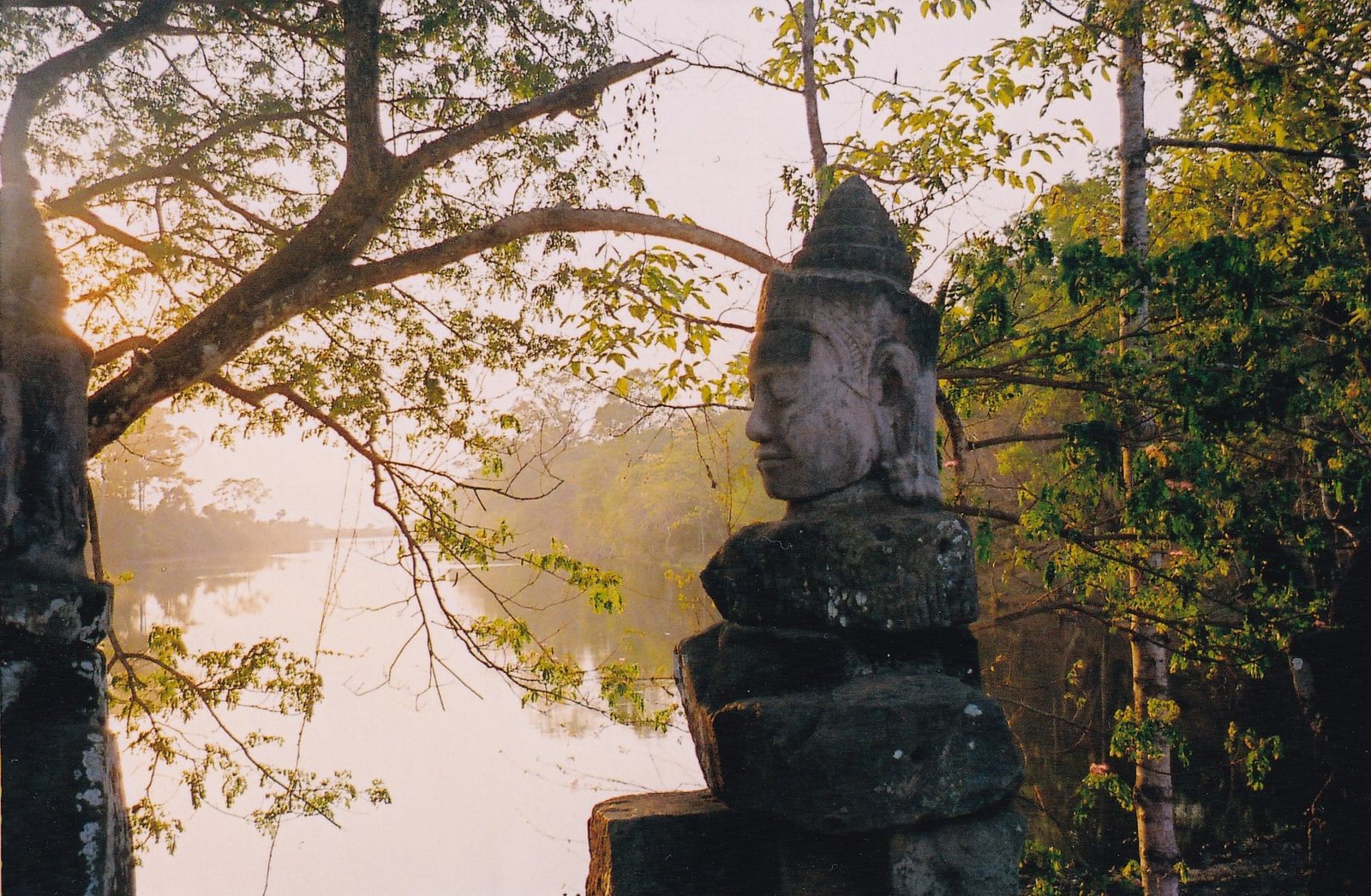
What a beautiful image of peace to see just before the south gate of the Khmer capital, Angkor Thom–a heck of a lot prettier than billboards on the LA freeways. But his counterparts sure had bad attitudes. Both gave the Khmers in the 13th century a resounding message that they were entering the world’s most important place.
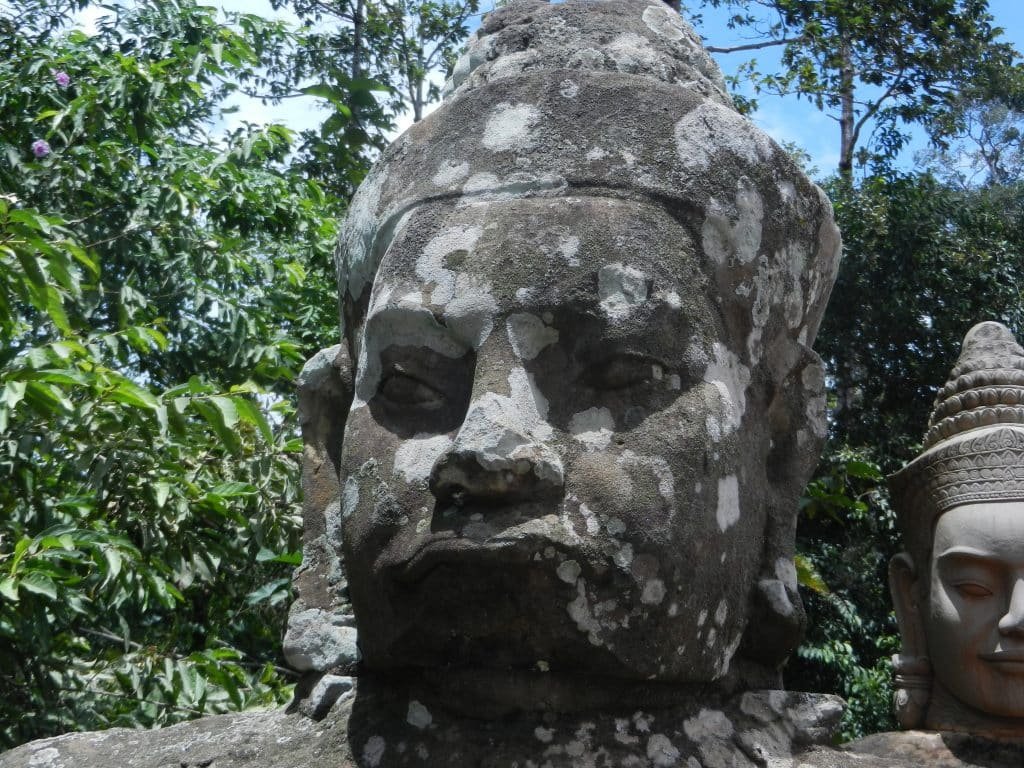
Angkor Thom (The Great Capital) was built by King Jayavarman VII about 50 years after Angkor Wat was finished. A lot of earth-shaking events happened in between. Chams from Vietnam invaded, and they might have sacked Angkor. Several quick royal successions ensued and contemporaries wrote that misery descended upon the land. Jayavarman VII then took the throne around the age of 50 and began a building program that would be the greatest in Khmer history and one of the greatest in world.
The peaceful and angry figures in the two above photos flank the road in front of the south gate of Angkor Thom–the royal city which Jayavarman built over the older capital. They have special meanings which gave visitors an intro to the center of an empire that would have humbled its European contemporaries who were building Gothic cathedrals. Their city entrances were ragtag in comparison, though what was happening inside them was pretty lively.
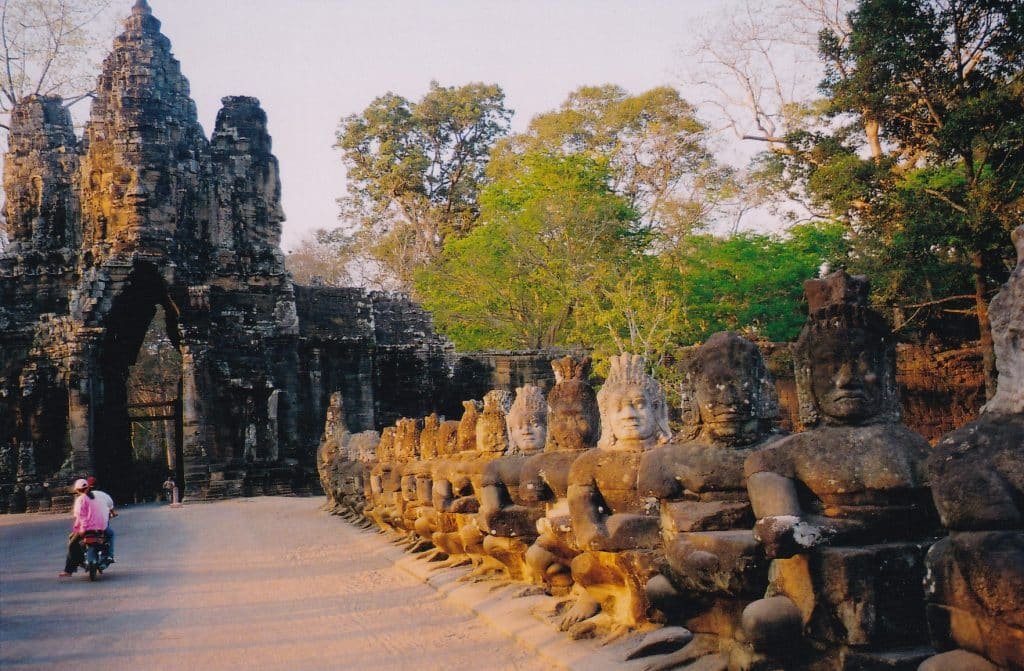
Fifty-four figures line each side of south road to Angkor Thom. The calm ones are gods and the others are asuras (demons). Both groups are pulling a giant snake called a naga (the seven heads of one greet visitors in the below photo).
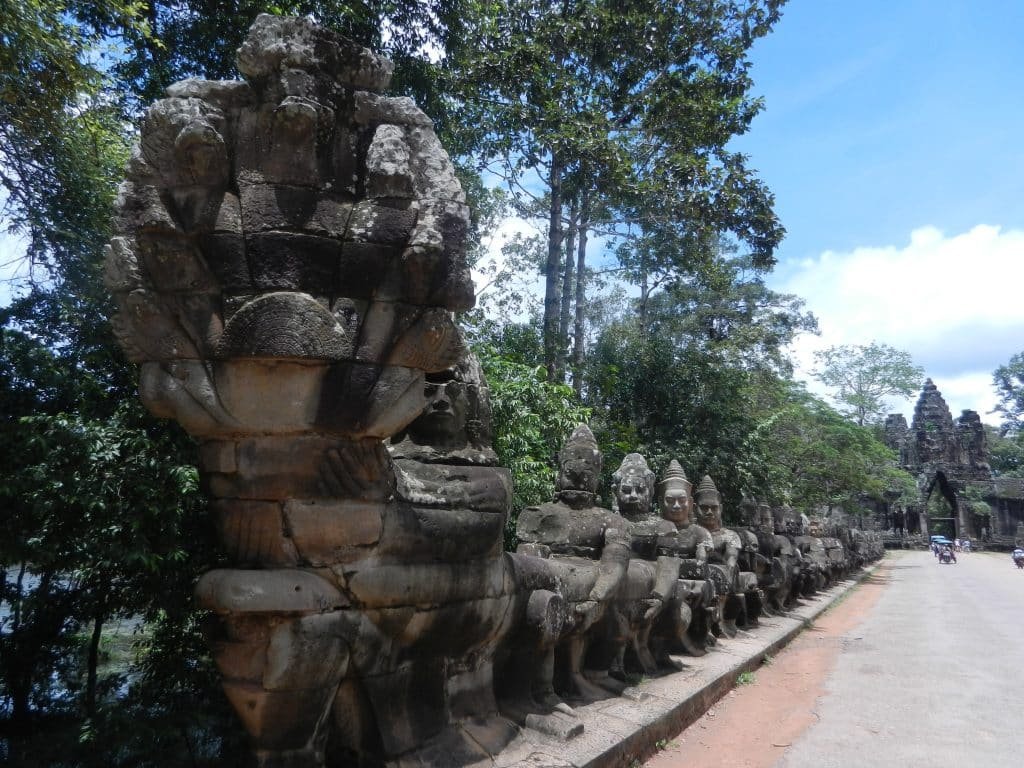
An enormous scene of gods and asuras pulling a naga was carved on Angkor Wat’s east wall 50 years earlier. So Jayavarman was probably reproducing an image of a key event in the universe’s history. In Hindu mythology, this tug-o-war churned the sea of milk at the beginning of creation. The entrance to Angkor Thom was thus probably associated with a pivotal event in the ordering of the universe.
And it wasn’t a mundane kind of order. Claude Jacques notes that many Khmer temples also have naga balustrades that line the approach, and that they might have linked our world to the world of the gods. George Coedes thought that naga bridges corresponded to a rainbow. If this road represented a rainbow bridge to the gods, it would have resonated with the annual rains that Khmer society depended on.
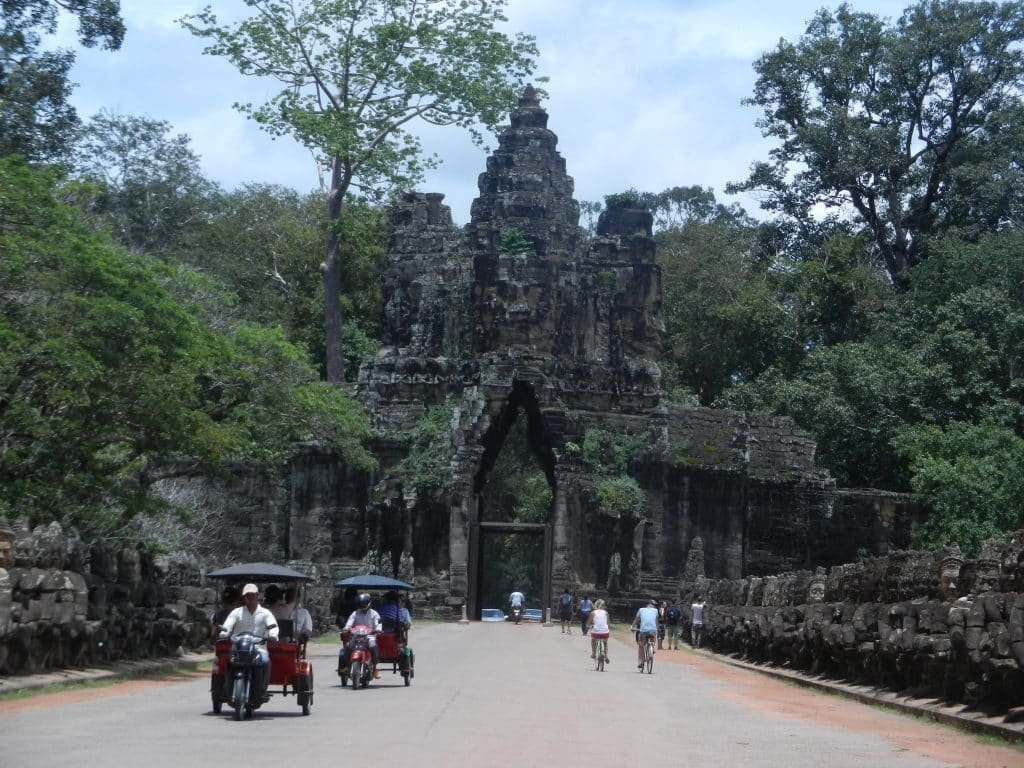
The gate that the bridge leads to is equally stunning. Angkor Thom has five of them, and each has four giant laterite faces (one on each side) above the corbelled arch over the entrance. They smile a bit, without showing teeth.
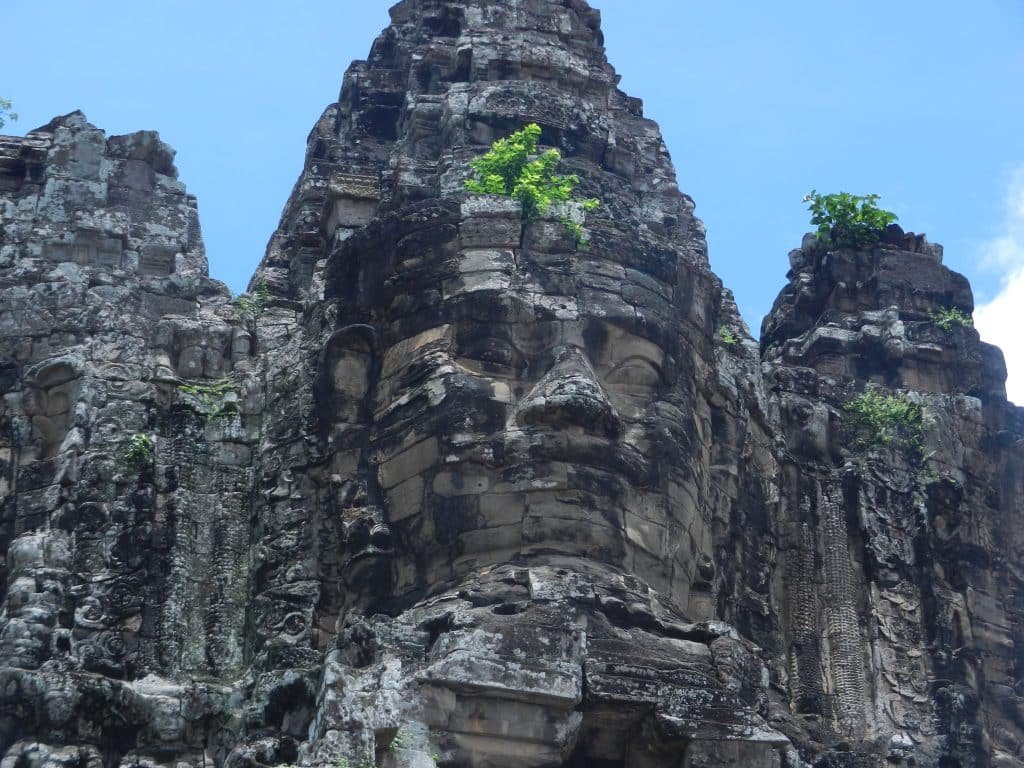
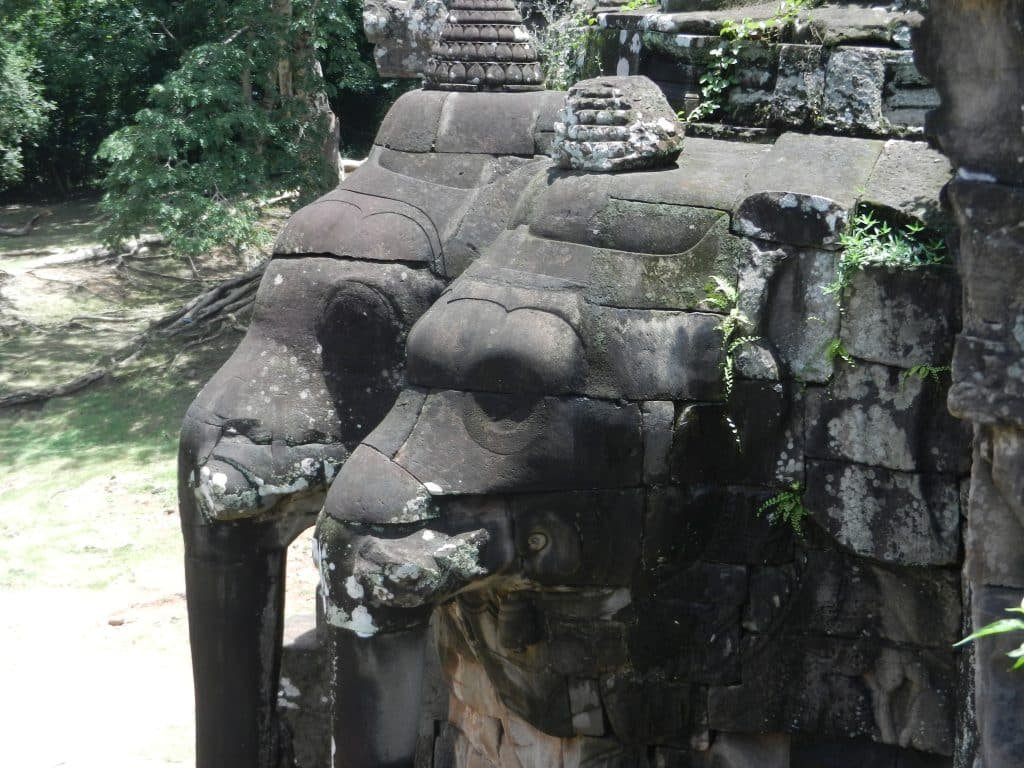
Some scholars have thought that they represent Jayavarman VII. Others have written that they embody Lokesvara, a Mahayana deity that represents the Buddha’s compassion and who helps keep the world in order between the Buddha’s passing and his next incarnation as Maitreya–Jayavarman became a Mahayana Buddhist. Jayavarman might have fused his identity with Lokesvara in these towers. Other ideas about the faces have been proposed too, but if they did represent a Buddhist deity, the entrance to Angkor Thom combined Hindu and Buddhist ideas into a sensational introduction to the royal city. The two following photos below are of one of the three-headed elephants that support the face towers; Khmers had portrayed the Vedic god Indra riding them for more then three centuries. This ancient image was closely associated with the coming of the annual monsoon, so it would have resonated with folks approaching Angkor Thom.
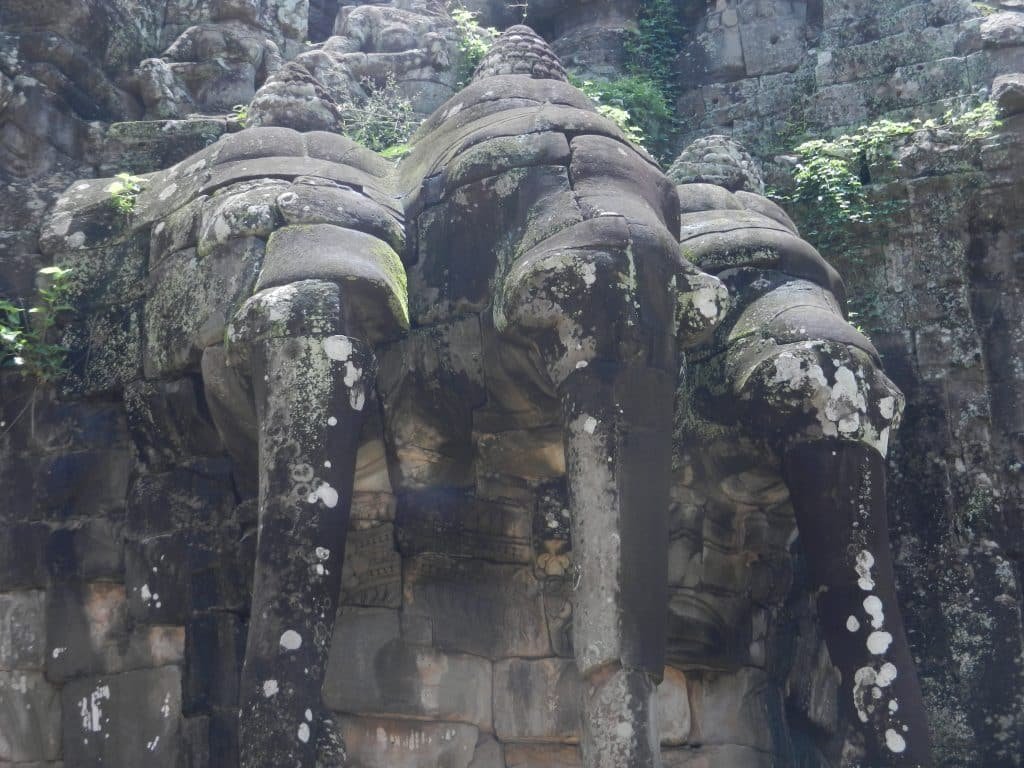
Jayavarman’s images of them were as regal as the face towers.
After the turmoil from the Cham invasion that followed Angkor Wat’s construction, Jayavarman VII might have been covering all bases to ensure people that that they were entering the political and spiritual center of the universe. A total of 108 figures pull the nagas on the bridge. There were 108 towers on Phnom Bakheng, the royal cult temple of the builder of the older capital. This has been one of the most important numbers in Indian mythology; it has symbolized the entire universe and its energies. So Jayavarman was using ideas that former Khmer kings established to order the empire and mixing them with newer blends from Mahayana Buddhism.
And this is just at Angkor Thom’s entrance. The massive walls stretch for about 1.8 miles on each side. About 325 feet inside them, a wide canal formed an inner perimeter, and in the corners, four temples dedicated to Lokesvara housed stelae that contained details about the city’s construction. An avenue proceeded from each of the five entrances to the city’s center, and each road was 98 to 131 feet wide. This was ideal for royal rituals and processions of troops. They ended at main temple, the Bayon. Face towers rise rise from it and from several other major shrines that Jayavarman VII built. All faces together show the Buddha and probably Jayavarman’s fusion with him permeating the city and radiating through the whole empire.
Recent lidar-based studies have concluded that least one million people lived in or around Angkor Thom, so this was one of the world’s largest cities at that time, rivalling China’s capital during its Southern Song Dynasty, Hangzhou. The gates gave people a dramatic intro to one of the most spectacular places ever created. We’ll explore more of its monuments soon.