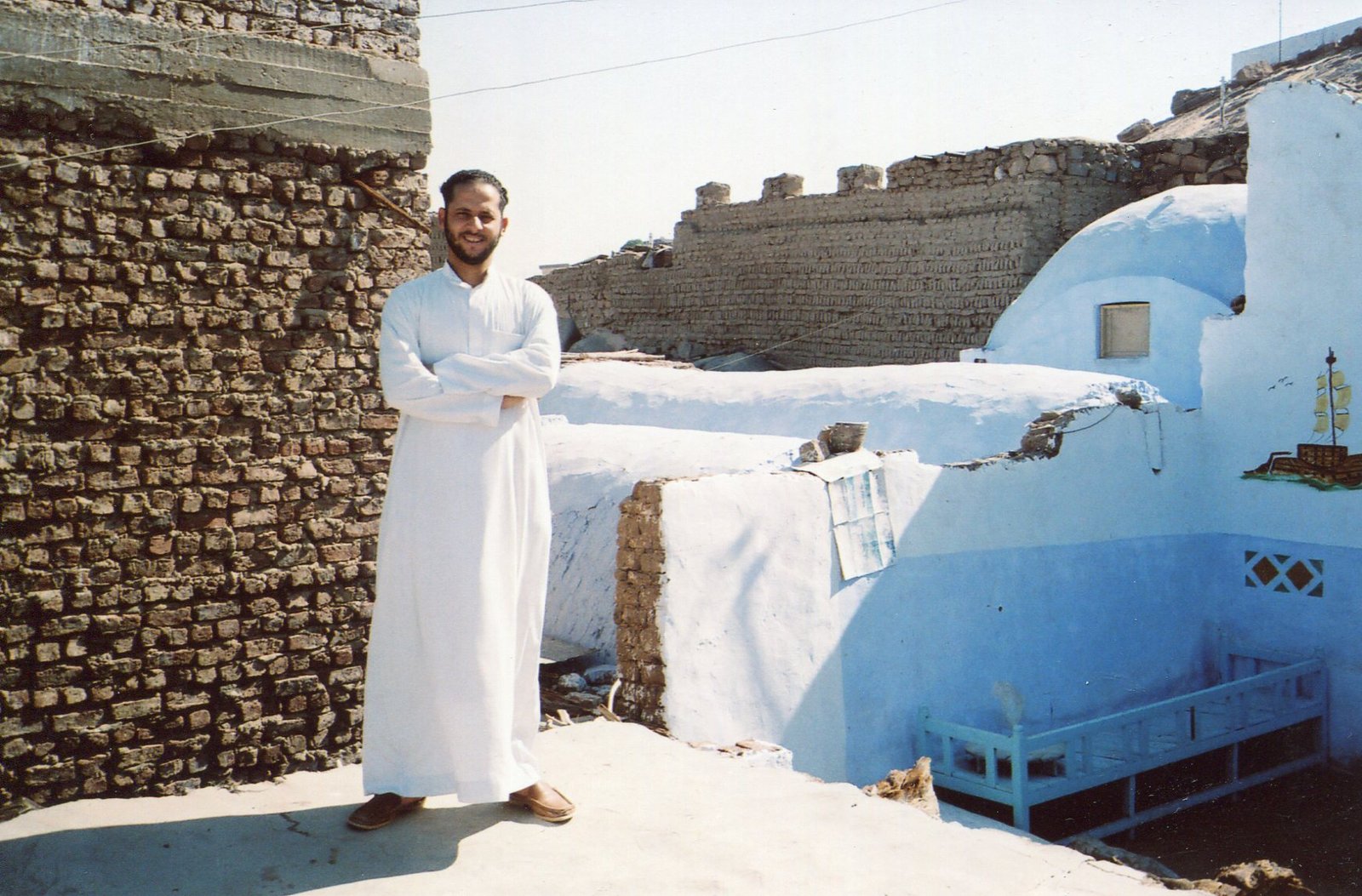
Flying over the Holy Land is dramatic, even at 35,000 feet. You see long stretches of tan with no other colors. No vegetation or clouds, just pure desolation that threatens to engulf you, even at this altitude. The monotony is broken by jagged mountains that seem as hostile to life as the sands. This isn’t the Greek world’s measured landscape with clear distinctions between coastline and land, and between valleys and wild uplands. You’re entering a different world.
This landscape can feel overwhelming, and you respond to it with a sense of awe and by venerating the creator of all things. There’s less Greek love of balance here. The logic of this land is more all-or-nothing. Many ancient Greeks liked checks and balances in the universe. The Olympians bickered with each other, but nobody ever completely won. Zeus was king, but other gods did things behind his back.
But most of the Holy Land is not a place of abstract geometric shapes and clear lines. It often feels like it’s under the infinite power of the sky and the earth. When the sun shines, it’s scorching. When the rain comes, it’s a dramatic break. When the crops grow, it’s a miracle. A change in weather reflects the glorious and overwhelming power behind it. A change in natural landscape from desert to fertile plain also highlights the infinitely magnificent. God is great!
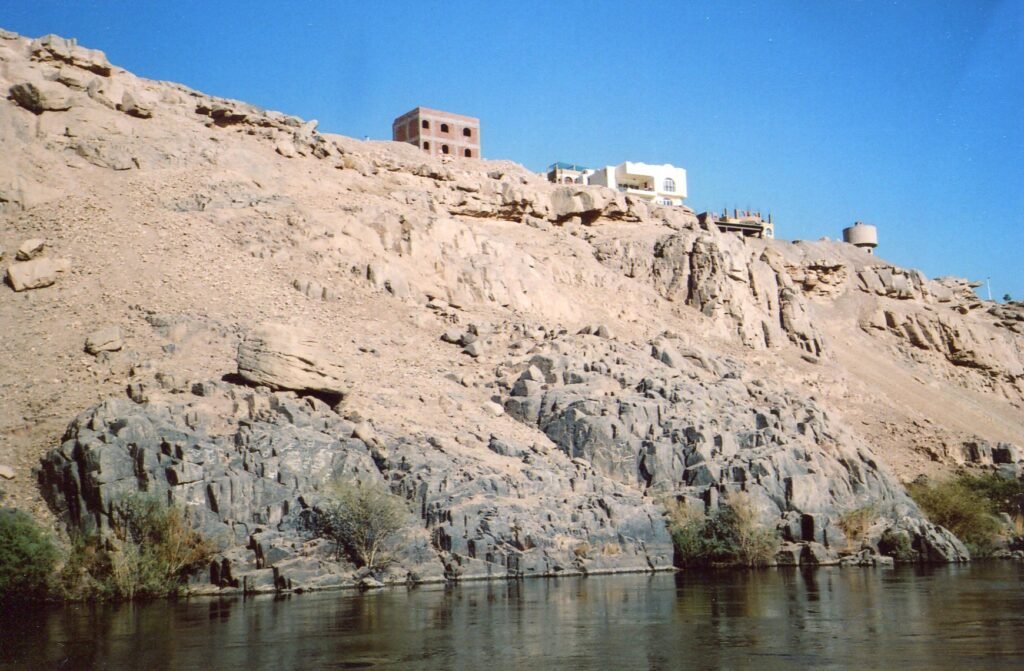
While staying at a hotel in a small village high above Petra, Jordan, I decided to hike up the mountainside that the community hugged. The village was smaller than Wadi Musa, which is down in the valley and where many tourists stay. My hotel was the only one there, and it was designed like an ancient village (with one-story stone buildings with flat wooden roofs), so it blended into the neighborhood. As I walked down the main street, a middle-aged man approached and asked if I needed anything. I told him that I had to exercise my dinner off, and he said, “Go anywhere you want! It’s perfectly safe here.” I trusted him because many Jordanians are proud of their hospitality. Before leaving home, I had read that crimes against tourists were very rare, so I turned onto the steepest road and headed towards the mountain top, and into an experience that I felt took me back to some of the most ancient roots of Christianity, Judaism, and Islam.
I reached the village’s edge after four blocks and kept walking uphill. The community’s lights twinkled far below and stood out under the sapphire night sky. With no streetlights, the only other things I could see were the stars and the barely perceptible peaks around me, which were as jagged as lions’ teeth. I couldn’t even see the edge of the road and thus had to take care to avoid falling off a cliff.
I stopped where the road leveled off. The sky was pure; no streetlights or smog hazed my view of the stars. The black vault of Heaven was studded with jewels. Powerful updrafts from the desert below buffeted me. The contrasts between domains were awe-inspiring rather than proportioned and human-scale, as they typically are in Greece.
The first lines from Genesis came to me: “In the beginning, God created the heavens and the earth.” I then thought of the beginning of the Koran’s first chapter: “In the name of Allah, the most gracious, the most merciful.” Ancients who saw these stark contrasts between community and wilds, lowlands and uplands, land and sky, and life and death while wondering how the world was created were encouraged to focus on the power and glory of the creator of all rather than fundamental proportions, as most ancient Greek philosophers emphasized.
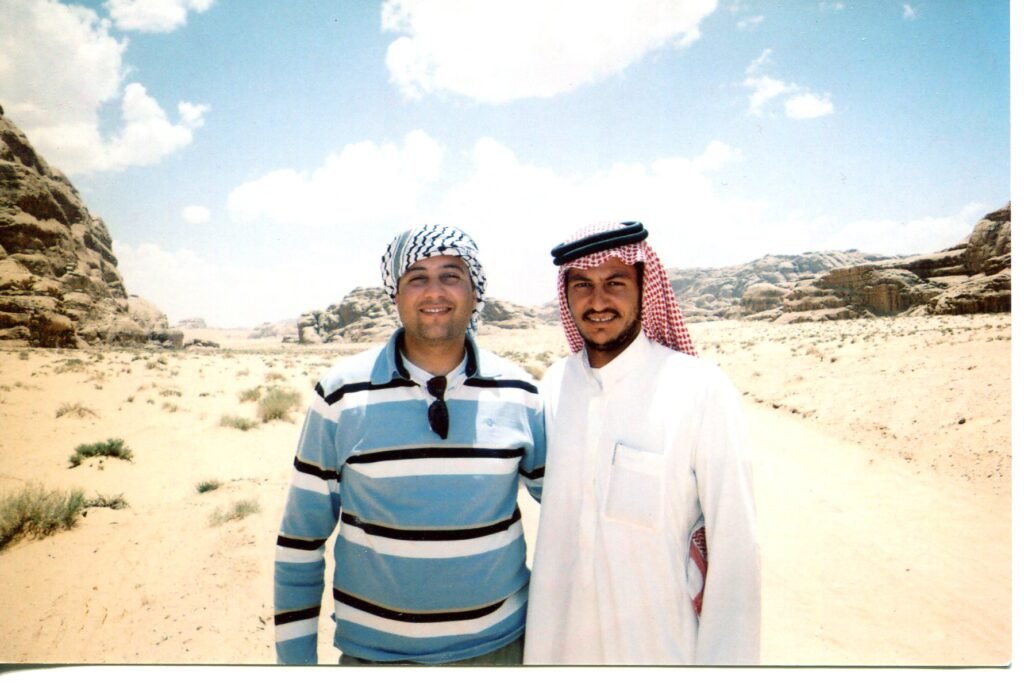
While I was in my hotel lobby in Amman, Jordan, a video played on the TV with a plea for peace. A young man stood alone in the desert. He was smiling and singing, looking up to the clear sky which beamed with the sun’s radiance. His long white gown and the sands he stood on looked pure.
The scene then changed to soldiers in combat, then to a family quarreling vehemently, and then to a business meeting of dour men that I wouldn’t buy a car battery from. But the three scenes were then shown in reverse as though all people, with their divisive mentalities, were being brought back to their basic roots. The scene then changed back to the man singing in the desert. Now all the other people were walking towards him in separate lines. They converged on him, became one group, looked up to the sky, and sang together.
Though Westerners often think of the desert as a remote and exotic place, it often stands for purity in many Middle Eastern cultures. Nothing is between people and the sky, with all-powerful God, who created all things. Mosque architecture expresses this sensibility.
This blend of simplicity, unity, and glory is a key aspect of Middle Eastern culture. Today’s political conflicts make it easy to forget the ancient roots of this region and focus on the divisive present, which is mainly a gift from greedy governments, energy companies, and arms sellers. But the the Bible, the Quran, and the Mishnah were created in these currents.
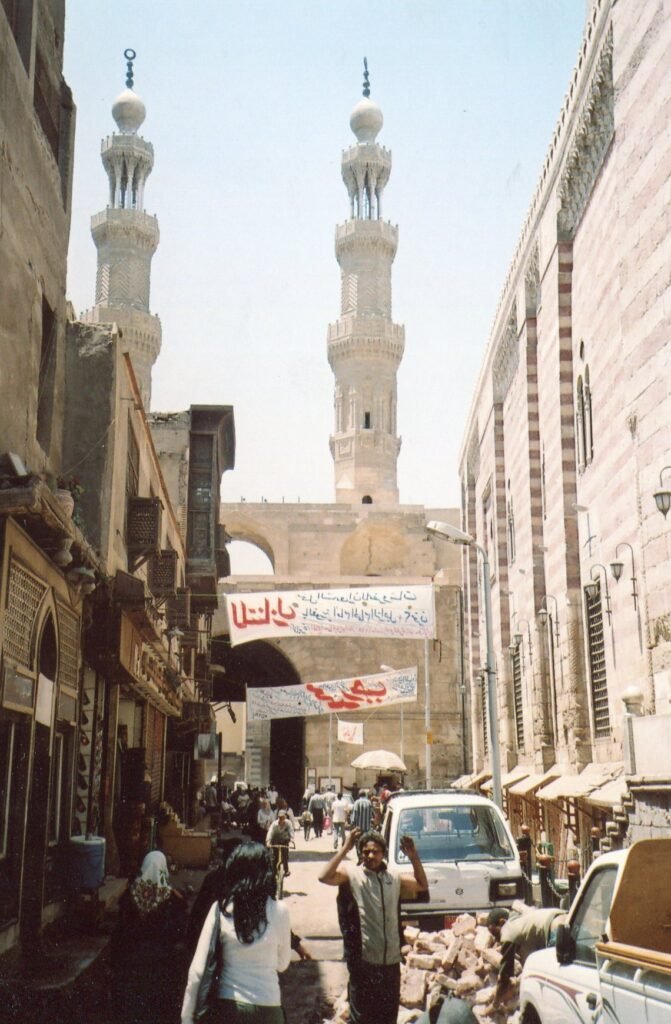
In The Venture of Islam, Marshall G.S. Hodgson wrote that the surface of life in courtly society during Baghdad’s caliphate which began in 750 CE as brilliant and decorative. It fostered the ideas of adab (personal refinement). A cultivated discipline in poetry, architecture, the use of color and form in one’s clothing and eating utensils, and refinement in one’s speech showed cultivation. These ideals were adopted my many subsequent courts, and they radiated beyond them into markets and homes.
But Hodgson felt that courtly glitter was largely founded on greed and pride, torture and murder, and falsehoods. Beneath the opulent surface was the realm of spiritual responsiveness, and many people had a rebellious spirit inclined to smash all the elegance and find ultimate reality. Profound awe toward nature initially inspired the monotheistic religions that emerged in the Middle East. Rapacious corporations and corrupt governments have often overshadowed it. Remembering the region’s cultural roots can diminish their influence.