This is a rather long article for my website, but I found Petra as magnificent as the pyramids of Giza. To appreciate it well, you need to explore depths in the culture of the Nabateans, who built it, and the connections with the natural landscape and neighboring societies.
Frankincense and myrrh grow on the peninsula’s southwestern mountains, and frankincense has sometimes been valued more than gold. Romans, Indians, and Egyptians burned this white gum resin, which seeps from cuts made in trees, as incense. They also grow in East Africa, but their grade was often considered inferior. Much of Arabia’s is purer. It burns with a luminous and fragrant white smoke—it surely pleases the gods, carries prayers to heaven, and purifies temples and homes. People also used myrrh as incense and for medicine, perfume, and, in Egypt, embalming. Romans, Indians, and Egyptians had prolific religious imaginations, so these two products became major industries.
Petra was a key center of this trade. The Nabateans built it from about 300 BCE to the early Common Era as they prospered as middlemen transporting this precious cargo and other products in caravans up to the eastern Mediterranean. It was already a very old industry.
Several earlier states in South Arabia tussled over it. Then just after 700 BCE, King Karib’il the Great of the Saba state waged several campaigns against his rivals and conquered the southwestern peninsula. He bragged about these deeds in engraved texts in the temple of Saba’s main god, Almaqah. Saba dominated this area for several centuries, and people in its fertile highlands clustered into small towns. This kingdom also traded goods from India and Africa, including ivory, woods, and tortoise shells.
Nabateans carried these products north and up to the Fertile Crescent and the eastern Mediterranean. By the first century BCE, they joined South Arabian kingdoms (Minaea, Hadramawt, and Himyar had grown to compete with Saba) as a central link between all these areas. They lived in a crossroads between many lands and created a culture that lasted throughout the 800-plus years between the conquests of Alexander the Great and Islam. I found Petra far more fascinating than what any picture can convey.
The Nabateans began as hardy desert nomads who knew lands that few others ventured into. They were experts at finding waterholes and kept them well-guarded secrets. This made them the best qualified people for transporting goods from the south through the arid lands between Saba and the Fertile Crescent. They made fortunes after Alexander the Great’s conquests, when trade between the West and East grew. Their business expanded further when Rome emerged as the West’s dominant power.
The city of Rome’s population swelled to about one million souls, and people from the East brought a colorful variety of cults. Most immigrants crammed into the city’s multistory apartment buildings. This made business boom for religions. The uprooted people in dark flats and jostling outdoor crowds needed to cling to a group of familiars and share rituals, meals, and friendship. Rome already had a large assortment of nature and agricultural deities that had accumulated from many groups that had settled around the Tiber River over the previous centuries. They now blended altar smoke with eastern imports, including Magna Mater (the Great Mother, from Turkey), Isis and Serapis (from Egypt), Mithra (from Persia and Turkey), and Dionysos. Beginning with Julius Caesar in the first century BCE, emperors expanded the state cults and used their wealth to sponsor civic rituals and build magnificent forums and temples. All these religious practices required incense. Petra’s fortunes rose even more.
As Petra grew, Nabateans’ horizons expanded beyond their desert and into every neighboring civilization, including Egypt, Mesopotamia, Persia, and the Greco-Roman world. But they were more nomadic before this huge cultural payload, scratching out livings with small flocks of animals, and much of their art was initially simple. Some sculptures of gods were stark, with a square head, a horizontal line for the mouth, a vertical line for the nose, and two little horizontal slits for the eyes.
Nabateans’ main gods represented basic forces of nature. Dushara is considered by many historians to have been the most honored deity. His name meant The Lord of Sharah (al-sharah was the name of the mountains that enclose Petra). He was a male sky god associated with the surrounding mountains, the sun, and daytime. Greeks associated him with Zeus. Al Uzza was female, and she represented strength and fertility. Her name meant The Strong One, and Greeks identified her with Aphrodite. Shaz al Kum was a god of the night, a messenger, and a protector of caravans. Traders must have asked him for protection as they bedded down on the desert sands.
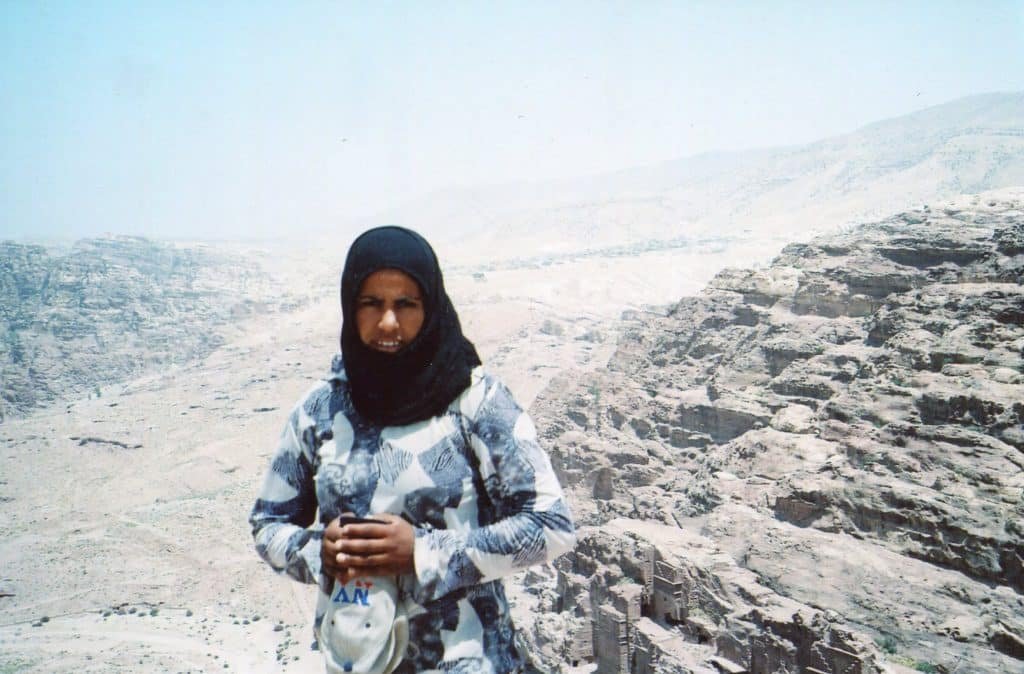
I asked a Bedouin who was living alone in a tent in eastern Jordan’s desert if he often got bored. “Why would I get bored? I have the sun and the moon. And I can think about what I want to do with my life.” The early Nabateans were equally close to nature’s basic powers.
But as they learned about neighboring cultures and began to grow wheat and vines, they acquired tastes for luxury that contrasted with the old simplicity. They also became masters of irrigation and developed terraced fields. By the early first century CE, they established farming villages in southern Jordan and the Negev, in southern Israel. Luscious vegetal images now adorned some of their temples. Sculpted vine motifs blended with characters from Greek mythology and visual patterns from many Levantine cultures. Dushara became identified with Dionysos, the Greek god of wine—Nabateans brought the mighty sky god down to earth. Petra became a mixture of many cultures’ forms, and you’ll never forget the place if you linger there.
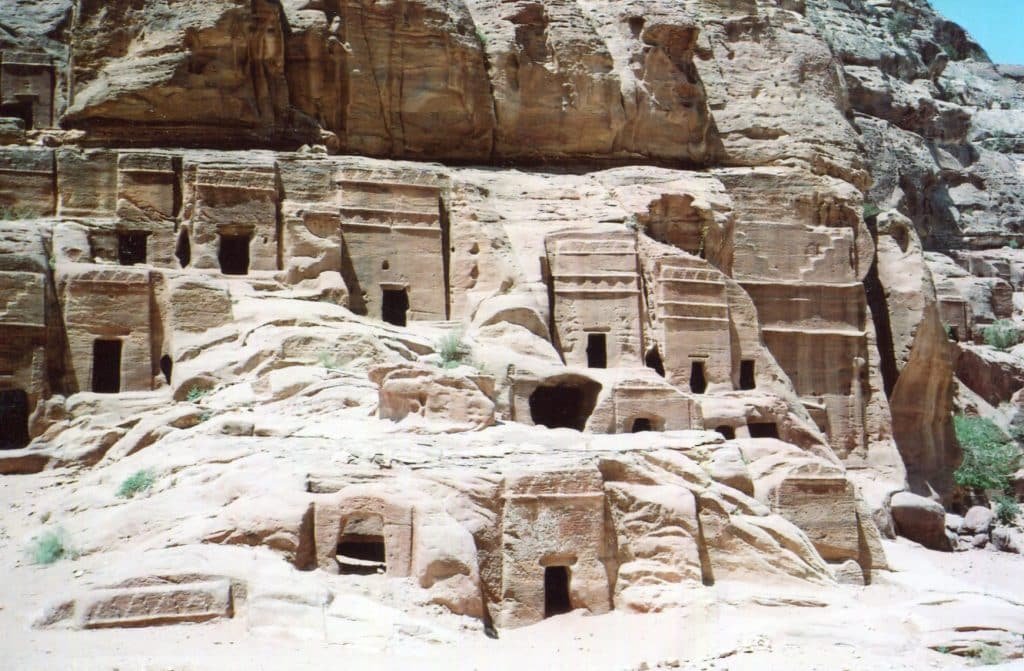
Hundreds of tombs carved into the rocks allowed families to connect with their lineages and show them off. As the above photo shows, some were so densely packed that their owners must have been as conscious of their neighbors as they were of their predecessors.
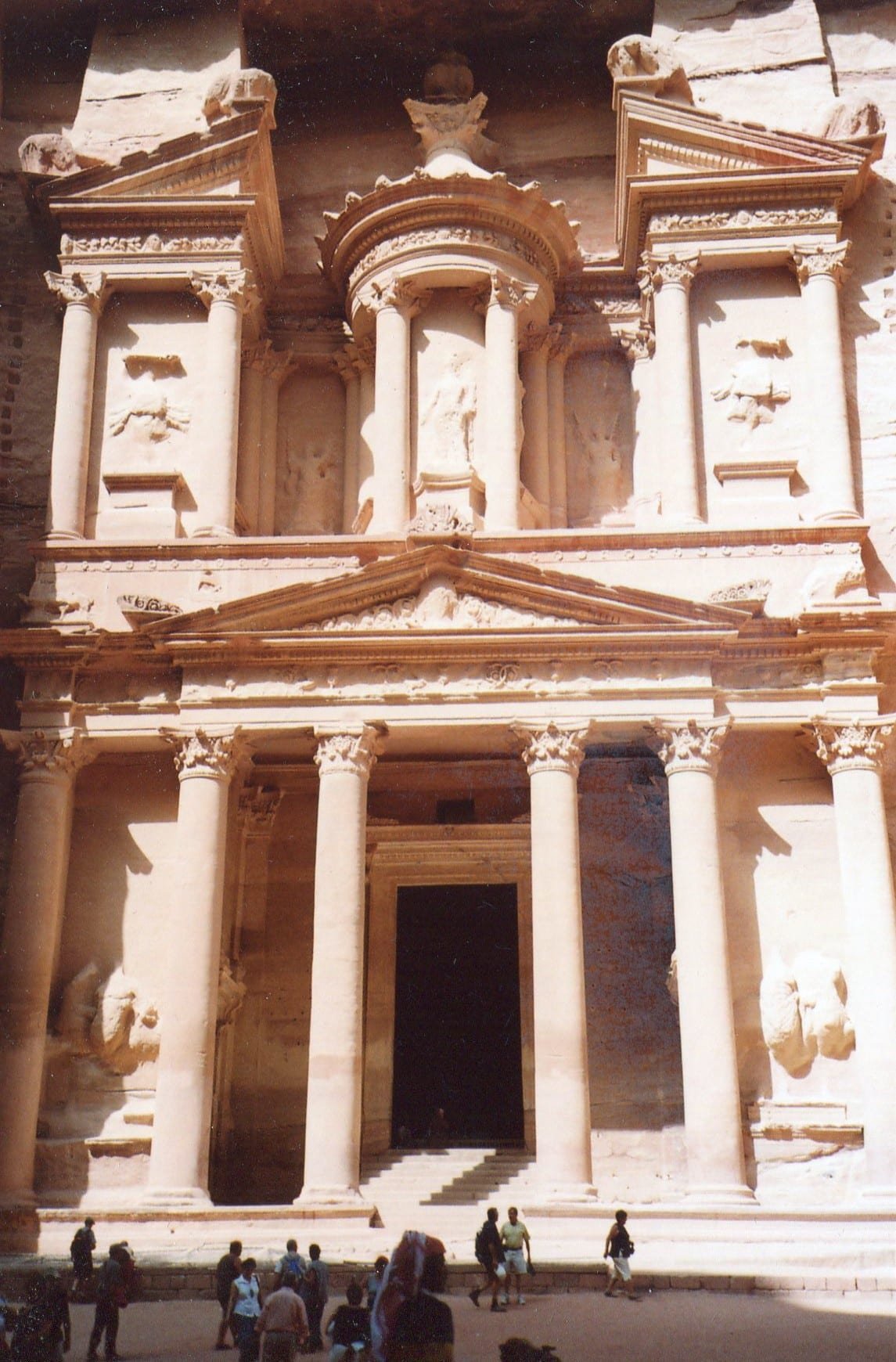
The famous Treasury, which was probably a tomb that has been dated from the second century BCE to the second century CE, mixed Greco-Roman designs with figures from Egyptian and Greek mythology, including what were probably Isis and the Dioscuri (Castor and Pollux). The latter accompanied the dead on their journeys to the next world, and many Greeks and Romans honored them. Some adopted Egypt’s associations of Isis with the afterlife. The monument thus might have incorporated figures from several cultures to encourage blessings after death. Another tomb sports an elegant row of Egyptian obelisks in the front.

The town’s central avenue was flanked by the royal palace, numerous temples, colonnades, and a garden with flowing water. Several markets also thrived along the road—what Nabatean didn’t love business? A large home with Roman architecture perched on a hill above the road. At one end of the street, enormous royal tombs were carved into the rock. Their facades were in patterns derived from Greek architecture, with stately colonnades.
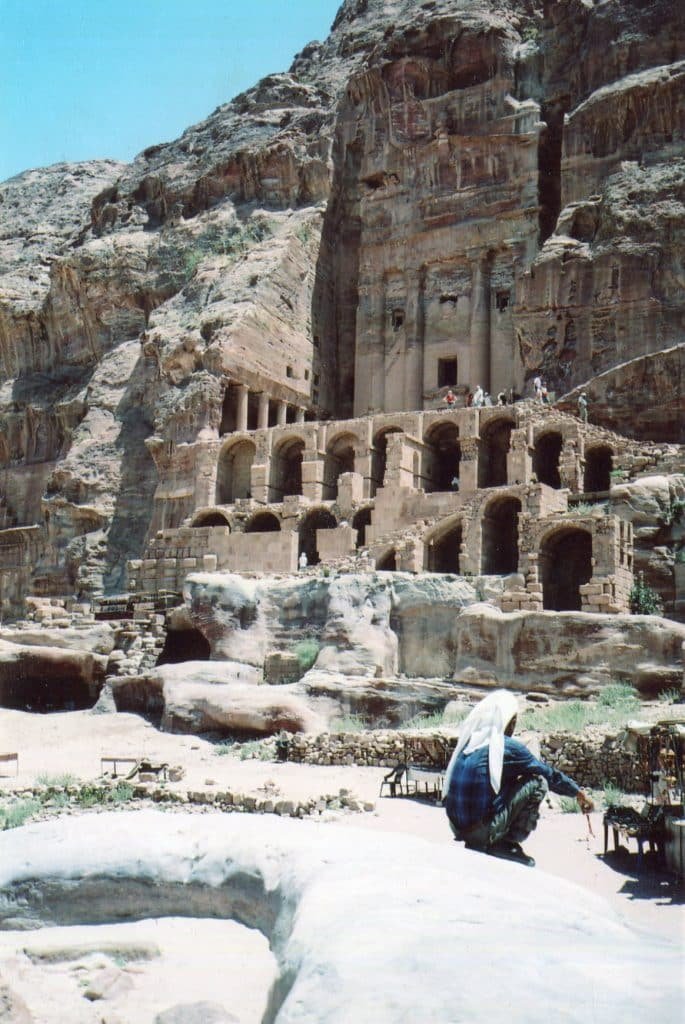
At the other end of the road stood a large temple with a spacious inner area divided into three rooms that were side by side.

Its outer walls were covered with painted plaster. The building’s overall design mixed Greco-Roman and Middle Eastern forms. Petra became a major international emporium, and art forms from many regions bedecked it.
I find the Nabateans easy to like. Instead of fighting they preferred to enjoy their wealth. They battled well when necessary and thwarted an invasion by a largely Greek army under Antigonus in 312 BCE. Greeks in those days complained about their caravan raids, but Nabateans soon found it more profitable to protect travelers. Make wealth, not war. At the beginning of the Common Era, the Greek historian Strabo noted that the Nabateans’ cities were not walled, because their territory was peaceful. They were relatively egalitarian, rarely enslaved people, and allowed women prominent roles. He also wrote that the king sometimes served others at ceremonial gatherings. He also gave an account of his leadership in the popular assembly, which periodically examined his lifestyle.
Their civic environment reflected their love of freedom. The palace was directly across the street from the main markets. I found it surprisingly small, especially for the Middle East. There were no Babylonian city-sized royal residences with mazes of courtyards and cavernous incense-hazed halls. The living area was no larger than a modern upper middle-class businessperson’s home.
There is no adequate photograph of Petra. The whole city mixed lots of cultures’ forms, high surrounding cliffs, and tombs carved into them. All domains were together; the king, the people, nature, gods, and ancestors mixed in a harmonious valley that I found as stunning as the pyramids of Giza.
Petra’s natural features are as special as the cultural mixtures. The acoustics seem mystical. Sounds reverberate around the valley’s walls as though the ancestors are speaking. From the High Place of Sacrifice (a small ritual center on a cliff about 300 feet above the town), I could hear groans of camels and brays of donkeys down on the main street bouncing around the canyon walls. The sounds seemed to convey sacred power.
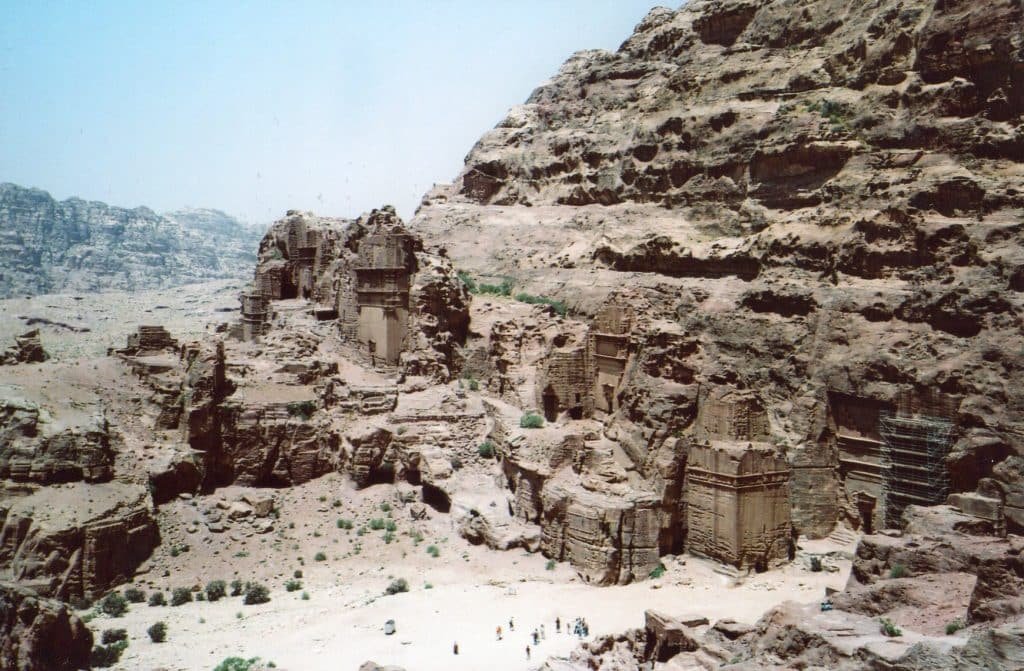
The area is also visually stunning. The cliffs are streaked with reds, purples, and oranges that are so vivid that many seem painted. I climbed to another sacred building with a Greco-Roman frontage carved into the rock, called the Monastery, which is on the other side of town from the High Place of Sacrifice.
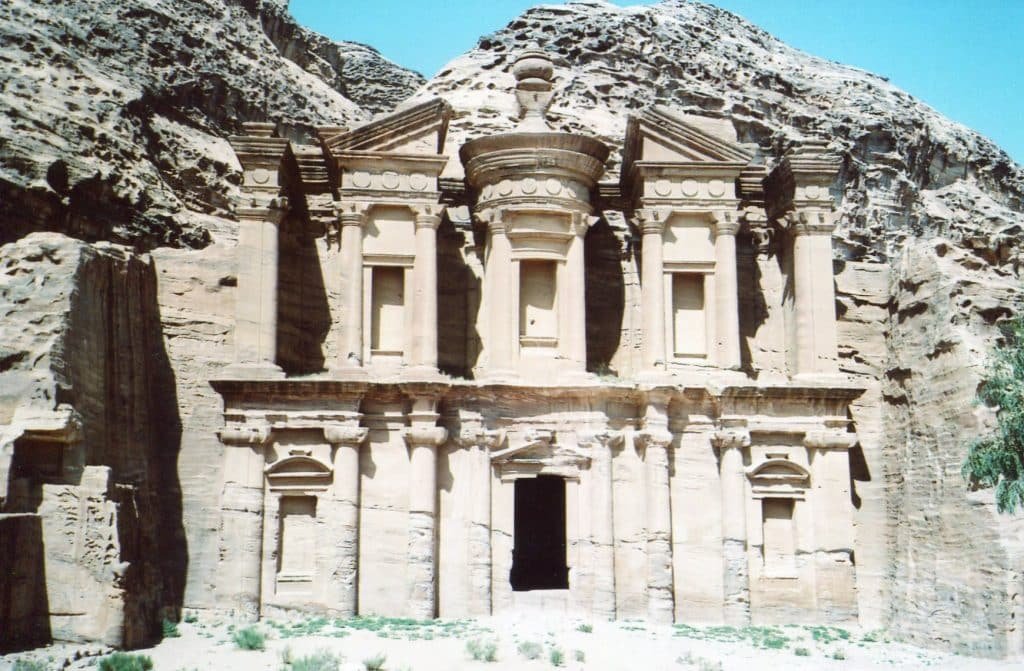
The edifice is huge. I was afraid to climb over that stone at the bottom of the entrance. It rose nearly five feet above the pile of rocks I was standing on. The stone thus might have been four feet higher on the inside, so I could have gotten trapped inside.
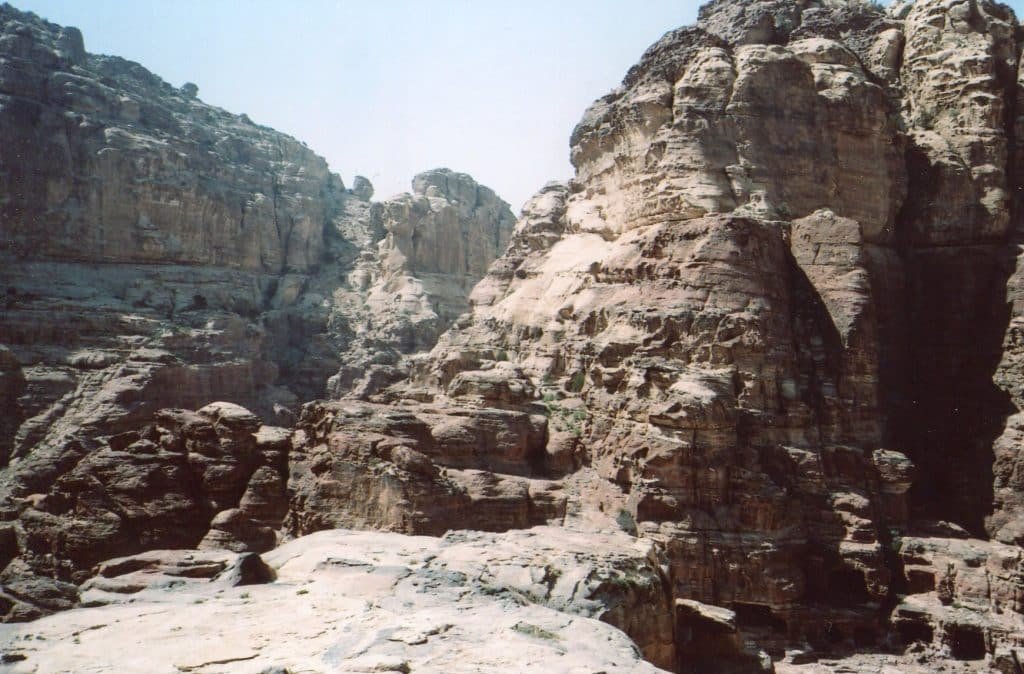
Near the summit, I looked outwards and beheld a moonscape of cliffs and peaks in countless shades of beige and brown thrusting upwards into jagged forms, with no vegetation in sight. I found it especially dramatic because it was the opposite of the lush foliage I had recently enjoyed in Mauritius and Southeast Asia.
The surrounding area is also enrapturing. Mountains tower about 2,000 feet above Petra, and their peaks are also toothed. Some of the land a little north, which I rode through on the way from Amman, was covered with sand. A sandstorm was blowing to the east, coloring the sky with thick beige swirls. To the south, Wadi Rum is furrowed into sandy valleys that finger between bare rocks which rise hundreds of feet.
Nabatean country is a visual feast worthy of the gods. But Petra is cozy, with all cultural forms and ancestors together.
Bedouins still live in Petra, some in caves and others in the area just outside. As I hiked up to the Monastery, a man riding a camel approached me and offered a ride for a fee. I patted his camel’s hump, pointed to my stomach swelling with local pastries, and said, “This is just as good. You pay me, I’ll carry you!” He called my bluff, “You carry me, I’ll give you the camel!” Direct, confident, mentally quick, and always looking for a deal—just like the ancient Nabateans.
The Roman Empire expanded under Augustus Caesar (r. 27 BCE–14 CE), and trade increased everywhere its arms reached. Unprecedented volumes of goods flowed between Red Sea ports, the Horn of Africa, Arabia, India, and China. A handbook on sea trade from the first century CE, called the Periplus of the Erythraean Sea, which a Greek-speaking sailor living in Egypt wrote, described ports along Africa’s east coast extending down to modern Tanzania. The world became more integrated than ever. As Rome’s wealthiest citizens grew richer, the demand for luxuries from the East skyrocketed. Between 117 and 109 BCE, Eudoxus of Cyzicus sailed directly across the Arabian Sea to India with the annual monsoon three times, showing how to make international trade easier.
Rome annexed Nabatea in 106 CE, and trade further increased around the western Indian Ocean. Gold and cash flowed east, and Indian spices, jewelry, and fabrics traveled west. Ivory was especially popular in the West; upper-class Romans used it for statues, furniture, carriages, birdcages, and combs. Writers ranted about women draining Rome’s cash reserves to satisfy their vanity, but men were equally guilty. People began to supplement the supply of ivory from the Upper Nile by buying more from Africa’s east coast.
But Petra’s importance in commerce decreased in the third century CE as trade routes shifted and as Rome was shaken to its foundations by several invasions, a pandemic, economic crises, and political upheavals. In 363 CE an earthquake destroyed about half of Petra. Historians, however, have found that it was still a fairly important urban center until at least the mid-fourth century, and that people were still living there in the sixth.
Some Nabateans became early adopters of Christianity, and the multicultural mixtures in their art influenced flowery Byzantine motifs which inspired medieval European art, Islamic designs (flowing plant motifs adorn the Dome of the Rock in Jerusalem and the Great Mosque in Damascus), and Coptic Christian sculpture and architecture. I enjoyed seeing transformations of Nabatean art from its early simplicity into luxurious international blends in museums in Amman and Petra. Their Arabic descendants would experience the same contrast as they built Islamic civilization from their base in the desert into a multicultural empire which they later governed from some of the largest cities in the world.
So the Nabateans were middlemen in more ways than commercial. They synthesized and shared art and ideas with the most influential cultures around them and bequeathed them to newer civilizations that still thrive. Although Petra was a small space surrounded by cliffs, it has shone for thousands of miles and over many centuries.