
I think this is the most exciting time in history to ask big questions, given the number of cultures and historical periods we can explore. Ideas of what is fundamental in our field of connections are wide open for reconsideration.
Many Westerners since the late 19th century have felt that all reality is based on the fundamentals of physics—what the physicist Richard Feynman called the jiggles of atoms. Another Nobel Prize-winning physicist, Frank Wilczek, in Fundamentals; Ten Keys to Reality, wrote that the physical world’s basic particles have only a few properties: mass, charge, and spin. That’s it. An electron’s mass is very small (1/1836 of a proton’s), its electric charge is -1, and its spin is 1/2. A photon’s mass is 0, its electric charge is 0, and its spin is 1. An up quark’s mass is about 10 times an electron’s, its electric charge is 2/3, and its spin is 1/2. A down quark’s mass is roughly 20 times an electron’s, its charge is -1/3, and its spin is 1/2. Other elements have different charges than electrical (exchanges of electrons) because they don’t interact with electrons. Gluons have no mass or electric charge, but they’re fundamentally important because they enable the formation of protons and neutrons. Without gluons, atoms cannot form. They interact through what are called color charges, and they have spins of 1. By analyzing these three properties of the basic elements, we might be able to understand the basis of all reality. Or will we?
Wilczek wrote that models based on matter and physics and models based on mind and psychology are valid, and “If a painful narrowing of one’s outlook was the price of accepting the scientific fundamentals, many people would reasonably conclude that the price is too high. Thankfully, the fundamentals of science do not require you to make those corrosive applications of science. . . . Science contains beautiful ideas, but it does not exhaust beauty. It offers a uniquely fruitful way to understand the physical world, but it is not a complete guide to life.” We should thus regularly ask big questions about the varieties of what we can consider to be fundamental in reality.

The historian of science Max Jammer wrote books about the histories of the concepts of mass, force, and space, and said that Albert Einstein thought that studies of the basic concepts that science uses would be “very fruitful.” Ideas of mass and force are often centered on distinct entities and their fields, as are the charges and spins of the basic elements that Wilczek listed. Force is what accelerates or decelerates objects, mass is the difficulty accelerating or decelerating them, charge is a force between them, and spin measures their rotations. A researcher at Fermilab, Don Lincoln, said that most of a proton’s mass actually comes from the energy of its quarks as they dart around at nearly the speed of light. Since E = MC2, the energy from these extremely high velocities is much greater than the resting masses of quarks. Lincoln said that he found it mind-blowing that our masses are mainly energy from motions of tiny particles. This seems mind-blowing because Westerners have an ancient tradition of thinking that static and distinct entities are the most basic realities. But ancient Indian and Chinese thinkers saw energy flows as more basic than distinct objects, and they conceived them in other terms than force or mass, including yin-yang flows, holistic vibrations throughout the universe, and subtle states of consciousness. We have a variety of basic concepts to consider.

Some scientists who are not physicists have been emphasizing ideas from their own fields as fundamental. The biologist, physician, and complexity theorist Stuart Kauffman, in A World Beyond Physics, wrote that our world rests on particle physics’ foundations, but it cannot be derived from them. He asked how many possible proteins there can be with only 200 amino acids. Since 20 different types of amino acids make up proteins, there are 20 choices at each position. He thus calculated 20 to the 200th power and concluded that this number is so large that it would take 10 to the 39th power times what he calculated as the 13.7 billion-year history of the universe (measured at every tick of the Planck time clock, which happens every 10-43 seconds) to produce all possible proteins with 200 amino acids. Kauffman sees this enormous abundance of possibilities for different lifeforms as fundamental in the universe and feels that the abundance is not reducible to the ways that particles interact. Different types of proteins emerge from this abundance. He wrote that our biosphere “explores untellable reaches of complexity” among a huge range of opportunities.

The scientist and medical doctor Robert Lanza also looks at the universe from a biological perspective. In Biocentrism; How Life and Consciousness are the Keys to Understanding the True Nature of the Universe, he cites 32 numerical constants which together enable atomic interactions that allow complex and conscious organisms to develop. They include the masses of electrons, deuterons, neutrons, and protons. They also include the fine structure constant, which is also crucial for life. If it were just 1.1 times its present value, fusion would not occur in stars, and critical chemicals for life are created in the fusion. According to Lanza, life-friendly values of physics are built into the universe. Each one is extremely improbable; all together suggest that life is a fundamental aspect of it.
Lanza also claims that there is no separate universe outside of life and consciousness, pointing out that without conscious observations of quantum behavior, the “matter” is in an undetermined state of probability. For example, experimenters find a particle or a wave after it passes through two slits, depending on how they decide to measure it. The decision to observe and measure it must first occur, otherwise there is a multitude of probable states (even with Pauli’s Exclusion Principle, which limits the number of electrons in the same orbital to 2 and requires that they have opposite spins). Lanza concludes that consciousness is a fundamental and necessary aspect of the universe.
In a similar vein, the physicist Carl Rovelli emphasizes the basic importance of the interconnections between scientific experimenters, the instruments they use, and what they observe. He says that there is no separate universe and that there are no separate objects outside of these connections. Objects exist and have properties only when they interact.
But what is an observation of the world around us? As someone who looks more broadly into cultures, I don’t think there are impermeable boundaries between society and the observation in the lab. Before the observation of particles passing through two slits, there was an international community of scientists who agreed on the most important things and properties to measure, institutions that spent a lot of money to build the lab, protocols for conducting experiments and writing about them, a long history of the most commonly used scientific concepts (the 17th century was a pivotal time, when Galileo, Newton, and their followers focused more on objects, their masses, the forces between them, and Cartesian space; Domenico Bertoloni Meli detailed much of the rich cultural background in which these emphases emerged in Thinking with Objects; The Transformation of Mechanics in the Seventeenth Century), and influences from ancient Greece. All converged into the idea that observations of sub-atomic particles’ masses, charges, spins, and locations are the most fundamental ways to understand the universe. No observation of particles occurs outside this enormous field of convergences (research universities–Oxford is shown below–weren’t built overnight by one person).
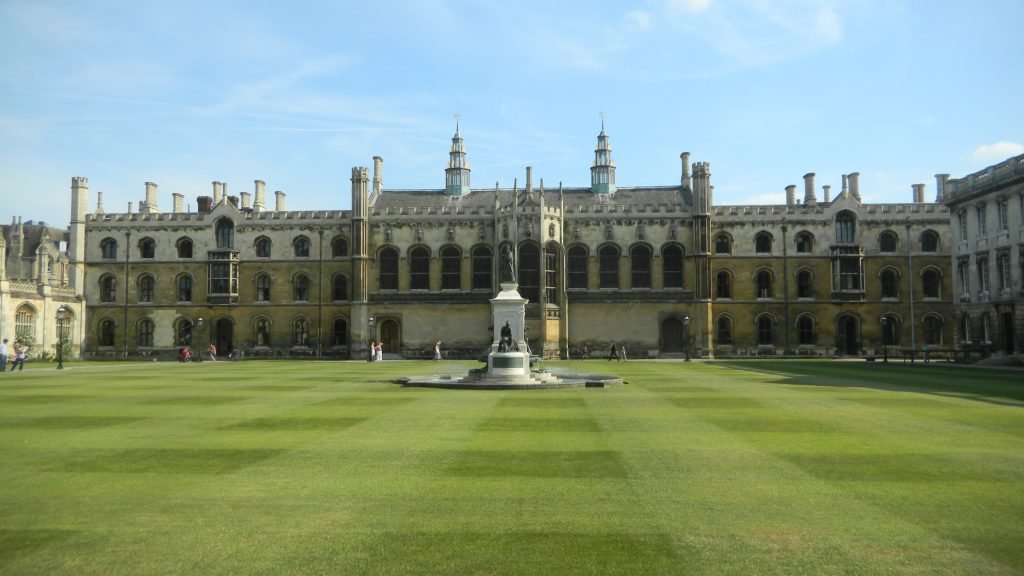
The Nobel Prize-winning physicist Werner Heisenberg made a similar point in Physics and Philosophy; The Revolution in Modern Science by writing that there is “. . . a subjective element in the descriptions of atomic events, since the measuring device has been constructed by the observer, and we have to remember that what we observe is not nature in itself but nature exposed to our method of questioning.” Our method of questioning is influenced by ideas that we consider most basic and many aspects of cultures. Robert Lanza wrote that most theories of the universe that are supposed to be comprehensive fail to realize that people formulate the theories, and that we are biological and social creatures.
The Harvard University physics professor Gerald Holton, in Thematic Origins of Scientific Thought, wrote that scientists use fundamental presuppositions, notions, terms, and methodological judgements when conducting research. He called them themes, and said that they’re diffused and not derivable from experimental observations or analytic techniques. They converge into intellectual commitments that researchers hold, including the primacy of mass and force. In The Scientific Imagination, he noted that Heisenberg said that these themes have included elementary particles and that this concept should be replaced by the concept of fundamental symmetry. But symmetry of what? Yin-yang flows and Indian mandalas are also symmetrical but in different ways, which are conceived more holistically than mass and force.
Ideas, themes, theories, and methods of questioning emerge in cultures, and they converge with a lot of other aspects of experience, including concepts of space and time, emotions, many common words, music, and uses of language. All these aspects are perpetually open to being reconceived, since each society’s ways of experiencing them converge within an infinitely abundant cultural landscape.
Regularly asking big questions about everything we explore can change our treatment of ideas from static objects that are supposed to completely describe things to convergences of our cultures, which reveal some aspects of our field of connections. As we continue to explore new ideas, we can become ever less dependent on a single conceptual framework or way of observing and be increasingly able to assimilate new frameworks until the expansion of our perspective becomes at least as basic as any idea that we’re trying to comprehend reality with. This expansion can keep growing in more directions as we delve into more cultures.
We will thereby be increasingly encouraged to appreciate ideas as emerging in infinitely abundant cultural landscapes and as able to reflect other cultures’ ideas and world-views. They then increasingly seem less like tools for completely grasping what we apply them to and more like vehicles for expanding our perspectives.

As we keep exploring more cultures, we can see more ways that their ideas can reflect each other. Ideas can then help us look With by providing insights about our own culture as we compare others with it. This includes the West’s focus on distinct objects. Other cultures have seen what Westerners have conceived as objects in different ways, including Chinese, Indian, and African.

Our ideas can also help us look Beyond by being compared with ideas that other cultures emphasize, including Islamic, Native American, and Southeast Asian. They can thereby expose ever more abundance within ourselves as we compare them with our own assumptions. We can also expose more ever more abundance in other people as we compare them with multiple cultures. We all can shine in ever more dimensions and patterns. As we continue to look With and Beyond, ideas lead to expansion in ever more directions and increasing the love, grace, and varieties of beauty in our world.