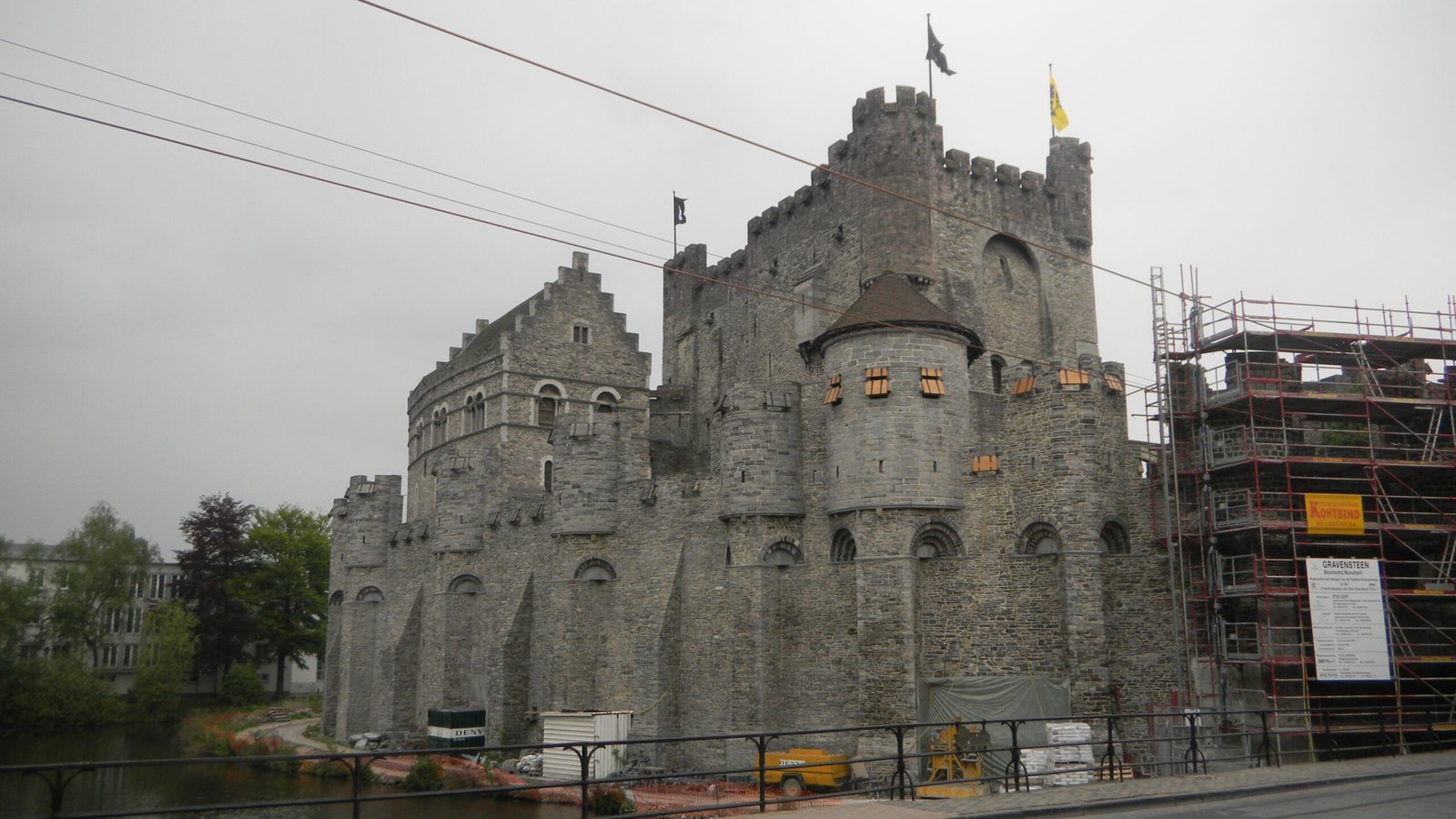
The anthropologist David Graeber said that culture is a way of telling off your neighbor. People often use culture to distinguish themselves from other societies. He noted that Athabascans in Alaska steadfastly refused to adopt Inuit kayaks despite these being more suited to their environment than their own boats. Inuit refused to adopt Athabascan snowshoes.
Cultural prejudices can also be explained from a systems standpoint. The systems theorist and physicist Fritjof Capra, in The Hidden Connections, wrote that cultures delimit the range of accepted behaviors, and said, “People’s behavior is informed and restricted by their cultural identities, which in turn reinforces their sense of belonging.” This situation, he writes, is similar to a cell’s membrane, which selectively screens out and admits different substances to enable the cell to maintain its identity.
The anthropologist Gregory Bateson likened cultural identity to an organism’s metabolism. Each organism has metabolic ranges, and processes must occur within them. Chemical processes that convert food and liquids into energy happen at certain rates, and they need certain nutrients to keep the organism alive. Cultures also must maintain their political processes, economic exchange structures, symbols, and meanings.

Beijing’s Forbidden City’s majestic halls imparted a resounding message that visitors were in the center of the political universe and that all other states orbited around China.
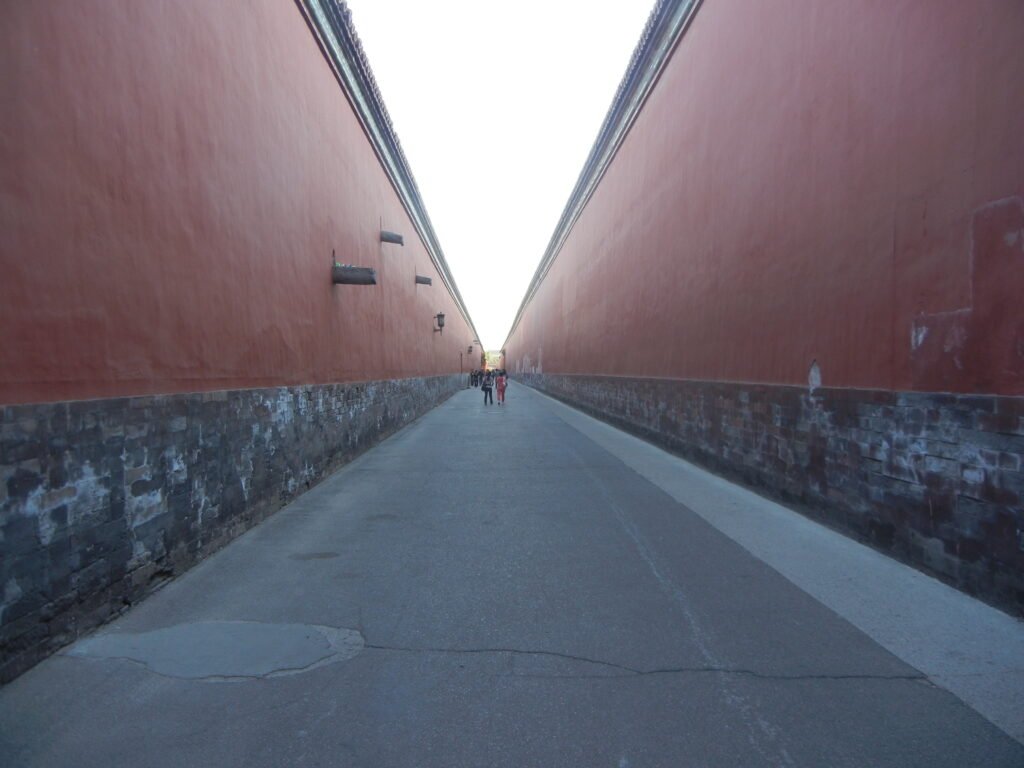
People walking between the high walls surrounding its courtyard complexes were equally aware of the power that enforced proper behavior.
There are also neurological bases of cultural preferences. When I was a teenager, I was mowing the lawn in our backyard. I looked toward the patio door to our living room, and saw our Shih-Tzu lying down and watching me through the glass. I walked over, kneeled down, and pressed my nose against it. She leaned forward, and when her nose touched it, she jumped up and started barking. I had to open the door, pick her up, and hold her to calm her down.
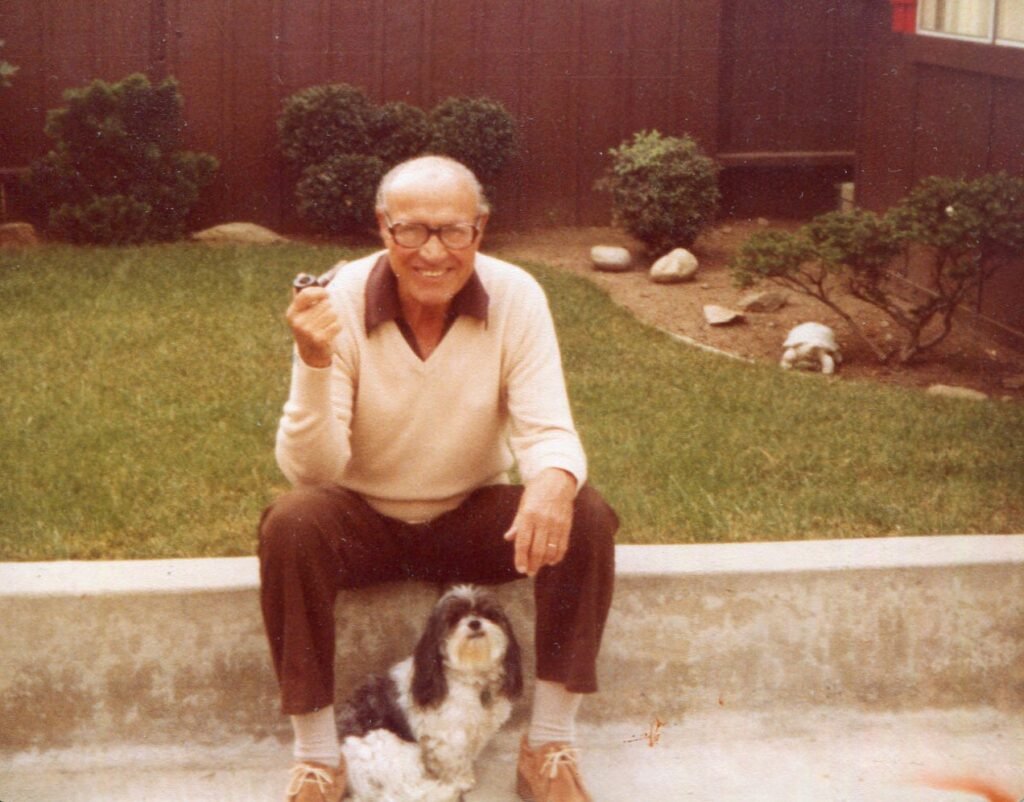
She had experienced constant affection since she was a puppy, and she slept on our beds every night. When she was about to touch my nose, she must have expected the same human smell and soft, warm flesh. The hard, cold glass with a completely different odor must have completely upset her sense of security, which she felt while sitting between my father’s legs in the above photo.
In The Uses of Enchantment; The Meaning and Importance of Fairy Tales, the child psychologist Bruno Bettelheim wrote that fairy tales give children a way to process their fears, including abandonment, isolation, and monsters. These and other cultural products enable people to feel that they belong to a larger group that will protect them.
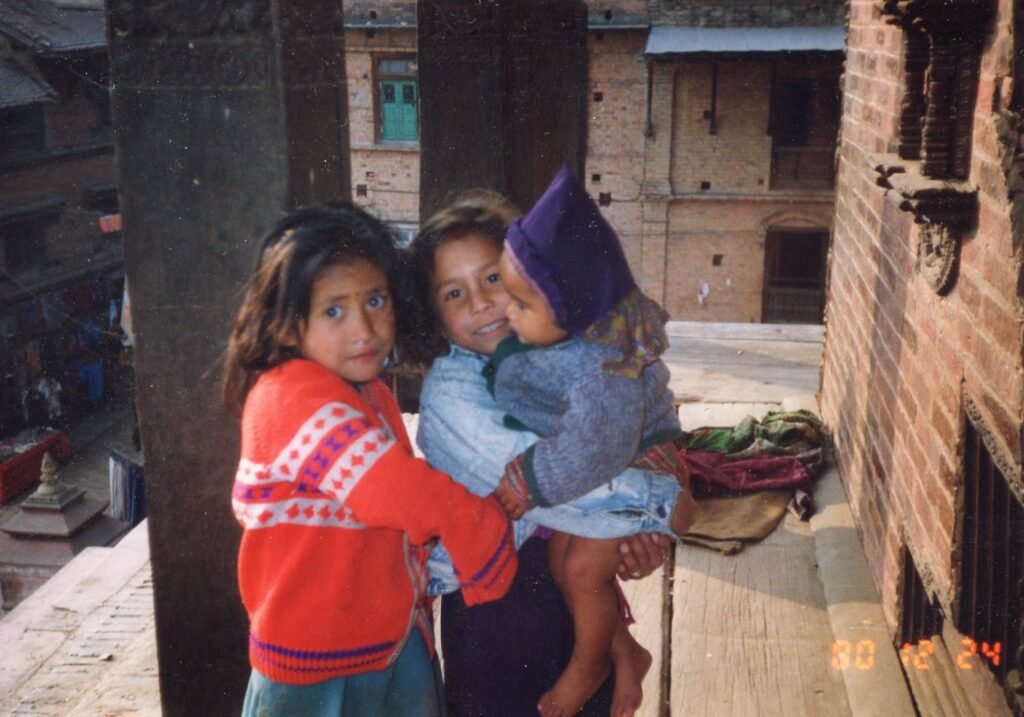
The girl on the left (in Nepal) was afraid of me a mysterious stranger, but having others to cling to prevented her from screaming or feeling the need to run away.
Culture has become a loaded term for lot of people in the US, where many have felt that academics use it to praise themselves and look down on those who aren’t included in the cultures they admire. But many popular cultures in America are equally rich. Country music has recently become the most popular style here, partly because of its emotional directness. The lyrics in songs by Hank Williams come straight from the heart, such as these lines from Hey, Good Lookin’:
I’m gonna throw my date-book over the fence
And find me one for five or ten cents
I’ll keep it ’til it’s covered with age
‘Cause I’m writing your name down on every page.
A wide variety of people have been able to use such lyrics to articulate their experiences and bond with each other.
Country music has also been loved for its humor, including these song titles:
It’s Hard to Kiss the Lips at Night that Chew Your Ass Out All Day long
I’m the Only Hell My Mama ever Raised
I’m Home Getting Hammered while She’s out Getting Nailed
Lyrics to other country songs can be as gut-wrenching as any tragic opera or blues song. The Stanley Brothers recorded one about two babies that died in bed together during a house file. But Ralph’s gentle voice made it seem that an angel was telling the story and delivering their souls.
Overall, country music provides windows into a very rich and diverse world which has been a big part of America’s heritage.
So the word culture and appreciating cultures can easily become divisive. Several types of experiences reinforce each other to give people strong preferences for their own cultures and feel discomfort with others. This requires us to see the world in a new way again and again rather than expand the perspective only once and call the new one universal truth. This poses several inspiring questions:
What is your capacity for appreciating the full diversity of cultures, with their different ways of perceiving, thinking, and experiencing emotions? Can you understand ones that are very diverse? Japanese, Yoruba, Portuguese, Cherokee, and Cantonese have languages and thought patterns that are very different from each other. Can you appreciate them equally?
How light are you? In other words, how deftly can you mentally travel from one culture to another without being encumbered by those you’re already familiar with?
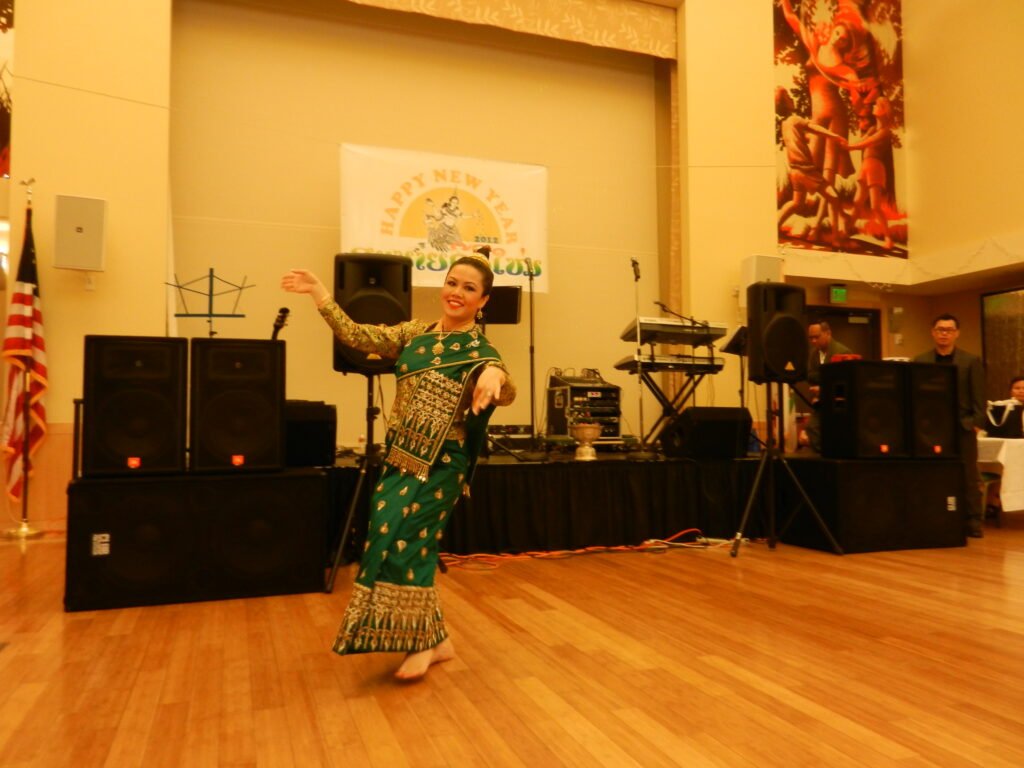
Sporadic jumps to new perspectives are mere revolutions, but we can instead leap so frequently that it becomes like a dance all over the world. As we leap, we can feel more engaged with all the places we explore.
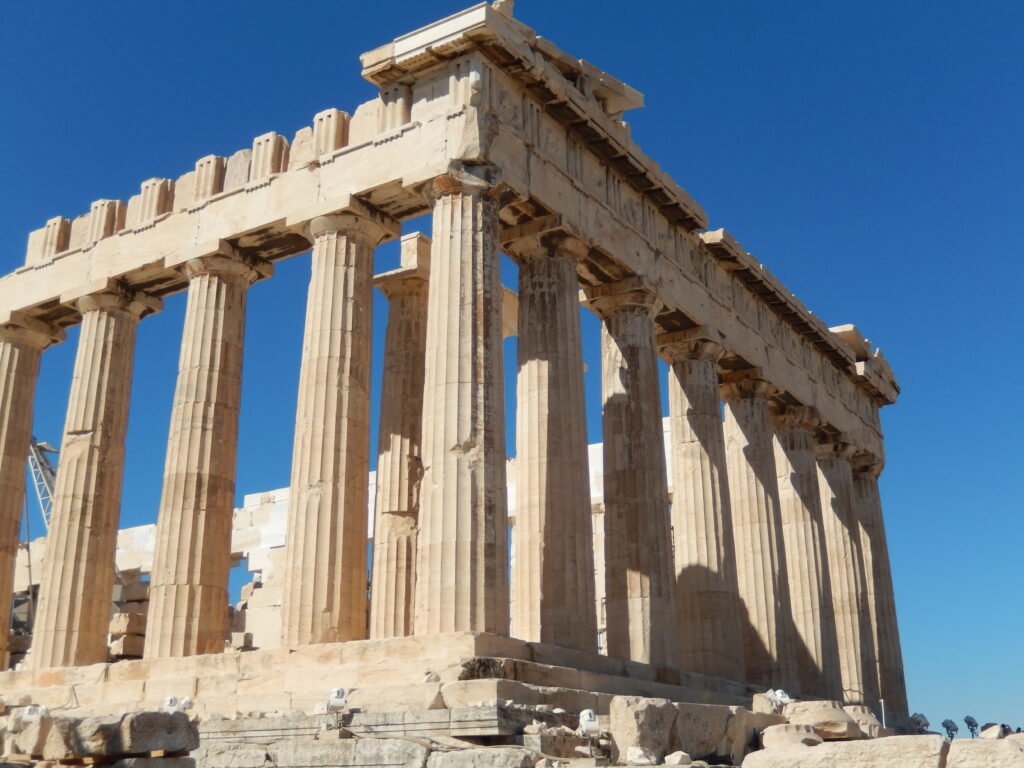
For example, while standing in front of the Parthenon, I first enjoyed its exquisitely proportioned forms. I then relished them even more while comparing them with the abundant flows that Hindu temples project, syncopated geometric patterns in many African art works, and holistic flows of yin-yang patterns in many Chinese art works. I savored the ways that each culture’s basic assumptions about art have reflected its history, natural environment, politics, music, and philosophies. The Parthenon provided an excellent contrast with all these other cultures, and they in turn heightened the uniqueness of Athena’s house and the society that built it.
So when we mentally leap, we don’t lose sight of where we previously were. We can instead view things from many more locations. All the places we compare can illuminate each other, and they can reflect each other’s facets in ever more ways so that they become like stars shining on each other. As this happens, it becomes easier to take more leaps.
Our views of the world can become increasingly inspiring as we shift between looking At, With, and Beyond in a cycle that includes ever more cultures. This cycle always transcends past mental limits; we can keep seeing things in new ways so that our perspectives of the world become increasingly large, inclusive, and conducive to regular creative breakthroughs. We can think about the world with an ever enlarging range of concepts which we can compare with each other, and all have their unique histories to explore. We can thereby gain ever more freedom to choose concepts and more ability to find new meanings in each.
Being able to use a range of concepts that includes cultures all over the world enables societies to keep their ideas fresh. Seeing concepts from new perspectives (comparing them with ever more cultures, historical periods, and philosophic interpretations) frees us from the danger of apprehending things only in terms of the same old networks of ideas.
Looking only At encourages people to confine human beings, cultures, and things to certain categories. It keeps divisions sharp and excludes. But balancing it with looking With and Beyond ensures that perspectives will always be renewed and ever more inclusive.