The Kabbalah is a very deep spiritual tradition (the word literally means tradition) with fascinating assumptions about language and reality. By the beginning of the Common Era, some Hebrews saw reality as a unified field full of metaphysical energies and developed elaborate ways to meditate on God’s all-pervasiveness in the world. Aryeh Kaplan wrote that the Sefer Yetzirah is this tradition’s seminal text, which is a short and dense work that details relationships between the ways in which God permeates all creation.
The ten sefirot are attributes of Him, and they emanate in the following order: Crown (Keter), Wisdom (Chakhmah), Knowledge (Binah), Love (Chesed), Strength (Gevurah), Beauty (Tiferet), Victory (Netzach), Splendor (Hod), Foundation (Yesod), and Kingship (Malkhut). But Kaplan said that all followers of this tradition have declared that one should never worship the sefirot or pray to them. They’re not like a proliferation of Vedic gods that can be honored in sacrifices. Instead, they form a ladder on which one can climb to approach the universe’s only god.

The Sefer Yetzirah treats each of the 22 Hebrew letters as full of symbolic meanings. For example, the first letter in the Torah (the first five books of the Hebrew Bible: Genesis, Exodus, Leviticus, Numbers, and Deuteronomy) is the B of Bereshit (In the beginning). The final letter is the L of Yisrael (Israel). They thus encapsulate the process of God creating the universe and humanity. Together, they spell a Hebrew word for heart. The Torah is full of combinations of letters, which hold meanings that reveal deep structures of the cosmos. Since the Torah is the main book in which God revealed his wisdom (Chakhmah), these combinations form the architecture of reality.
Each letter corresponds with a number, and the numerical value of each word can be found by adding up the numbers that its letters correspond with. Deeper meanings in the text can thereby be identified by finding relationships between numerical values.
Furthermore, the Sefer Yetzirah details 32 paths of wisdom, which are all expressed in the description of God creating the world in Genesis. “In the beginning God created,” “The spirit of God hovered,” and “God said, ‘let there be light’ ” are the first three. “God said ‘let the waters be gathered’,” “God called the dry land and earth,” and “God created man” are others. All 32 can be correlated with sefirot, letters, and numbers so that the whole Torah is dense with signs of God’s emanation throughout creation.

In addition, Kaplan made the point that the word for path in the Sefer Yetzirah did not mean public road (derekh). Instead it was netivot, which was a personal route for the individual. It’s hidden and lacking markers or signposts, so a seeker must discover it himself. God’s permeation of nature thus includes each person’s psychology and inner life. Although God is absolutely transcendent, there is no place in the universe where He is absent.

Barbara A. Holdrege, in Veda and Torah; Transcending the Textuality of Scripture, compared Vedic and Jewish mystical traditions and saw them as different species of the same genus. Both have considered the powers by which the universe emanated to be contained in a text and in a language that’s thought to be sacred and charged with power. Both developed elaborate sacrificial traditions, purity codes, and legal systems. The Vedas and the Torah have been conceived as, not just descriptions of events, but more fundamentally as the structure of nature and as the power that created it.
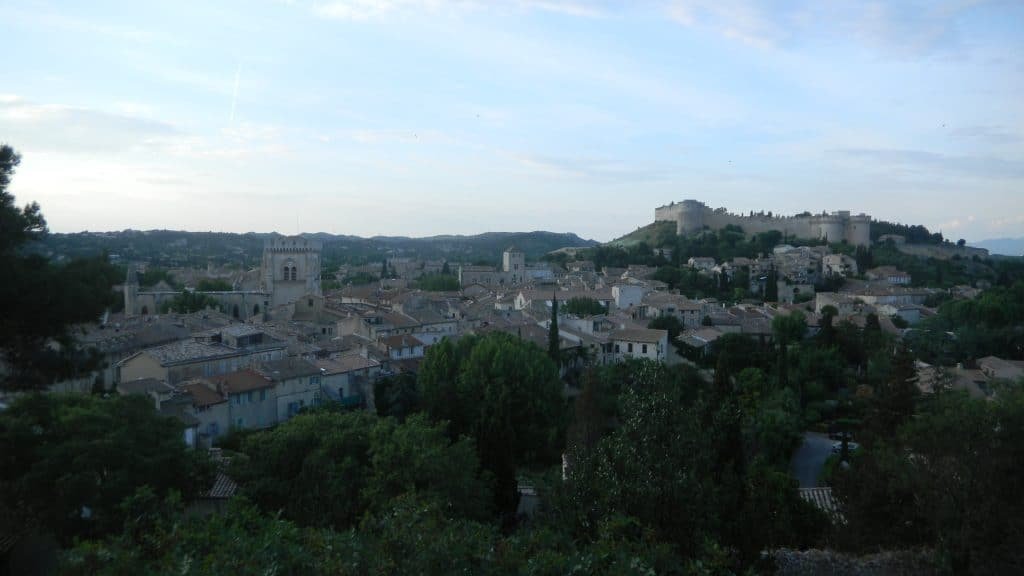
Hebrew mystical traditions evolved into the Kabbalah in southern Europe in the 12th and 13th centuries, specifically Province (pictured below) and Catalonia. The Sefer-ha-Zohar (Book of Splendor) was written in the 13th century, and is considered to be the Kaballah’s climax.
The Kabbalah is very complex. so only a tiny minority of people have become adept at it. Most folks have shared the Torah’s easily visionable and locatable stories. Christians later adopted them and honored them in biblical narratives, and the modern West inherited this focus on vision and easily seen objects. But people who have deeply studied and practiced the Kabbalah have found an alternative to its assumptions that reality consists of distinct objects and that the function of language is to describe them. Thought and language have many varieties, as you can also see in Sanskrit and Chinese.