
Most ancient Greeks saw the world in ways that reflected their intimate city-states. Most of their views were human-scale and proportioned. Romans in their early days also saw the world in this way. But their state grew into a vast empire in the last two centuries BCE. This clash of contrary perspectives sparked a lot of creativity, including Virgil’s Aeneid. We’ll examine it more deeply here, since uniquely Western ideas and art works emerged from this contrast.
A second century CE writer in the Roman Empire named Apuleius wrote The Golden Ass, which recounts the journey of a man called Lucius, who accidentally turned himself into a donkey while experimenting with magic. He wandered around the Mediterranean to change back and was ultimately granted his wish by Isis (Romans had imported this popular Egyptian goddess, who was associated with salvation). Although the tale was fanciful, cities often dominated its geography. The Roman Empire’s urban centers included a forum, public bathhouses, theaters, libraries, paved roads, and aqueducts. Lucius could travel to any city and assume that he would meet people who shared this world, and they conversed as though they knew its institutions and idioms. Characters debated in Roman oratorical styles, and they invoked legal procedures that Apuleius’s urbane readers would have recognized.
The Golden Ass expressed both perspectives. It portrayed an international community of urbanites and a world of magic. It then became spiritual when Lucius was introduced to Isis and she restored his human existence and taught him a lesson: Aim for higher things than base magic.
Mixing the physical and metaphysical wasn’t new in the West in Apuleius’s time either. By the sixth century BCE, the proportioned colonnades of Greek temples made the world and sacredness mirror each other.

They embodied the universe’s enduring order, and they graced cities. The Homeric epics portrayed Olympian gods as though they were human beings, right down to Zeus and Hera’s marital roes and Aphrodite’s spoiled brat pouts. As below, so behaved the gods above. In the early fourth century BCE, Plato made this mutual reflection a general philosophy by saying that the universe was created according to divine ratios and static geometric shapes. But The Golden Ass was a different beast.
Apuleius’s book portrayed a world more out of joint. People’s forms and fortunes transformed quickly, and magic could turn humans into animals. As a donkey Lucius suffered one mishap after another. He was forced to drive a grinding wheel in a corn mill and then had to pull an overloaded timber cart while the boy in charge of him beat his right hip until it was covered with blood. The historian of literature Erich Auerbach noted that even the writing style expressed a disjointed world. Apuleius used a refined Latin style to detail the open sores on Lucius’s body after the beatings and to describe other grotesque scenes, including two women urinating in a man’s face. So much for timeless Platonic beauty.
But Isis saved the day. After wandering through a world full of perils, Lucius met a divine personality who transcended the winds of change and turned him back into a man (a priestess for Isis is shown below, on a tomb a little south of Rome). What happened to the natural balance in those Greek temples? Why was the world so topsy-turvy before Isis put things right?

Apuleius struck a nerve that was already sensitive throughout the empire. More than a century before, the Roman poet Ovid wrote his Metamorphoses, which was full of transformations from Greek mythology. A horny Zeus changed into a bull to carry off Europa, and Daphne turned into a tree when Apollo ran after her. The Homeric epics had been central literary models for Greek and Roman writers, and they had unified themes (Achilles’ impact on the Trojan War in the Iliad, and Odysseus’ return home in the Odyssey). They gave these topics moral dignity, but Ovid irreverently told Greek myths as loosely related stories that ended in a sudden shape-shift. The world had changed between the time of those Greek temples and the Roman Empire. It had become integrated into an economic system that reached all the way to China and the Funan area in Cambodia. But it seemed disjointed to many.
A first century CE Roman writer named Petronius brings us into this world in his fictional story, The Satyricon, by letting us eavesdrop on a banquet. The host, Trimalchio, has recently become rich and he’s eager to show off his new wealth. Two of his guests slander his wife, Fortunata, by saying, “All she cares about is money, but before their marriage, her work was so lowly that you wouldn’t have even taken a piece of bread from her hands. But now she watches her husband’s money like a hawk, and when she takes a rest, she gossips like a magpie.” The visitors marvel at other people’s sudden changes of fate. Some have suddenly made fortunes while others have been ruined.

It’s now time to eat and Trimalchio serves a round plate with dishes that resemble the 12 zodiacal signs. A hunk of beef lies over Taurus (the bull) and a pair of testicles and kidneys garnish Gemini (for being associated with twins). He picks his teeth with a silver toothpick and then makes a literary allusion that reflects the shallow learning of a parvenu. “Wine lasts longer than us poor humans, so let us drink it up and enjoy.” Six hundred years before, Greek lyric poets sang this life-is-brief-so-enjoy-the-moment theme so much that it became a literary cliché. Trimalchio thus tries to appear sophisticated but repeats what’s been worn out for centuries. He then gets drunk and boasts about the tomb that he plans to build for himself, which will immortalize him with reliefs of ships that brought him his fortune, and of gladiatorial games that he sponsored. Everything he does and says is a laughable example of bad taste. But for him and his guests, the world is constantly changing. Fortunes are quickly made and lost and social positions are unstable. Nobody has the chance to become refined; people can only put on garish shows to show off their wealth. The guests observe the circus-like atmosphere with the wide eyes of country boys who have just arrived in the city.
Petronius strived to be different, and his cultivation became so renowned that Nero appointed him as his arbiter of taste. But working for the boss from hell made him just as vulnerable to life’s sudden changes. A jealous rival denounced him and he was arrested. Believing that execution was inevitable, he committed suicide by slashing open his veins. The fickle goddess Fortuna enriched the refined and the rustic, and then turned on both with equal indifference.
Fortune’s cruelty wasn’t just a literary theme; it was a fact of life in the city of Rome because grandeur and squalor were close neighbors there. Thousands of multi-story apartment buildings rose in it. One was so high that it was considered the eighth wonder of the world. Collapses and fires were so frequent that Augustus Caesar limited their height to 70 feet. Rooms not by the street received little light, but apartments and halls reeked with odors and writers suggested burning bread for relief from them. Because many buildings lacked running water, people had to lug heavy buckets up the stairs, and they often dumped waste from their windows. May the gods help anyone unpopular with his neighbors. (A typical Roman apartment is shown below. A hallway is on the right, and the apartment is on the left. It would have been piping hot in the summer.)
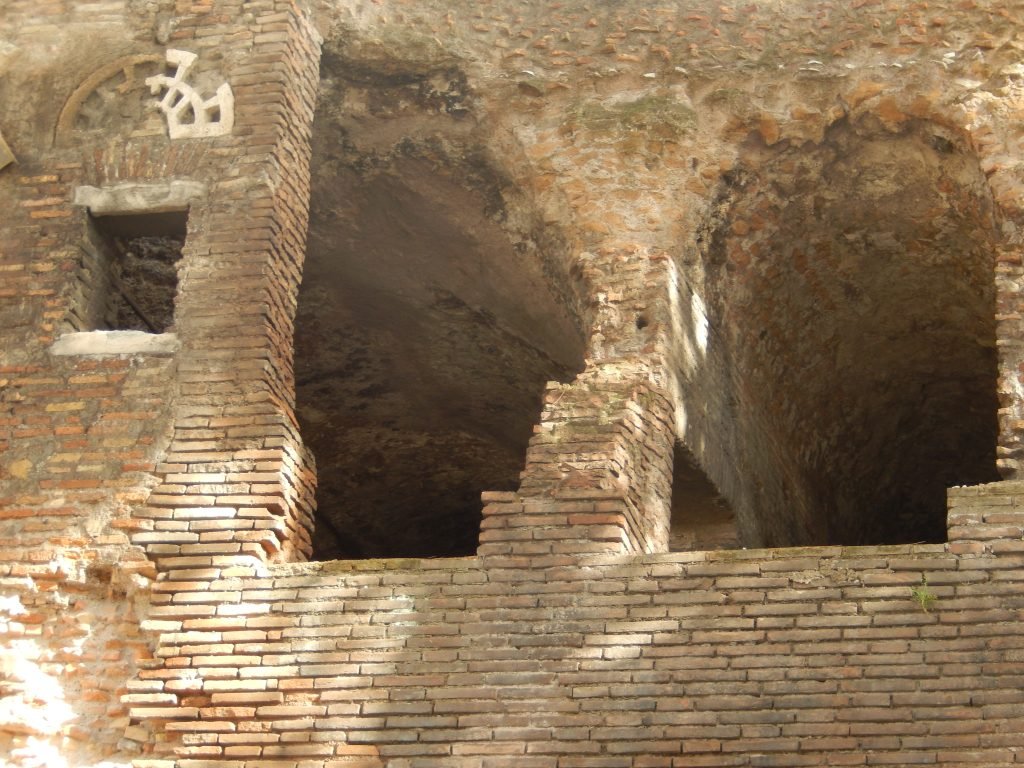
Many streets were so narrow that it was illegal to drive carts on them during the day. People delivered goods in the evenings, shouting at each other to avoid collisions. Garbage piled up, dogs foraged, and thieves prowled. Between 300,000 and 400,000 slaves lived in the city, and they did most of the manual labor. Hoards of unemployed men thus hung around with nothing to do, so emperors regularly gave them bread and gory shows in the arenas to keep them from turning into subversive mobs. Streets were often so crime-ridden that only a fool would have ventured out at night.
Emperors built magnificent monuments and forums between the mazes of firetraps, creating a cityscape that alternated between splendor and shabbiness. Around 50 BCE, Julius Caesar erected a new forum that branched off the main one, which had been Rome’s commercial center since the sixth century. Augustus then constructed another forum next to Caesar’. Throughout the first century CE, more emperors erected their own forums. They also built palaces, public bathhouses, temples, theaters, stadiums, and victory arches (part of Domitian’s palace is pictured below).
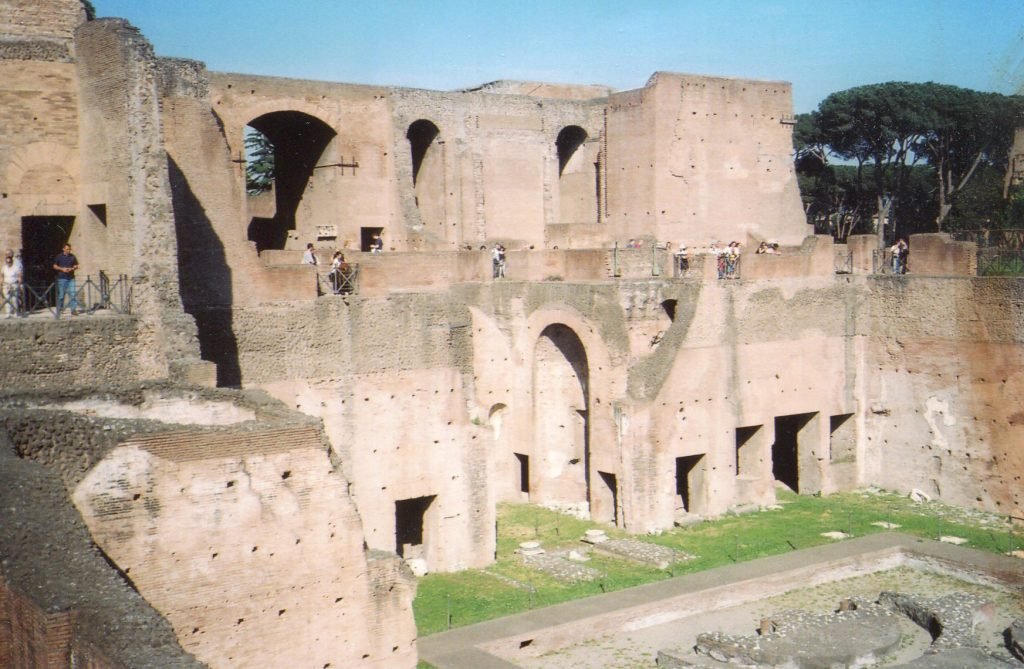
The perspectives that people had while walking through ancient Rome alternated between overcrowded slums and the grand marble colonnades and statues of gods and emperors in open public spaces (many of the rich lived in villas in the hills and countryside, sheltered in their private gardens). Slogging through crowded trash-strewn streets, a person would have suddenly seen the towering arches of a theater, or the 1,000-foot frontage of the baths of Emperor Trajan. The disjointed perspectives in Apuleius’s and Ovid’s writings thus reflected Rome’s cityscape (most of the remains that the 15th century Florentines saw were of the grand monuments—they idealized Rome as the model of civic order but weren’t exposed to the ancient city’s seamy sides).
The largest bathhouses were stupendous, and they provided temporary relief from the social tensions. Rich and poor had access to both cold and hot baths, which were surrounded by gardens, sporting grounds, fountains, lecture rooms, libraries, and covered promenades. Some were as big as a modern shopping mall but more elegant, with coffered ceilings and niches for marble statues at regular intervals. Anyone could enter them for a break from the crowded streets, and for a while, enjoy beautiful surroundings in the company of friends, snack-sellers, and musicians.
But the Coliseum operated from morning to night. I first walked around its upper concourse and admired the size of the building, which sat more than 50,000 people—as many as a major league baseball stadium. Cavernous arches ringed the entire edifice, and they allowed it to be filled and emptied in minutes. But I then descended to the lower level, where thousands of people had suffered and died.
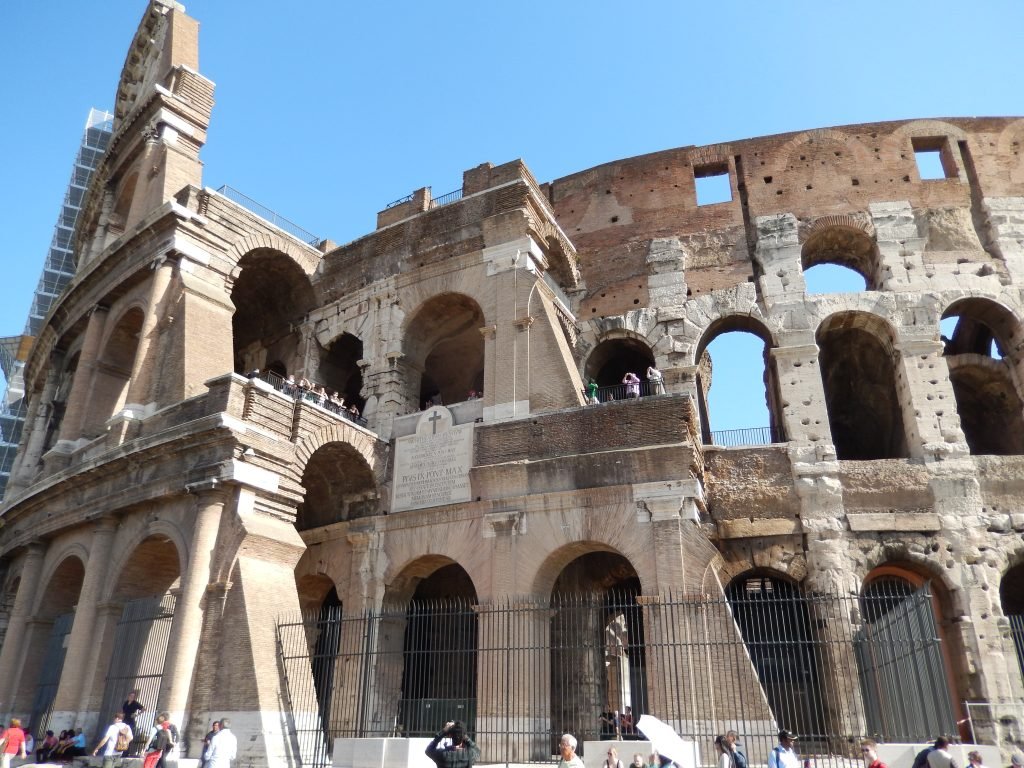
When I visit an archeological site, I linger in several places to imagine how people lived and thought. I usually love getting as close as possible to the ways people experienced the world, but the Coliseum became unbearable. To my left, victims quivered as leopards yanked out their intestines, and to my right, spectators ate figs and cheered. The word arena comes from harena, which was the sand that was spread on the ground to soak up the blood. I looked up towards the seats and thought, You assholes! How can you enjoy this?
To take my mind off the sadism, I looked up at the architecture but that only made me feel worse. The contrast between the arches’ grandeur and elegance and the inhumanity that they framed was sheer madness—the building glorified the cruelty. I couldn’t stand it anymore and stormed out of one those outer arches.
But within five minutes, I was walking past one of the ancient city’s most magnificent public halls. This was the beginning of the original forum. As ancient Romans did, I saw dramatic contrasts between those that the goddess Fortuna smiled upon and the ones that she cast down.
China at the same time also consolidated into a huge empire, but most political leaders, thinkers, and artists emphasized a single harmonious whole. Romans more openly expressed the dark sides of empire.

Most Indian philosophies at that time emphasized an overwhelmingly vast cosmos which dwarfs all political entities and human lives. Romans usually kept the perspective on conflicts in this world, but many also expressed longing for transcendence.

Romans developed dialectics between:
The entire political order and the individual’s struggles–the state is both harmonious and oppressive.
Worldly politics and transcendence.
Both perspectives were highly developed in ancient Rome, and they provided roots for Christianity, medieval thought, and modern thought. Romans saw the world in multiple ways at the same time, and this has given Westerners a bottomless well for creative thought and art.