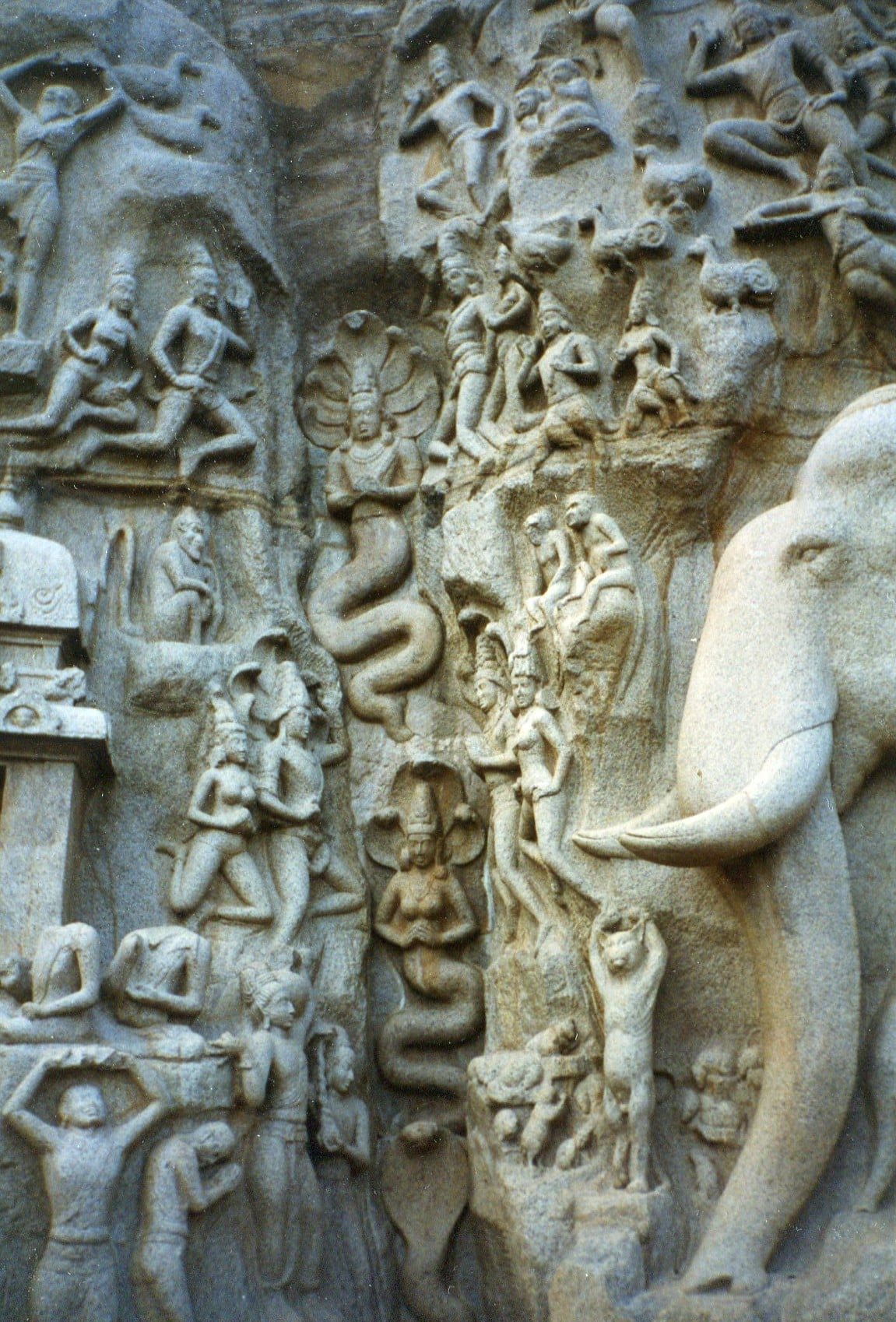
The above photo sure doesn’t look like an ancient Greek temple. Nor does it look like a Romanesque cathedral. Instead of focusing on the simplest forms, this carving revels in sheer abundance.
This is the middle of a 152 foot long frieze in southern India–in Mahabalipuram, 45 miles south of Chennai (it was originally called Mamallapuram, meaning city of the great wrestler). The kings of the Pallava state commissioned these carvings in the 7th century and used them as statements of political and spiritual unity. But this unity was expressed with very different aesthetics than Greek temples’ and Romanesque art’s. What the heck is going on in that crowded scene?
Specialists have asserted two possibilities:
1. It either represents a story from the Mahabharata in which Arjuna (the hero in the Bhagavad Gita) practices austerities in order to persuade Shiva to give him a weapon called the pasupata.
2. Or it’s about the descent of the Ganges River, which was originally up in the sky. The cleft you see in the middle is where it would have landed. Nagas undulate in the middle of it, and many creatures face it–many features of the frieze thus support this interpretation.

Whether the Pallava kings used one tale or the other, or both, they illustrated it with an abundance of life forms.

They have features that are common in Indian art:
1. The characters are in motion. They’re not static like most of the earliest Greek sculptures.
2. The characters are integrated with many others, and several species are mixed. All life forms are unified in an enormous flow of energies.
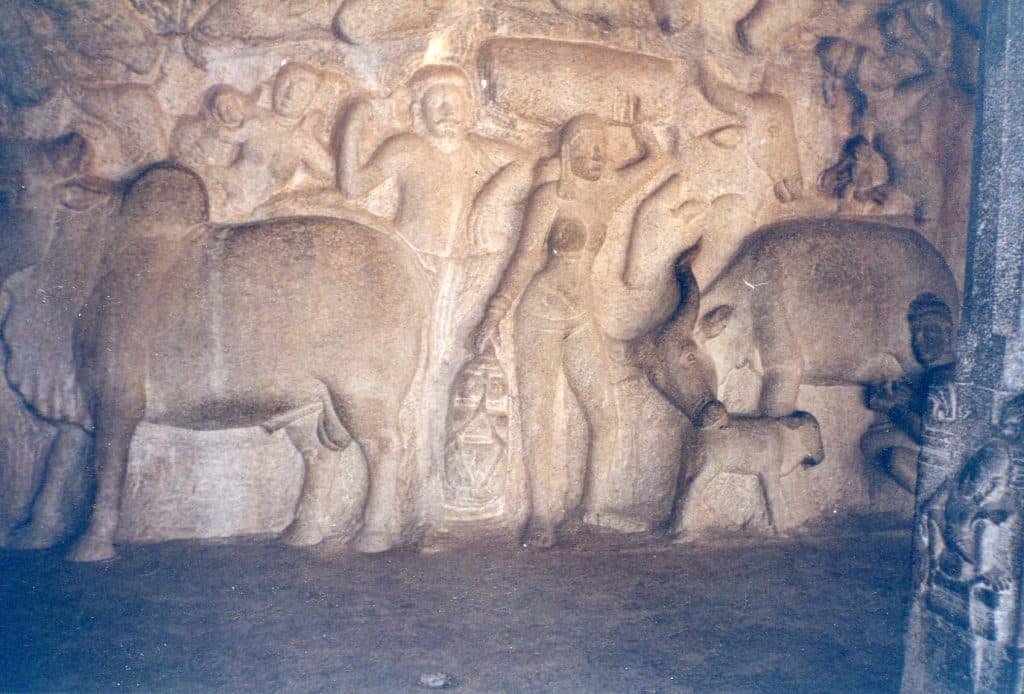
The above photo is also from Mamallapuram. It lovingly shows a man milking a cow while she licks her calf. This scene could be of rural India today. But many other beings surround them, and all gently flow together.
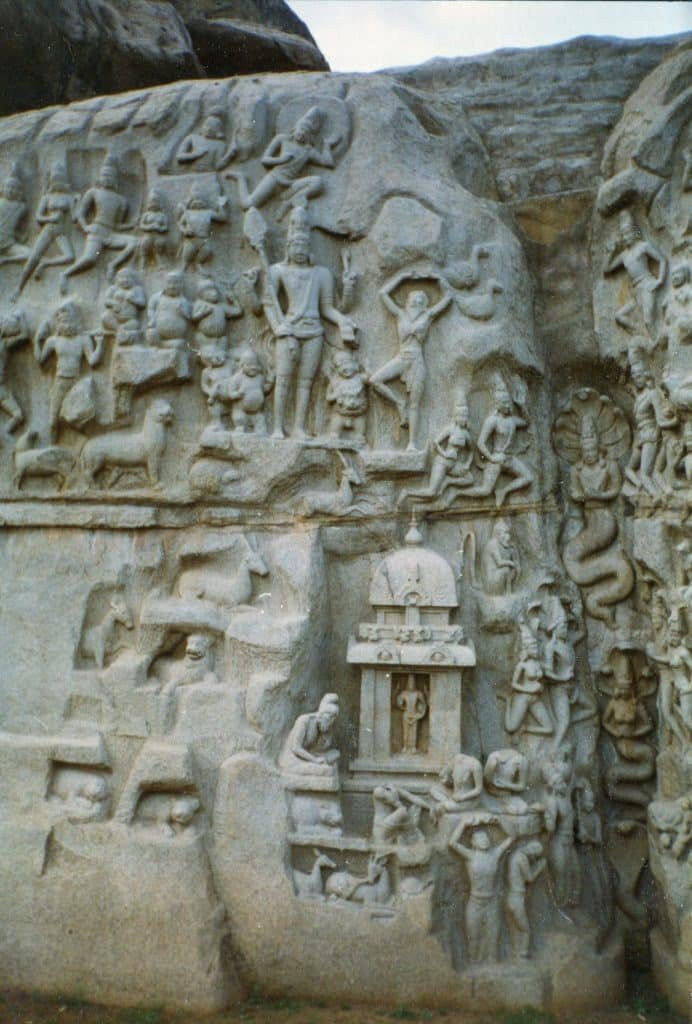
Western artists have usually partitioned scenes into separate domains. But Indian ideas of unity have more often been expressed in panoramic perspectives in which everything flows together in the same ocean of cosmic energy.
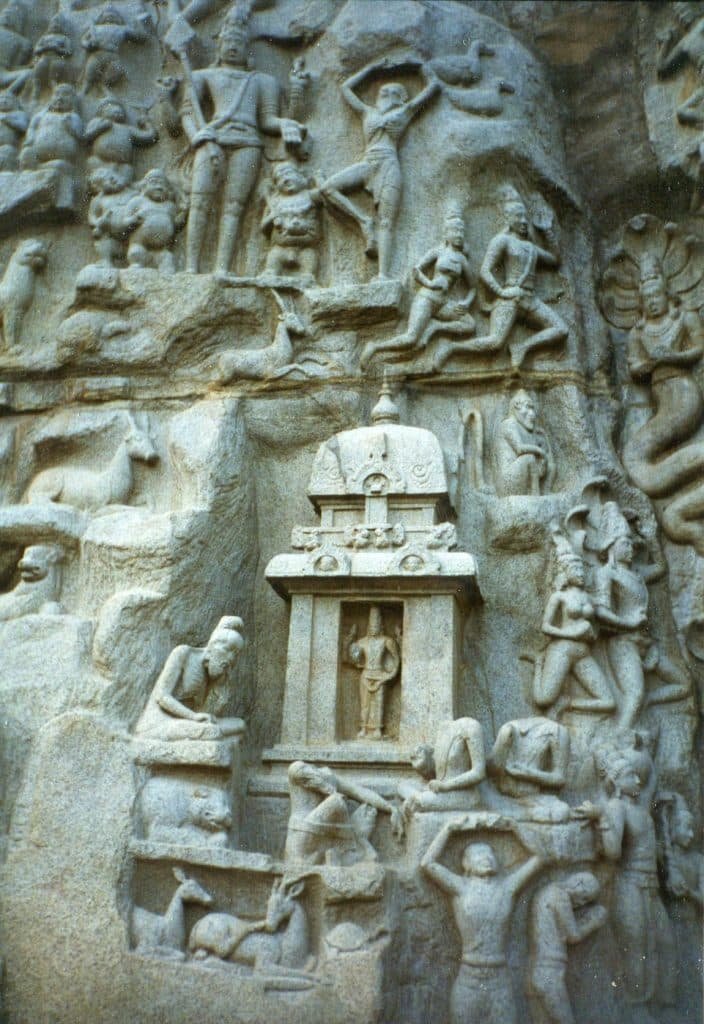
Indian art ain’t your father’s Romanesque or Gothic cathedral either.
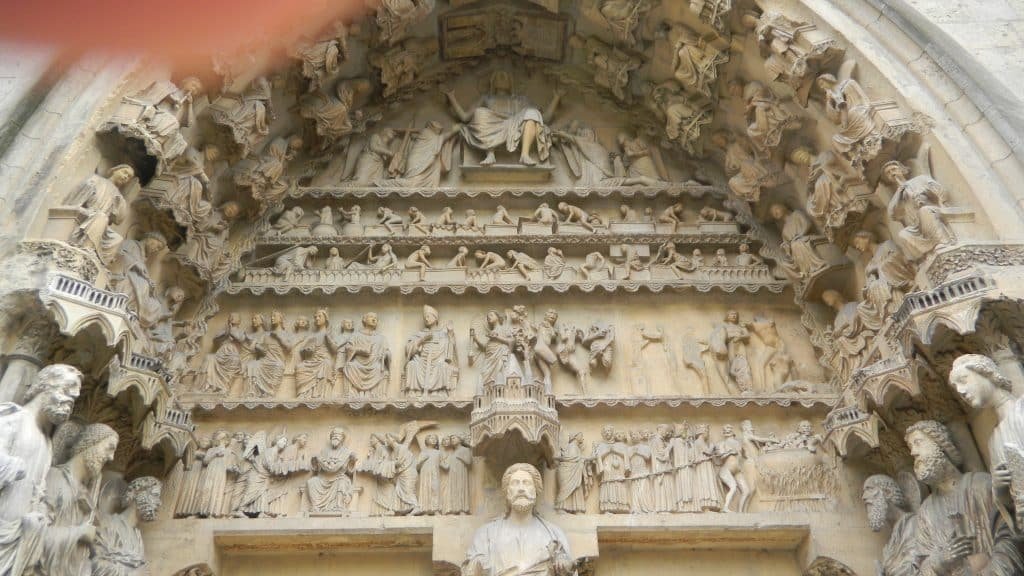
Above is a carving of the Last Judgment over a portal at Reims Cathedral, which is a little north of Paris. Mamallapuram’s carving depicts the descent of the Ganges River. Both have a couple of common traits:
1. They’re of cosmic-scale events–they have important meanings for all life forms on earth and heaven–and in the first panel, a very nasty place below.
2. They’re exuberant–the guys who planned and carved these friezes enjoyed portraying as many beings as possible.
But they also reveal two different ways of seeing the world and representing reality.
Reims Cathedral’s Last Judgment portal is an excellent example of Western ways of seeing. It’s linear–the events are arranged in rows as neat as military drills. Christ is on top. The resurrection of the bodies is in the two levels beneath him. Virtues and vices are under them, and the elect and the damned are on the bottom. Around them are six saints, and above them hover three rows of beings: angels on the outermost level (the most highly evolved), deacons in the middle, and wise virgins on the inside of the left and foolish virgins on the right. Welcome to Medieval Western thought–every being is in its place in an ordered universe, with God as the creator and Christ as the judge and redeemer.
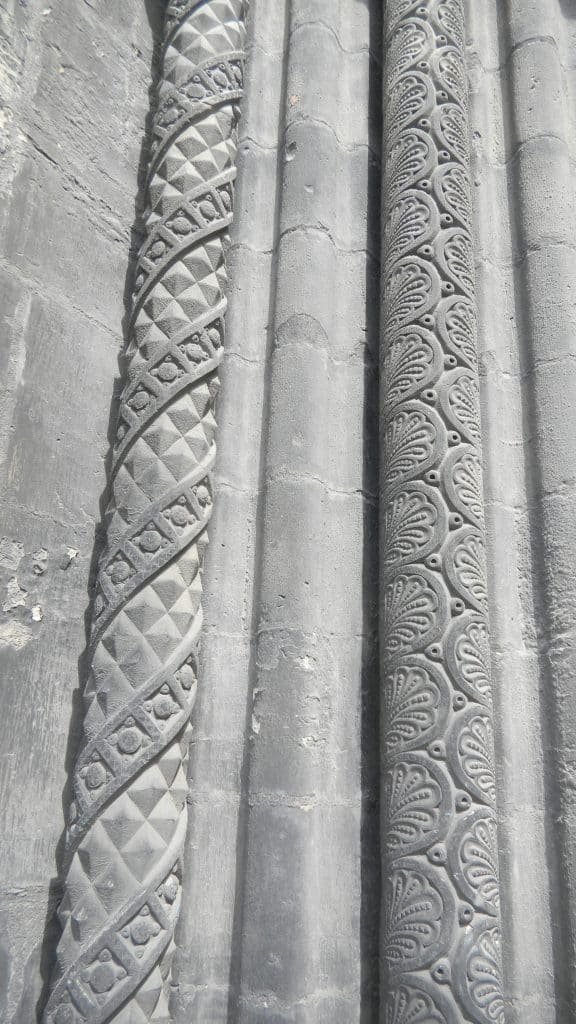
Above we see a detail of a pillar around one of the the Basilica of St. Denis’ portals. Nature’s forms are exuberantly portrayed, but within firm lines.
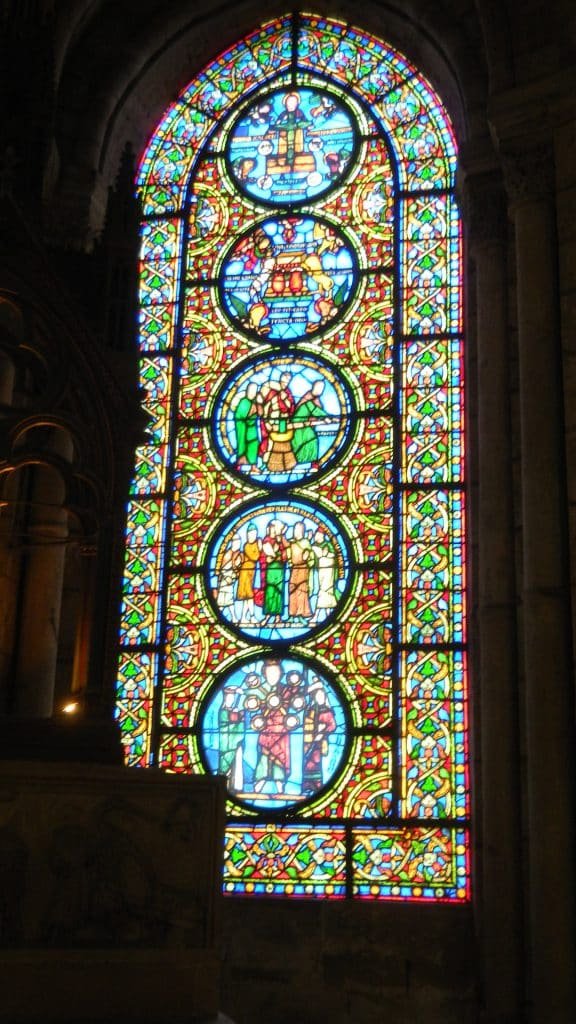
The stained glass windows at the Basilica of St. Denis also has exuberant forms hemmed into linear arrangements. The forms are so vivacious that they threaten to burst the lines, but they never do. The love of nature that French artists were expressing in Gothic cathedrals in the 13th century seems to be in a tense relationship with God’s order, as though nature wants to break free. But God’s linear order holds firm.
But the frieze at Mamallapuram isn’t divided by lines. All beings in the universe are portrayed in the same field, and the unity of life is stressed more than divisions between species. This sensibility has inspired every artform in India, including music and architecture.
In the story of the descent of the Ganges, the universe was seen as a vast and unified field, rather than one partitioned into distinct domains. The frieze at Mamallapuram visually reflects this tendency of stories to range across the universe.