Language is much more than what the cognitive psychologist and linguist Steven Pinker called words and rules. For example, aspects of Sanskrit helped encourage ancient Indian thinkers to imagine the universe as an abundant and vast flow of energies, and the multitude of meanings of Mandarin words has helped encourage traditional Chinese people to think that the universe is highly resonant. Languages reflect their speakers’ assumptions about the world.
This happens even at the level of single words. The Anlo-Ewe of eastern Ghana have often used the word seselelame for listening. Sese means hearing, le means within, and lame means body, flesh, or skin.4 They have thus thought that more places than the ear are involved in attending to others’ messages. The word can refer to tingling in the skin, sexual arousal, heartache, a general feeling in or through the body, or an inspiration to dance or speak. So listening often involves the whole body. People in dialog are thus fully present physically, and they often move as though they’re dancing. Seselelame thus refers to a kind of hearing that involves the entire body in motion. Many traditional African societies also conceive of music in terms of bodily movement. A word that is treated as basic can have a range of meanings that reflects the whole culture.
The English literary scholar and poet William Empson wrote that many common English words have a multitude of meanings rather than only one. In The Structure of Complex Words, he analyzed meanings of the word dog in late 16th-century literature. It’s hard to imagine a more ordinary object than the animal that people in many cultures have lived closest to. But a dog can be friendly or aggressive, and children have to learn to tell the differences between various dogs’ temperaments and moods. Cultures can emphasize certain qualities (many Muslims have considered them dirty). Empson noted that the word dog was sometimes used derisively in Shakespeare’s England, denoting abjectness. But it also expressed affinity between folks in lower classes in that time when many tenant-farmers in the countryside were losing their homes as their landlords enclosed lands for sheep farming. “Sheep eat men” was a common expression then. Affectionately calling someone a dog sometimes meant, “We’re in this trouble together and we’ll support each other.”
In Seven Types of Ambiguity, Empson wrote that prose sentences are often ambiguous. The sentence “The brown cat sat on the red mat” can be split into several statements. It’s about a cat, a mat, and sitting, and it evokes images of brownness and redness. Empson wrote that several statements are often implied in one statement. Rather than only focusing on a separate object, many statements have an overabundance of meaning which extends through the cultural landscape. Images of a cat, a mat, sitting, brownness, and redness can imply many situations. And each word has several meanings, not just one. A cat, for example, can be quiet, finicky, elegant, sneaky, ferocious, or a loveable pet. Each idea inspires different images and narratives.
The linguist Zellig Harris said that words that can be used in the same place in the same sentence can be said to be in the same “substitution class.” Thus cat and dog in the statement in the form “The X ran up the hill” are in the same substitution class. But images of both animals are not completely interchangeable; they often suggest different pictures, such as various types of running. People often imagine nimbleness and slinkiness when they think of a cat running. The kind of running that they often associate with dogs is more lumbering if large or bouncy if small. The regal bearing of this Chow Chow–

was different than this perky chihuahua’s behavior.

When different animals are substituted for each other, different images can emerge, with different activities, landscapes, characters, and stories. A cat chases a mouse, or runs when an angry man it awakens at night throws a shoe at it. A dog runs to his master, after prey as he loyally helps his owner hunt, or after a ball.
A sleeping cat–
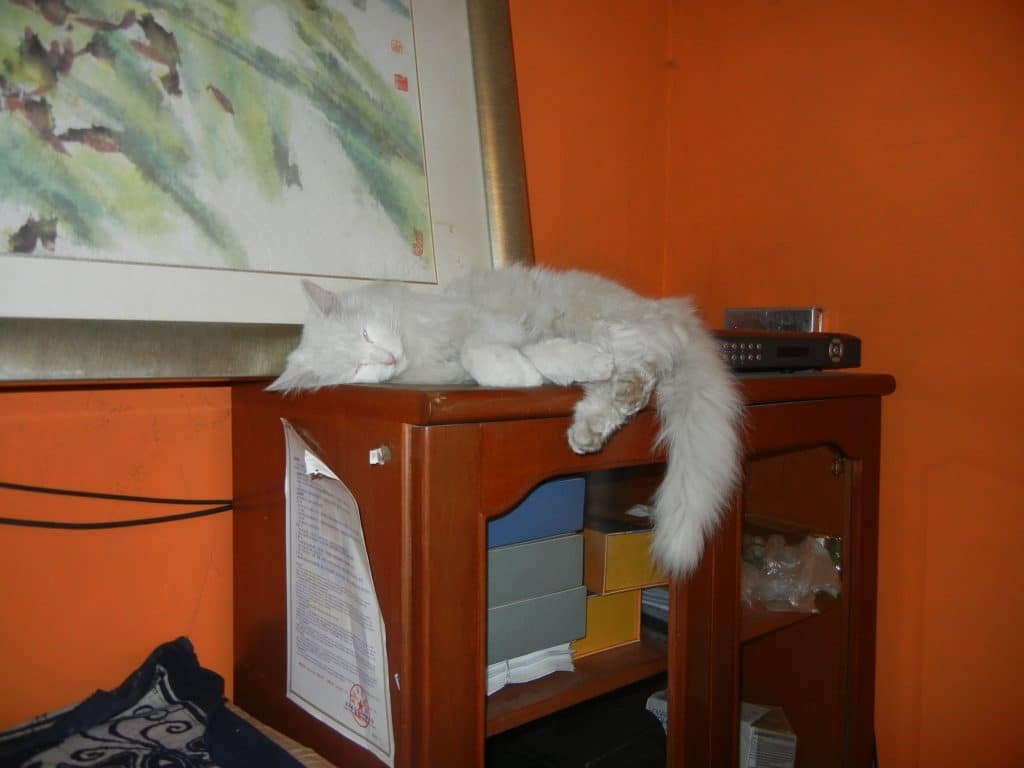
–often provokes a different narrative than a sleeping dog does. The latter seems lazier, like these two taking a break in Athens.

Words thus cannot always be completely substituted for each other, because meaning doesn’t only exist at the level of the single word or the sentence. It’s also derived from whole contexts, narratives, and world-views. Several concepts often blend to give a word its meaning. For example, a horse’s quickness is typically different from a cat’s. It is strong, graceful, and noble. It also glides over the grasses everyone else trudges through, and this has inspired some cultures to associate horses with flying and the heavens (e.g., Indra’s chariot and the Ashvins from ancient Indian mythology and the Greek Pegasus).

A cat’s quickness is usually associated with other qualities, including sneakiness and the ability to squirt into places that human beings cannot reach.
So languages are more than words and rules. They’re more multidimensional, more deeply lived, and more conducive to open-ended creativity. The philosopher Hans-Georg Gadamer said that commonly used words have meanings that are rooted in their cultures’ ancient histories. Rasa and dao are notoriously hard to translate into English because they convey a whole world of meanings from their societies.
The psychologist Iain McGilchrist, in The Master and His Emissary, wrote that the areas of the brain that are most centered on language are near areas that largely focus on pointing, music, and dancing, and that all these areas emerged together as our ancestors evolved.

He concluded that the neurological evidence does not support Noam Chomsky’s assertions that language is based on an abstract universal grammar that is hard-wired into our brains, which provides the rules by which we structure our experience. Instead, language is more deeply embedded in the body and more integrated with several other mental functions. These functions’ interactions construct meanings, and there is a lot of scope for cultural variation. Stephen T. Asma, in The Evolution of Imagination, also wrote that several creative abilities co-evolved with language, including music, dance, image making, and gesturing.
The philosopher Ludwig Wittgenstein wrote that different cultures play different language games, which are heavily influenced by assumptions about the purpose of language. For example, modern Westerners describing what they saw in places where they traveled share the assumption that a key function of language is to describe visible things in the world. Other cultures have assumed that language also has other functions. Vedic thinkers have assumed that Sanskrit contains the vibrations of the universe’s energies and that properly chanting Vedic hymns can channel those vibrations for one’s own benefit. In traditional Chinese culture, meanings of the same word can resonate with each other. Language games that Chinese play thus often extend beyond describing things; they also include amplifying ways that things resonate and harmonizing oneself with society and nature. Much of a whole culture is thus reflected in its assumptions about the uses of language. It is also reflected in commonly used words and in sentences. Some of the most basic aspects of language converge from billions of experiences.
I thus like to think of words as convergences of a whole culture rather than as single objects. Words don’t just denote things they supposedly signify. They also reveal depths in people’s whole world views and invite them to explore other cultures’ ways of using language and apprehending the world. Languages have a lot of depth that AI systems don’t yet contain.