The growth of Islam in Southeast Asia has always intrigued me. The faith has been uncompromising in its basic tenets. God is Tawhid (unity) and there is no other reality than Him. There is no Christian trinity. There is only One. Yet Islam has been embraced by millions in a region where life is typically pluralistic (it’s profuse with spirits). Several currents encouraged both cultures to mesh into one of the world’s great crossroads (more Muslims live in Asia than in the Middle East).
Merchants first brought Islam into towns, including Malacca, Aceh, Banten, and Makassar, and the faith became associated with wealth. As traders throughout the Malay world networked with each other, Islam became a common frame of reference. They felt that they could trust fellow Muslims that they saw bowing to Mecca in mosques. The Koran emphasizes business ethics—people in the Arabian Peninsula lived by trading, and keeping promises was a life-or-death matter in the unforgiving desert. Islam allowed merchants in states throughout the Malay world to feel that they could depend on each other.
Sultans of the growing commercial states could bolster their own prestige by adopting Islam. Their courts were flashy, and rulers often employed scholars to write about Islam and help administer its law. In the Malay world’s hierarchical societies, elites awed commoners with resplendent rituals, and the latter felt impelled to follow their superiors into Islam.
Royal ancestors had already been honored in the Malay world, as they were among the Khmers and many other Southeast Asian societies, but they now acquired some powerful additions to the family. Alexander the Great and kings in the mighty Persian courts became proud predecessors in genealogies of Islamic rulers; Malay sultans could add them to their own roots. Islam also introduced legal codes and provided stable procedures for royal successions.
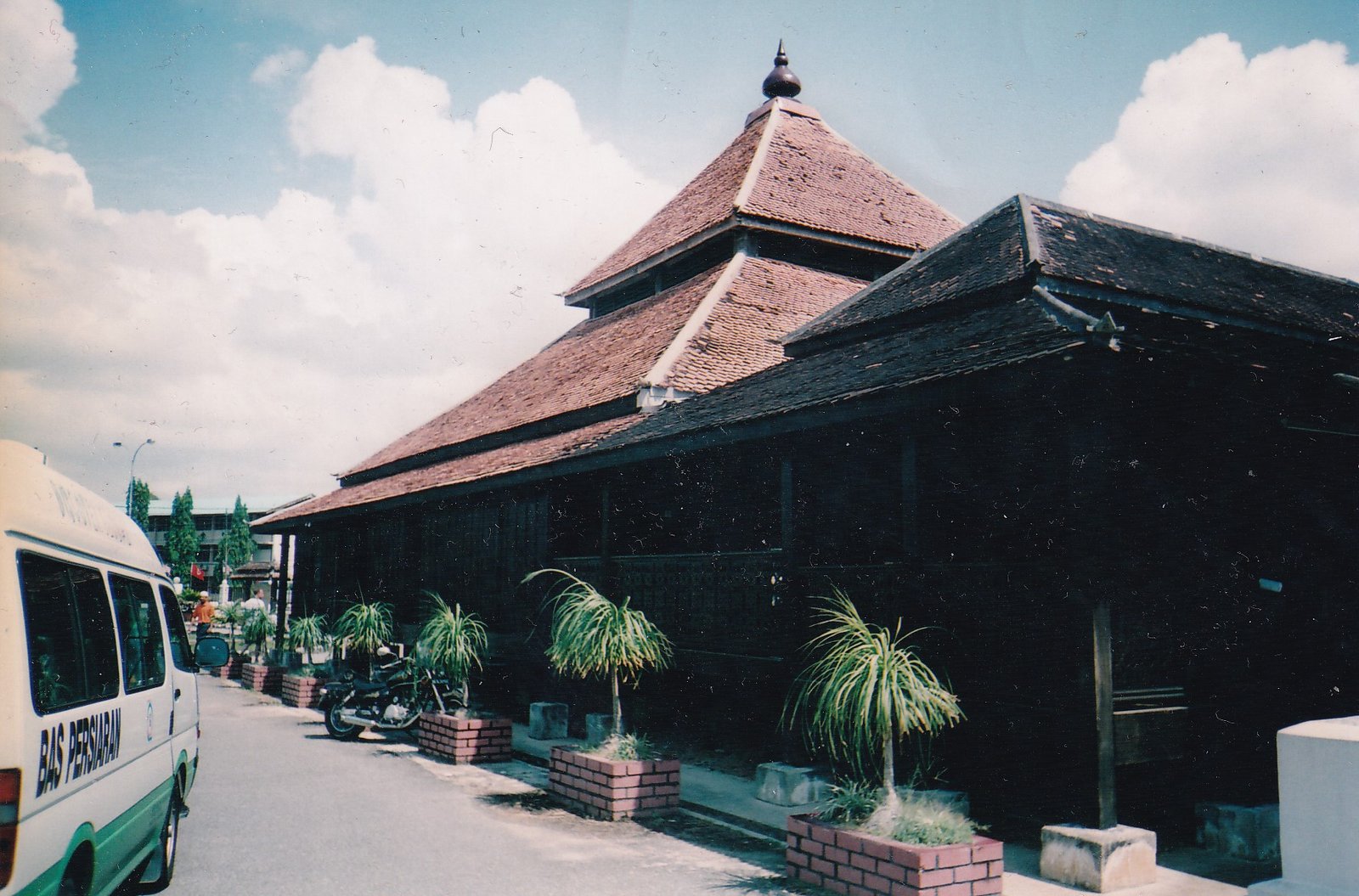
Some people in Malay societies were slaves, and they could free themselves by becoming Muslims. Forces from the top and bottom of the social hierarchy thus converged to establish Islam among Malays. All could sit side by side in the prayer hall in buildings like the old mosque a few miles from Kota Bharu, Malaysia (in the first photo here).
Commoners who had to leave their ancestral lands as ocean-going merchants and warriors could find the universality of Allah and the portability of the Koran comforting. They could also share them as key aspects of their common field of meanings.

At the same time, the Malay language became more standardized as Islamic literature spread and pan-regional trading became more frequent. People’s identities as Malays grew and they considered Islam to be a central aspect of their culture.
Sufis brought mystical varieties of Islam which found welcomes in Southeast Asia, where people had long believed that the world is profuse with supernatural powers. Malays who converted could feel connected to the power (berkat) of holy men and sultans. Even in modern times, many Malays seek the berkat of saints at their tombs. Many have believed that Koranic passages contain magical efficacy, and they’ve paid specialists to chant them to improve health and wealth. Some have displayed verses in their homes to promote the family’s well-being. Certain passages are known to cure diseases, ease emotional problems, and ward off others’ evil intents.
The above reasons have been given by several historians, but Southeast Asian Islam has another dimension which can only be appreciated from an insider’s perspective. Cozy family and kampong (village, or neighborhood in a city) life are basic in Malay society. Adibah Amin wrote a wonderful memoir called As I Was Passing in which she rhapsodized about the joys of being at home during Islam’s fasting month, Ramadan. Old men read the Koran, wives cooked with chili powder, and children played. After the daytime fast, neighbors visited each other and shared dishes. Daily prayers and big events like weddings give people reasons to gather and enjoy each other’s company. Malays take a lot of pride in their hospitality, and Islam provides many occasions for sharing warmth.

Though Islam professes unity, it adds yet more diversity to Malay society. The mosque expresses God’s unity by rendering all the worshipers in the prayer hall and courtyard equal under Him and pointing them towards Mecca. But its vibrant forms and colors add even more wealth to Southeast Asia’s landscapes.
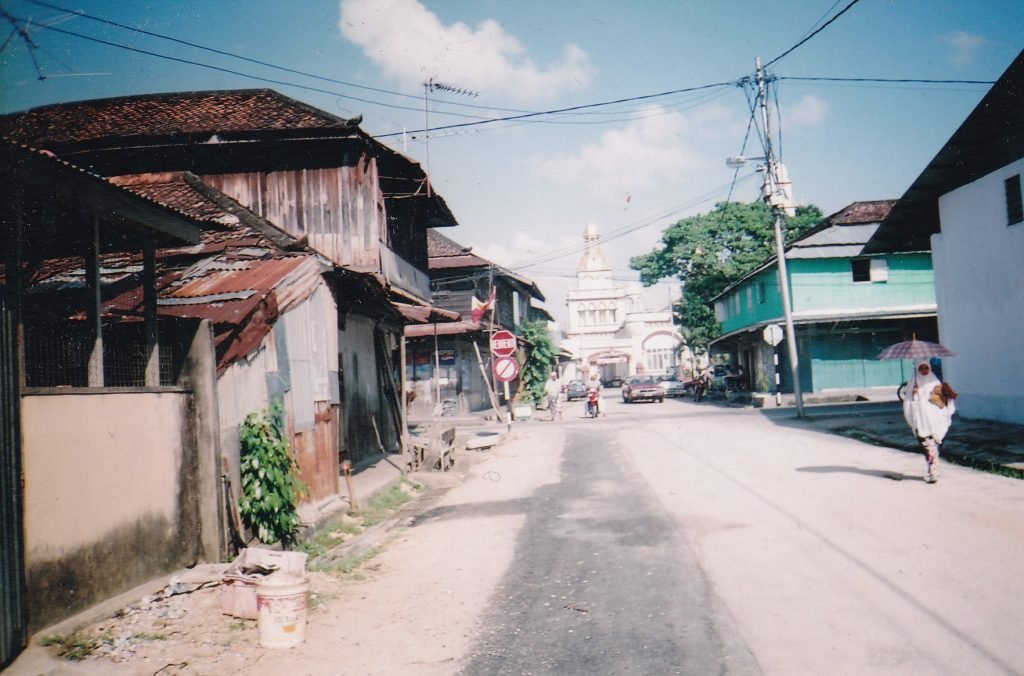
The golden domes and slim white minarets mix with the foliage as handsomely as Thai temples do. (Kota Bharu’s main mosque beams over the the neighborhood in the above photo).
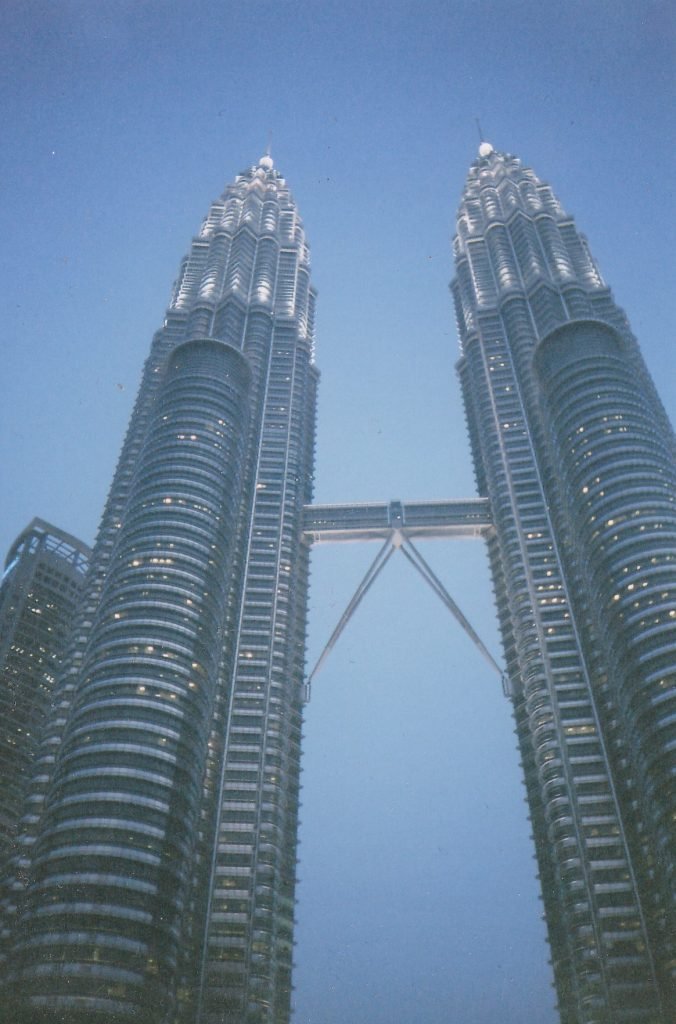
People can have it both ways in Malaysia. They can honor God’s unity and enjoy its diverse manifestations in the world. Traditional Arabic designs now grace some of Kuala Lumpur’s modern skyscrapers, including the Petronas Towers (above). You can explore Islamic ideas about geometry in an earlier article.

The National Mosque in Kuala Lumpur (above) mixes Arabic designs and traditional Malay architecture. Islamic and Malay cultures are very deep, and their fusion will be creative for a long time.
The many roots and facets of cultures give them a lot of points of contact, even when they have opposing differences. Our world can be unified through its glorious diversity.