I was in one of the Bayon’s inner sections in the above shot, just next to the central platform. The area was dense with columns and walls, but the approach to the innermost area made me feel energized. We’ll explore the temple’s heart here.
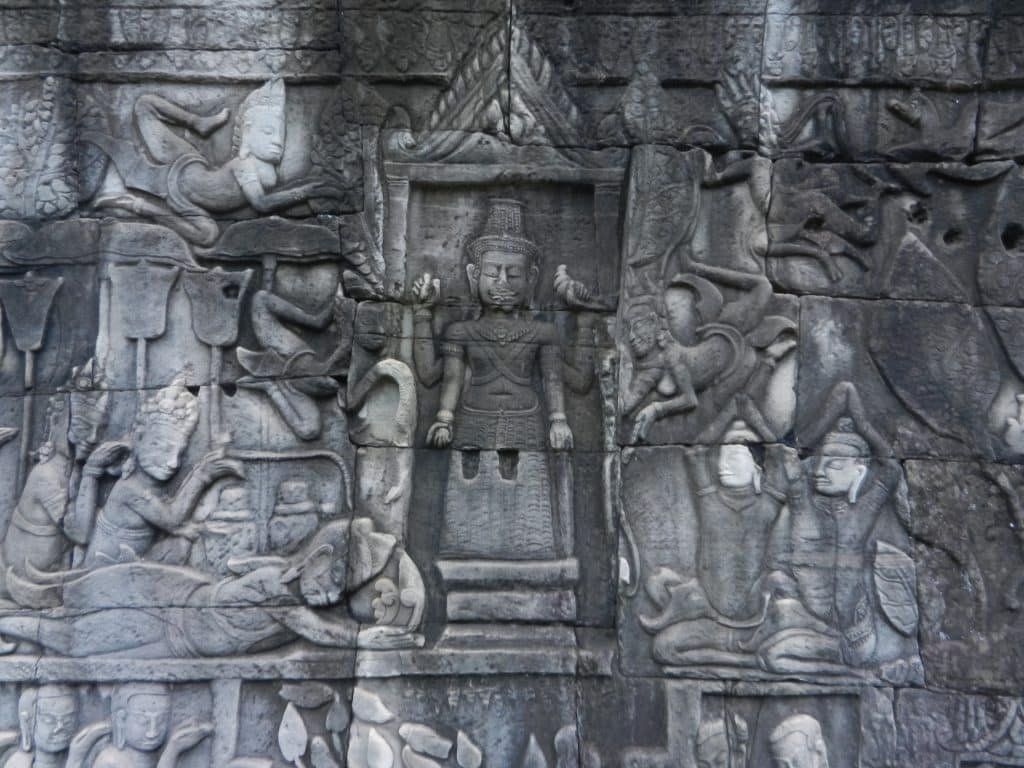
An inner enclosure contains friezes as the outer walls do, but most were carved after Jayavarman VII’s reign. There was a Hindu reaction in the late 13th century, under Jayavarman VIII, and many of the scenes glorify Hindu gods. In the above image of Vishnu, apsaras pay homage from above.
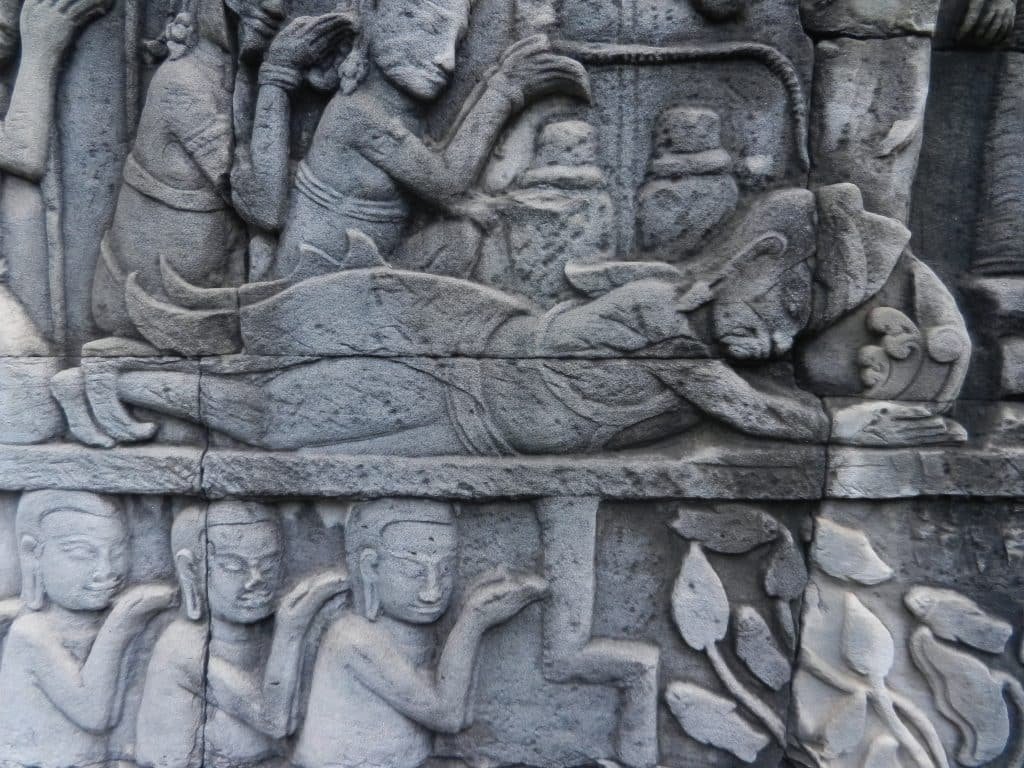
A very well-dressed person, possibly King Jayavarman VIII, prostrates in the center.
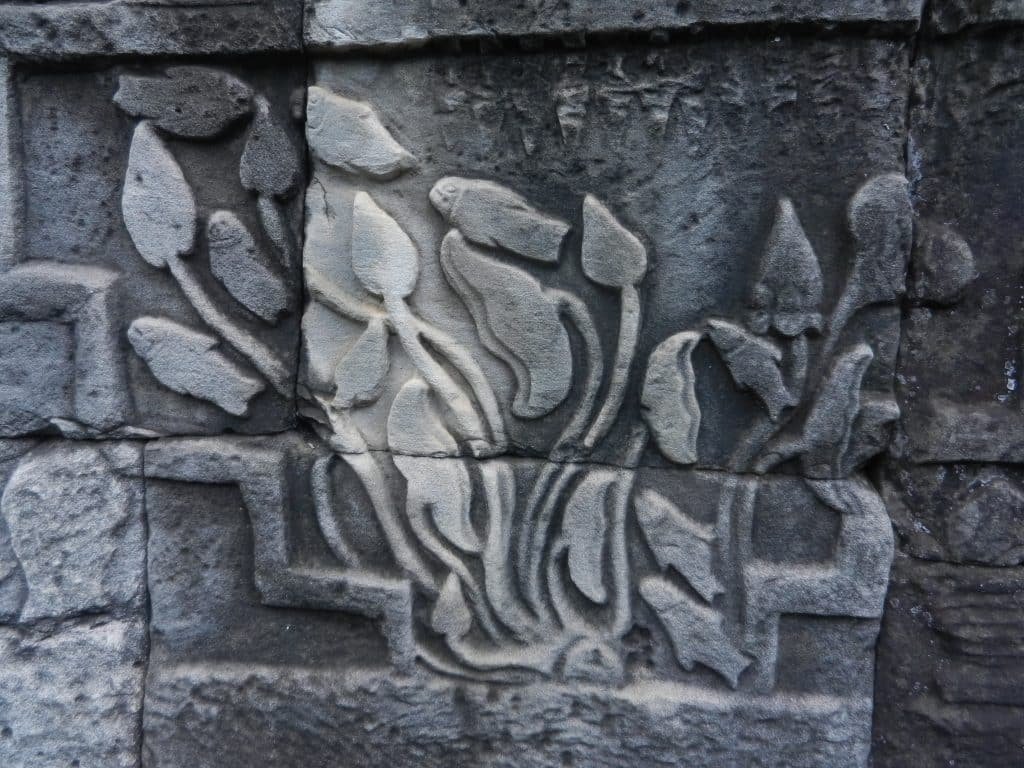
And lotuses and fish intermingle beneath everyone. The Bayon has a lot of these sweeping perspectives which include all domains in the world and beyond. This artistic tradition came from India, and Khmers adapted it to their great monuments, including Banteay Srei and Angkor Wat, to represent the power and glory of the gods and the king.
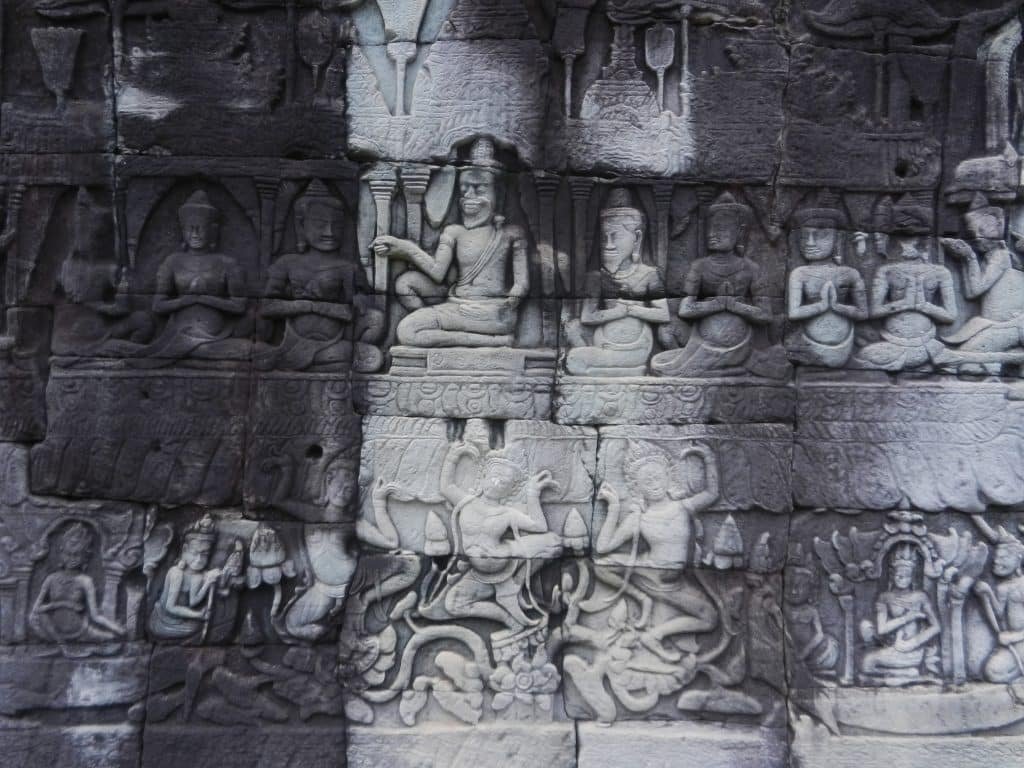
Shiva gets his honors in the photo below. He presides in the center of a palace or a pavilion while worshippers flank him. Underneath, dancers celebrate on lotuses and an upper-class woman rides a boat on each side.
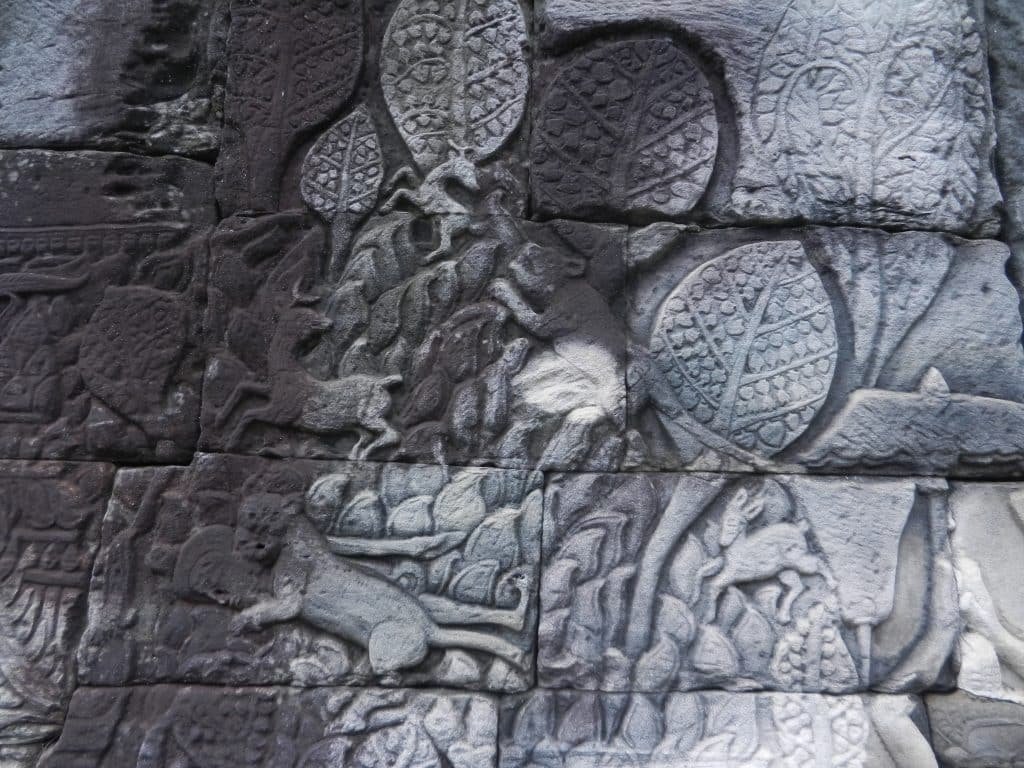
This sweeping view of a mountain forest includes a tiger attacking a man.
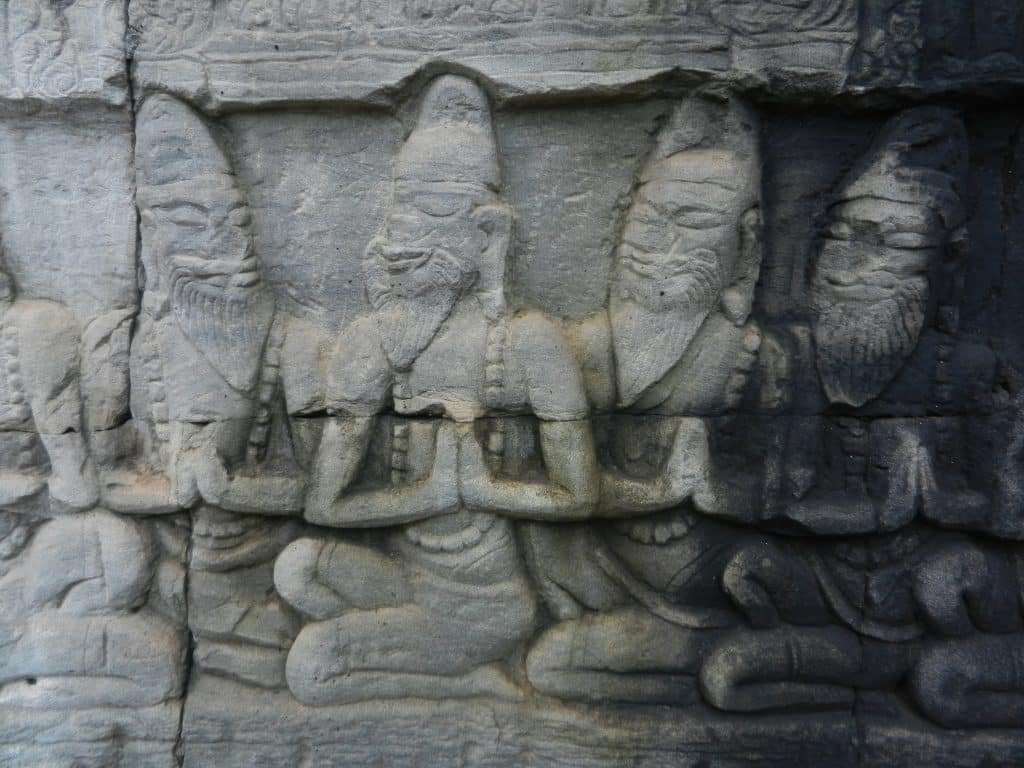
But these ascetics blissing out are unconcerned.
The Bayon’s inner gallery also has scenes of soldiers and other people as the outer gallery does.
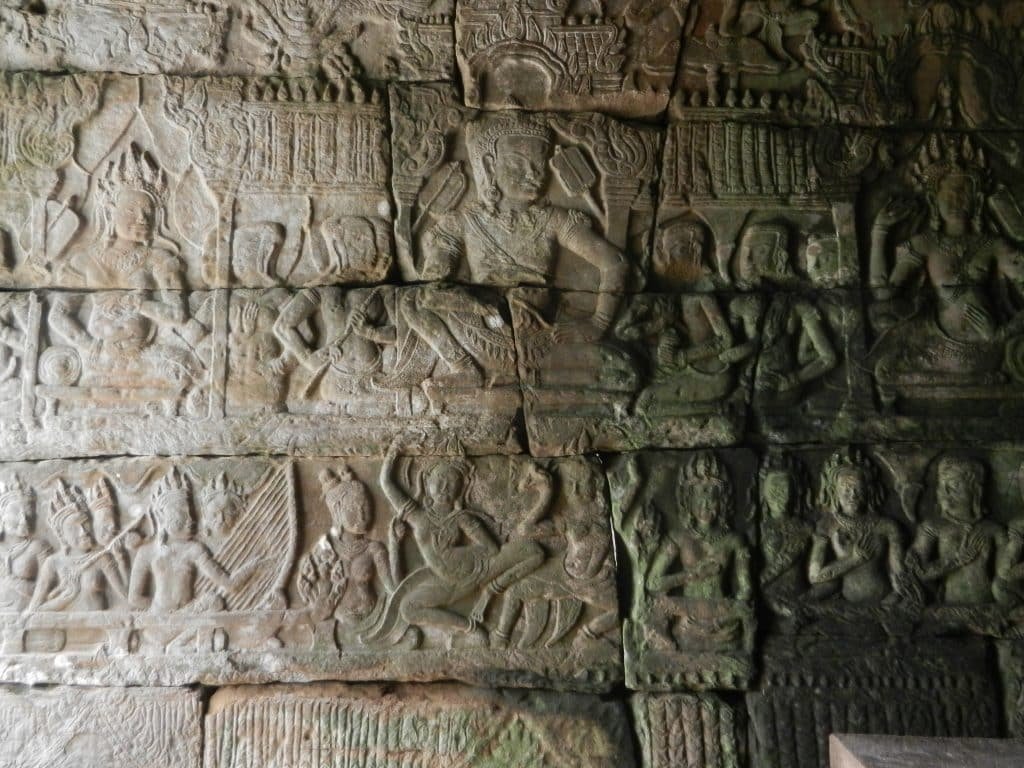
Above, musicians and dancers entertain the king or a lord, two people fan him, and he looks very content.
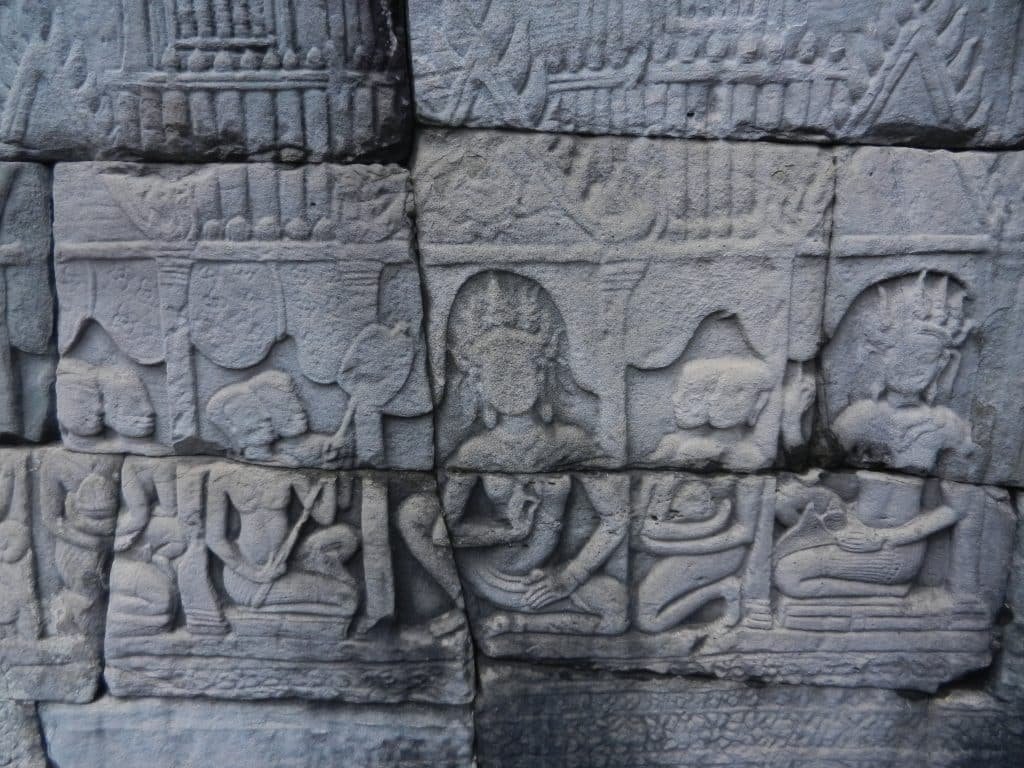
In the above shot, an elegant woman or a goddess is given royal treatment.
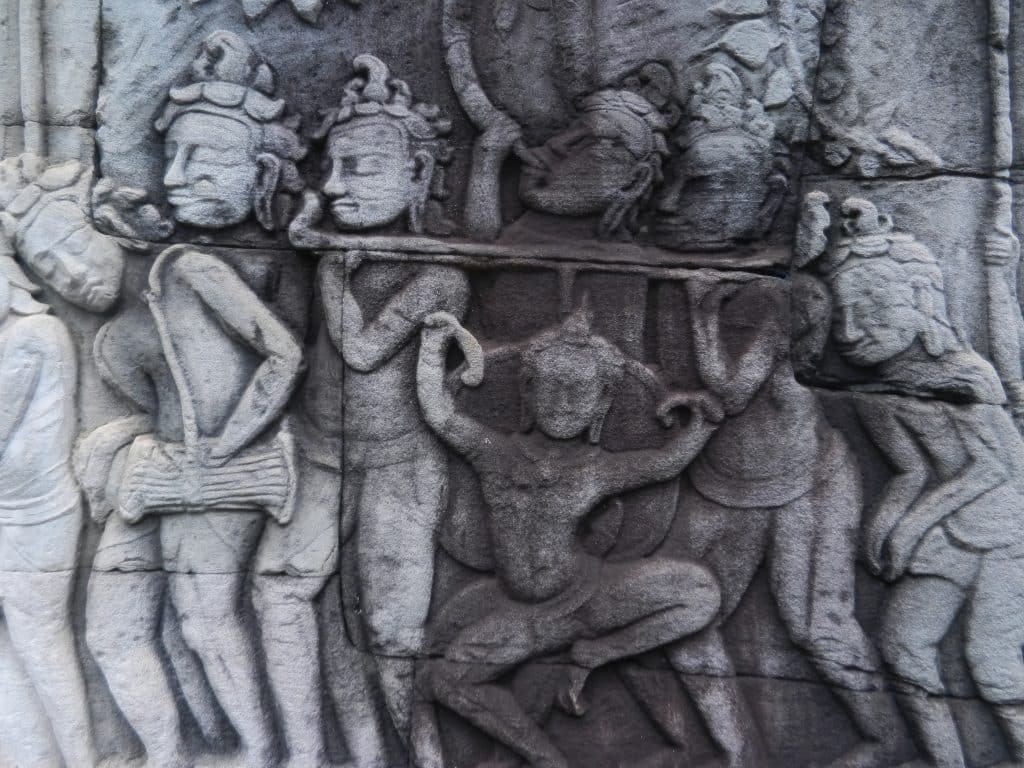
Other scenes are louder, like this procession.
The enclosure for these diverse sculptures surrounds the area around the central tower’s platform, and many thick square columns cram the space into narrow passageways. Some of the galleries were built later, during the Hindu reaction. The effect is claustrophobic. I could barely squeeze through some of the walls and pillars.
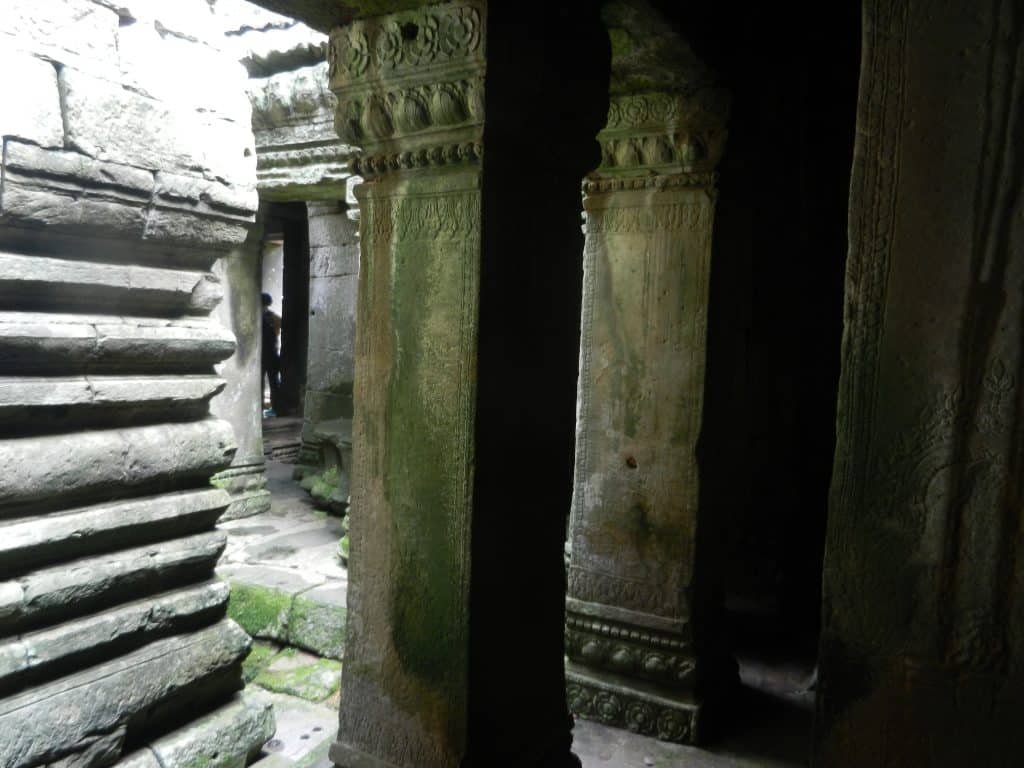
The narrow, musty corridors invoked images of chanting priests and aromas of incense. A pungent smell would have carried well in this place, and it would have made the temple seem even more powerful and sacred. When I was on the west side, the odor of urine wafting through one of the passages was almost unbearably strong. I wanted to escape the combination of ancient mystery and present squalor.
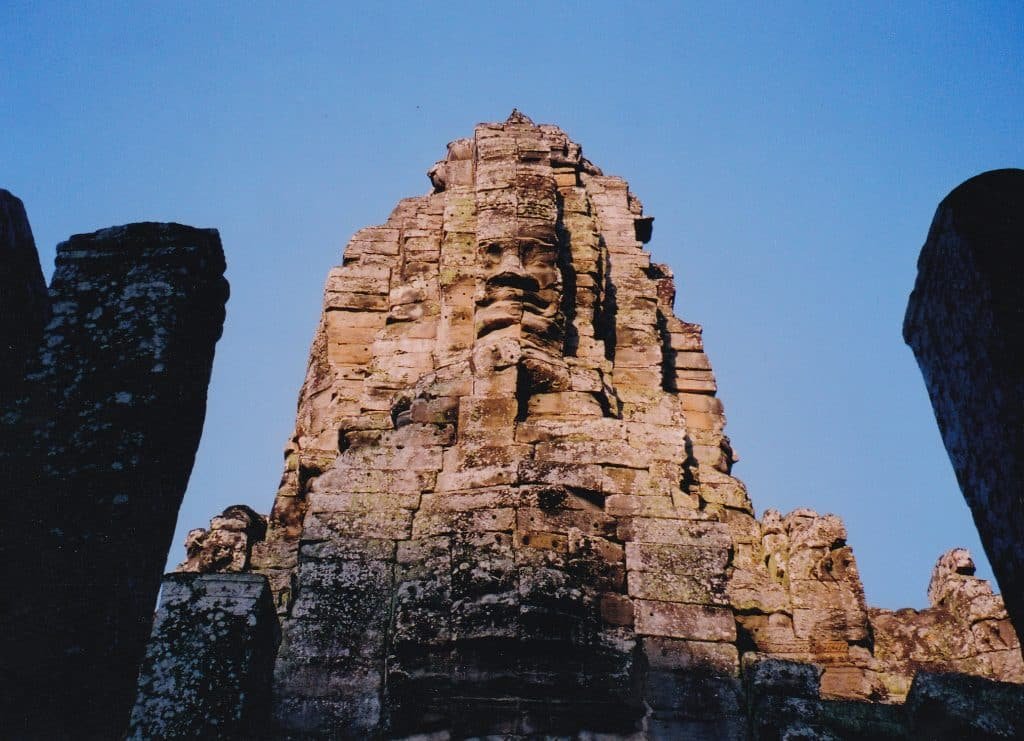
I felt liberated when I ascended the steps to the top level. I was now surrounded by the face towers on one side and the central spire on the other. Their lips turn up at the corners into Mona Lisa smiles so that they look both reserved and enigmatic.
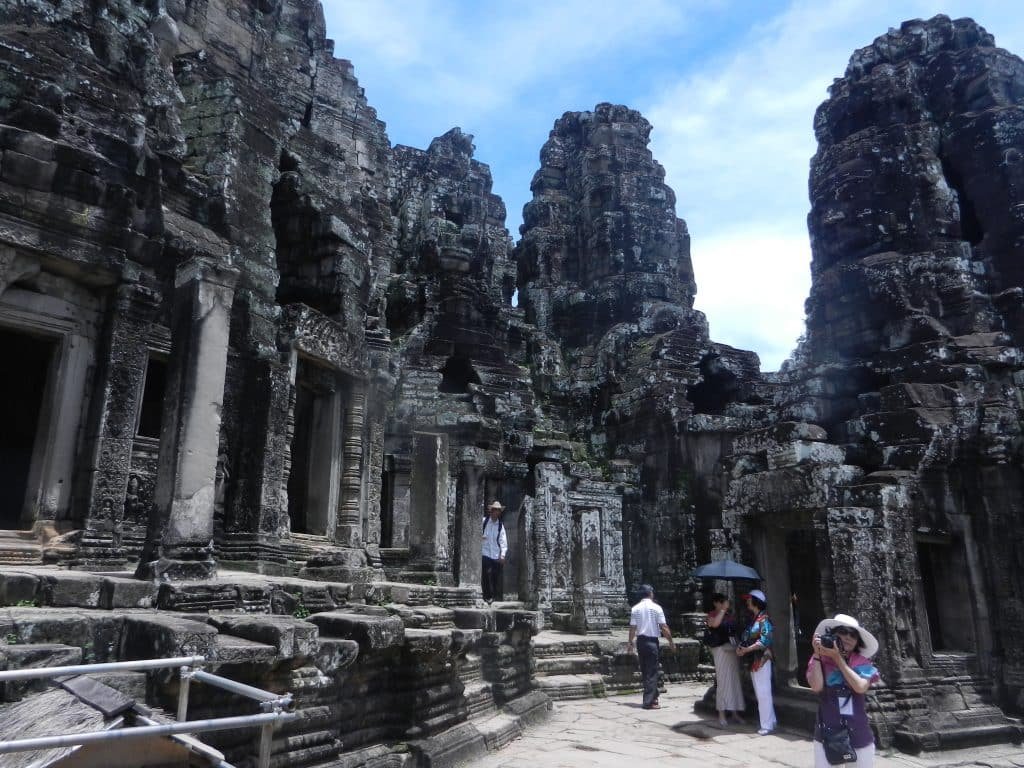
Though some guidebooks have said that the faces portray Jayavarman in the guise of Lokesvara, who represents the Buddha’s compassion, other interpretations have been proposed. One of the most interesting is detailed in a recent book, Bayon, New Perspectives. One of its contributors, Peter D. Sharrock, has seen Tantric influence in this temple. Tantric Buddhism fused the Mahayana tradition with Hindu ideas that saw creative sexual energy pervading the universe’s abundance of forms, and it flourished in northern India by the late first millennium CE. It emphasized yogic techniques for becoming conscious of the unity of all things and reaching enlightenment. According to Sharrock, the face towers depict, not the king, but a Tantric deity called Vajrasattva. The profusion of faces thus might represent him emanating throughout the universe so that his nature permeates every inch of it.
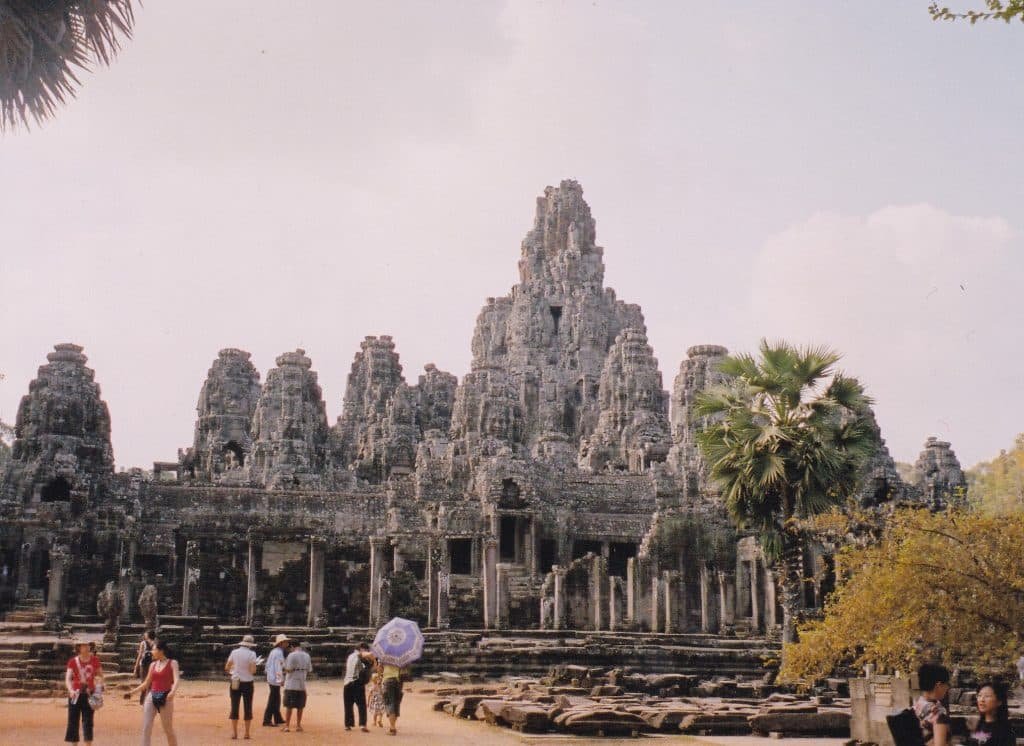
The Bayon’s wedding cake form might symbolize a spiritual universe before it condensed into solid matter.
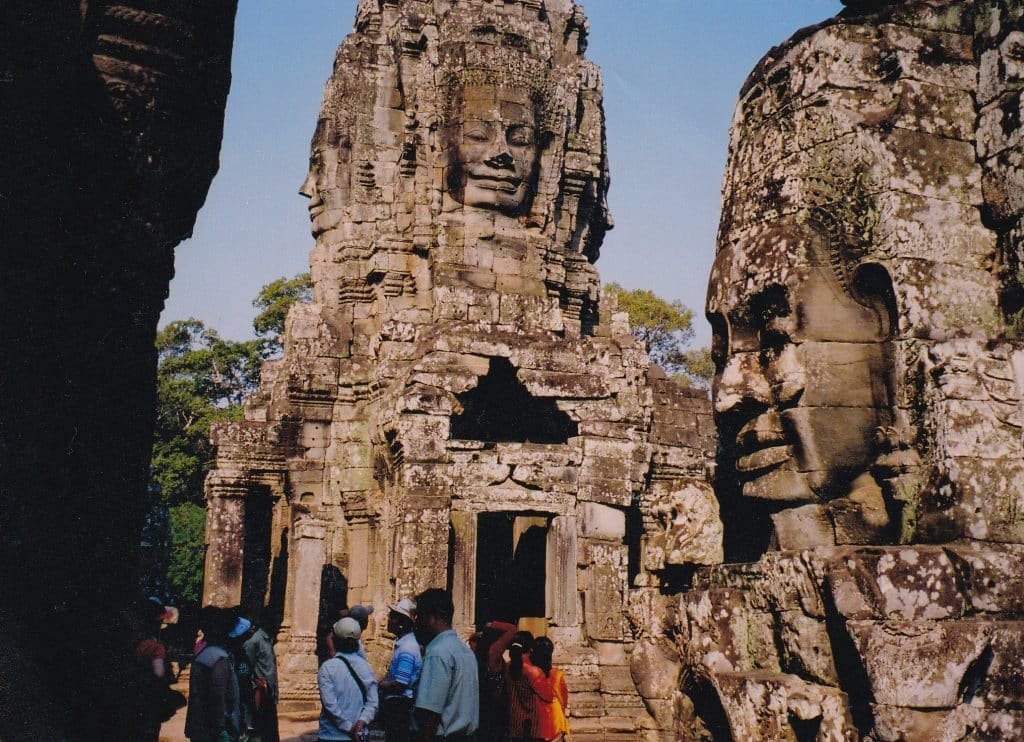
Sharrock argued that the faces on the towers don’t look like Lokesvara or Jayavarman VII.
The latter’s surviving portraits show a sturdy ex-military man with a bull neck and the paunch of a middle-aged king who had substituted banquets for battles.
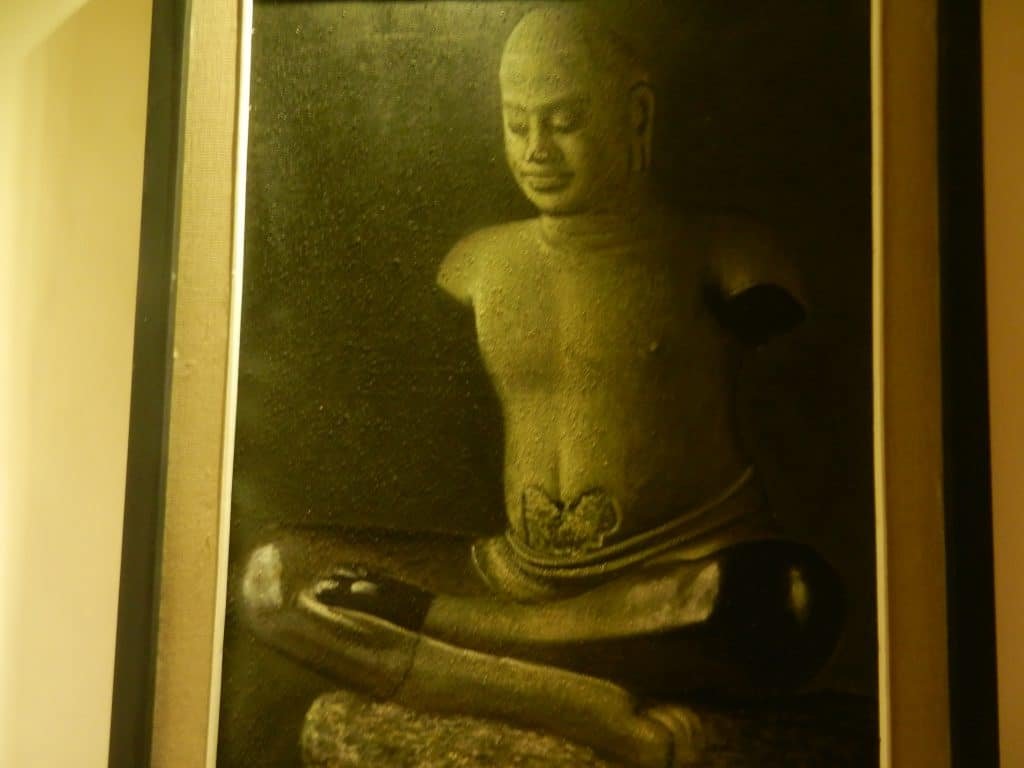
His cheeks are fleshy, but the ones on the Bayon are more elegant. Its faces seem more idealized, but Jayavarman’s made me imagine his wife teaching the old warrior about compassion with a few playful pinches. She’s pictured below; both paintings superbly reproduce sculptures of husband and wife. Her expression shows all the compassion that the Buddha does.
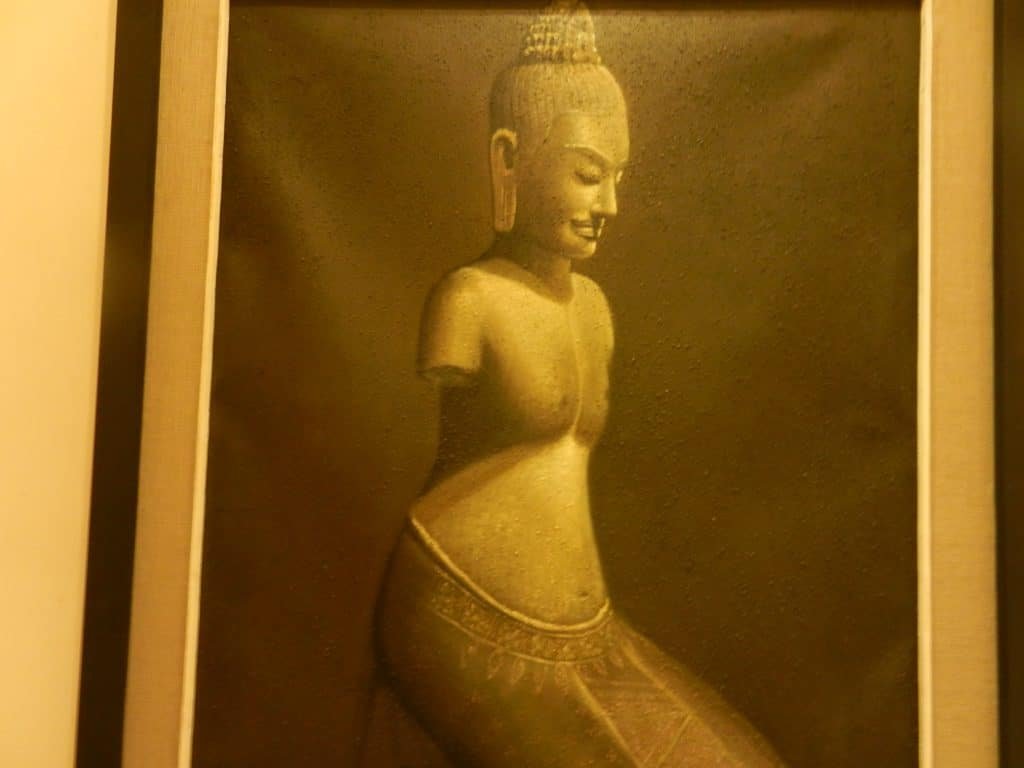
Many ascetics in northern India practiced Tantrism when Jayavarman took the throne, but in the 1190s, Islamic armies from Afghanistan swept through the land, ransacked Buddhist monasteries around the Ganges, and butchered many of their monks. Some who escaped fled to Southeast Asia and they might have influenced Cambodia’s king. Khmers were long used to synthesizing images and ideas from India with their own royal cults.
It is not even necessary to posit Tantric influences to see the Bayon as the Buddha permeating the universe. In the 1930s, Paul Mus said that it might embody a miracle he performed to convince skeptics that he could help liberate them from their karmic chains. He manifested himself in infinite images from all angles, and they rose to the highest heaven. Mus felt that the Bayon’s multitude of face towers reproduced this captivating mythic image in stone.
Other art historians see the Bayon as a Khmer map of the world, which combined local cults with ideas from India. The temple contains inscriptions that identify deities, prominent Khmers, cities, and provinces, and it used to house at least 117 statues (they were later stolen). The Bayon thus seems like a microcosm of the empire and the heavens. If the temple represents a shift to Tantric Buddhism, it synthesizes it with local ideas of geography, ancestral cults, royals, and Hindu gods. This is Southeast Asian syncretism at its finest.
I then approached the center of it all. A line of connecting rooms enters from the east and they lead to the middle chamber, which surround the central tower (below).
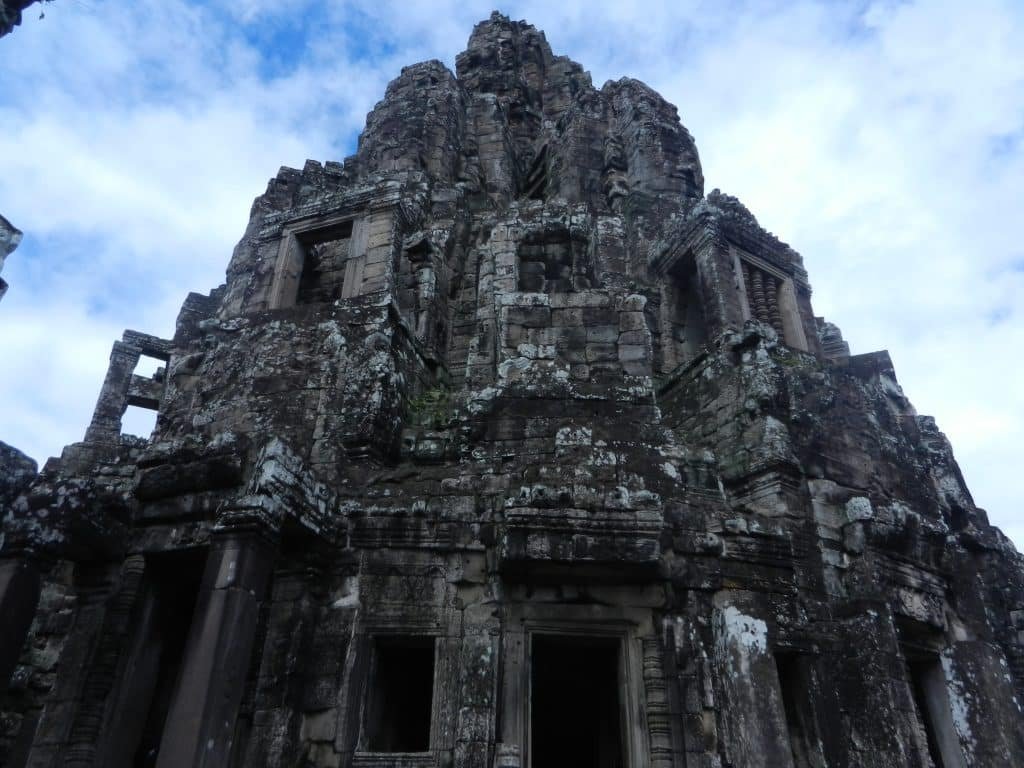
The room is circular and it once housed a 12-foot-tall statue of the Buddha until the Hindu reactionaries smashed it and threw it down a well. A narrow corridor wraps around this space, and two circles of 16 rooms project from its other side like lotus petals. Some historians have seen this configuration as a mandala, which is a circular diagram of the cosmos emerging from the center. These chambers thus might be the first forms of the universe’s emanation. It’s a pretty design, but the interior was dark and constricting, with stuffy air and bats darting overhead. A priest sat in the middle and took offerings from a few locals.
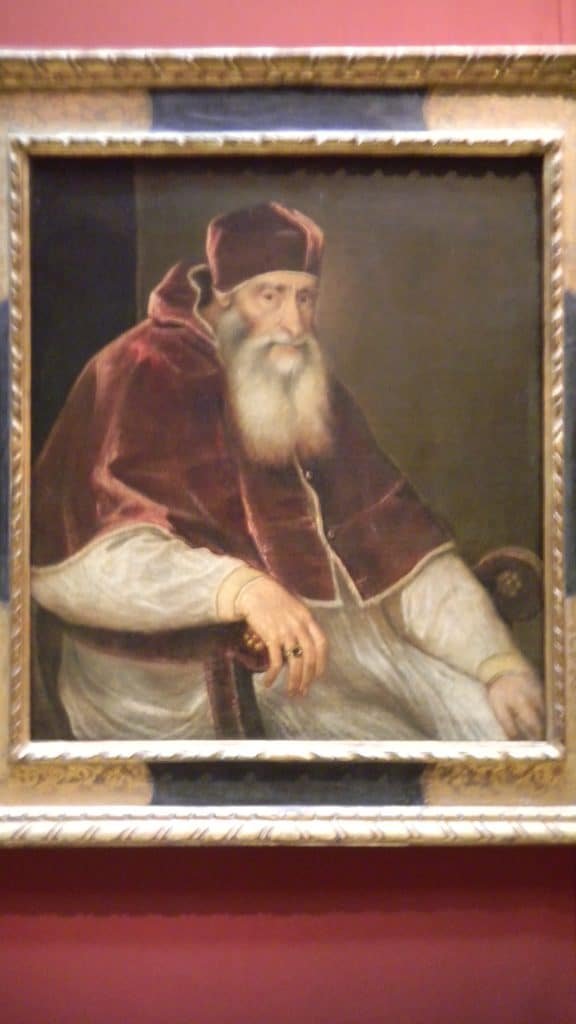
So my progression through the whole temple alternated between compassion and mysterious power. The carvings on the walls project both. Their style is named after the Bayon, and it’s folksier than Angkor Wat’s. Some fans of Khmer art say that its quality is lower than its predecessor’s, but the figures are easier to relate to. They look more like real people and express a wider range of emotions. But though the reliefs expand perspectives to commoners, they still focus on centralized power. The people are not differentiated from the temple. The carvings aren’t portraits by Titian or Rembrandt which meet your gaze with dignity as individuals who have deep inner lives (Titian’s Pope Paul III, shown below, looks world-weary and cynical; Titian’s portraits were so psychologically penetrating that they sometime revealed characteristics that their subjects probably wanted to hide).
Instead, the Bayon’s people merge into crowded scenes and alternate in images of marching soldiers, battles, and ordinary folks’ daily lives. Some warriors kneel and raise severed heads over themselves. In an image of a naval battle, a crocodile chomps on a human corpse. All the people seem like cogs in a larger scheme in which the universe’s energy and the king’s prestige are more important. No scene stands out from the others. All wrap around the temple as though the grand system is its main concept.
Jayavarman built the Bayon in a time of crisis. According to inscriptions from his reign, Cham armies sacked Angkor, and he took the throne by force and defeated them near the royal palace. Recent scholarship has questioned the sacking of the city, but it agrees that the Cham invaded the eastern part of the empire, and they might have conquered and ruled Angkor for a while. Being in the midst of invading armies and lacking a strong king, Khmers might have thought that the universe was in turmoil. Claude Jacques felt that Jayavarman VII’s power was fragile because his enemies were near. David Chandler saw his regime, with its manic building program, as an attempt to break with the past after he violently assumed leadership and drove the Chams out. Perhaps he projected his authority with so much construction because it was dicey to begin with.
The Bayon expressed both openness to new perspectives and a desire to assert centralized power as ardently as ever. It expanded horizons to common folks and Mahayana ideas, but used them to give cosmological backing to a new king after a turbulent time. Jayavarman seems to have deployed the full range of ideas that Khmers held to secure his kingdom in every possible way. Like Angkor Wat, it’s so intricate and multifaceted that it elicits several interpretations and all are awe-inspiring. It shows an expansive view of the whole universe, takes you into peoples’ lives, and reflects its era’s political tensions.
Indians were building equally fascinating temples at the same time.