In 1980 archeologists started to excavate a walled city about 40 km north of Chengdu, at a place called Sanxingdui. What they found revolutionized many people’s ideas of ancient China.
People had thought that the Shang Dynasty, which presided around the middle Yellow River, was the one great bastion of Chinese civilization around 1200 BCE. But the Sanxingdui site and excavations in other parts of China have greatly expanded people’s views of ancient China. Robert Bagley concluded that China at that time was larger, more diverse, and more interconnected than historians had realized.
The Sanxingdui site was a city surrounded by a wall 1.6 to 2 km from east to west, and 2 km from north to south (shown above). It was a rammed earth (hangtu) wall–a pan-Chinese construction method with deep cultural roots. This city was as big as the largest Shang urban settlements. The Sanxingdui culture was no provincial outpost. It was the political center of the Chengdu plain, which has been an agriculturally fertile region in southwestern China.
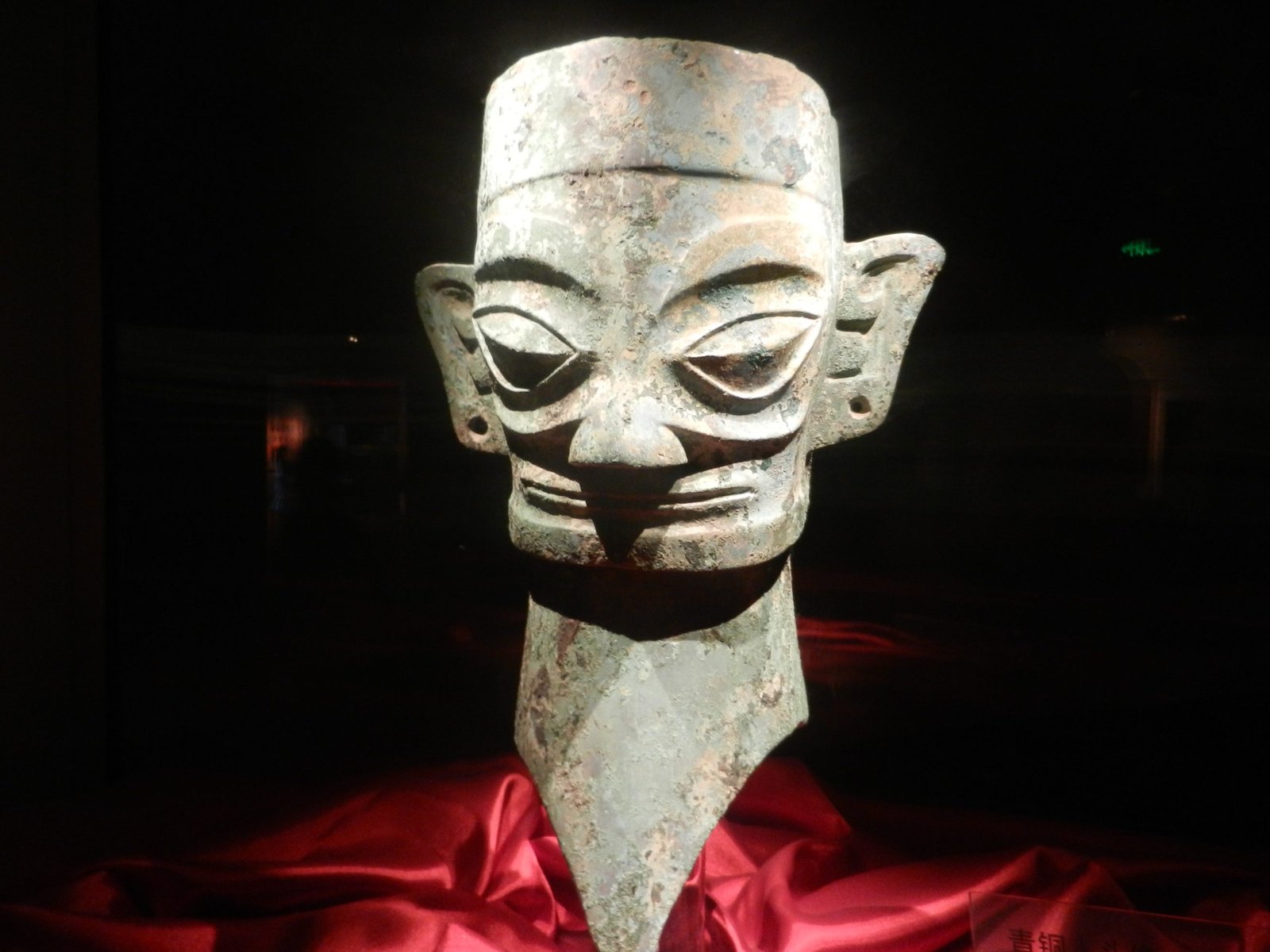
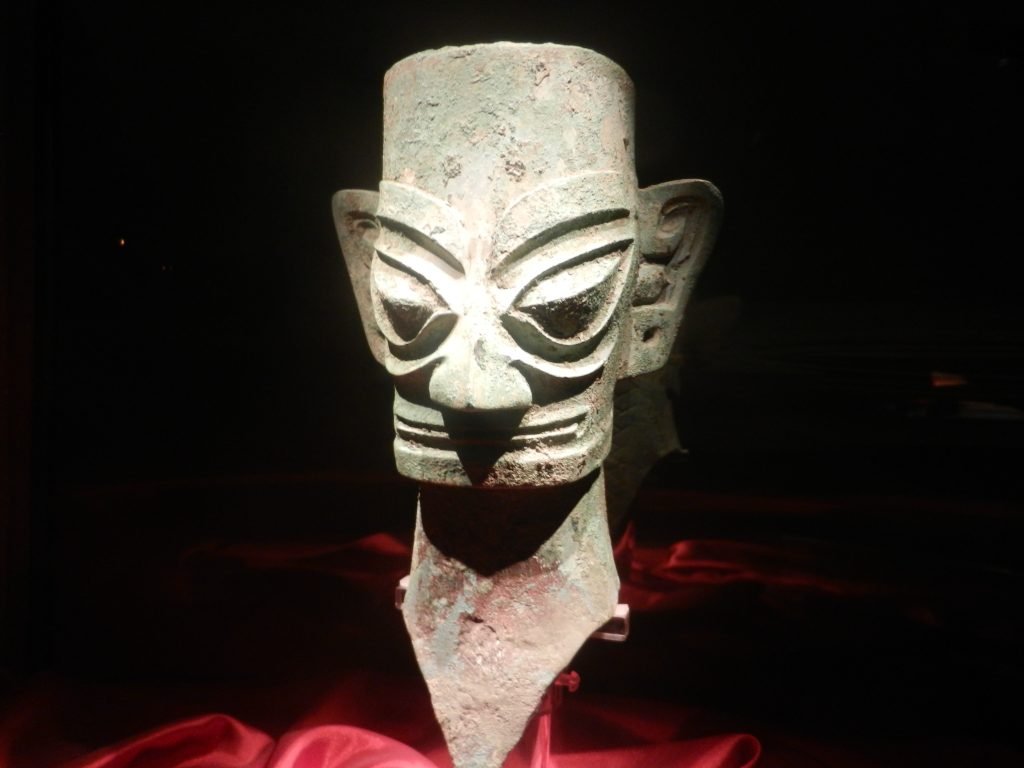
And the Sanxingdui culture had its own values. One of the most startling facets of the site is the number of bronzes with humanized faces.

The Shang Dynasty didn’t leave many images of people. Its artists were more interested in animals, fanciful creatures, and intricate geometric patterns. And most Shang bronzes were ritual vessels. But the Sanxingdui culture fashioned many statues and masks with engaging faces.

What did they use them for? Were they tomb guards, like the terra-cotta army near Xi’an, which Qin Shihuang created about 1,000 years later?
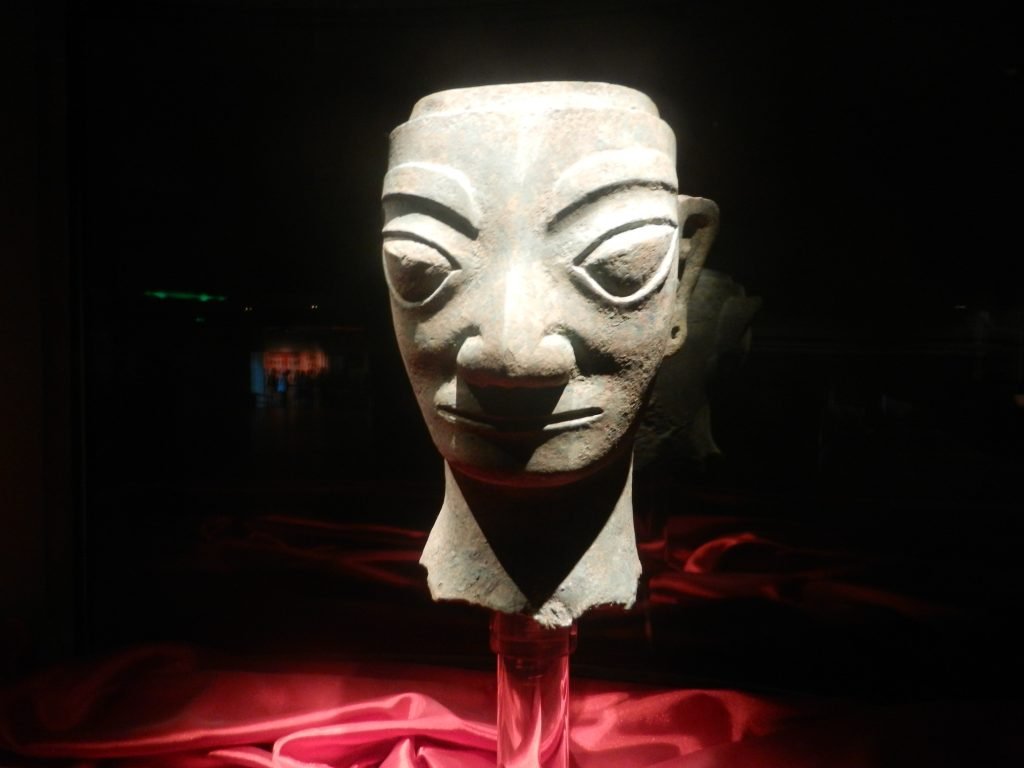
Enormous eyes and ears are two of the most common features of these figures, and the eyes of the mask pictured below protrude like rays. But several bronze’s faces were covered in gold. One wears a crown or garland around his head. So some of the figures seem too aristocratic to be guards. And many are smiling–you don’t expect guards to have a good time while on the job.

Were they supposed to be gods or shamans helping a departed ruler’s spirit rise to Heaven? Or were they stylized portraits of elites? Ancient Nigerian cultures like the Nok and the Yoruba made large bronze sculptures of elites, with some features exaggerated to project their dignity. But human remains have not been found where the bronzes were buried.
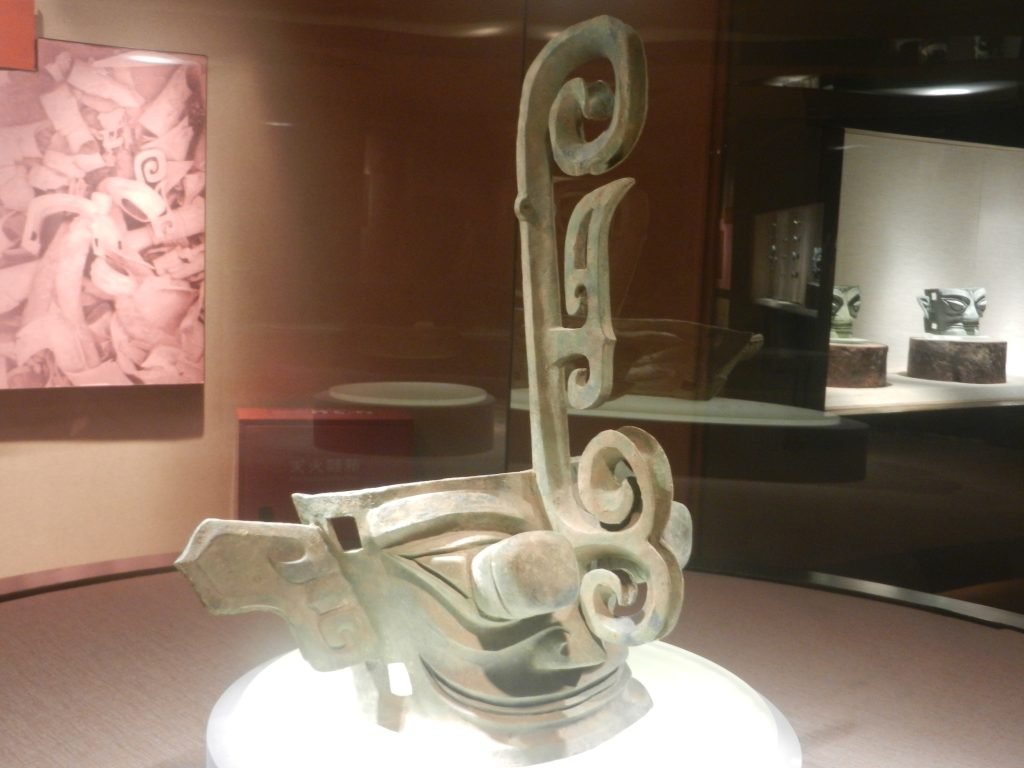
Theories abound, but nobody really knows what the Sanxingdui bronzes were for. Writing wasn’t used in Sichuan until the third century BCE. But the Sanxingdui figures project confidence and power that are more stately than menacing.
The Sanxingdui culture also made large bronze trees. Their branches are full of birds, fruit, petals, and pendants.
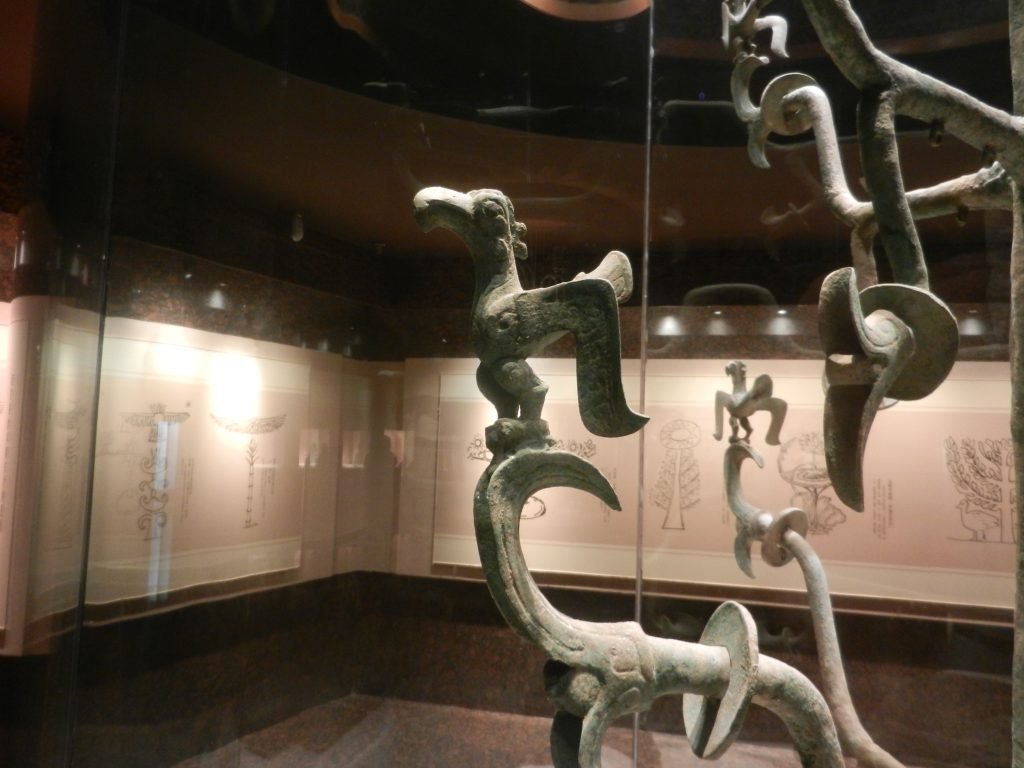
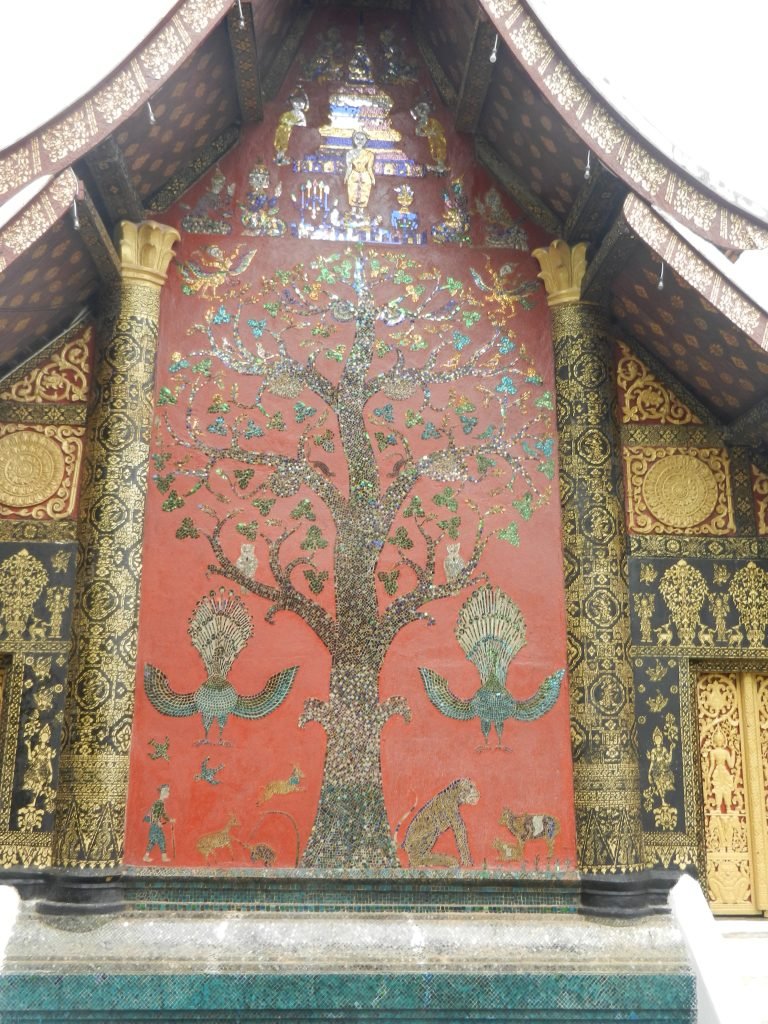
People in several cultures in Southeast Asia have imagined the universe as a giant tree from which nature’s abundance comes.
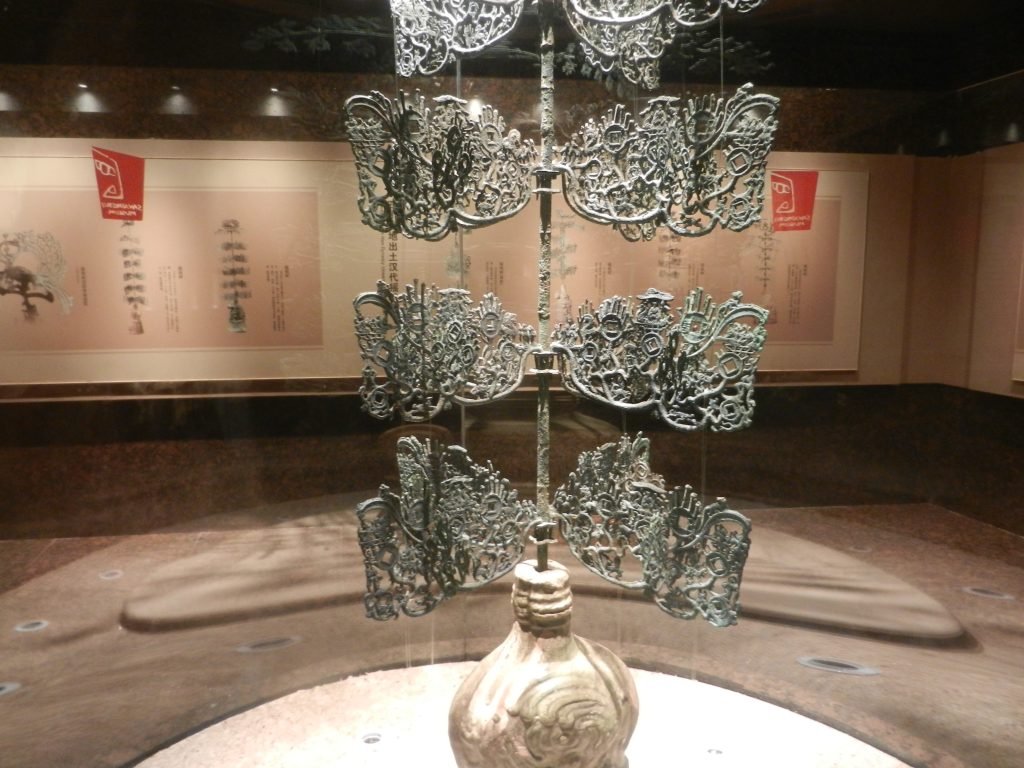
The top of the tree in the above photo is shown below.

A mural of the cosmic tree graces the most honored temple in Laos (below). The Buddha preside above it. But though he said that people shouldn’t form attachments to the world, the tree takes up much more space, expressing joy in nature’s bounty.
Some vessels that they Sanxingdui culture made were found filled with cowry shells. Several historians have felt that this suggests a religious system that was different from the Shang’s. Gideon Shelach-Lavi thinks that it might have been shared with various polities in the south, in the upper and middle Yangtse basin.
The Sanxingdui culture grew from the local Baodun culture of the third millennium BCE. It adapted bronze-making technology from the Shang and used it to express values that were well established in its own region.
China around 1200 BCE consisted of many societies which traded technologies and ideas. They had common features, including hangtu walls and palaces and the use of large bronzes to express political centralization. But different cultures created their own patterns. Archeologists are still discovering how rich and complex ancient China was. Watch this field with eyes as big as the Sanxingdui statues’.