
This applicant for a job in the terra-cotta army was turned down. He now works as a writer.
The terra-cotta warriors get lots of media attention, but they only compose a small part of the tomb for the first king of a unified China. Since I failed to become a guard, I’ll switch roles and take you into the Qin emperor’s world.
But we first need to go farther back in time. China was already ancient when Qin Shihuang ruled (221-210 BCE), and he and his ministers synthesized a lot of earlier ideas. The Late Shang Dynasty (1200-mid-11th century BCE) already had a well-developed cult of the dead king. Some of its political leaders dug huge cruciform pits up to 42 feet deep, filled them with treasures, garnished them with blood of human sacrificial victims, and worshiped their kings as the state’s ancestors according to a precise ritual schedule.
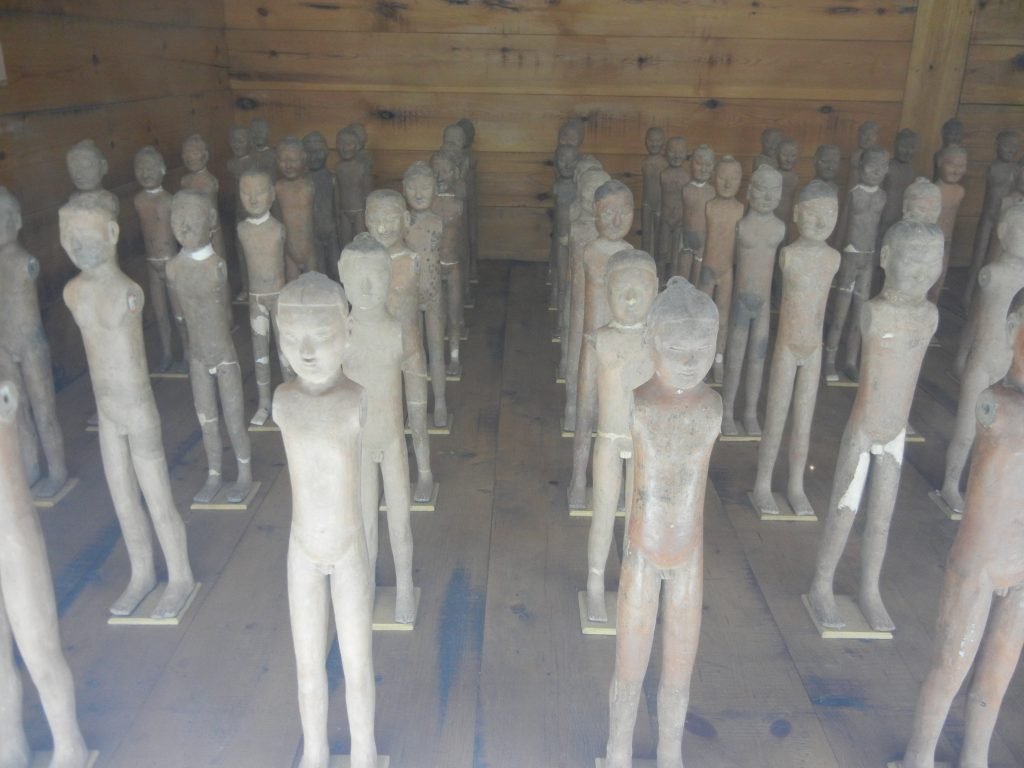
Continuity between the living and dead has always been a key feature of Chinese society, but a major change was occurring around 500 BCE. The photo below is of a group of servants at the tomb of the early Han Dynasty emperor Jing, who reigned from 157 to 141 BCE.
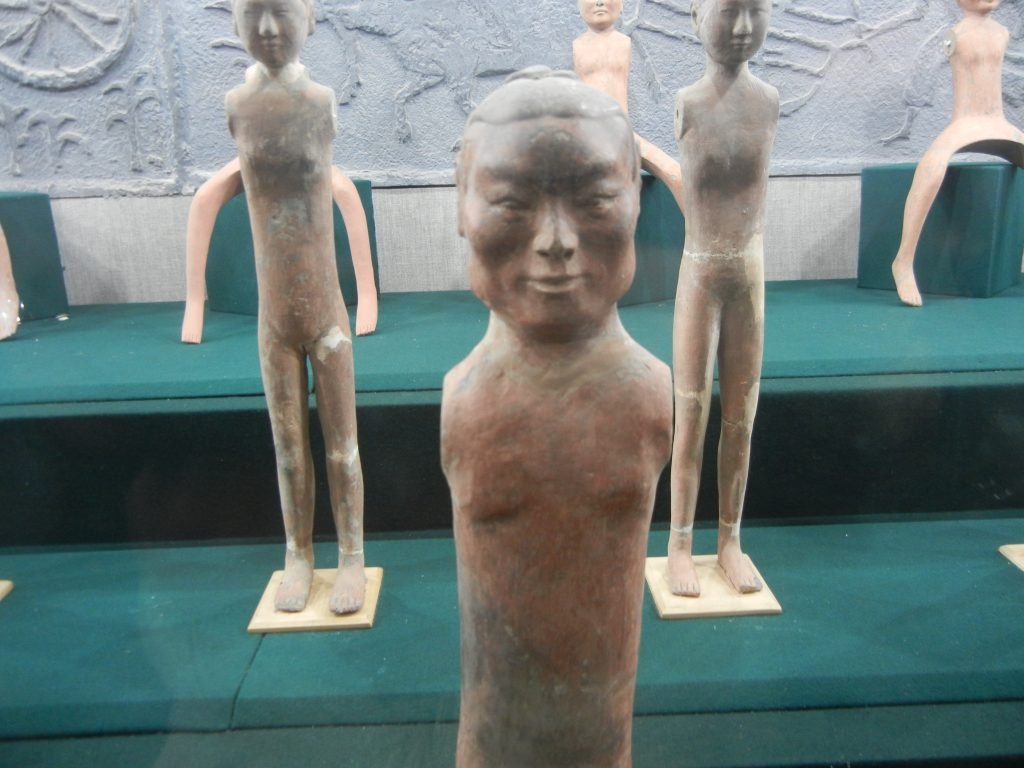
This fellow seems quite happy with his job.
Jessica Rawson noted that Shang rulers didn’t put many objects from daily life in their tombs. They included bronze vessels so the dead could be supplied with food and drink, but not much that suggested that they enjoyed themselves or had existences as individuals. They only received offerings and perhaps gave offerings to their own ancestors.
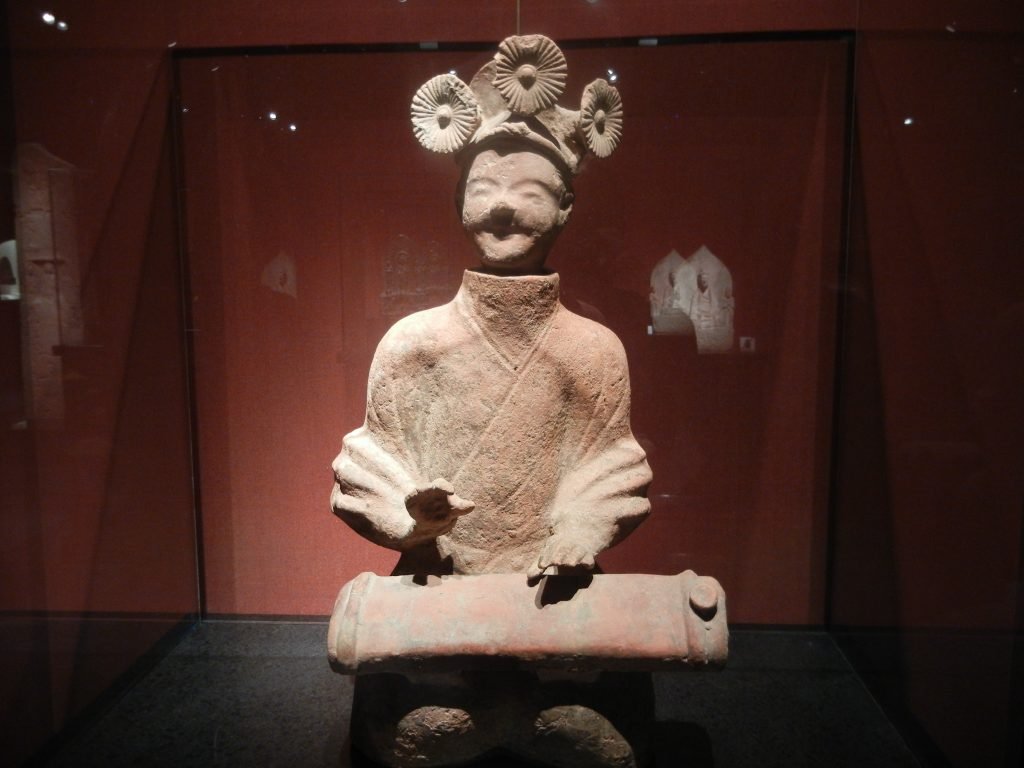
But in the mid-first millennium BCE, people began to partition tombs into rooms as though they were models of homes. More folks supplied their tombs with tableware, clothes, and musical instruments. By the third century BCE, elites made many models of servants dutifully standing or kneeling, awaiting orders. The zither player above is from the Han Dynasty.
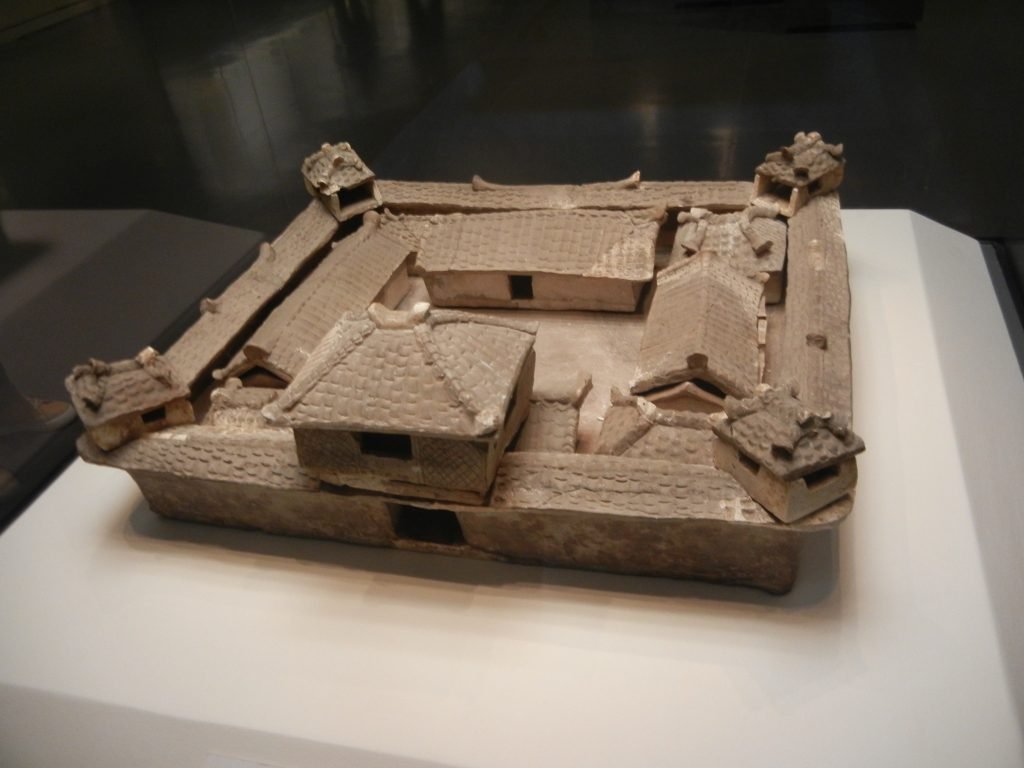
People also created models of homes and included them in their tombs.
So tomb burials increasingly resembled the good-living that political leaders enjoyed in the world. Rawson thinks this change might have been due to the break-up of the Western Zhou Dynasty in 771 BCE. People couldn’t take centralized rule for granted, and they began to see themselves as more distinct from the whole social social hierarchy. Other historians have seen the increasing self consciousness as a product of an increase of literacy. Poems from the Book of Odes reflected on personal experiences by 600 BCE.
Qin Shihuang built the greatest tomb in the third century BCE. The historian Gideon Shelach-Lavi says that it was probably the largest burial complex of a single ruler ever constructed anywhere in the world. Qin Shihuang brought together beliefs and practices from many regions in the vast land which he conquered and took tomb construction to a climax. The terra-cotta army only guarded it.
Let’s get inside this guy’s head.
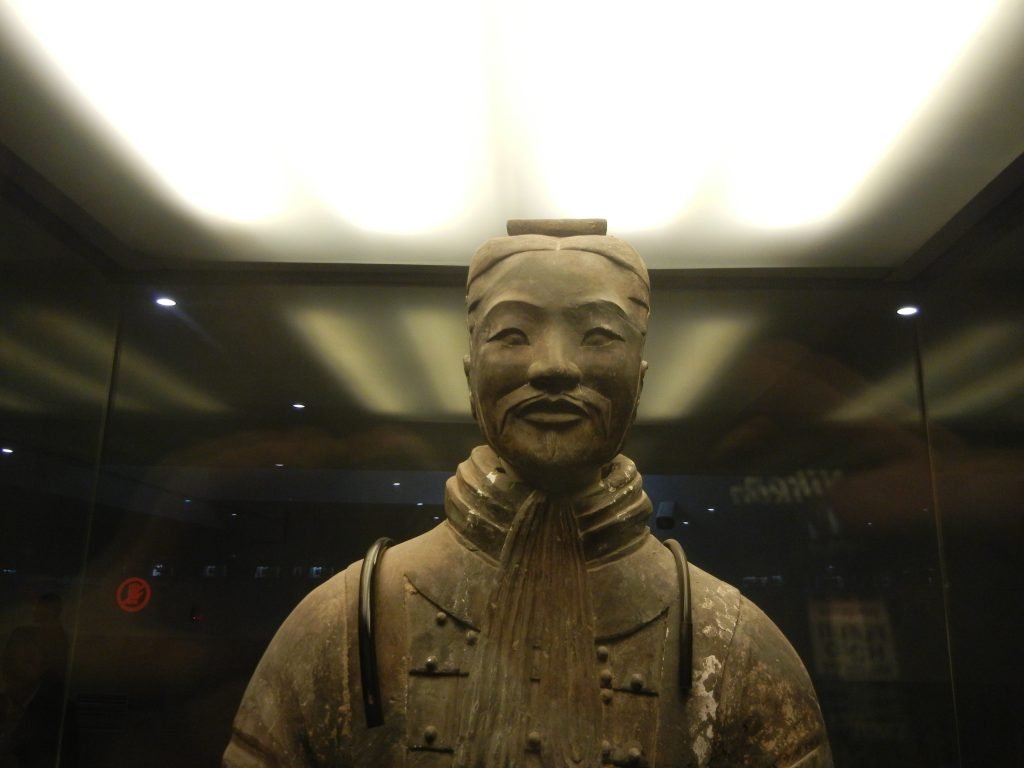
Before he conquered China, Qin Shihuang ruled a kingdom in the west called Qin, which China gets its name from. A minister called Shang Yang centered the state on the army in the years just after 359 BCE. Infantries had already been growing over the previous two centuries. They were becoming more important on the battlefield than the old chariot-based nobility.
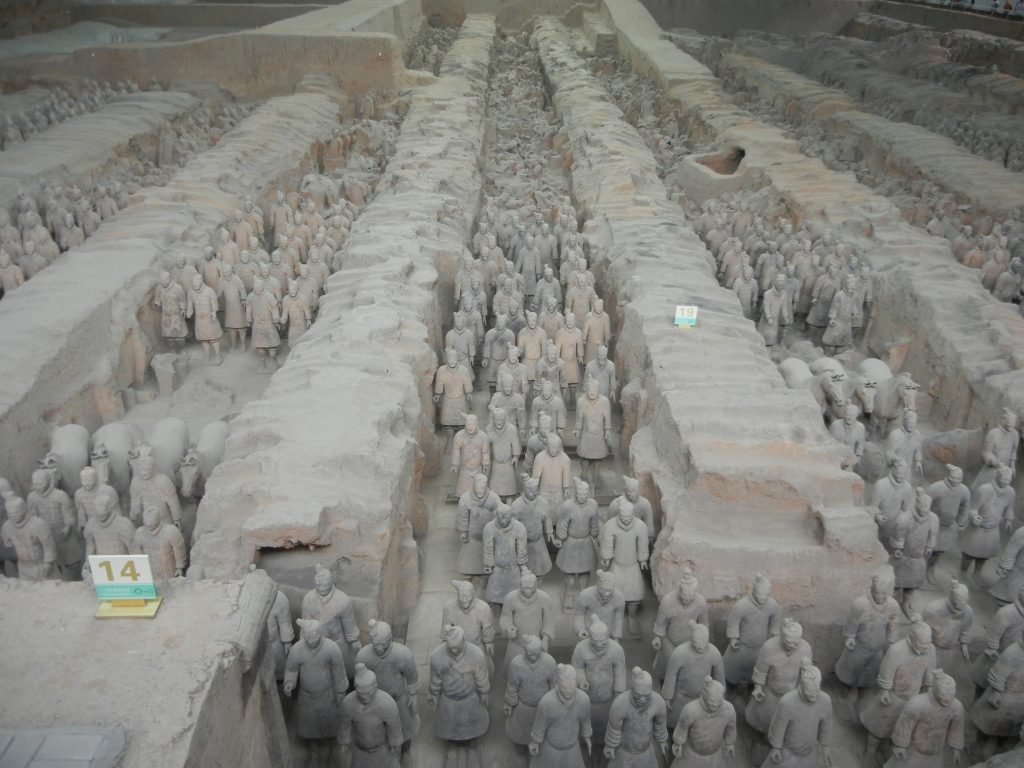
So groups of thousands of foot soldiers became common sights. Shang Yang took these changes to extremes by making universal military service, with a system of ranks, a key foundation of the state’s administration. And he organized the Qin state into a grid of military districts.
Shang Yang could radically organize Qin because it was in the far west and thus outside the mainstream. Its land was also poorer. So Shang Yang and his king didn’t have to deal with a powerful class of aristocrats fighting for their vested interests.
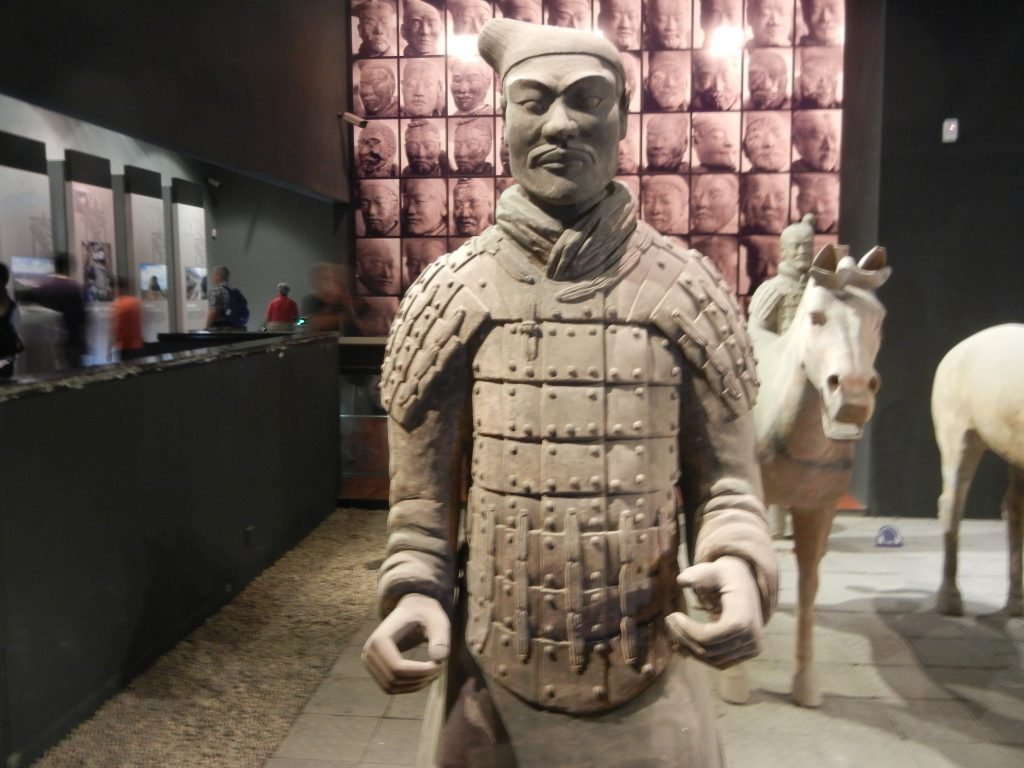
Several technological changes also helped make the standing army a major part of society:
1. The invention of the crossbow
2. The increasing use of iron weapons
3. The development of armor composed of leather plates sewn or lacquered together
So folks like the ones in the above pictures of some of Qin Shihuang’s army represented order by the time he created his afterlife trophy home.
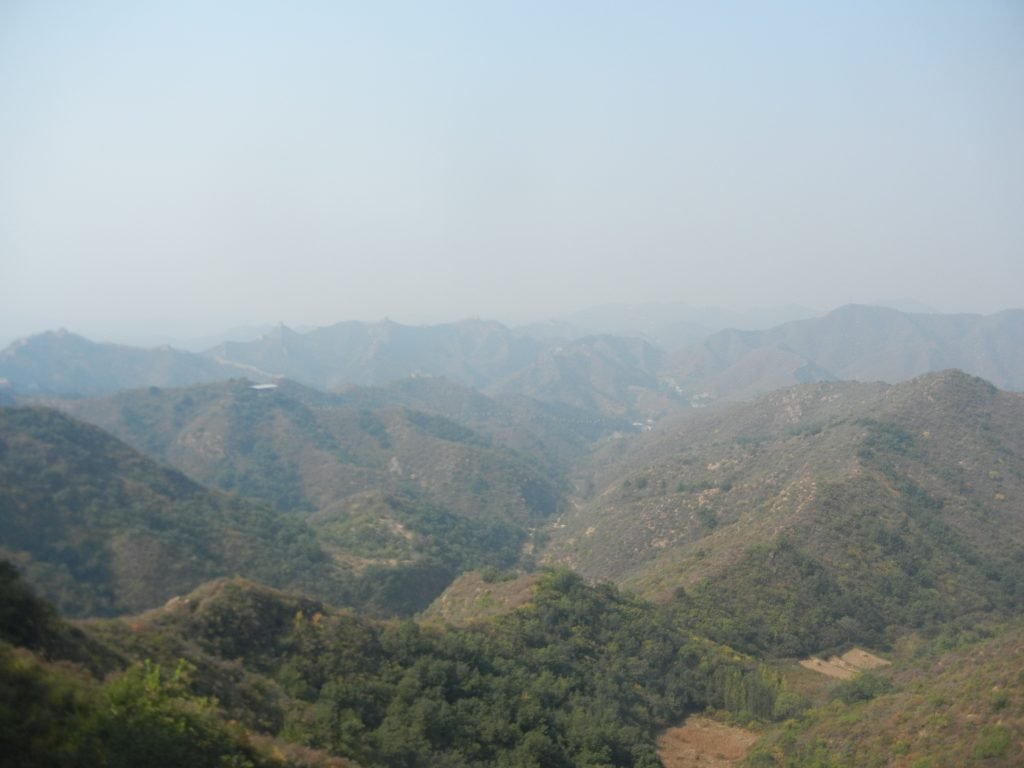
Intellectual currents reinforced Qin’s focus on the military. The state adopted Legalism. This school of philosophy emphasized an orderly kingdom run by an impersonal system of laws. The emperor presides over it, unseen but seeing all. The people are to live simply. Farm or fight, but avoid everything wasteful, including many things that are fun, like music, ostentatious rites, succulent food, and fine wine.
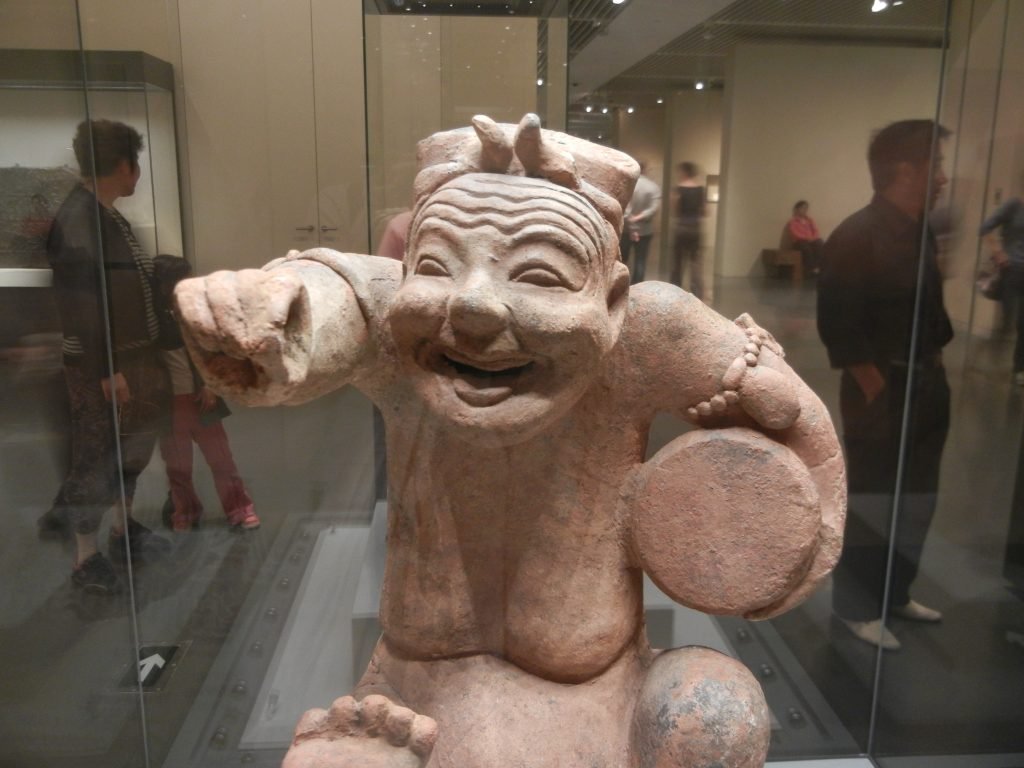
The Han Dynasty, which followed the Qin, gave it a bad rap as excessively ambitious and brutal and lacking Confucian values. Some wealthy Han people put figures like the above guy in their tombs. Entertainers who drummed and told lively stories were popular. Fun returned, and folks hoped to continue it in the afterlife.
But as the picture above the ancient Chinese Keith Moon shows, China is a huge land that’s full of rugged territory. And many states were competing for dominance during the Qin state’s rise. Unifying the country required a political center with a will and heart that were much harder than this drummer’s flab.
So the more-than 7,000 terra-cotta warriors in Qin Shihuang’s tomb resonated in his world. Several events in the previous 300 years converged with the political and intellectual landscape of his time to create these soldiers and officers.
But what you see below is only a small part of the terra-cotta army’s world.
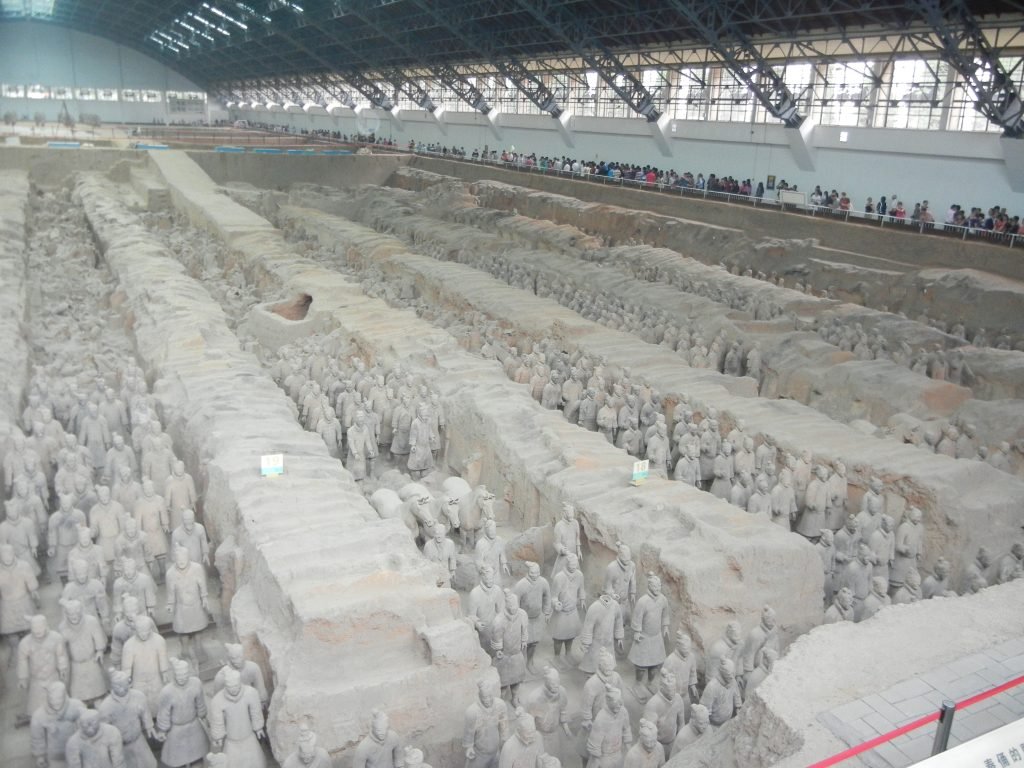
Qin Shihuang planned to take much more into the afterlife, and the 7,000-plus soldiers, archers, cavalrymen, and officers that he commissioned aren’t even in the major part of his tomb. What in the world were they guarding?
The central part of Qin Shihuang’s burial complex was a funerary park that two rectangular walls enclosed. The outer measured 2,165 meters north to south and 940 meters east to west. A pyramid-shaped mound is in the southern half.
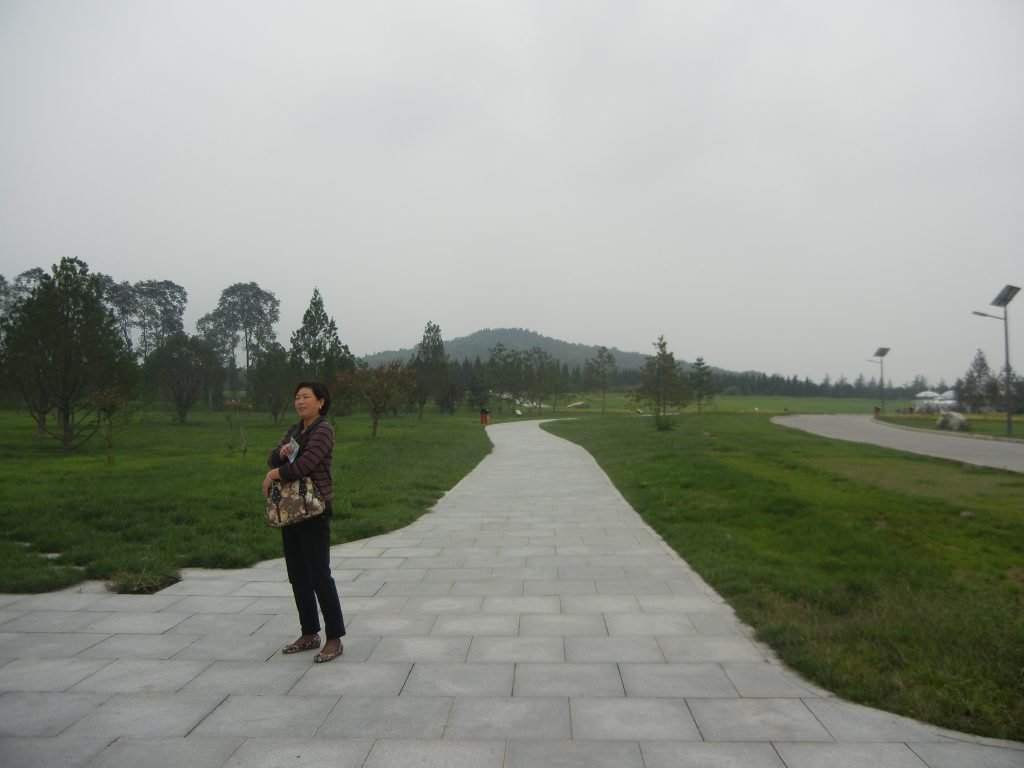
It’s about 165 feet high now, and it was probably about twice as tall back in the day. The terra-cotta warriors are east of the mound (near where I stood while taking the above picture). Qin Shihuang’s tomb is under the mountain, and it has yet to be opened. But Sima Qian, who wrote a monumental history of the known world under the Han emperor Wudi (r. 141-87 BCE), gave a dazzling description.
Qin Shihuang began building the mound as soon as he took the Qin throne in 246 BCE. When he unified China in 221 BCE, he transported 700,000 men from all over the empire to work on his tomb. They fashioned replicas of palaces, observation towers, and daily utensils. They used mercury to make imitations of the major rivers and the ocean. They also represented all the known heavenly bodies. They used “man-fish” oil for lamps, which would burn for a long time without extinguishing. All Janis Joplin asked the Lord for was a Mercedes Benz, but Qin Shihuang wanted nothing less than the whole universe.

A large complex of buildings stood north of the mound, and they have been identified as sacrificial halls in which people placed ritual offerings to the king’s spirit. A walled area in the northeast corner of the central enclosure has rows of tombs. Wu Hung, in Chinese Sculpture (in the Yale series on Chinese art) thinks they were probably sonless consorts who were forced to accompany Qin Shihuang in the afterlife.
The man in the above shot is a civil official with an expression that’s both proud and gentle–an ideal person for running the governmental machinery. He and several similar figures were found in a burial pit to the immediate southwest of the tomb’s mound.
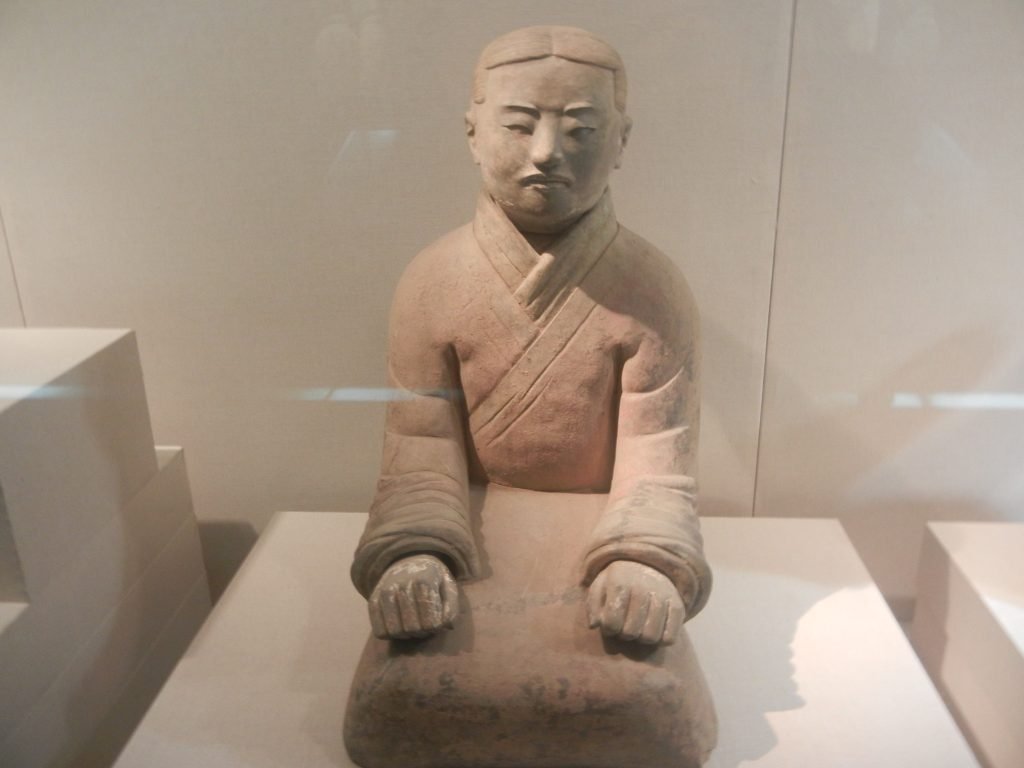
Pits were found to the east and west of the mound, and the attendant in the above photo awaiting orders is from one of them. Another pit contained acrobats.
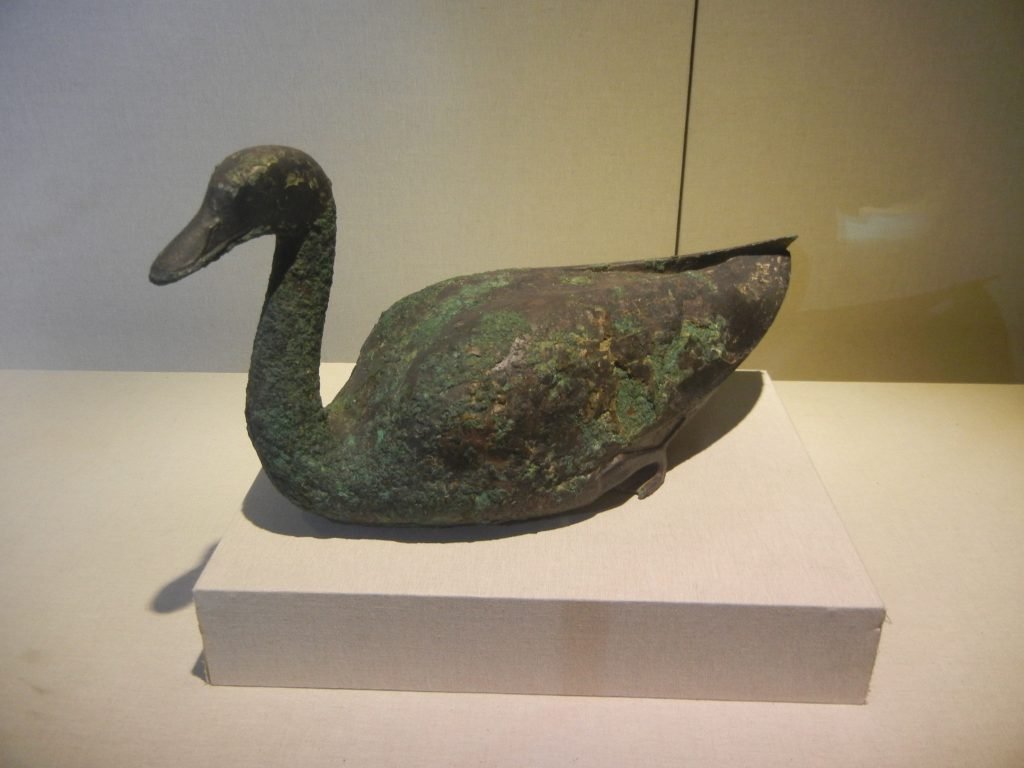
Another had figures of animals and birds, including the goose in the above shot. This underground zoo was managed by ceramic zookeepers.
Most pits aren’t mere trenches, but real underground buildings with paved floors, pounded earth walls, and wooden ceilings.
There’s the saying, You can’t take it with you, but Qin Shihuang tried to take the whole universe with him. Egyptian kings built pyramids which they thought would transform their bodies into a more spiritual existence, but none devoted so many resources to replicating the whole world around the pyramid.
Qin Shihuang is a complex figure in Chinese history. He’s been detested for his cruelty and admired for being the first king to organize all of China into a state. We’ll discover that he built much more than his tomb in the next article.