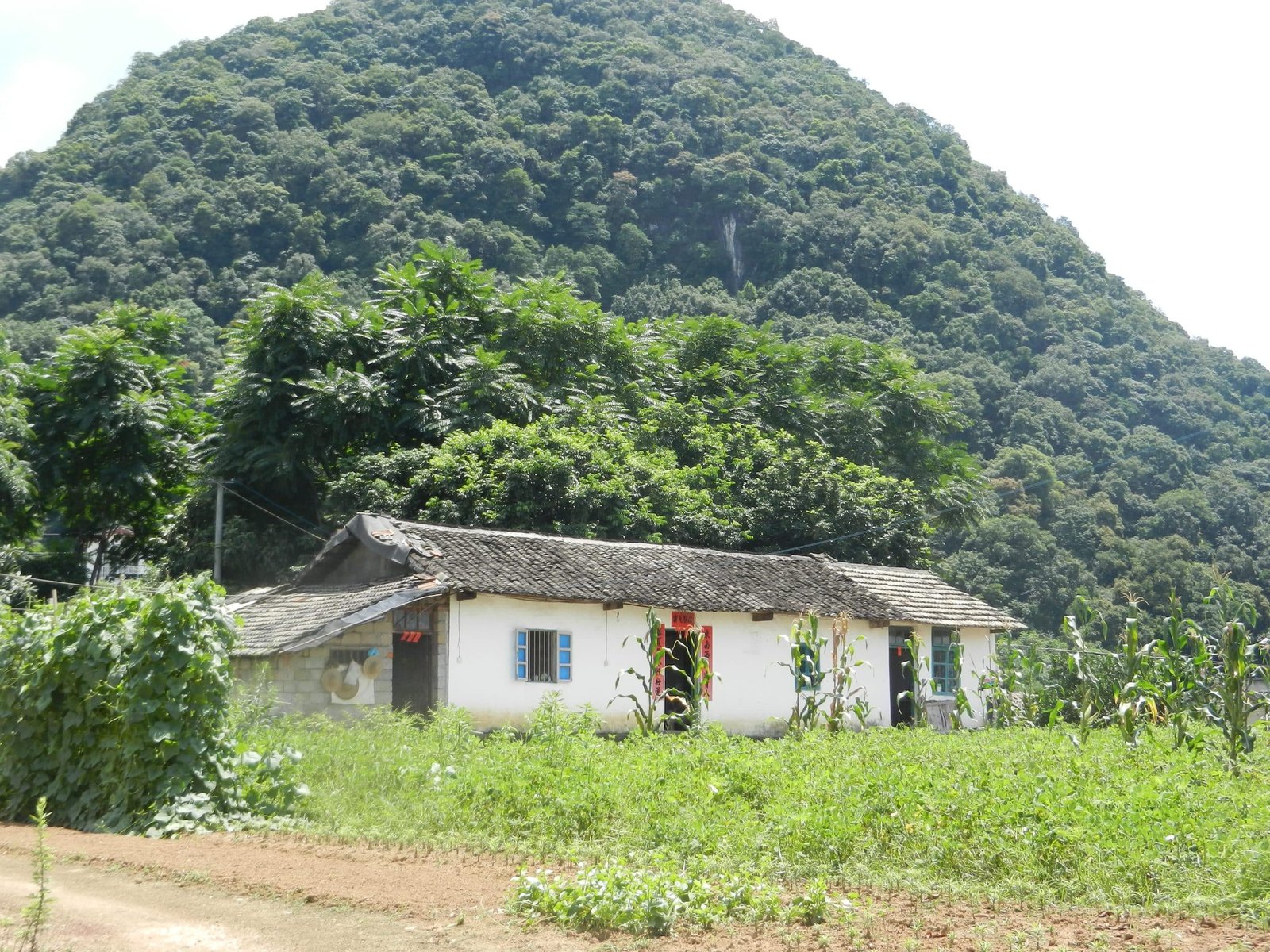
Agricultural ways of life, which China’s Confucian tradition has honored, became common along the great rivers during the Yangshao period around 5000 BCE–4,500 years before Confucius taught. So we’ll travel way, way back and see how Chinese culture originated.
The first scientifically excavated Neolithic site in China was discovered at the village of Yangshao in Henan Province in 1921. The term Yangshao first referred to Neolithic cultures in central China. It was then generalized to sites all over China that thrived from 5000 to 3000 BCE.
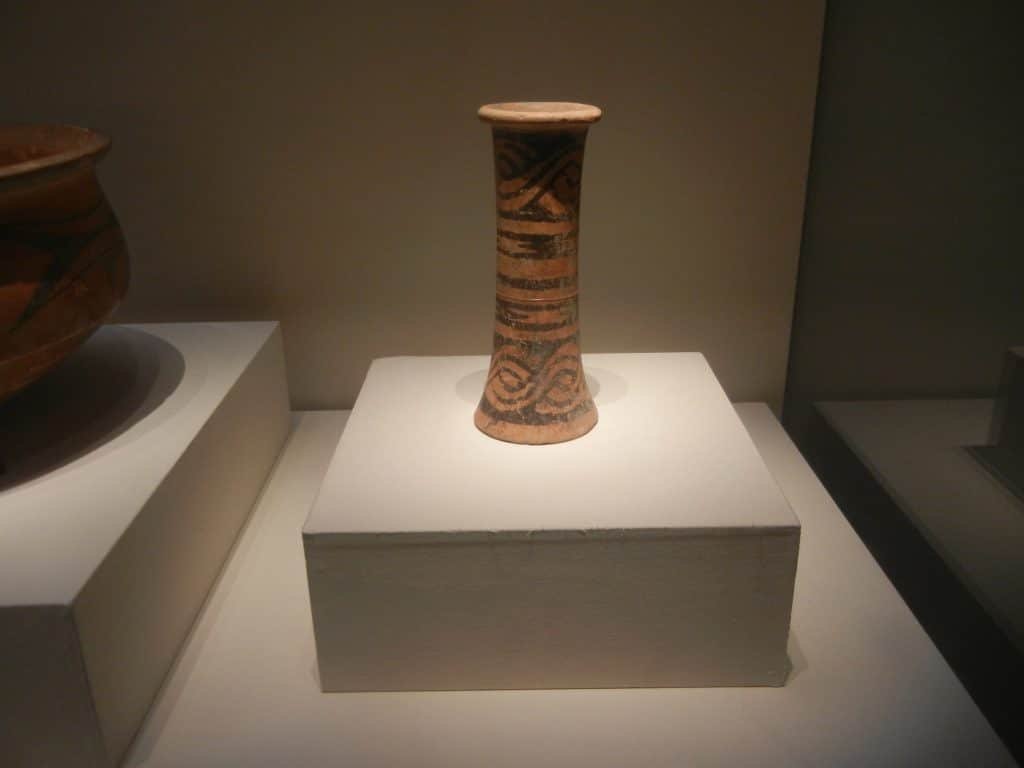
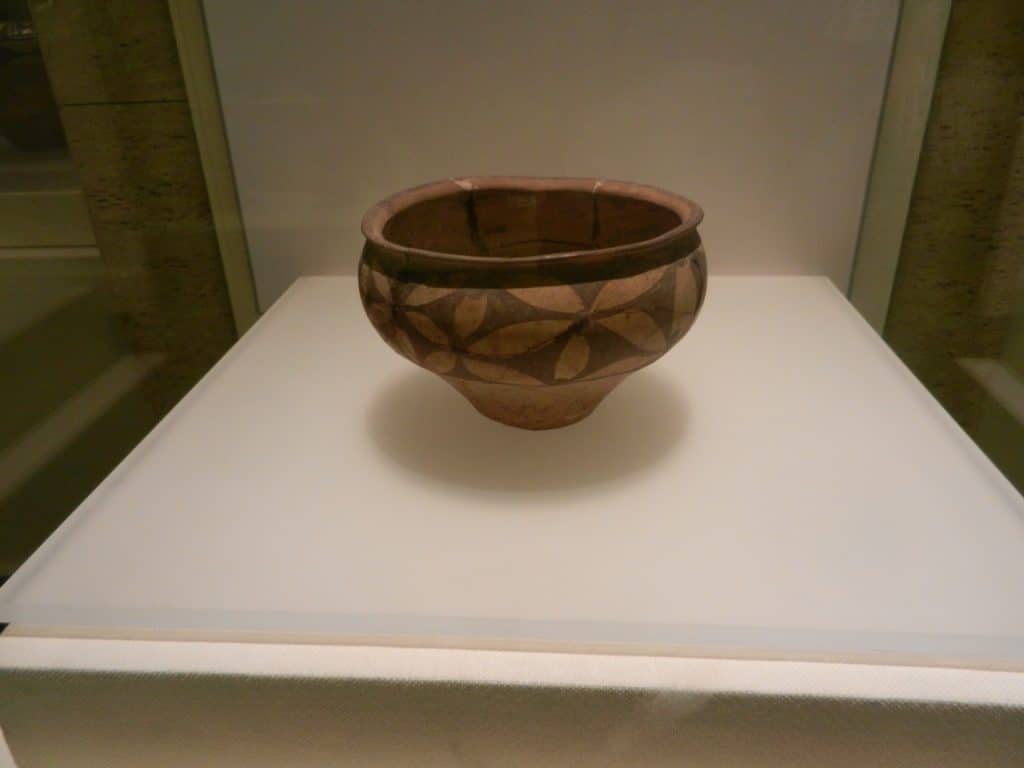
The above vase is from the Daxi culture, which existed in Sichuan around 5000 BCE.
The Yellow River valley became the center of millet growing, and people along the middle and lower Yangtze farmed rice. Farming became the main way of making a living in many villages along the two great rivers and the Liao River in the northeast (in Manchuria).
Zhang Zhongpei, in The Formation of Chinese Civilization, wrote that trade between the Yellow and Yangtze rivers became common during the Yangshao period. New developments in technology and culture could thus spread, and there were many new developments.
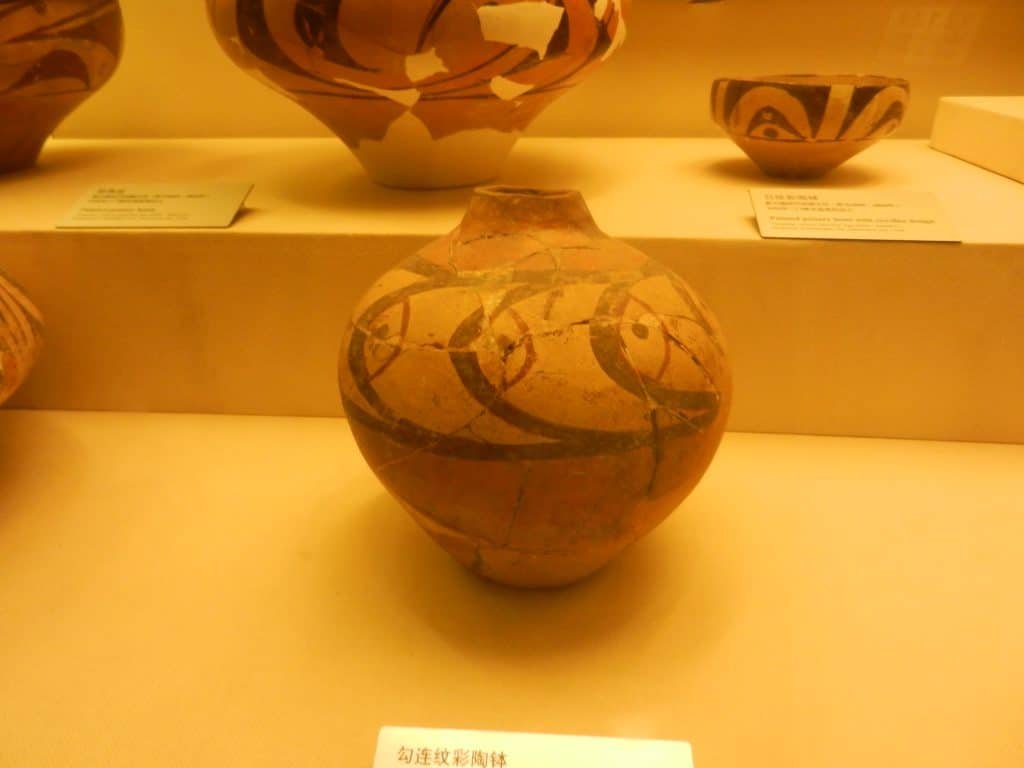
Yangshao ceramics are known for red vessels with black designs painted on them. Many, like the above vase, have abstract curves that convey a sense of flowing energy.
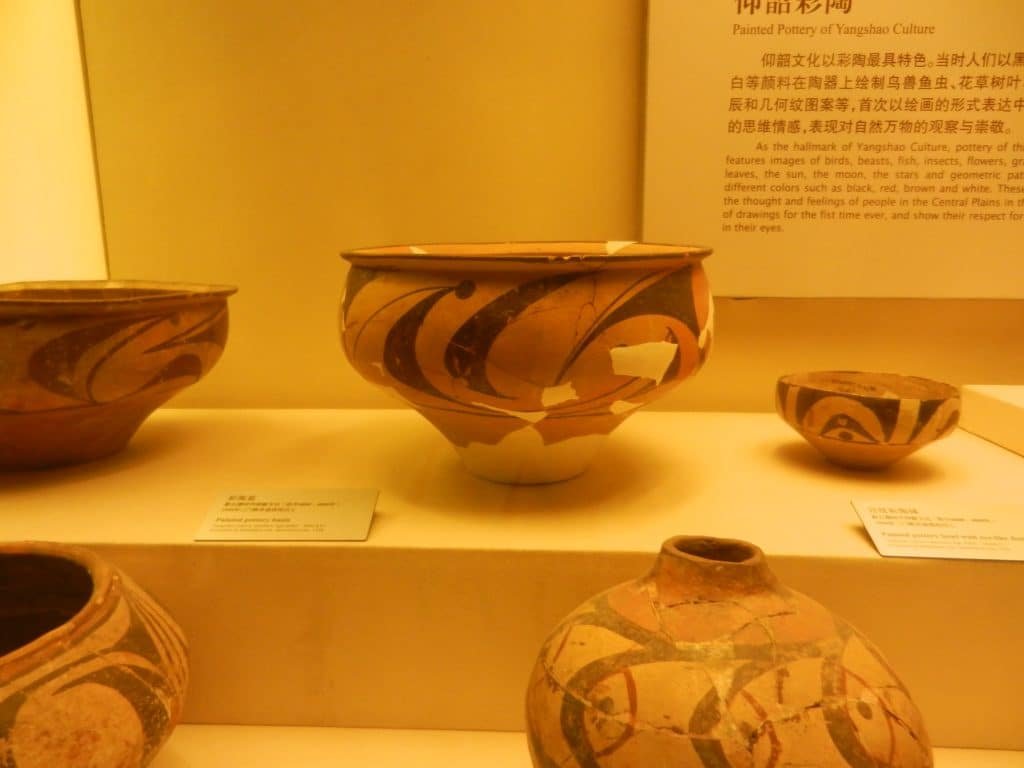
These vases make the eye move around the vessel, and some gracefully transition between thick and thin dark and light surfaces as though they’re proto Yin/Yang patterns.
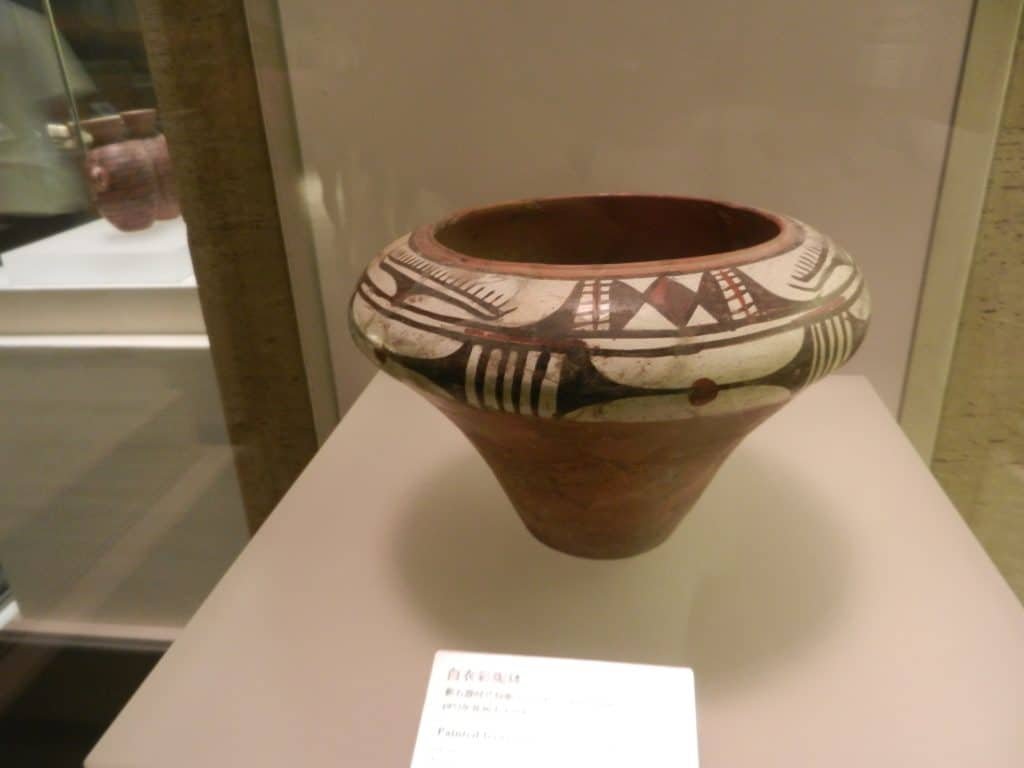
Were Yangshao potters already thinking in terms of holistic energy flows?
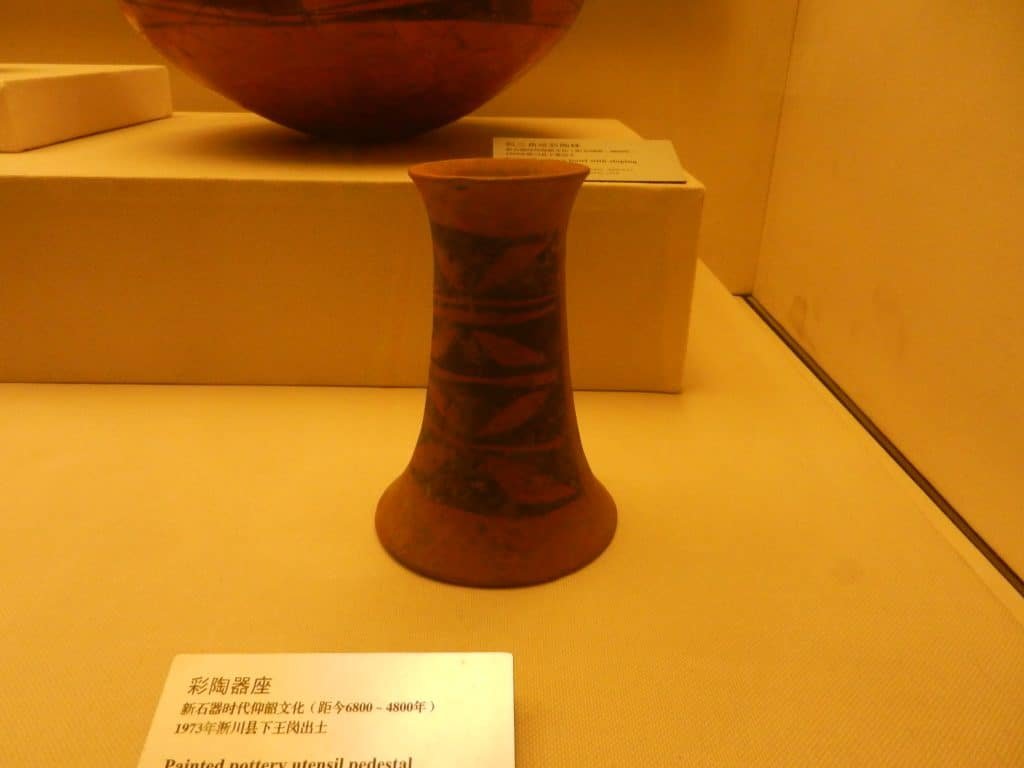
This was long before writing emerged, so this is only a maybe. Whatever the painters thought, their designs finely balance power and elegance.
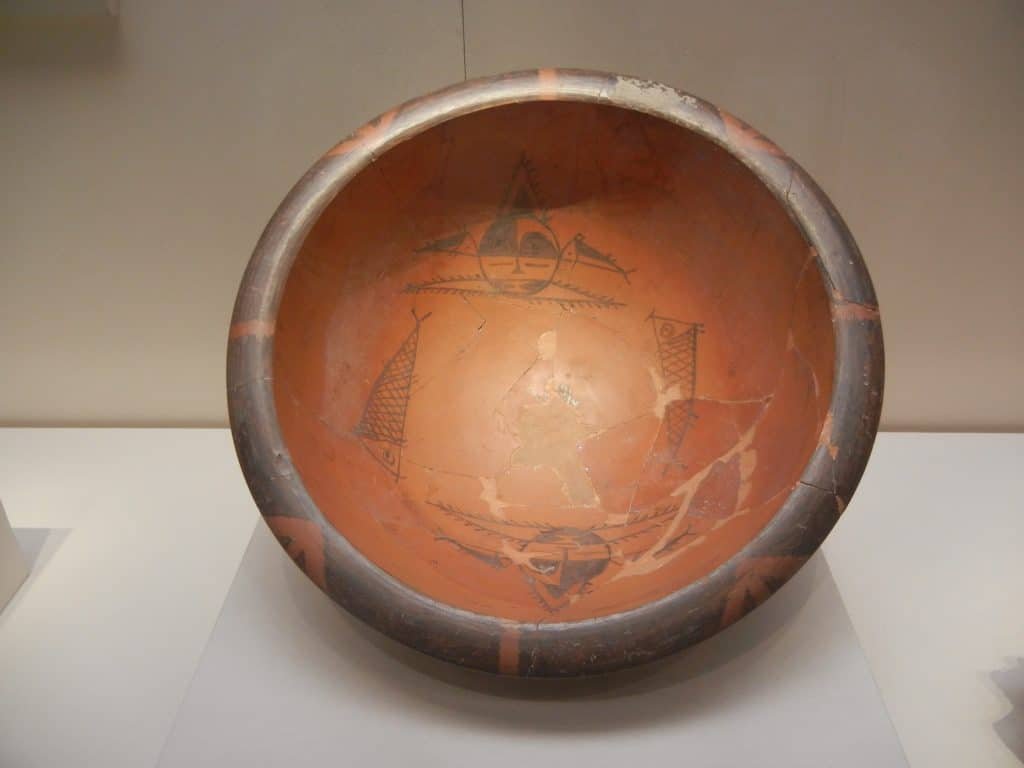
But the Banpo culture in Shaanxi Province (near modern Xi’an) divided interiors into quarters for two pairs of images, which often included fish (above), animals, and people. Though both traditions were different, they emphasized polarities and harmonized them into one pleasing design–another proto Yin/Yang trait.
Some Yangshao cultures, including the Banpo, began using potters’ wheels.
Other new industries emerged during the Yangshao period, including lacquer ware and metal. Metal wasn’t widely used until the Erlitou Culture in the mid-second millennium BCE, but small copper and brass artifacts have been found. So has an occasional bronze knife. Though people in China didn’t start to make the large bronze ritual vessels until the Erlitou period, Zhang says that they did have all that period’s main technical skills and industries. Jade working also became common, especially in eastern China. As farming developed, the population grew and larger villages emerged in coastal areas and uplands as well as areas around large rivers.
So before 3000 BCE, people in China were developing many technological and cultural traditions which later dynasties like the Shang and Han became famous for. These earlier cultures were becoming increasingly integrated in trading networks, and their populations were growing. The land was ripe for developing common cultural patterns.
Here are some more facts and maybes about ancient China’s Yangshao period:
1. Archeological findings show that differences between people who were wealthy and folks living at subsistence levels were increasing. Some graves from the fourth millennium BCE contained many more goods than most others did. They included stone and jade tools like axes whose blades had never been used. They might have been employed in rituals to display the departed’s status on earth. David Keightley, in his chapter in Heritage of China, wrote that people might have believed that elites maintained their status in the afterlife.
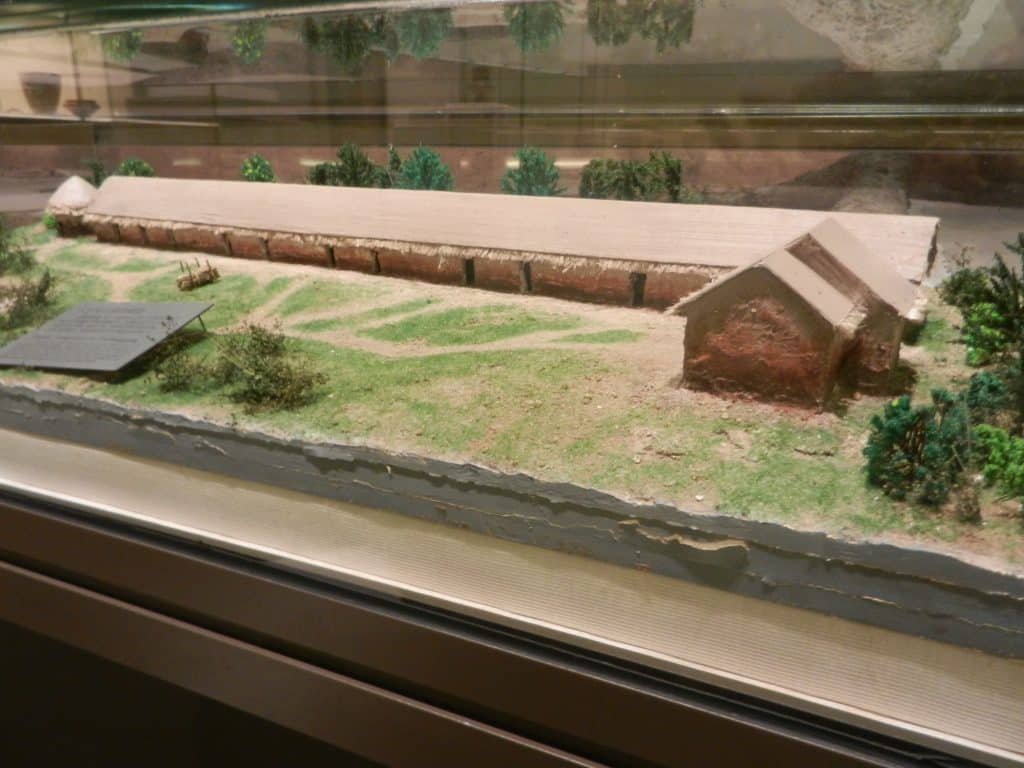
2. Houses with multiple rooms became common in the Yellow River area and the middle Yangtze. In many, each room had its own door. Zhang Zhongpei wrote that a different nuclear family might have lived in each room and that all might have been within the same lineage. Some homes were in the form of a longhouse (like the above model of a home from Henan Province) with a line of separate rooms. Some were over 200 feet long.
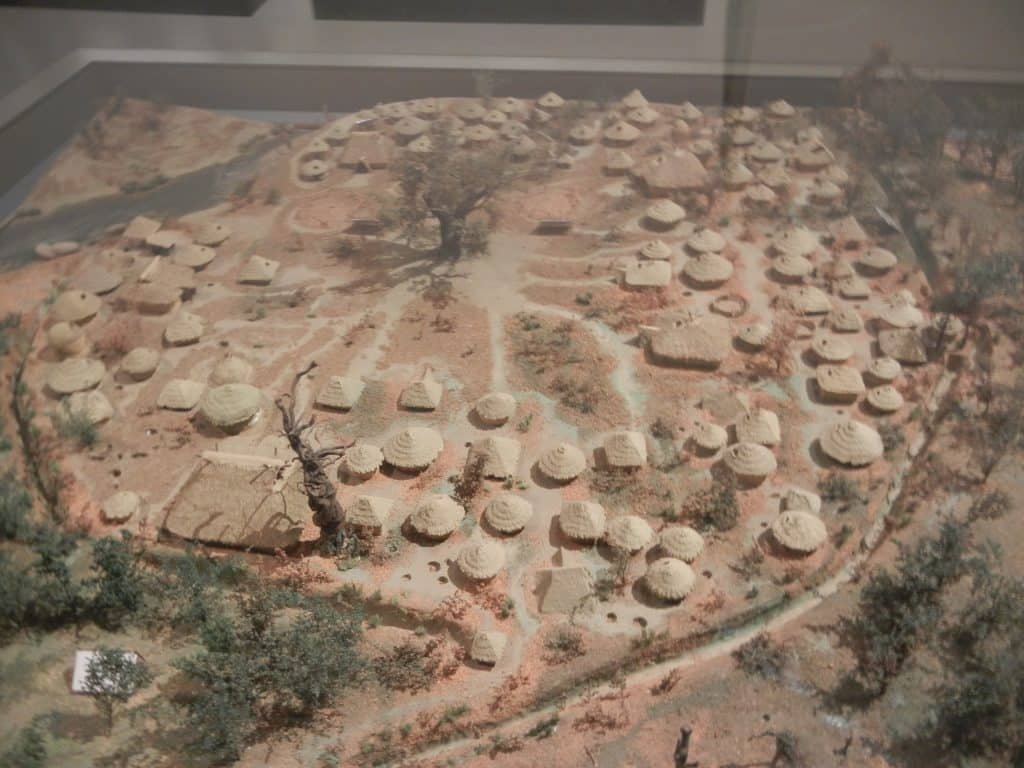
3. Zhang wrote that differences in status emerged between villages. Some were surrounded by defensive walls, and they had a chief’s meeting hall and buildings with religious functions. You can see a few especially large buildings surrounded by small ones in the model of the Banpo village in the above photo–status distinctions were becoming visible in several media. In this village, each large building was surrounded by 10-20 smaller ones. All the buildings surrounded an open central area which could have been used for ceremonies and political assemblies.
Larger buildings in some villages had rammed earth (hangtu) foundations. They required a lot of labor, with a large group of people pounding the ground flat with the ends of heavy polls. So either someone directed a big team or groups formed consensuses. Yangshao villages needed a lot of planning and cooperation to build.
So archeology suggests that people in the Yangshao period settled into increasingly large communities that were tightly knit, socially stratified, and perhaps organized into different lineages. Some of the most dominant political structures in China’s history were already emerging.
David Keightley, in Heritage of China, wrote that heads of main lineages could access their own ancestors without an independent class of priests. Each strong man in the community was his own priest. This focus on intimate relations with ancestors and with the most sacred animals suggests that people back in the Yangshao period had a sense of continuity between the living and dead and of harmony between the main powers in nature. These roots of Confucianism and Daoism emerged thousands of years before the philosophies were articulated in writing.
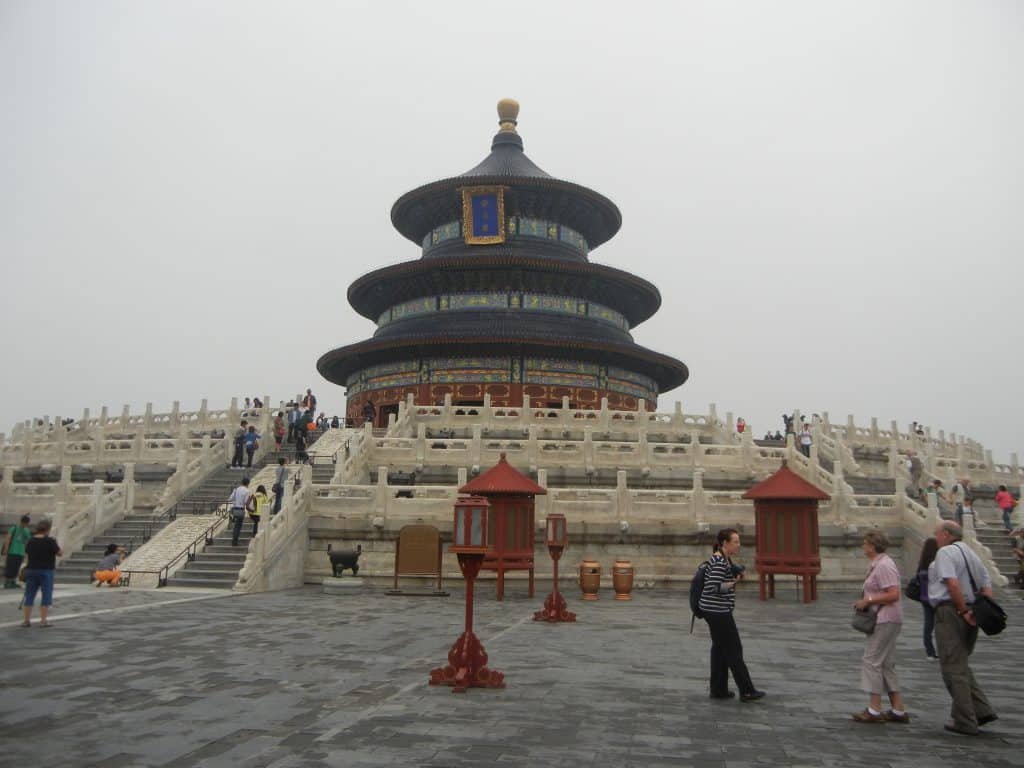
When the Shang culture emerged in the second millennium BCE, the most powerful lineage heads had become emperors who ruled a large state. They kept their priestly functions, and their rituals (including the famous divination with shoulder blades of oxen and plastrons of turtles) were supposed to harmonize the state. Beijing’s Temple of Heaven (above) continued this tradition of seeing continuity between the state and heaven and treating the emperor as the state’s high priest.
So several of Chinese culture’s most salient traits became visible along the Yellow, Yangtze, and Liao rivers by 3000 BCE, and there was increasing trade between these waterways. They might have begun to reinforce each other into a system of values that became the most common in China:
1. Tightly knit communities centered on farming.
2. Social hierarchy.
3. Patriarchal families.
4. Assumptions that nature is continuous. Families and their ancestors remain in close contact. The ruler maintains harmony between the state and the cosmos. Society and nature form a self-sufficient whole. K.C. Chang contrasted this sense with ancient Middle Eastern emphases on creator gods in the sky who were drastically different from people. Chang wrote that traditional Chinese culture has emphasized continuity instead of distinctions. All beings and domains compose the same field. The concept of transcendence, which many Western cultures have emphasized, has often had little meaning in China. All beings are in the same whole. Tu Wei-Ming called this “continuity of being.”
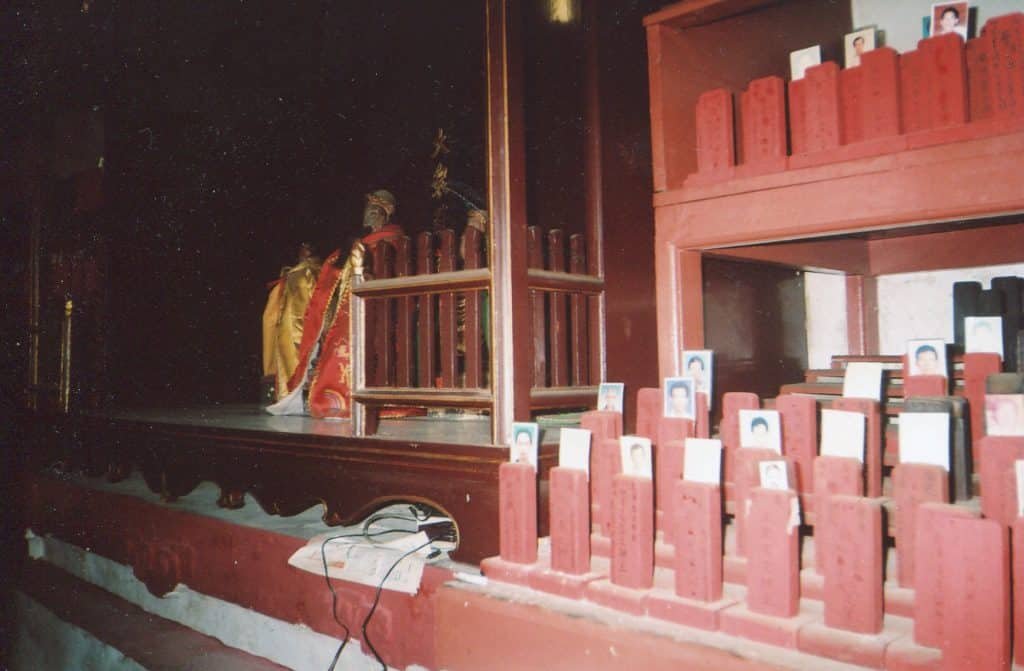
Many Chinese still honor their departed relatives in their homes and temples as though they’re all still intimately related. The above shrine is way down in Malaysia, in Malacca’s Chinatown.
5. Art that stresses harmony and balanced patterns. Many ceramics depict balance between dark and light colors and graceful transitions between them. Yin and Yang energies weren’t systematically written about until the first millennium BCE, but many people seem to have thought in terms of balanced energy flows by the Yangshao period.
The bowls in the above photos and–
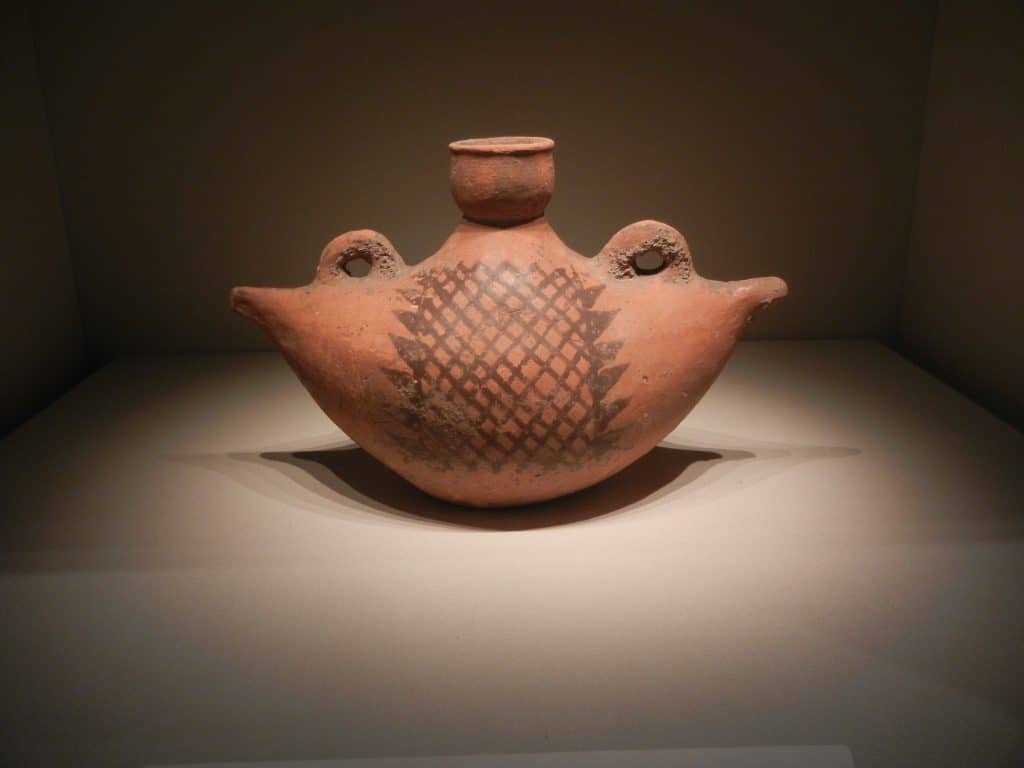
this ewer in the shape of a boat, with a net design, express a world in harmony, which is patterned in balanced forms. Chinese ceramics continued along this path, but they were already on it in the Yangshao era.
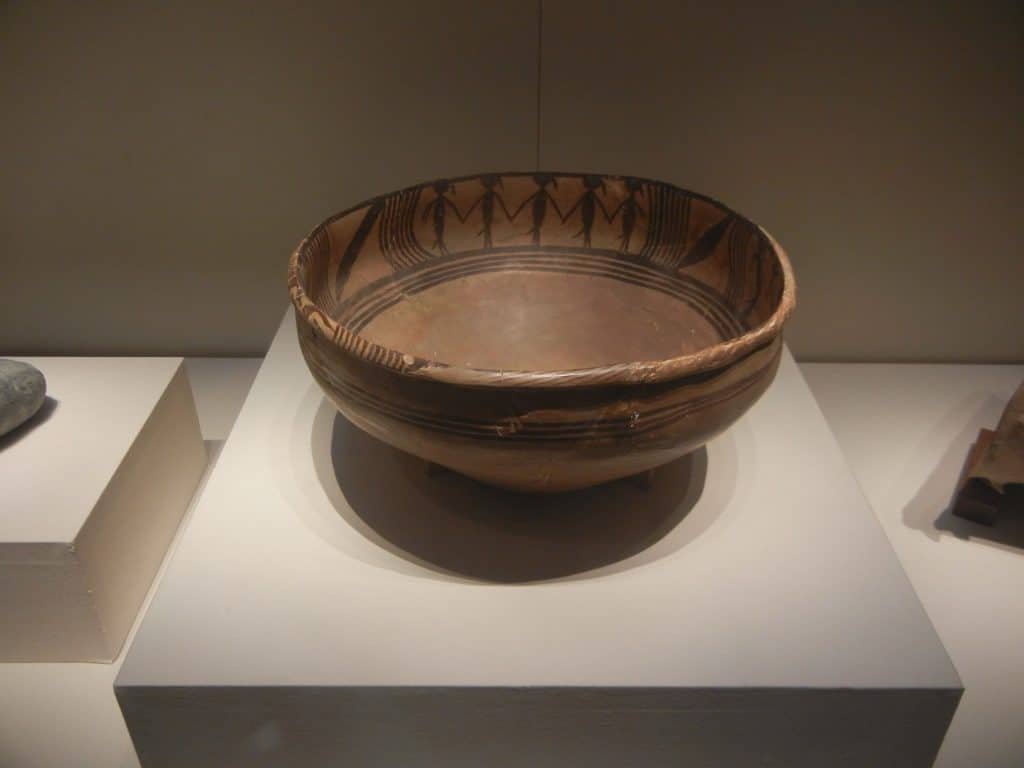
This bowl from a late Yangshao period culture called Majiayao has lines of five dancers on the inner rim holding hands between wavy lines that resemble grains in the breeze. They might have been conducting a ritual for crop fertility.
All these ceramics stress balance more than the abundance in a lot of Indian art. They seem to reflect communities of people and ancestors living in a unified field which is stable and harmonious–ideal conditions for emerging agricultural societies. Their subjects express the natural world and communal life more than cosmic vastness that dwarfs human beings.
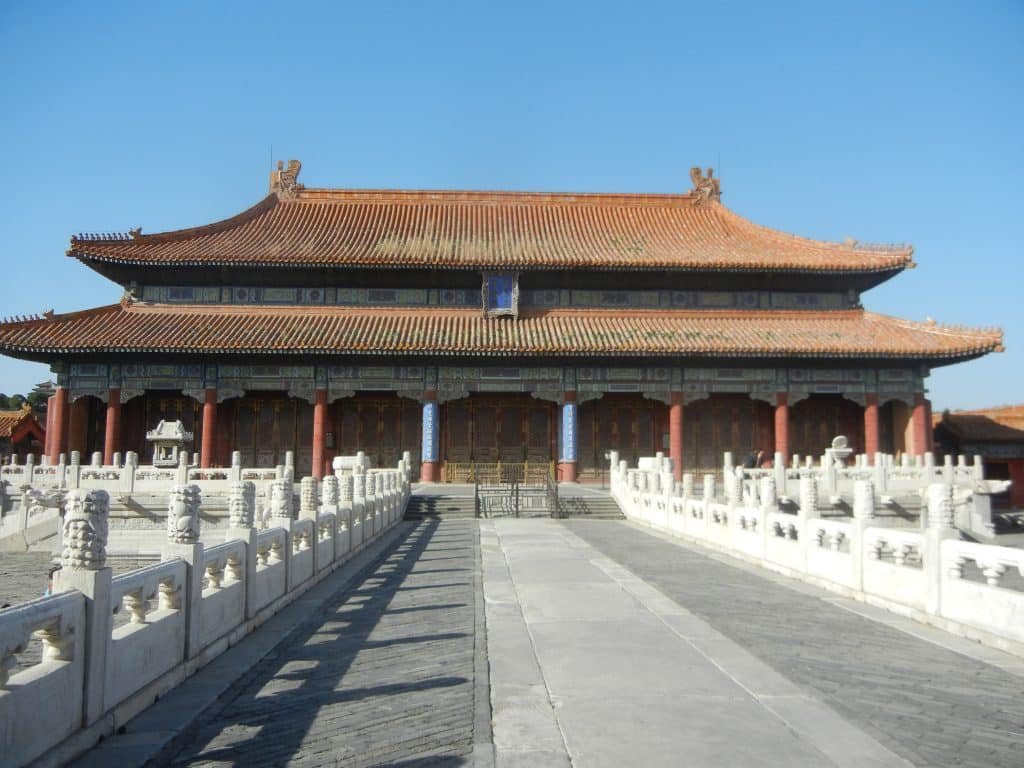
People in China stressed communal harmony, continuity throughout the universe, and social status way back in Yangshao times, and they thus laid deep foundations for many later products of Chinese culture, including Beijing’s Forbidden City (above). They’re also still evident in family-raising and even in modern art.