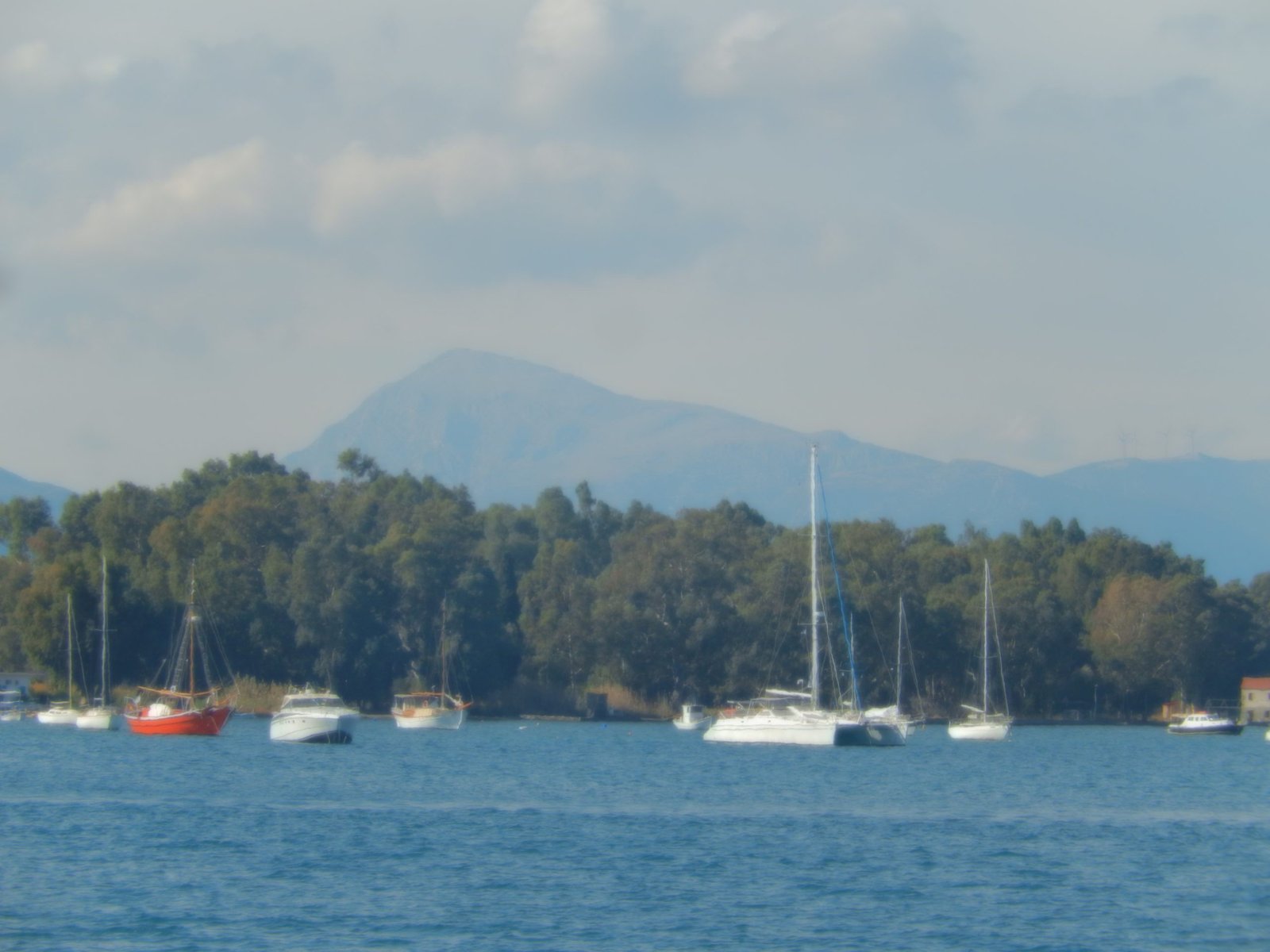
Greeks began to form colonies in the eighth century BCE. This movement, in which people loaded their belongings onto ships and ventured out to sea to build communities on other shores, probably shaped their thought as much as mapmaking, legal courts, city-states competing with each other, money, and the alphabet did.
Greeks in the last generation of the eighth century BCE founded a new settlement in Sicily and southern Italy about every two years on average. Different cities established these colonies. Many of the first settlers came from a long and thin landmass a little northeast of Athens called Euboea, where population pressures and economic opportunities enticed inhabitants to move. Sparta and Corinth also founded new colonies (Taranto in southern Italy by Sparta, and Syracuse in Sicily by Corinth). Throughout the Greek world, people sailed to a new place in which to live. They relocated for a variety of reasons, but all brought the language, religious traditions, myths, and political institutions from their mother cities, thereby spreading Greek assumptions about reality beyond their homelands.
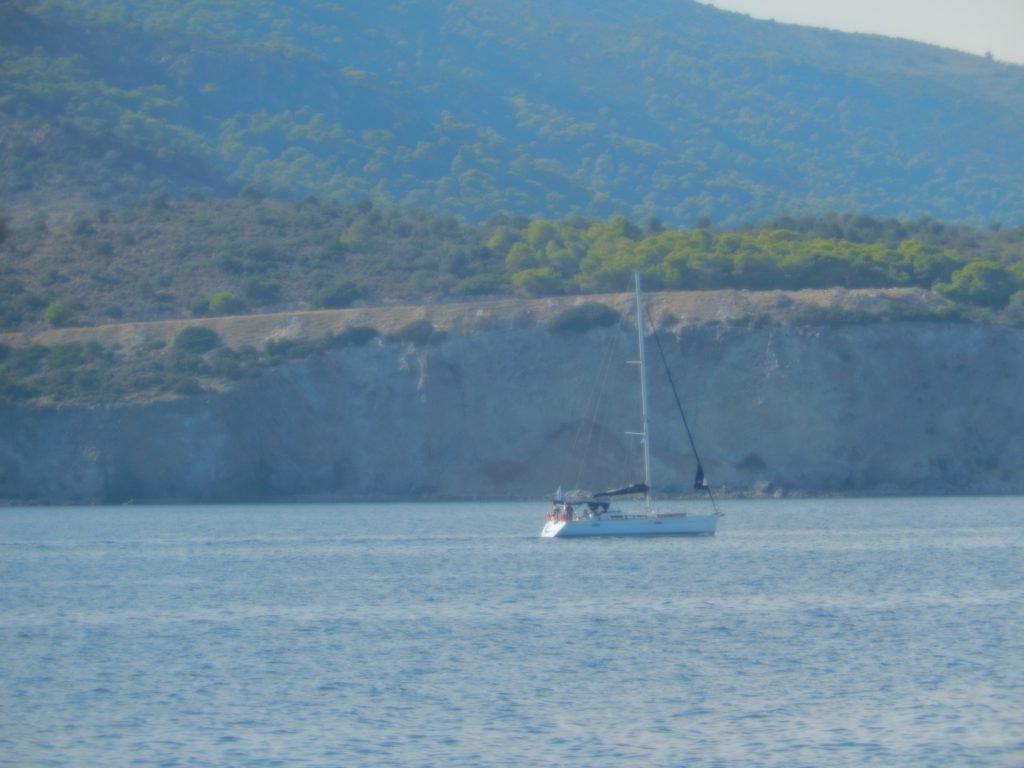
The ancient Greek word for colony was apoikia, which literally meant home away from home. The historian Carla M. Antonaccio felt that this word captures the movement’s spirit. People founded their new cities in environments similar to those of the mother cities; they were distinct communities that hugged Mediterranean coasts. Most colonies were politically independent from the parent towns, but many kept religious ties and pledged political support. Some people carried fire from a temple in the old city, transported it on a ship, and ignited the new temple’s hearth with it. But the new city-states usually made their own political decisions. So the old environment was reinforced; life in distinct city-states that were in places separated by clear boundaries dominated people’s ideas of the world, compared with ancient Indian ideas of a vast cosmos and ancient China’s centralized royal courts.

I found a resoundingly Greek atmosphere while visiting Paestum, which was one of the most important Greek colonial cities in southern Italy. It was called Poseidonia before the Romans took over, and three large stone temples from the Greek era dominated it. The temple of Athena presided at the northern end (above), and the temples of Poseidon and Hera anchored the southern area (below).

All are rectangular, proportioned, and surrounded by sturdy Doric colonnades. Much of the town, including its agora, was in between, bracketed by these embodiments of sacred permanent order. You can see a circle of seats for what probably political assemblies in the below photo–it’s much too small to have been a public theater.
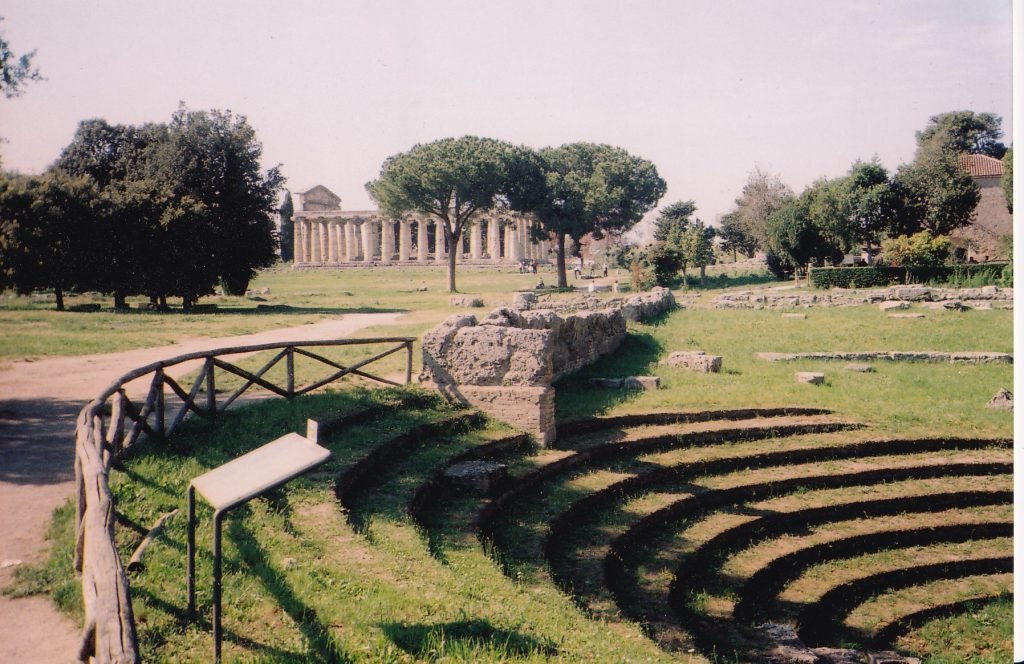
Rugged mountains rose in the east, and the sea spread in the west. So the residents nestled and prospered between these two zones of unpredictable nature.

While walking around, I found that my gaze was often pulled in these four directions. Wild nature and civilized proportions were opposites which were dramatically distinct from each other. Ancient Indian concepts of space could more easily take off into vast metaphysical realms, but Poseidonia’s citizens’ horizons were firmly grounded in their community.
One of the first acts that the new arrivals performed was the creation of public spaces, particularly the agora and temples. These areas where the whole community gathered to govern themselves, conduct business, join religious rituals, and generally hang out were also central in their former cities. Greeks’ orientations to proportioned communities in the here and now thereby spread to more of the West. They became standards of well-being and political prestige in Italy.
People in Sicily and the Italian mainland already had their own rich cultural traditions. Many seem to have believed in reincarnation. Pythagoreans and Empedocles emphasized it, but most people in other parts of the Greek world did not. All the same, common Greek ideas and aesthetics developed in all areas from Italy and Sicily to Turkey. Colonies in Sicily and southern Italy became wealthy, and they built stately temples and created ceramics with realistically painted scenes. A common field of meanings spread, including public politics, theater, proportioned city-scapes, and athletic games. All these traditions and locations converged into assumptions that many Westerners still consider basic.
Other cultures’ assumptions are equally deep, including Islamic, African, Southeast Asian, and Native American. Exploring other cultures can turn all into homes away from home for us.