The pyramid in the photo below looks even less impressive than King Menkaure’s. After he built the third pyramid at Giza, pyramids became even smaller.

But equally monumental things were happening under the surface. Ancient Egyptians opened up more horizons as they developed ways of expressing themselves in new media.
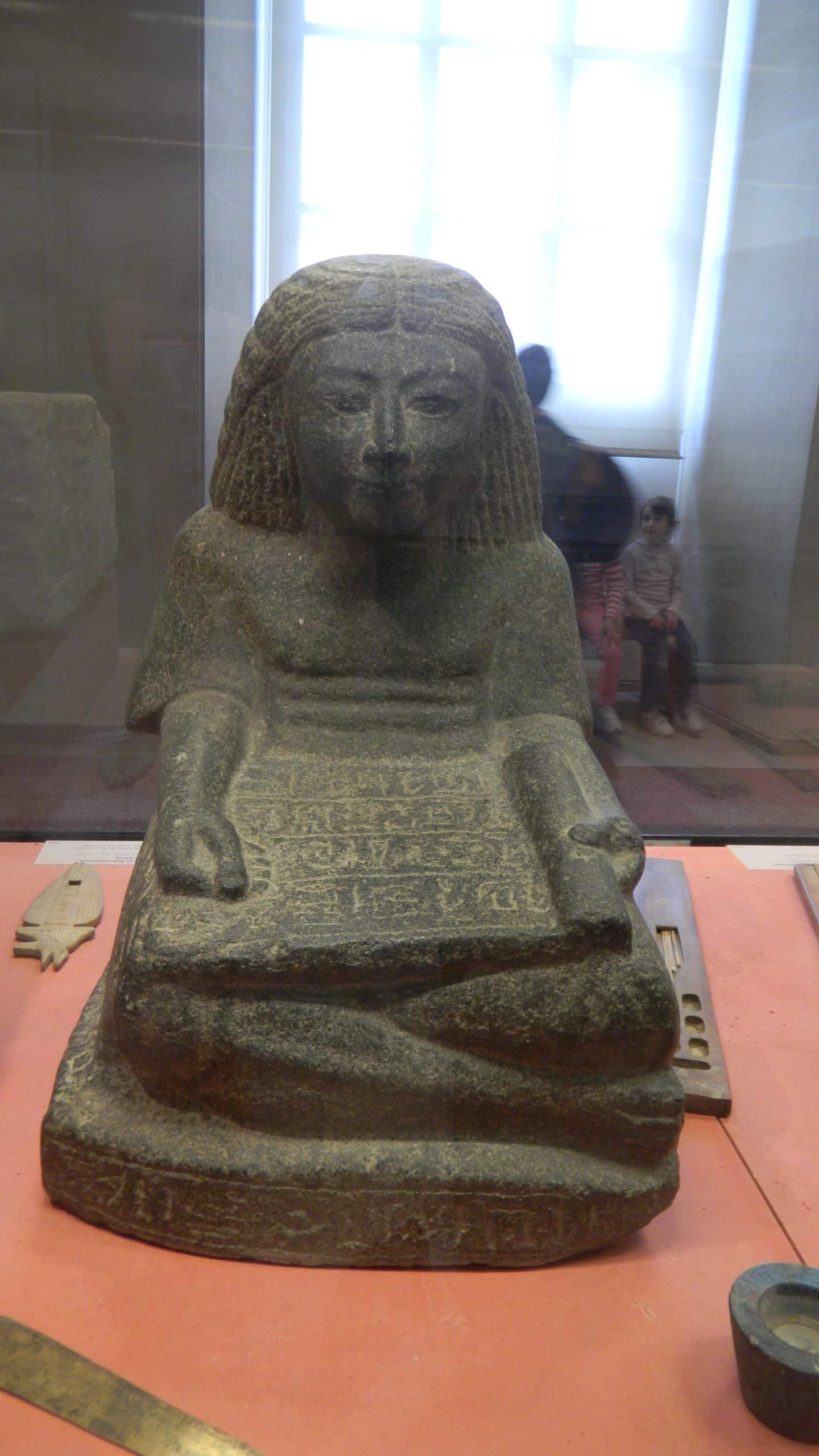
Menkaure’s son and successor, Shepseskaf, was the Fourth Dynasty’s last king. Userkaf founded the Fifth Dynasty (2465-2323 BCE), and Teti founded the Sixth (2323-2150 BCE). During this time, when pyramids were smaller and temples were growing in size, literature became more sophisticated as it began to express more aspects of human life.
Ancient Egyptian literature first recorded offerings in temples. Kings also used it to brag about vanquishing their enemies to establish themselves and unify Egypt into one political entity. Writing kept both these functions, but several major trends developed in the Fifth Dynasty.

1. According to Miriam Lichtheim, lists of offerings grew and grew until they became cumbersome.

Folks then shortened them into prayers for offerings. Prayers became standard in texts from then on. Writings in Fifth Dynasty tombs then asked, “May offerings be given at–“, and a long list of festivals and auspicious days followed.
2. Lichtheim noted that lists of officials’ ranks and titles became fleshed out with narratives so that the autobiography was born. People listed their virtues and great accomplishments: I pleased my father; I pleased my mother; I did my job well, I respected my superiors. They only listed the good stuff. No Keith Richards lauds his willingness to flip off abusive authorities. Ancient Egypt during those Old Kingdom dynasties portrayed an idealized world in which political unity and the regularity of the Nile and the sun reflected a divine order called Ma’at. Good people get satisfaction in this world and in eternity.

3. Wisdom literature developed. This took the form of a father teaching his son about proper behavior in an ordered society–Respect your elders. Do not talk loudly. Do not steal. Do not eat more than you should. In this world, Father knows best and everyone upholds high standards of etiquette and ethics.
4. Pyramid texts were later carved on the walls inside the tombs of some of the Fifth and Sixth Dynasty’s kings at Saqqara. They contained combinations of magical verses and beautiful images which enabled the king’s soul’s eternity after passing into the afterlife. After the Old Kingdom disintegrated, these verses spread beyond the ruler and his family and were adapted by common people, often in texts on the inner sides of coffins. Around 1400 BCE (during the New Kingdom), the Egyptian Book of the Dead was written on a long papyrus roll for a scribe, governor, and granary keeper named Ani. The elegant symmetries of its hieroglyphs and illustrations of gods now expressed individuals’ hopes for an eternally happy afterlife.
All four forms can seem dry and formulaic, but we have to appreciate the world that they were written in. They emerged from older lists of inventories and conquests. Hieroglyphs in tombs were expected to have magical potency, and they were recited like formulas. They reflected an eternal order.

This is the world that the pyramids’ perfect forms both portrayed and ensured into eternity. As Egyptians built them during the Old Kingdom, they developed other media to express this world in more human terms, including sculpture, temple architecture, and literature. All converged into a positive view of life, and they created a world of beauty with high hopes that it would continue forever.
Ancient Egypt fragmented after the Sixth Dynasty. Though this order didn’t endure in politics, Egyptians kept using the Old Kingdom’s art forms. Later dynasties did innovate so that sculpture and literature sometimes became more less idealized, temples became more complex, and texts grew in length and detail. But Egyptians always honored the old standards, including the balanced proportions, the pantheon of gods, the forms of temples and of hieroglyphs, and literature that expresses a beautiful and highly moral universe. They returned to this idealized world from the Old Kingdom for the next 2,500 years. Tourists from all over the West and Asia go there to admire it. This view of the universe still lives and captivates people that ancient Egyptians never dreamed of.