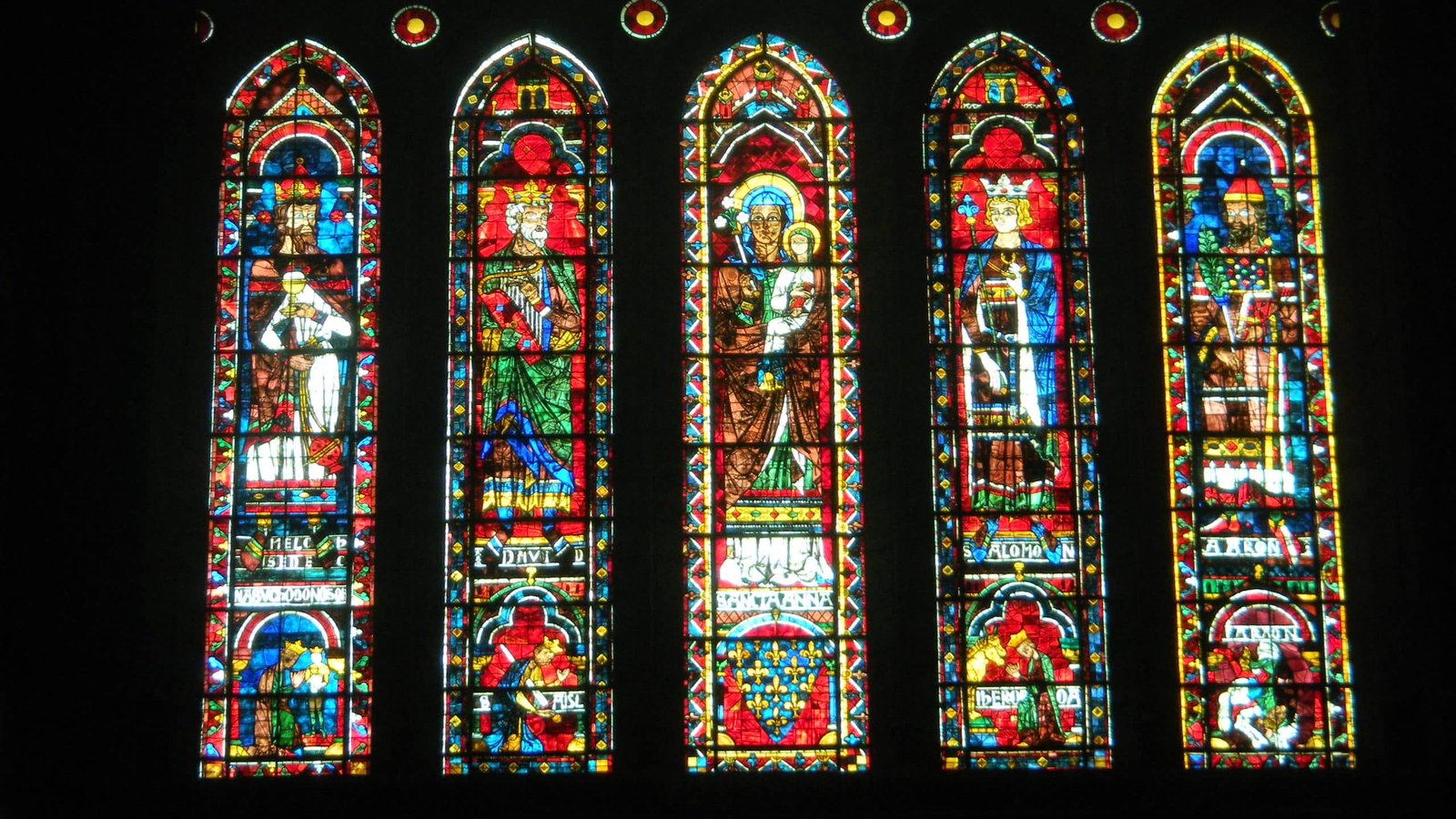
Above is only a minute part of what the builders of Chartres Cathedral achieved. Come inside and we’ll explore one of the world’s finest artistic achievements.
Now that Chartres’s builders had raised the height of the church and supported its frame with flying buttresses, they could use most of the wall space to let their imaginations fly.
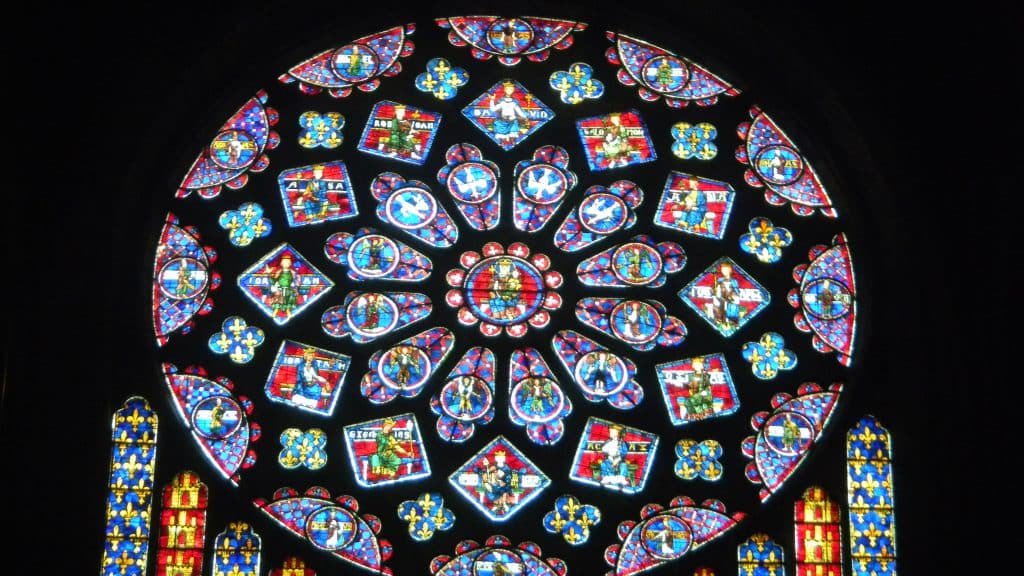
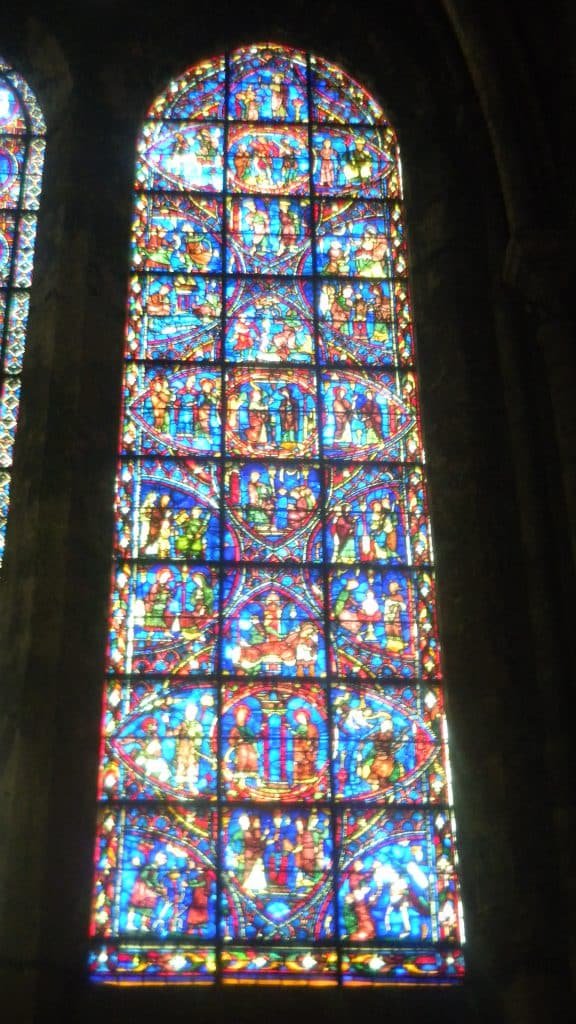
People filled the whole church with biblical stories in a way that represented medieval views of the universe. Both of the above pictures are from the north transept. The top photo is just below the Rose Window, which is in the bottom picture. This transept represents the Old Testament, but according to a new vision in the early 13th century, when the widows were made.
The Rose Window contains conventional Old Testament motifs: 12 semicircles surround the 12 minor prophets, and 12 squares house the 12 kings of Judah. But the central figure of the Virgin and Child graces the whole window. Mary’s cult became popular in the 12th century, and she’s represented in this window as the link between the Old Testament and the New Testament.
Likewise in the five panels below the Rose Window. St. Anne holds the child Mary in the center. They’re surrounded by honored Old Testament figures, including Melchizedek, David, Solomon and Aaron (the top photo).
A few recent posts have explored Islam and its focus on the believer’s direct relationship with God, which should have no intermediaries. But the West has stressed a human component of divinity. God is perfect, and He created all beings. The greatest expression of His perfection is having a son in people’s likeness to save them from straying from divinity. Muslims consider this idea absurd because it denies God’s uniqueness, but Christians consider this the ultimate expression of God’s glory and love.
The tall Gothic naves and their enlarged stained glass panels gave Europeans a new way to add human images of divinity.
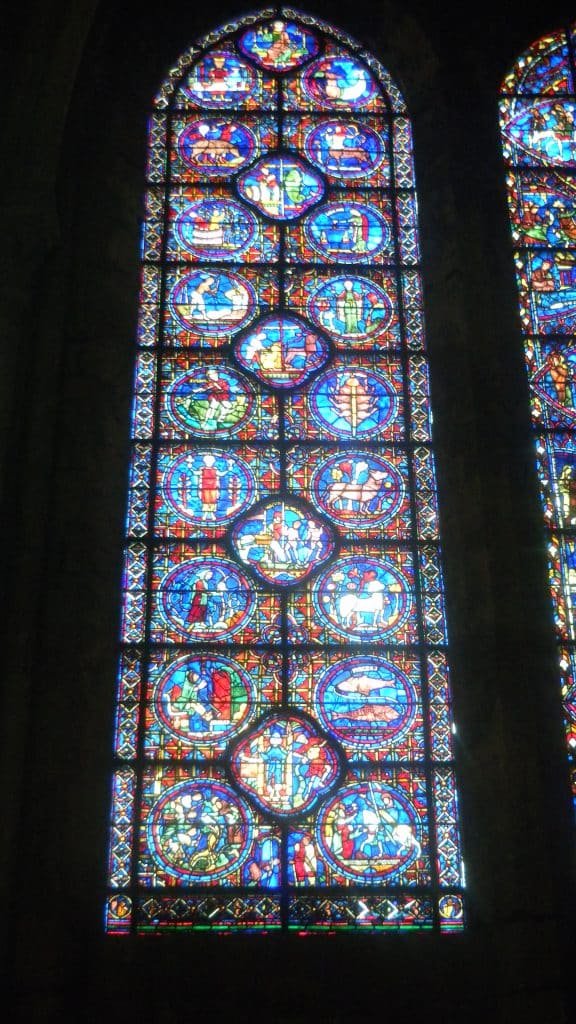
Now that windows filled the whole church, light from this divine family bathed the whole congregation. Mary was a key link from the Old Testament’s demanding God to the New Testament’s loving God.
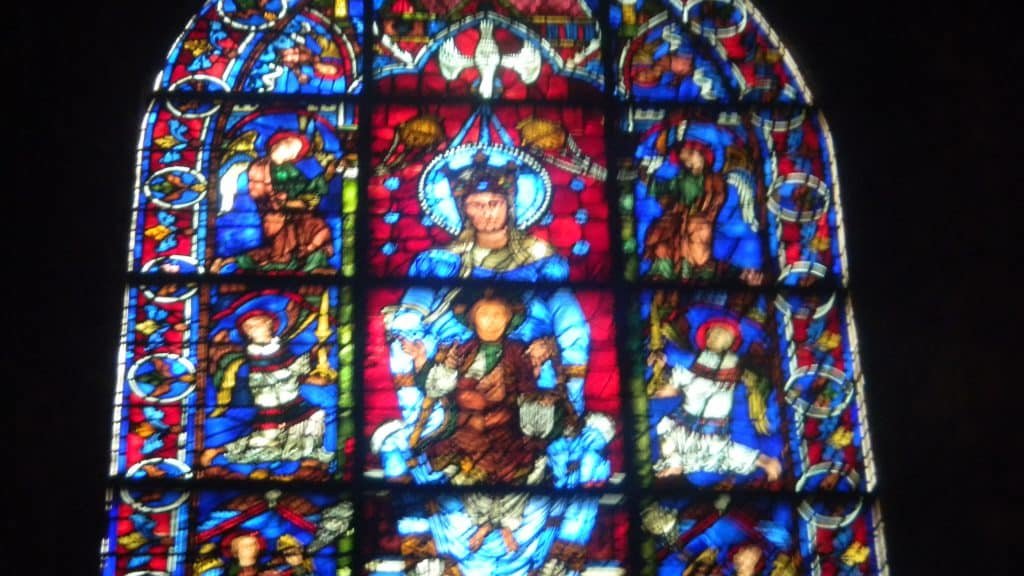
Her central place in the new windows made this idea tangible, and it allowed the divine light reach down to ordinary folks like a mother’s arms embracing her children.
Chartres Cathedral’s sculpture honored Mary with equal magnificence.
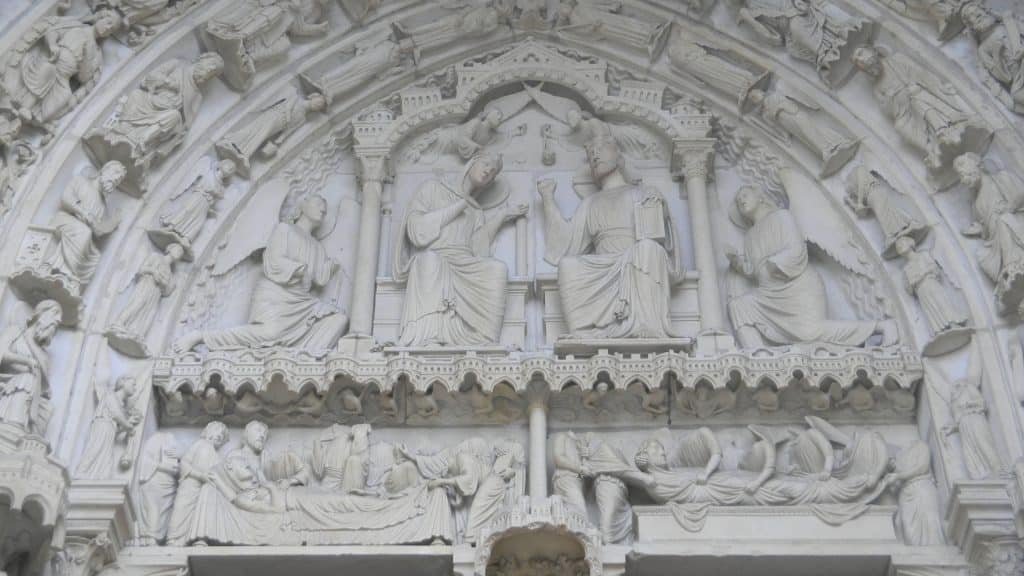
The picture above is from its north porch. The death of Mary is portrayed in the lower left, and her assumption is in the bottom right. Mary’s coronation is majestically sculpted in the upper middle. We can note several things:
1. People in the 13th century associated the north side of the cathedral with the Old Testament. It’s the dark side of the building during the cold months. The New Testament, which spreads the news about Christ and our salvation, is associated with the south. As in the stained glass windows, Mary is a key link between both books. So the sculptural program and stained glass windows complemented each other and reinforced the new popularity of Mary’s cult.
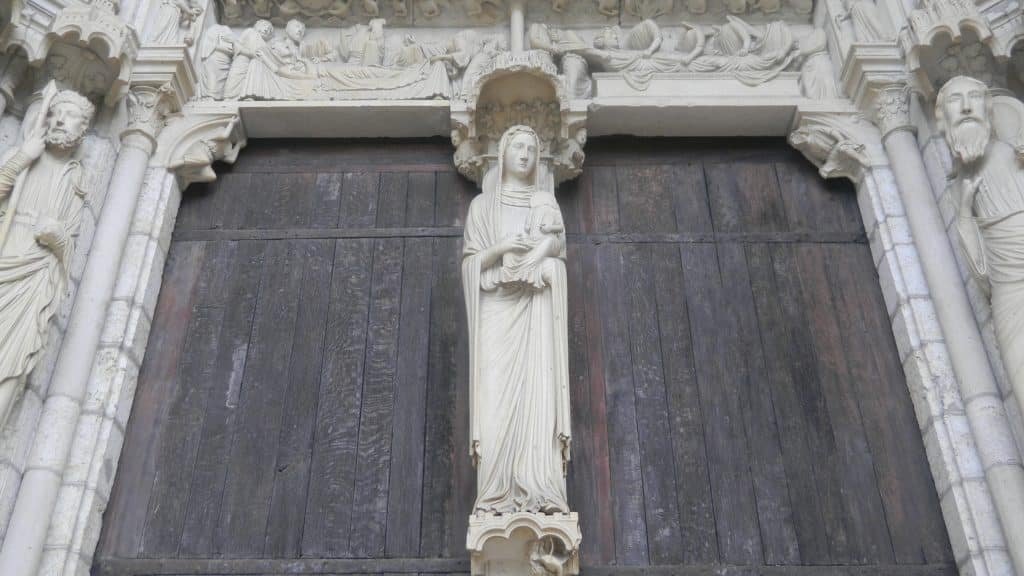
2. New standards of realism, with an emphasis on flowing lines, developed. Though some of the figures are stick-like as though their carvers hadn’t yet conceived them as free from the building’s columns and walls, they’re becoming more human than older figures, like those on St. Denis.
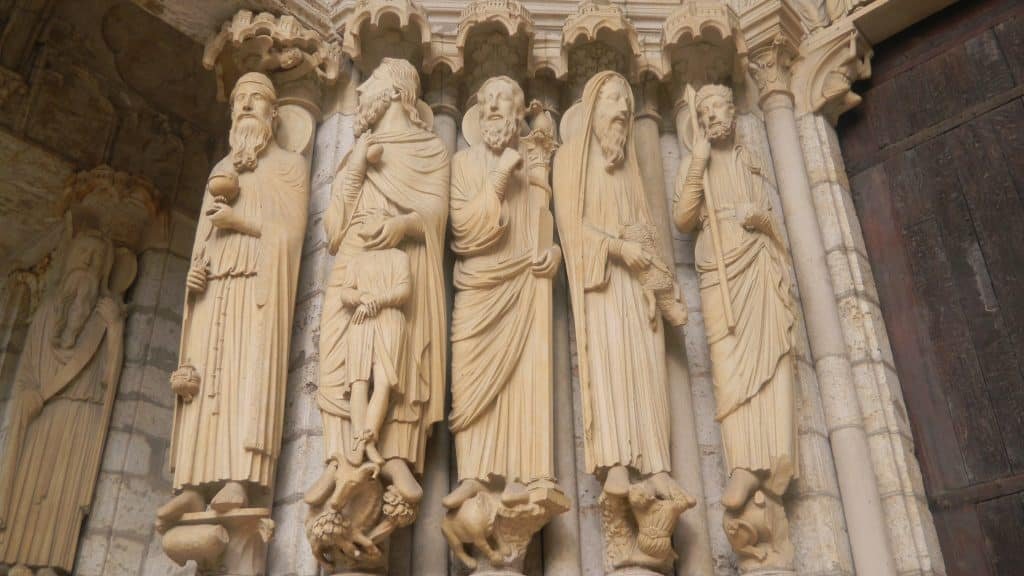
You can savor the flowing lines in the gowns on the figures in all three of the above shots. Instead of classical and Italian renaissance sculptures that glorify the body and are proportioned, forms embody gentle flows. Thai art also emphasizes gracefully flowing lines, but Gothic art used them to represent people and stories from the Bible. They made Christian stories and theology more appealing for common people in medieval Europe’s growing cities.
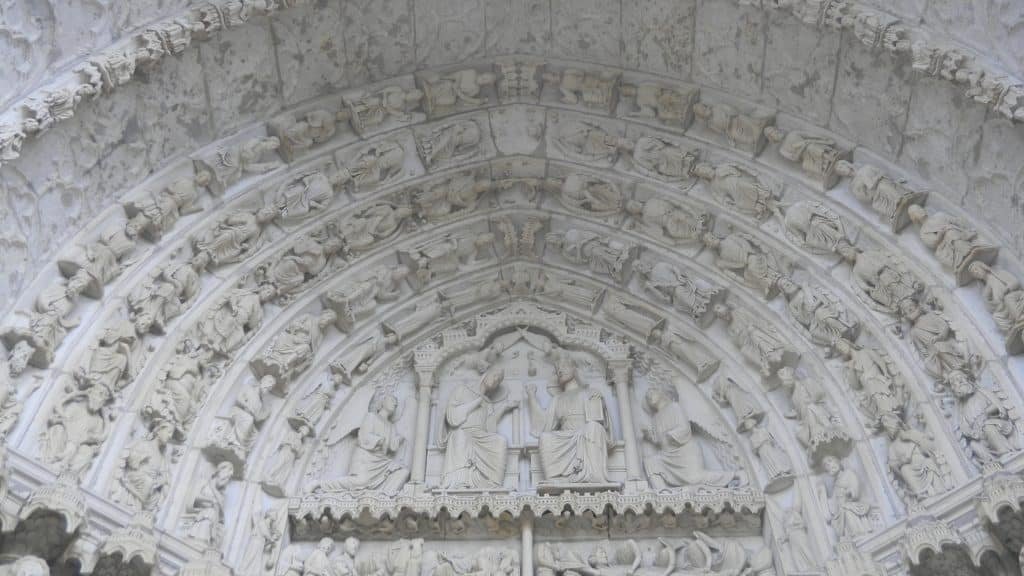
3. Logic and clarity. Above is a larger perspective of the first shot. A hierarchy of different beings surrounds Mary’s coronation. All the levels are clearly defined. Gothic cathedrals provided a total view of the universe for people in the 13th century, and its domains are clearly demarcated.
We can note several cool differences from the Khmer temples that recent articles here explored, and they indicate what makes the West unique.
1. The medieval West followed a single theology, which is centered on Christ. Khmers blended many faiths.
2. Clarity. Worshipers at Chartres could see all sculptures and stained glass windows portraying the key events in the universe’s history. You can’t do this at the largest Khmer temples, including Angkor Wat. Their multiple systems of enclosing walls, narrow corridors, and insular courtyards ensure that you only see a small percentage of the whole. Their enormous sizes are spellbinding, but they keep interconnections between all the domains mysterious.
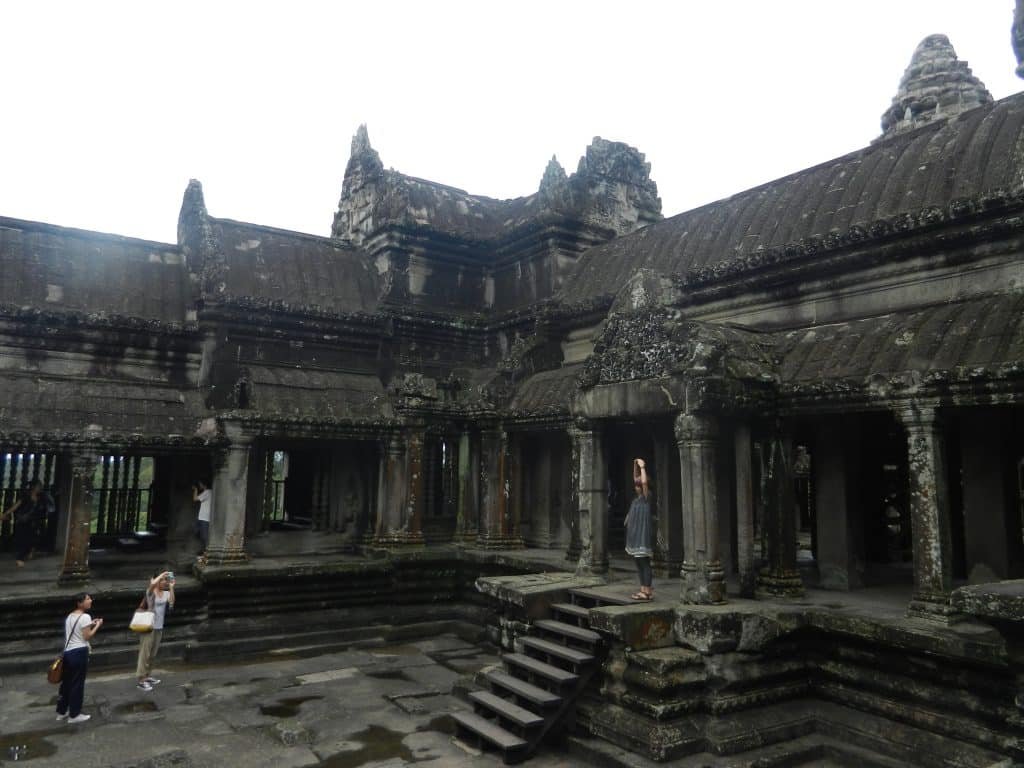
The perspective on Angkor Wat’s upper terrace (above) is so opulent that it seems otherworldly, but it’s also enclosed.
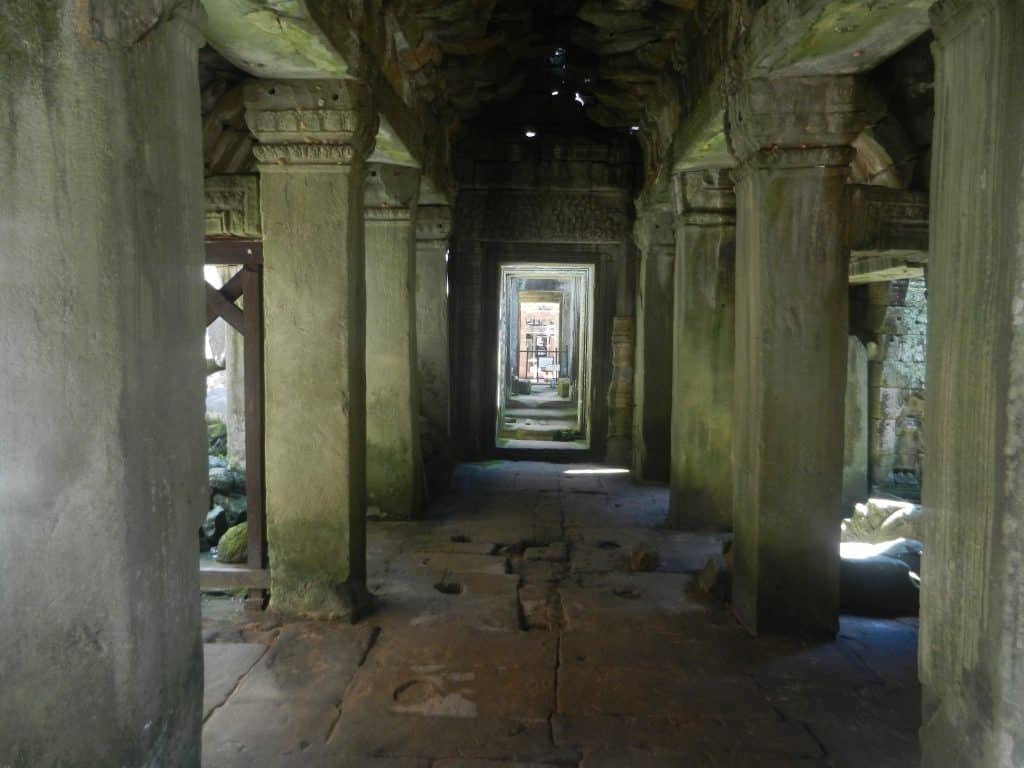
The halls around the central shrine at Preah Khan (above), which was built when Chartres Cathedral was constructed, are much narrower than a Gothic cathedral’s nave. Each priest conducting rituals at Angkor Wat and Preah Khan might have only been focused on a small part of the whole monument and the universe which it represented. All might have been coordinated under the authority of the king and his porohita (chief royal priest) with little say about the larger scheme of things.
Gothic cathedrals integrated all the Bible’s characters and events into a universal history that everyone in Europe’s growing towns could see and understand. The Khmers integrated a gloriously diverse range of faiths (Mahayana Buddhism, Shiva worship, Vishnu worship, royal cults, and local spirit cults), but with less of a clear conceptual framework that everyone shared. They were all linked to the king’s supreme power and integrated in rituals that elite priests conducted. But the elites don’t seem to have been as concerned with providing everyone with a perspective of the whole. They dazzled them with ceremonies instead.
Gothic cathedrals linked domains in the universe with linearity and Jesus. Large Khmer temples linked them with the king, his association with whatever gods he chose to honor, and sensational art and rituals.
3. The vertical dimension. I find this to be the most inspiring aspect of Gothic cathedrals. The tallest are more than twice as high than the largest Khmer temples (and many times higher than Preah Khan). Gothic cathedrals represent a realistic and logical view of the whole universe, and at the same time soar to the heavens to transcend the world that they portray.
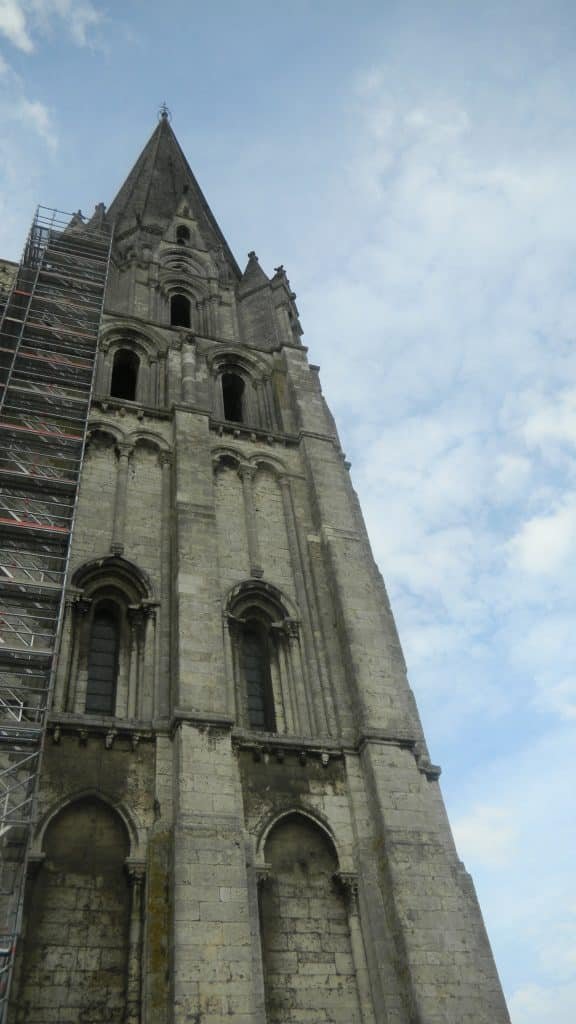
Like Indian temples, Gothic cathedrals can be approached from different levels. The cathedrals simultaneously express a linear and categorized world and an attempt to rise above it.
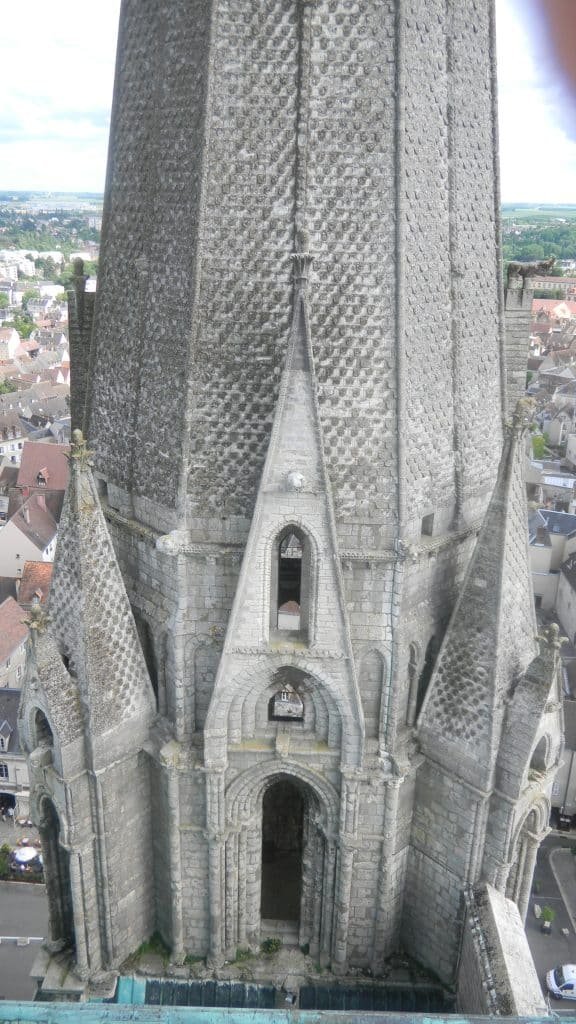
Because Gothic cathedrals appeal to different mentalities, every generation can find new meanings in them. They still attract millions of people in today’s digital world.