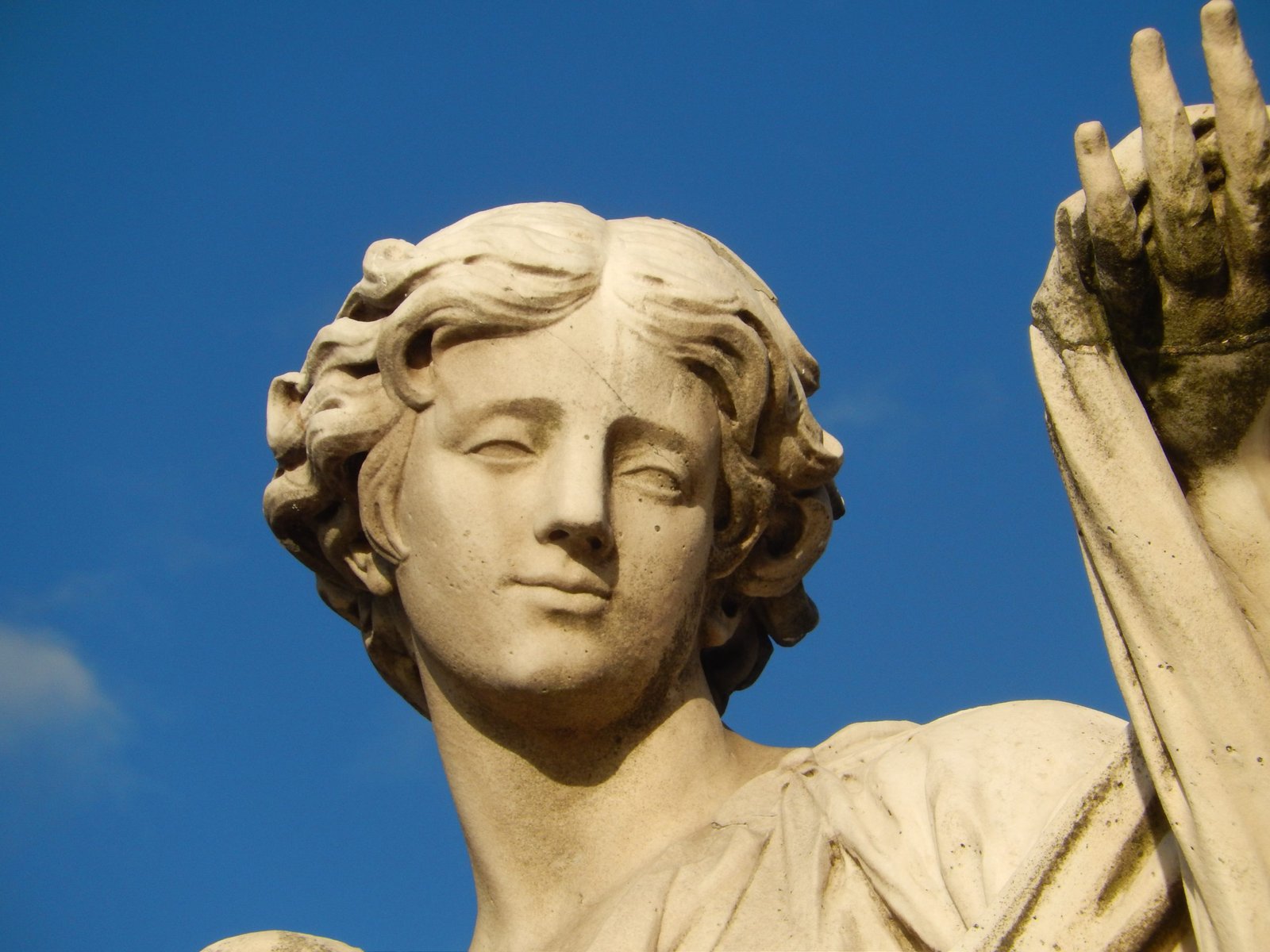
Alfred North Whitehead wrote that the European philosophical tradition, which America has inherited, is mainly a series of footnotes to Plato. Other philosophers have given Aristotle equal weight. A philosophy professor I had said that their minds pondered everything that subsequent thinkers considered. But not Chinese, Indian, Islamic, African, Native American, and other cultures’ thinkers. Plato and Aristotle inherited ideas and experiences from Greek traditions, which helped shape their assumptions and ideas.
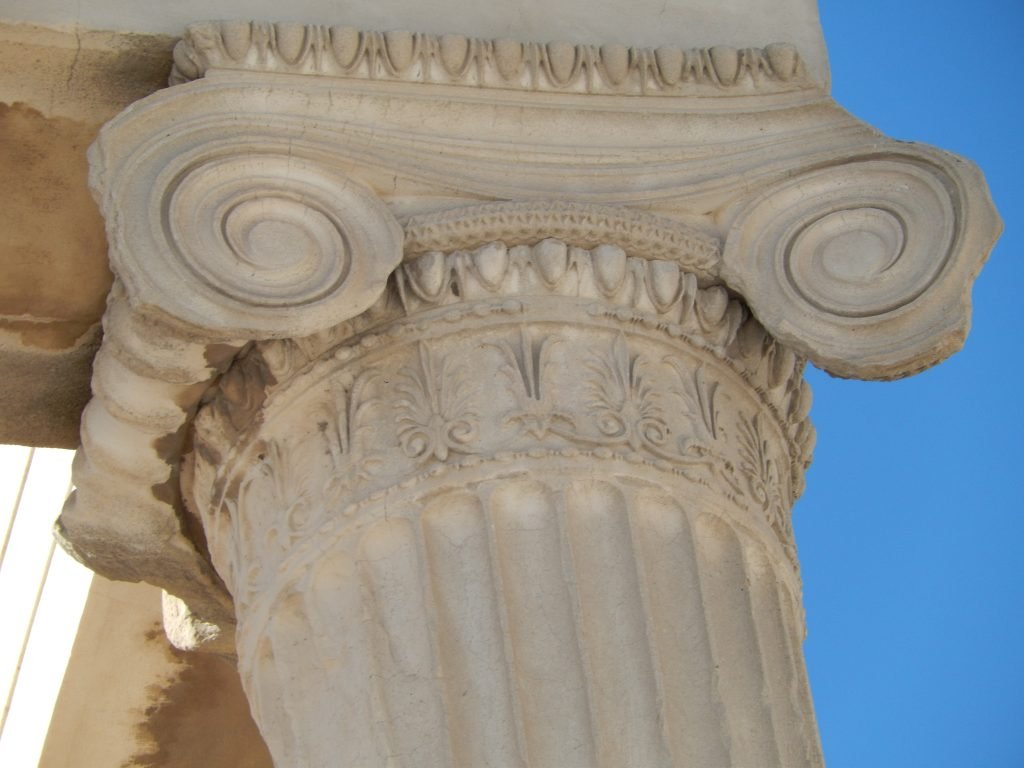
Plato searched for the distinguishing definitions and qualities of different things and ideas and projected the definitions and qualities into ideal forms that exist independently from the world. They can only be apprehended by the mind. There is thus no perfect circle in the world; the ideal circle exists as a form that all circular things get this quality from (the elegant spirals in the below photo crown one of the Parthenon’s Ionic columns).
Plato elaborated on his idealized geometric conception of the universe in his book Timaeus, which I think is one of the most beautiful expressions of Western assumptions about basic reality. Like most of his writings, it’s a dialog between men who lived in urbanized settings. The discussion was between Socrates and three people. Timaeus, a distinguished guest from southern Italy, described how the universe, human beings, and all other things were created.
The book said that anything that comes to be must be corporal, visible, and tangible. All things are fashioned from the four elements: earth, water, air, and fire. Empedocles had already said that they’re most basic and saw them as roots; Plato now conceived them as geometric shapes. Earth is a cube, and fire is a three-dimensional pyramid (a tetrahedron, which has four sides). Since it’s not possible to combine them, two more elements were created and placed between them to function as bonds. Water is immediately above earth in the shape of an icosahedron (with 20 sides), and air is between water and fire as an octahedron, with eight sides. Empedocles had already emphasized these elements; Plato now defined them in terms of numbers and permanent abstract shapes. The idea that numbers are inherent properties of matter thrilled the Nobel Prize-winning physicist Werner Heisenberg when he read Timaeus at the age of eighteen.
Timaeus then described things at an even more basic level. The sides of all four elements are either triangles (in tetrahedrons and octahedrons) or can be reduced to triangles (the sides of cubes are squares, which can be bisected diagonally into triangles).
All triangles derive from the two most basic triangles. Both have one right angle (90 degrees). In one triangle, the other two angles are 45 degrees, and in the other, 30 and 60 degrees. In contrast with brahman in India, Plato saw the basic constituents of the universe as permanent, abstract, and proportioned shapes.
And these shapes are basic aspects of the body. The gods began to fashion the human body by producing marrow, which acted as a seed for all mortal creatures.
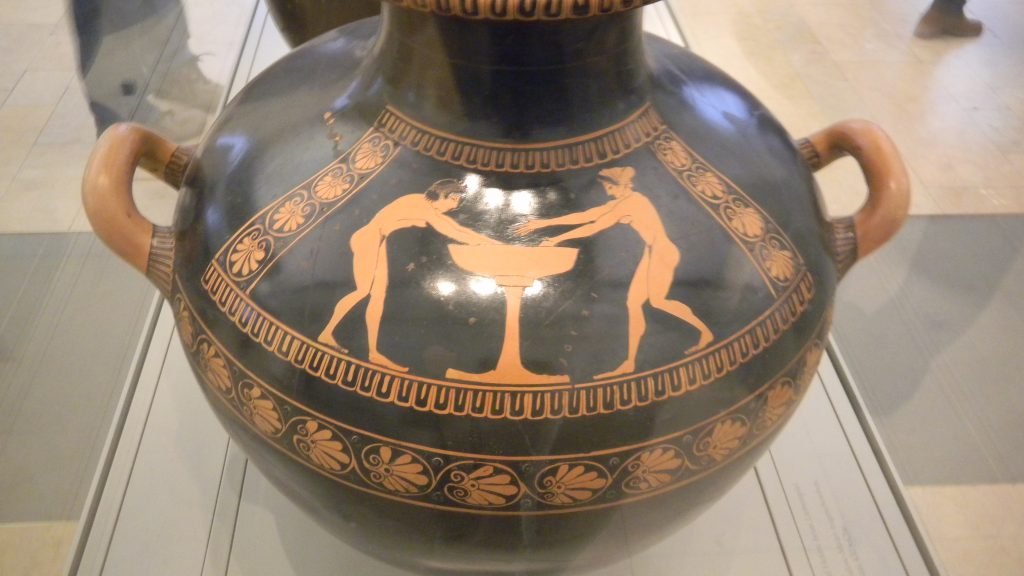
Marrow was made from a proportioned mixture of the four elements. The basic triangles in a child and a young adult are firmly locked together, since the marrow is newly formed and fed on milk. The triangles in the food and drink that a person consumes are older and thus weaker, so the body easily breaks them down and absorbs them. But its triangles weaken over the years as they do battle with these outside substances. After thousands of these combats, the body’s triangles are broken up with increasing ease by outside substances, and it thus succumbs to old age. The soul then gladly departs.
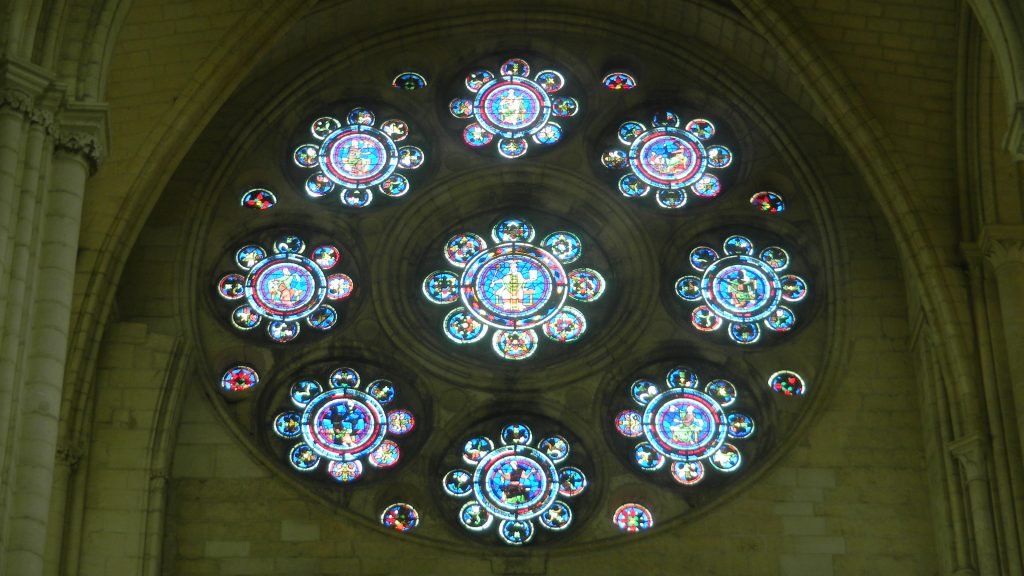
Although Timaeus wasn’t one of the most widely read books in antiquity, it became foundational in the Middle Ages and the Renaissance after it was translated into Latin in the sixth century CE. Several philosophers fused the Bible’s idea of God creating the world with Plato’s ideas of proportionate geometry. Laon Cathedral (below) had a school that was heavily influenced by Plato in the 12th century. Some of its stained glass windows imitated the perfect circle that he idealized.
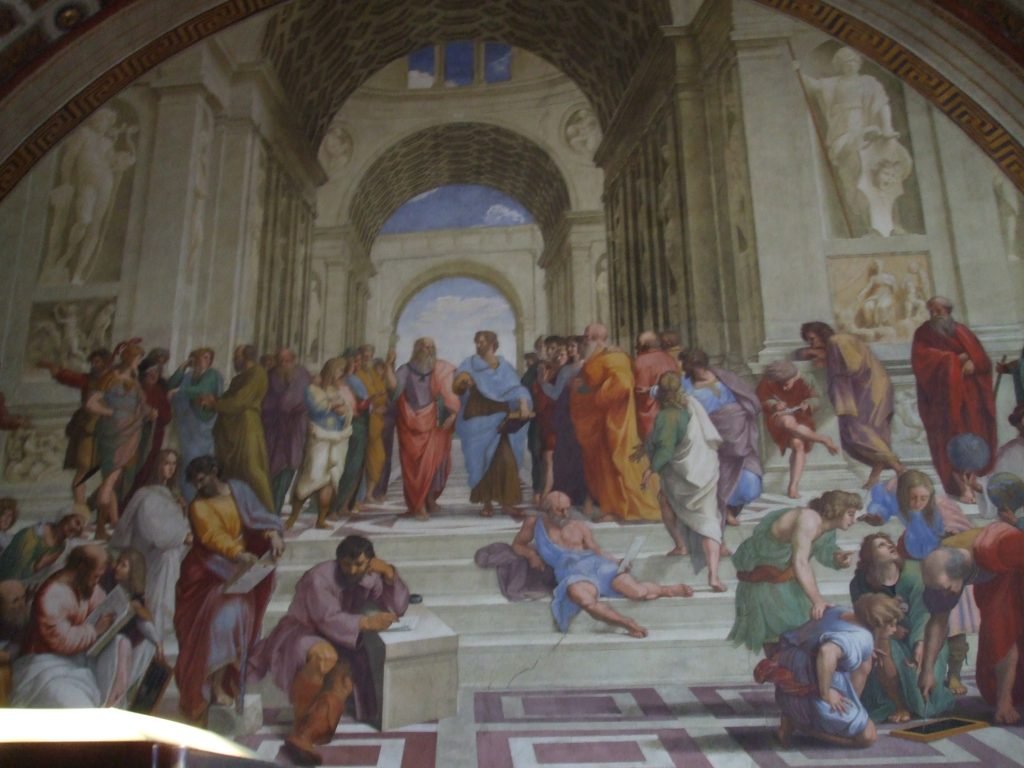
In Raphael’s famous depiction of Plato and his star student, Aristotle, debating about the nature of the universe (in the School of Athens), Plato is clutching this honored book in his left hand (in the center of the below shot) as he uses his right to point to idealized realms above people’s politics.
Aristotle later rejected Plato’s idea of perfect and permanent forms existing above the world of matter as too metaphysical and focused more on the dirt-under-your-feet world. He scrutinized many plants and animals, and Alexander the Great sent exotic samples to him as he expanded his empire in the East. Nearly half of Aristotle’s writings are about biology, physics, meteorology, and astronomy. In his book On the Heavens, he said that the science of nature begins with bodies and their magnitudes, properties, and movements rather than describing ideas subtle and invisible energies that later condensed into bodies, which many Indian thinkers considered basic.
He continued his emphasis on visible objects and their magnitudes by saying that a magnitude divisible in one way is a line, in two ways is a surface, and in three ways is a body. He then reminded his students that the Pythagoreans said that the universe and all that are in it are determined by the number three, and that three is the first number to which the word all is applied. Aristotle then said that three-dimensionality is the only one of the three magnitudes that can be complete, and that we cannot pass from a three-dimensional body to an entity with more dimensions, as we can pass from length to surface and from surface to body. He thus gave subsequent Western thinkers a superb expression of the ancient Greek focus on visible and distinct objects.
Aristotle thought that bodies are combinations of matter and form. Matter is the unqualified physical substrate, and form gives things their distinctness. Everything has the impulse to develop into its own physical form. Seeds thus grow into plants and fetuses develop into adult humans. Aristotle thus brought Plato’s ideas of forms down to earth and made them immanent in the things we observe. Both thinkers saw the explanations of things in terms of the final forms that they aspire to rather than subtle energies that flow throughout the cosmos.
Euclid, who lived around 300 BCE in Alexandria, Egypt, then wrote that the basic elements in geometry are the point, the line, and the plane and analyzed triangles, cones, and many other abstract shapes. He reinforced the emphasis on abstract and permanent forms that the first Greek temple builders, sculptors, painters, and philosophers treated as fundamental. Many communities in the West followed suit, including Rome. I was surrounded by stately circular and linear shapes almost as soon as I stepped outside its main train station (below).

Plato and Aristotle often focused on the visible world, proportion,, and linear relationships between distinct entities after several of their predecessors took steps into ideas of vastness and cosmic oneness, which were more mainstream in India. Several Greek thinkers imagined an infinitely vast universe, but like the traveling Odysseus longing for his wife’s embrace and his home’s warmth, they returned to what was visible and communally understandable. Their common view of the world had so many facets and was shared though so many media that it was too immersive to forget for long.
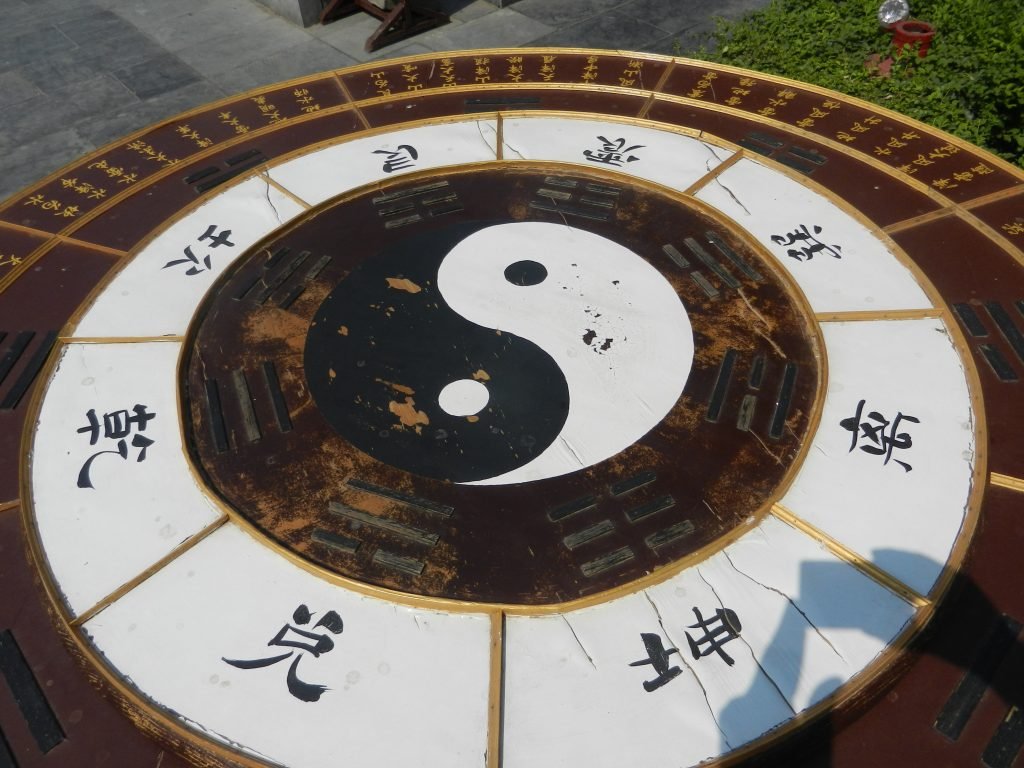
Their ideas have seemed basic because many experience converged to make them seem so. But other cultures have emphasized other ideas, which converged from their people’s shared experiences. Chinese concepts of circles have often been more focused on dynamic flows of yin-yang energies than the static outer perimeter. Chinese ideas of music have also reflected their cultural landscape.
So have Islamic ideas of a circle, Indian ideas of space, Southeast Asian ideas of harmony, African ideas of objects, and Native American ideas of domestic architecture. By looking At/With/Beyond and including ever more cultures, you can become increasingly free from one culture’s assumptions and enjoy conceptual flights that dance all over the world.