Several recent articles here explored depths in Westerners’ emphasis on abstract lines and distinct objects. But neither has been a central concept in China, where cyclic flows have been considered more primary. This assumption has been as deep, so we’ll dive into it.
One of the most basic concepts in traditional China for more than 2,000 years has been yin-yang. Most traditional Chinese thinkers have seen nature and culture in terms of cycles in which yin and yang change into each other. Different things, attributes, and domains are characterized by yin or yang patterns:
Yin Yang
passive active
dark bright
moon sun
interior exterior
female male
cold hot
down up
odd numbered even numbered
back front
matter energy
winter and autumn spring and summer
midnight noon
following & completing initiating
contracting expanding
wet dry
descending ascending
heavy light
trough peak
This list shows that yin and yang are not separate entities or states. They exist in a cycle in which they perpetually transform into each other. The whole cycle is more primary than distinct things, and things are conceptualized in terms of flows of its patterns of energy.
We can also see from this list that yin-yang does not refer to only one thing or one class of things. It characterizes all identifiable things, domains, and processes; they are thus not as distinct as Westerners have usually assumed them to be. When they share yin or yang patterns, they resonate with each other.
The body has thus been interpreted in terms of yin and yang:
Yin Yang
interior exterior
buildup of tissue breakdown of tissue
coldness heat
low energy hyperactivity
generation of blood
circulation of blood
substances, collagen, and fat metabolism and respiration
hypotension hypertension
deficiency excess
chronic acute
delicate features and voice strong features and a loud voice
a small and soft body a large and firm body
hormones and mucus secretion
The interchange of yin and yang integrates all things into a whole, which is expressed by this famous symbol:
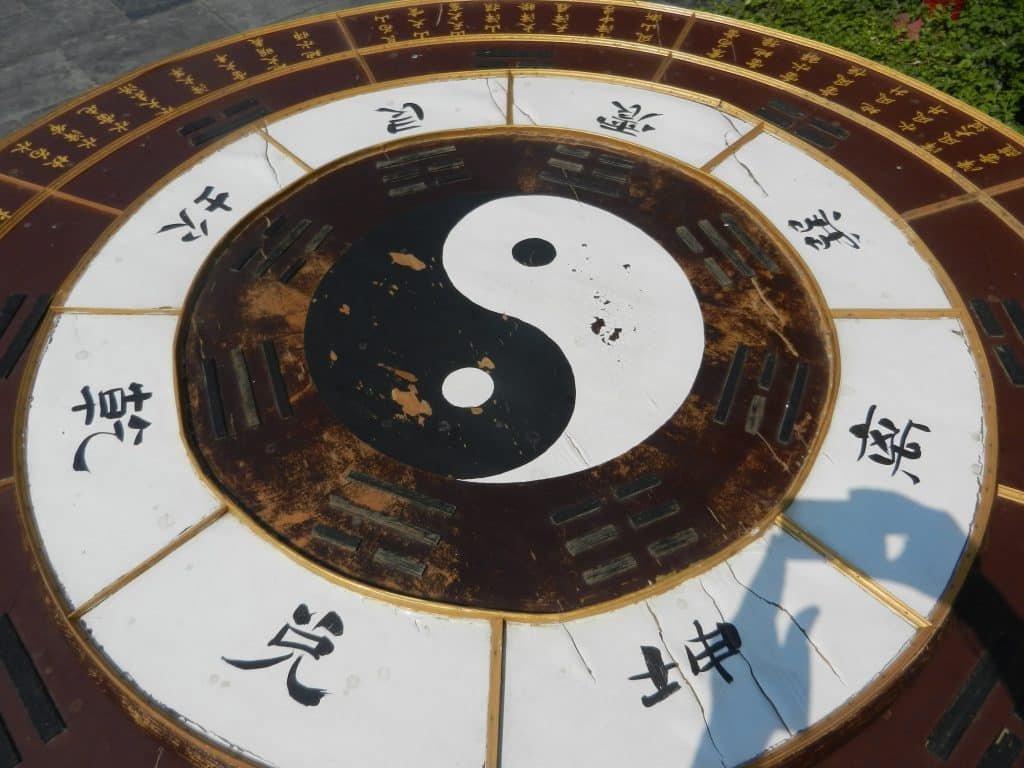
The dark side is yin and the light side is yang. The dark circle inside the light side represents the emergence of yin within yang, and the light circle in the dark side represents the generation of yang within yin. They’re therefore complementary rather than mutually opposed; each contains the seeds of the other. Thus a hyperactive temperament (yang) will exhaust itself and the person will need to rest (yin). Blood that is generated (yin) automatically circulates (yang). Processes are not separate. For more than 2,000 years, several of China’s traditional sciences have emphasized processes that are integrated into holistic cycles.
Traditional Chinese medicine has sometimes seen a middle-aged man with a bit of a paunch as the ideal of health. This can seem strange to people born in youth-loving, jock-worshiping America, but a 40-year-old who is neither muscle-bound nor disabled with a huge load of belly fat has a perfect balance of yin and yang patterns. Several athletic heroes and pop culture celebrities were luminous in their prime and feeble later in life. Muhammad Ali was full of yang as he thrilled fans all over the world, but it was depleted as he aged and suffered from health problems that probably came from all the blows to his head. Elvis was electrifying while young, but died at the age of 42 after years of eating yang-dominated high-fat foods that bloated his body and clogged his arteries. The ideal kind of health doesn’t exude too much yang energy at once. Instead, yin and yang flow in balance and continuously replenish each other.
The ancient Greek philosopher Heraclitus also saw the world in terms of balance between equal opposites, but he envisioned them in conflicts with each other, saying that warfare is the ruler of all. It’s the tension between two equal forces pulling a string from opposite directions that creates a musical note and which enables a soldier to string his bow. Empedocles saw Love and Strife as two equal and mutually opposed forces, which in turn integrate everything in the universe and pull them apart into separate regions. But yin-yang has been conceptualized as a cyclic flow of patterns of energy that transform into each other and which partly exist within each other. The primary changes in the universe flow in this cycle.
Traditional Chinese have focused more on a holistic universe as the source of the main changes in the world. Many ancient Greeks developed sharp eyes for distinct objects and clear distinctions and emphasized the permanent forms that structure them. Plato’s Timaeus superbly expressed this orientation in its description of the basic triangular shapes that everything in the world developed from. Ancient Greeks and ancient Chinese observed many of the same processes. Day and night alternate. So do summer and winter, sunshine and rain, and surfeit and want. Energetic and aggressive activities alternate with the rest that is especially needed by soldiers after battles and farmers after working the land all day. Ancient Chinese were more inclined to see the phases as parts of the same process, while Greeks usually saw them as more distinct.
According to the I Ching scholar Richard Wilhelm, the original character for yin meant cloud and thus overshadowing and dark. It was also associated with life-giving water and nourishment in general. The early character for yang depicted a yak’s tail or a pennant fluttering in the sun. Wilhelm thought that this meant something gleaming in the light, and more generally, something bright and energetic. He also thought that the character was associated with the political power of command that raises a banner as a symbol of authority. A classifier that meant mountain slope was then added to give yin the meaning the shady side of the hill and yang the meaning the sunny side of the hill. The states appear different but they’re not sharply separated from each other, since they’re regions of the same hill. The sinologist Derk Bodde thought people associated the ancient graphs for the two words with rain clouds and light rays from the sun. He justified this by writing that an agriculturally focused society would have closely observed climactic phenomena such as light and darkness, heat and coldness, and dryness and wetness.
By the third century BCE, Chinese thinkers were associating yin-yang with a wide range of phenomena besides climate and political authority so that they saw it as the most general way in which nature and society change.
This emphasis on cyclic flow has reflected many other ideas in China, including assumptions about the most basic elements in nature. Modern Westerners often assumed that the most fundamental elements are distinct entities and the smallest objects, before quantum physics emerged in the early 20th century. When atoms were found to be composed of electrons, protons, and neutrons, these smaller elements were then often seen as tiny objects. Early researchers in quantum physics were thus shocked to find that these particles behave like objects when they’re shot towards two slits at the same time and immediately observed at the slits (showing up as separate dots on a screen after passing through the slits) and like waves when they’re not immediately observed (they then show up as interference patterns that waves create, with peaks amplifying each other and troughs amplifying each other in certain spaces on the screen—they thus appear as dark vertical lines alternating with blank lines). This contradictory behavior (a particle is both an object and a wave) is baffling when sub-atomic particles are supposed to be distinct objects. Assumptions that particles are most fundamentally distinct entities have made quantum physics seem shocking.
But in China since at least the third century BCE, basic elements have traditionally been seen within a holistic cycle in which they change into each other, as yin and yang do. Traditional Chinese sciences have often emphasized five fundamental elements, which are called the Five Elemental Processes (wu xing). They’re wood, fire, earth, metal, and water. They are not separate objects; they can only be understood within a complete cycle of wood becoming fire, fire transforming into earth, earth becoming metal, metal changing into water, and water becoming wood. A.C. Graham, in Disputers of the Tao; Philosophical Argument in Ancient China, thus wrote that it’s more accurate to call them processes than elements. Benjamin I. Schwartz, in The World of Thought in Ancient China, wrote that they are better translated as actions or movements. They’re more accurately seen as transforming into each other within a holistic cycle than as distinct entities.
The third-century BCE philosopher Zou Yan synthesized this cycle with yin-yang, and since then, many traditional Chinese have seen this cycle as a basic model for all processes in nature. They flow in the cycle of wood, fire, earth, metal, and water.
This cycle has been correlated with many things that people can observe and experience. Please take a moment to think about the following list; it shows how this cycle has characterized a wide variety of domains.
Element: wood, fire, earth, metal, water
Direction: East, South, Center, West, North
Season: spring, summer, late summer, autumn, winter
Phase: growing, fruiting, harvesting, withering, dormancy
Activity: generating, expanding, stabilizing, contracting, conserving
Color: green, red, yellow, white, black
Climate: wind, heat, dampness, dryness, coldness
Musical note: C, D, E, G, A
Personality: creativity, enthusiasm, stability, determination, aptitude
Planet: Jupiter, Mars, Saturn, Venus, Mercury
Shape, rectangular, angular, square, round, undulating
Taste: sour, bitter, sweet, spicy, salty
These five phases make up a complete cycle. The idea that cyclic flows throughout the universe has a lot of depth because it characterizes all known natural processes and aspects of psychology. You can also see it architecture, painting, and language. Like the West’s emphasis on distinct objects and abstract lines, this focus has been reflected throughout the cultural landscape so that it has seemed most basic. We’ll explore how it has characterized Confucianism in the next article.