Dear Lord, let the people you love most live in this land! I often appreciated this old Bavarian prayer while savoring its beautiful mountains and old towns.
Of Bavaria’s towns, Augsburg has been one of the most prosperous. It was a key trading hub between Italy and the rest of Germany, so a lot of creative things happened there when the Italian Renaissance blossomed.
Many merchants and bankers in Augsburg did business with Venice. So as Venetians commissioned lots of great art with their boat-loads of money, people in Augsburg imitated them. The abstract lines and geometrical forms from Italy’s classical heritage were signs of prestige. So the good folks of Augsburg gave their city a Renaissance makeover.

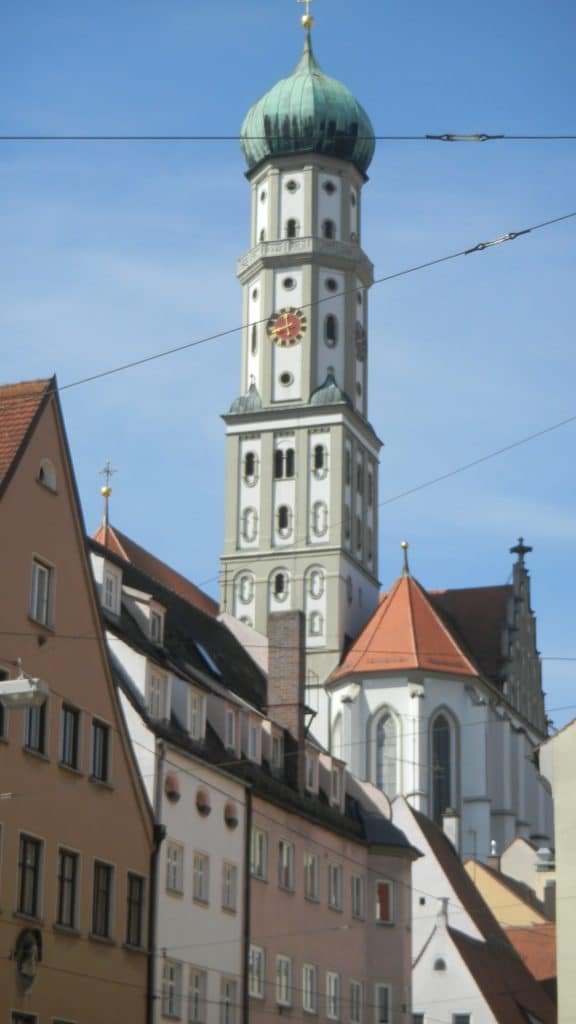
No space in Augsburg has been more public than Maximillian Street. It runs from the gorgeous basilica (St Ulrich and St Afra) in the above picture to its main town square. This was THE place for wealthy merchants to show off their new homes in the 16th century. Even the greatest northern European bankers of the time, the Fuggers, lived on it.

The street’s width and stately homes make it resemble Venice’s Grand Canal. Many of Augsburg’s citizens in the 16th century competed with their southern neighbor.

They built homes with wide frontages, which sported clear lines of large and straight windows. Like Venetians, Florentines, and Romans, people in Augsburg were stressing the abstract line and reinforcing Western culture’s assumptions that it’s a key basis of nature and society. Merchants in cities in Italy and north of the Alps associated it with social prestige and personal well-being. The rabble live in artless hovels.
But they blended these abstract forms with German culture. You don’t see any Roman arches in the photos. The windows are straight and orderly, like honest German merchants. Their owners were projecting themselves as people you can trust. During the Protestant Reformation, most people in Augsburg converted to the new faith, and they wanted to distance themselves from Rome.

But they were still Western. They selected forms from the Italian Renaissance that appealed to them. So when Augsburg decided to build a new town hall at the other end of Maximillian Street in 1609, its leading citizens approved the above design in which linear arrangements of tall and straight windows dominate everything but the crown. And the frontage’s divisions are as proportioned as a palace or public building in Venice, Florence, or Rome.
The people of Augsburg did make the crown fanciful. They did this in many of the homes in the picture above the hall too. A lot of German art has a split personality, with a dialectic between orderliness and dreaminess. You can also see this in the first photo in this article. The tower of St. Ulrich rises in clear linear sections and transforms into a more whimsical onion shape.
So people in Augsburg were inspired to imitate Venice, but they expressed classical arrangements of abstract lines in their own language. In the process, they added yet more variety to Western culture.
This happened in other German cities as well, including Heidelberg, whose castle received light from Italy. A simple abstract line holds infinite riches!
Heidelberg straddles the Neckar River, which flows into the Rhine, so it was an important trading hub. So when the Flemish sculptor Alexander Colin (1526-1612) created a classical-style facade for the Elector Ottheinrich, its forms inspired many artists in Germany who grew up in their land’s great Gothic and Romanesque traditions.
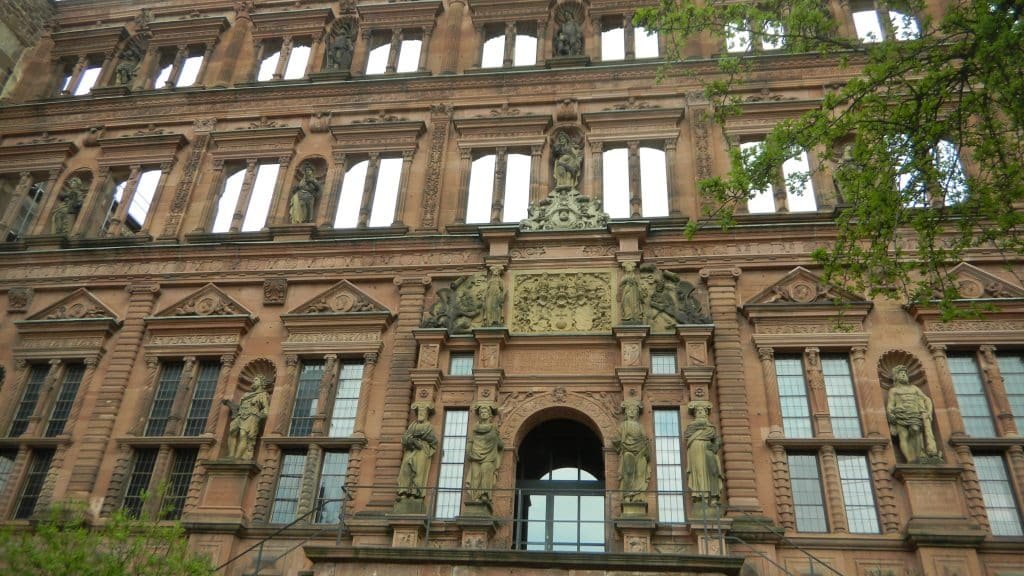
The building’s well-proportioned lines and stately sculptures were even more magnificent when it was inhabited. It had an audience chamber and a large banquet hall where the Elector could impress many guests.
And he wanted to impress them with his good government as well as his refined tastes. Greek gods and figures from the Old Testament embodied all the good things that he wanted his colleagues and subjects to identify him with.
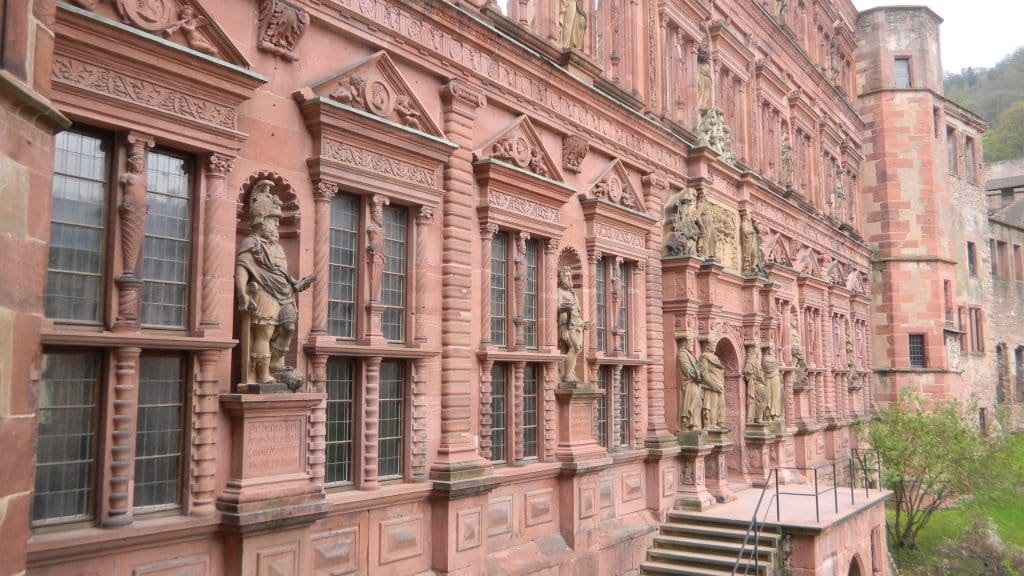
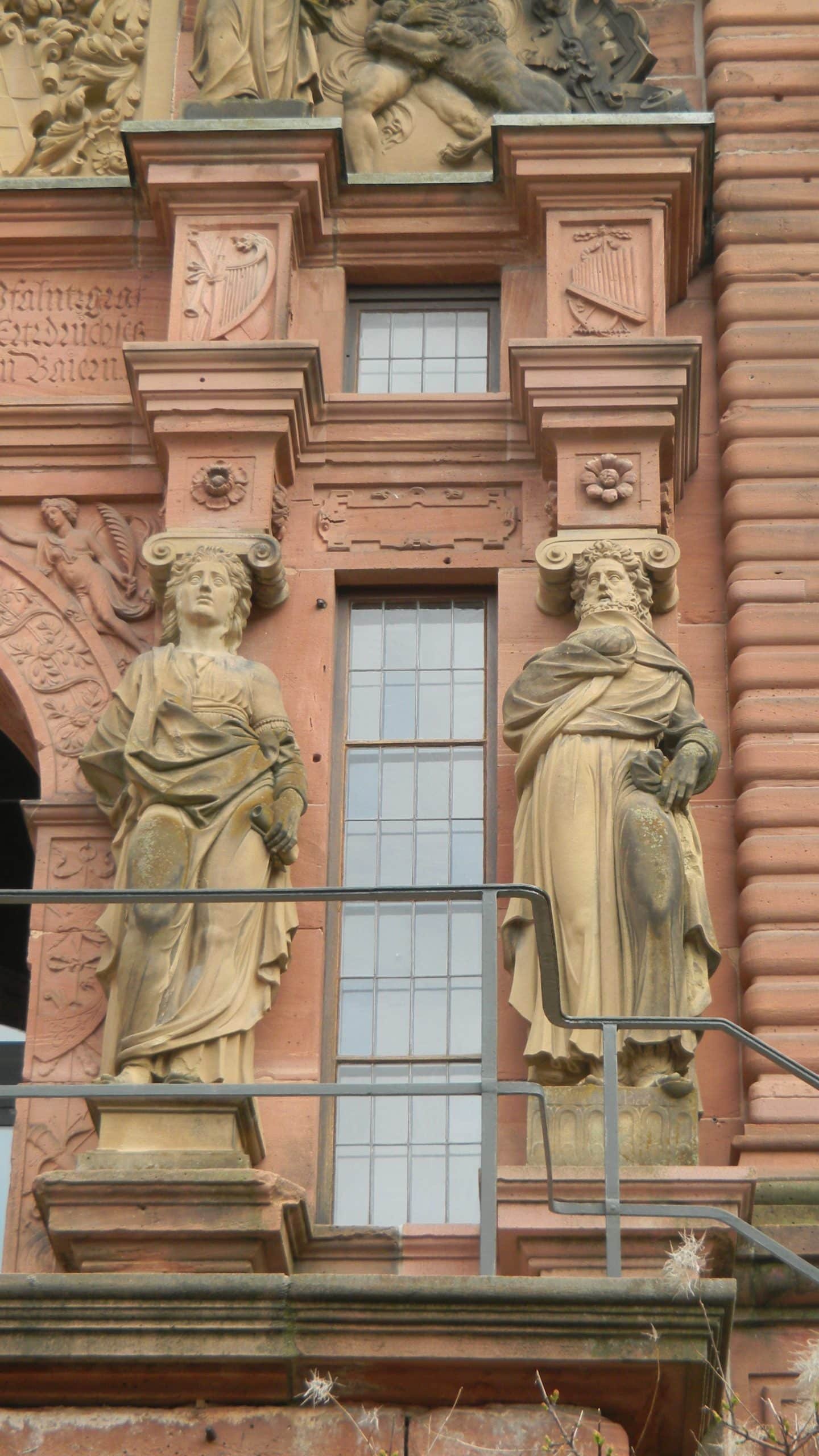
Sixteen allegorical statues were placed in a line on the four original floors. Each presided in a niche between a set of double windows. The niche’s form seems transported from buildings in Florence, like Orsanmichele.
The ground floor held symbols of military might including Joshua, Samson, Hercules, and David, who looks classically composed after conquering Goliath (below).
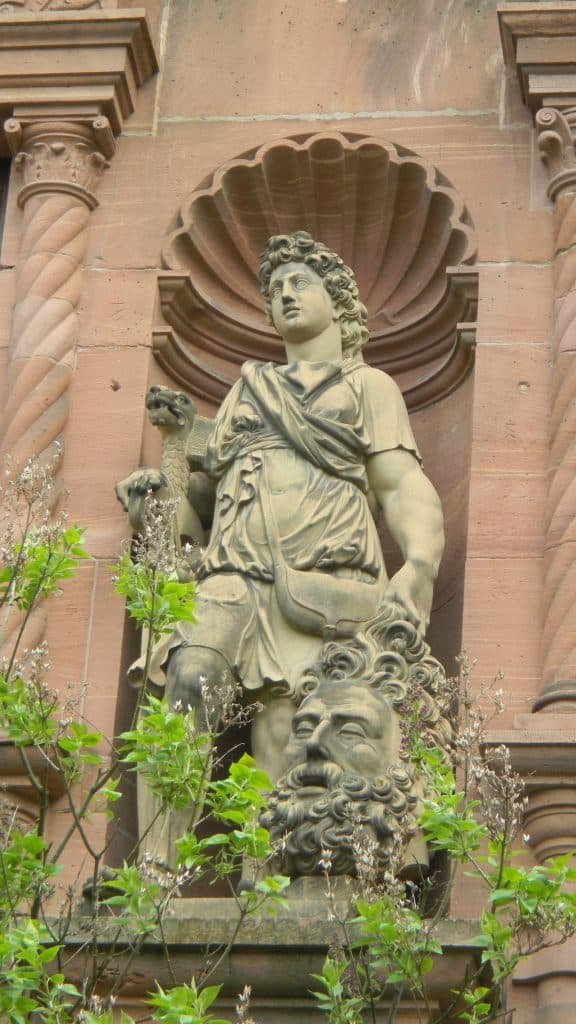
Faith, Hope, and Love (Christian virtues) were personified on the second floor. So were two virtues from ancient Greece, Fortitude and Justice. A good ruler should combine the values from all times.
And he should be in harmony with the universe, so the top two floors’ statues stood for Saturn, Mars, Venus, Mercury, the moon, the sun, and Jupiter. Uranus, Neptune, and Pluto hadn’t been discovered yet, so the Elector was aligning himself with the complete solar system.
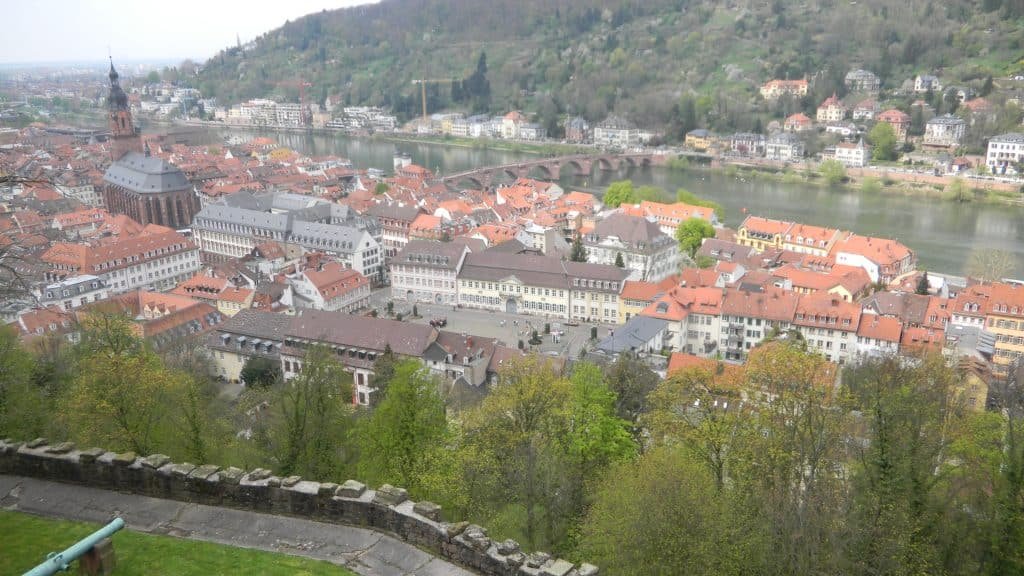
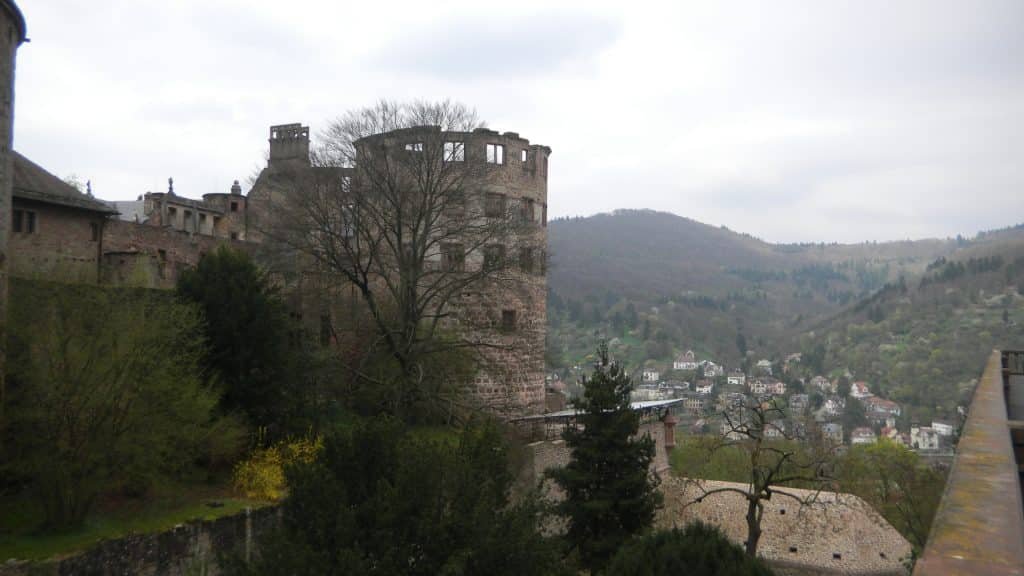
Above, you can see the view from Heidelberg Castle. The Elector arranged these hoary figures from classical mythology and the Old Testament in well-proportioned lines to project an image of a well-run universe. And the castle hovering over Heidelberg was a very powerful image–the Elector impressed.
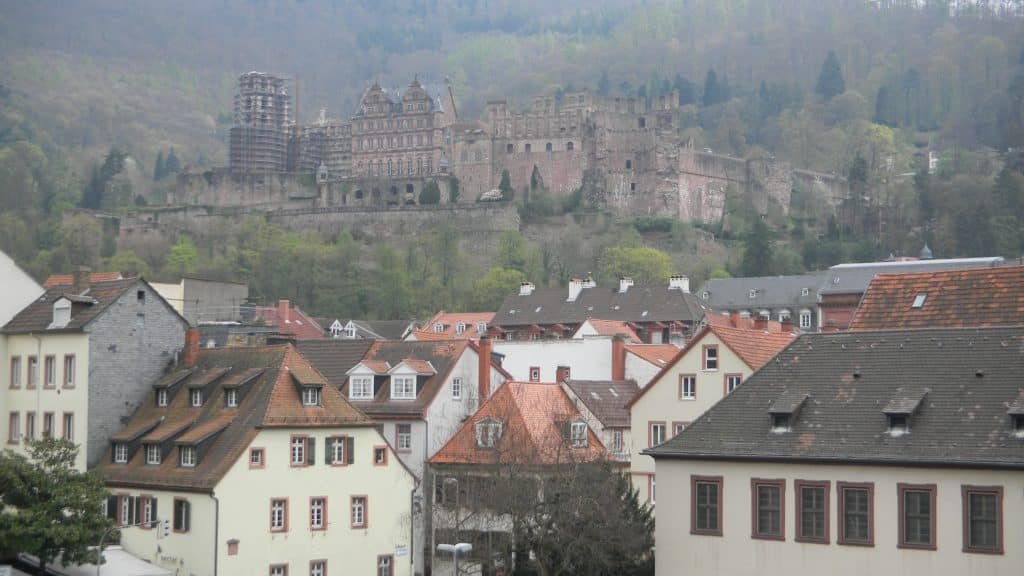
But as he reinforced the line and abstract shapes as key sources of meaning in Western culture, he made them even more robust by blending Gothic style with them. The coat-of-arms tablet in the above shot rests over the entrance, and its late Gothic forms add life to the facade and prevent from it being excessively symmetrical and formal.
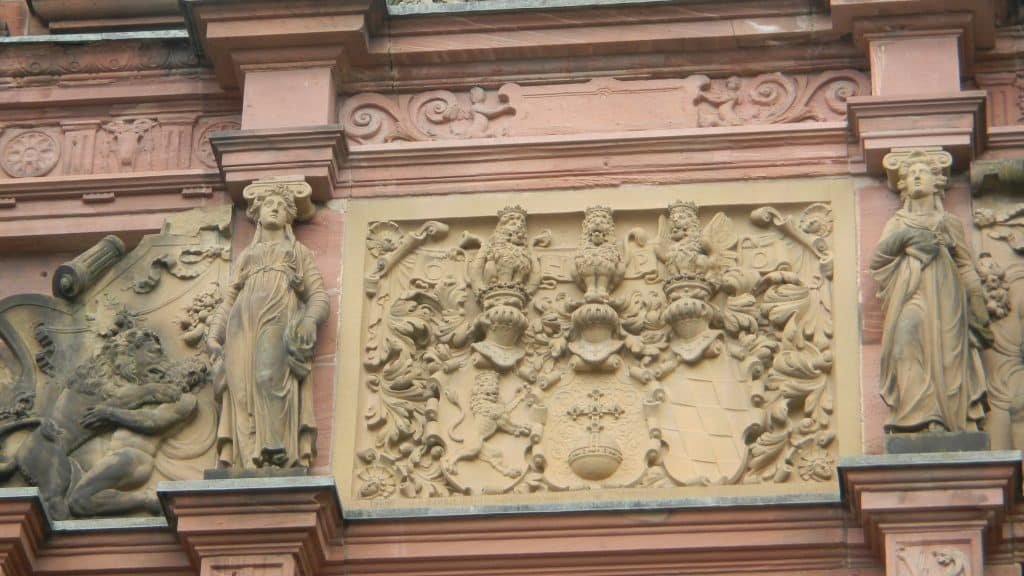
The Elector adopted forms from the ancient West, but by mixing German traditions with them and spreading them in northern Europe, he made them even richer.
So the more you examine the West’s focus on lines and proportioned shapes as nature’s and culture’s most basic forms, the more wealth you find in it. They seem basic, but like Thai temples, Laotian rituals, and African art, they take on infinite variations. Basic assumptions reflect a cultural landscape with infinite facets, which has roots in the ancient past. What seems basic reflects a whole world.