The Homeric poems are ravishingly visual; both are full of similes. The Iliad compares advancing troops to surging waves and a lion, and its battles contain many gross-out scenes. One man’s arms and legs are lopped off, and he rolls down a hill like a log. Whether beautiful or gruesome, every scene absorbs its audience in sensual details. The literary scholar Erich Auerbach wrote that there is no background in Homer; nothing is mysterious or half-said. Everything is clearly described, and every scene is equally important, whether it’s on Olympus or by a swineherd’s hovel.
The Rigveda, whose latest books (I and X) were probably composed around the time that the Homeric poems were, doesn’t emphasize lateral relationships nearly as much. It’s more centered on gods than on people, and the gods don’t interact in nearly as much detail. It doesn’t focus as much on description or narration. It emphasizes the ritual sacrifice and its efficacy. It sings of Indra freeing up the rains by slaying the massive serpent Vritra, but the narratives are short, without lingering over dramatic ups and downs, relationships with other gods, or visual details. Its orientation is more vertical than lateral. Its horizons are less hemmed in by the limits of interpersonal encounters and geographic locations.
Why did the Homeric poems emphasis details that people can visualize? Their audiences would have resonated with them.
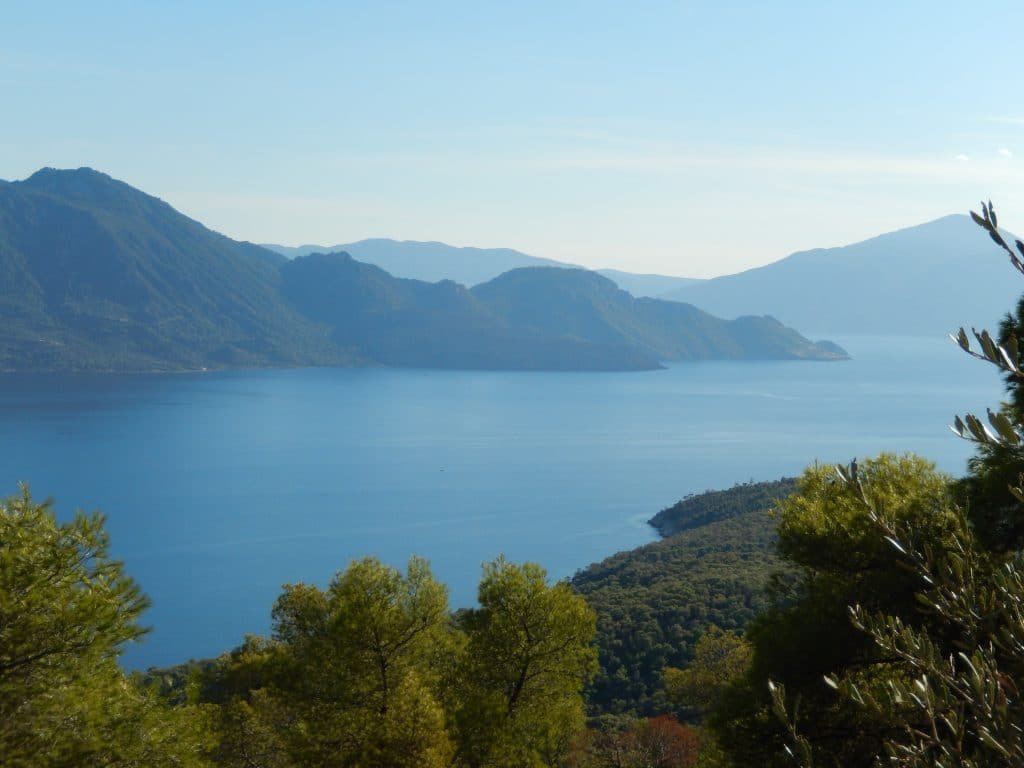
Early singers of the Homeric epics, called Homerieds, lived on Chios, which is an island off the west coast of Turkey. I explored Turkey’s west coast (a month after leaving Mauritius), which is characterized by small and separate spaces. Mountains and intimate little valleys separated the different communities that grew in ancient times. Settlements were distinct, and many routinely traded with each other and with lands as far away as Egypt, the Black Sea, and the western Mediterranean. People became oriented to the sea, and their gazes focused on clear divisions between domains. They scanned the horizon over the water, where they would have first sighted ships carrying goods or invading warriors. They also surveyed the clear coastlines which separated safe land from the unpredictable waters of Poseidon. They focused on what was near, distinct, and visible more than on the Rigveda’s vast sky or India’ abundant earthly energies and monsoons.
While staying in Nafplio, in the Peloponnese, I found myself focusing on boundaries. I sat on a pier that jutted from the old part of town and gazed out at the sea’s horizon. I scanned the bay and peered across the water to the coastline and the crests of the hills on the other side. I then imagined Agamemnon sailing outwards towards Troy and then back home, since his palace is supposed to have been a few miles inland.
People in ancient times watched those boundaries and distinct vessels because their lives depended on it. Are those ships appearing on the horizon driven by allies bearing goods to trade? Are they enemies intending to sack our town, carry off our women and children, and sell them as slaves? People lived by analyzing visual details and being perceptive enough to make correct decisions before visitors arrived. One of the most memorable stories from the Trojan War is of the giant wooden horse in which Greek warriors hid while Trojans brought it into their city, thinking it was a gift. Stories of hostile invaders deceiving the eye resonated with many Greeks.
However, ancient Greeks didn’t focus on precise details only because of fear; their landscape was stunningly beautiful. I took a bus from Nafplio to Epidaurus to explore its ancient temple compound for Apollo’s son Asclepius, who became the most popular god of healing in the fourth century BCE. The place was perfect according to the most widely shared Western aesthetics. The temples and dormitories nestled in a small bowl-shaped valley. Fragrant trees dotted the area, and gentle spring breezes filled the air with their scents. The simple rectangular and circular temple foundations and the straight columns which rose in lines blended with the natural surroundings so that no single thing dominated anything else. Buildings, hills, and trees were exquisitely proportioned with each other, and all were human-scale rather than huge and overwhelming. Being there simply felt good.
I still savor the images from all the Greek islands I visited. Hydra’s white stone houses, red tiled roofs, craggy slopes, sparkling sea, and little fishing boats stood out clearly and shone under the sun.
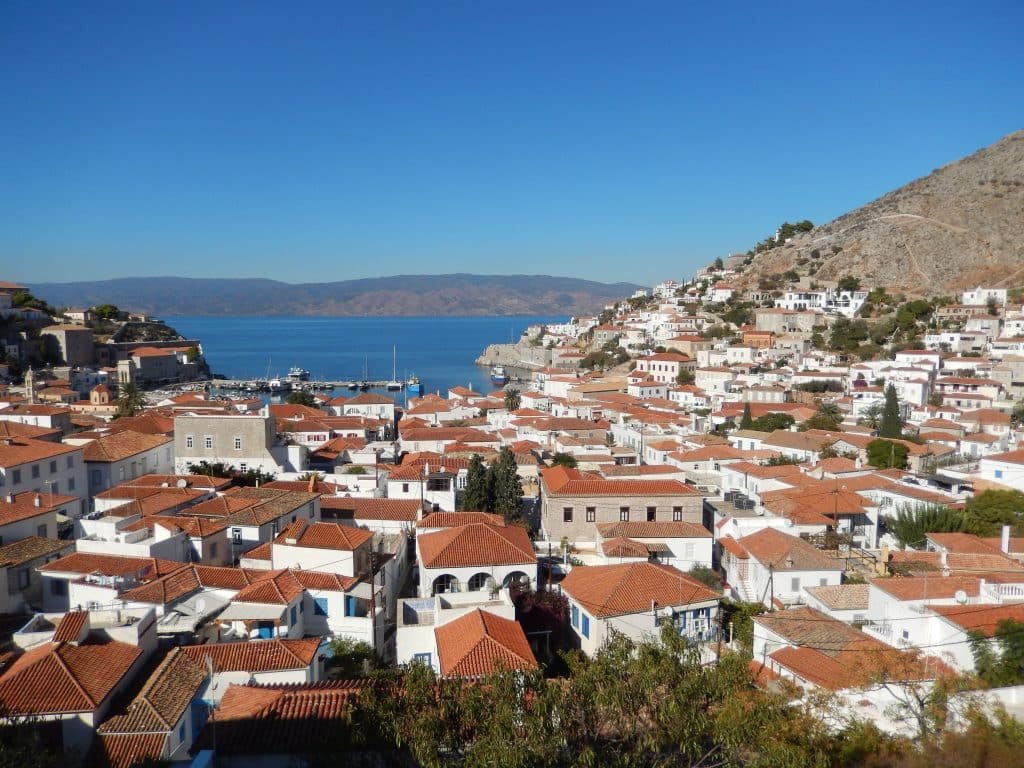
All were in scale with the friendly “Yassos!” greetings from the locals, the old men riding donkeys, and the house painters who asked me to play guitar for them after they finished their day’s work and then rewarded me with a glass of orange liqueur. Everything was in clear view.
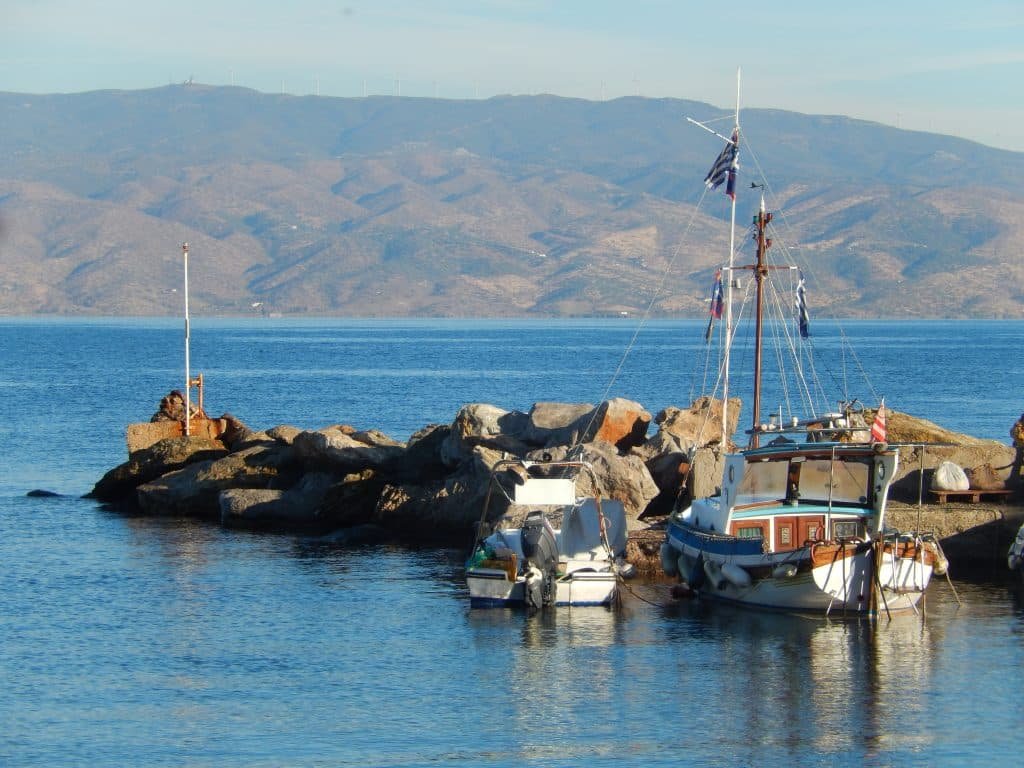
Nothing was overwhelmingly large or extravagant, and the existence of each thing as a distinct and human-scale object seemed heightened and transcendent.
Most Greek islands are small and within quick sailing distance from each other. While at sea, I found myself watching the water’s edge for islands, even when none were in sight. A landmass always appeared quickly. In a clearly outlined form that seemed as permanent as the abstract geometric shapes that the ancient geometer Euclid analyzed, each island represented security and civilized life.
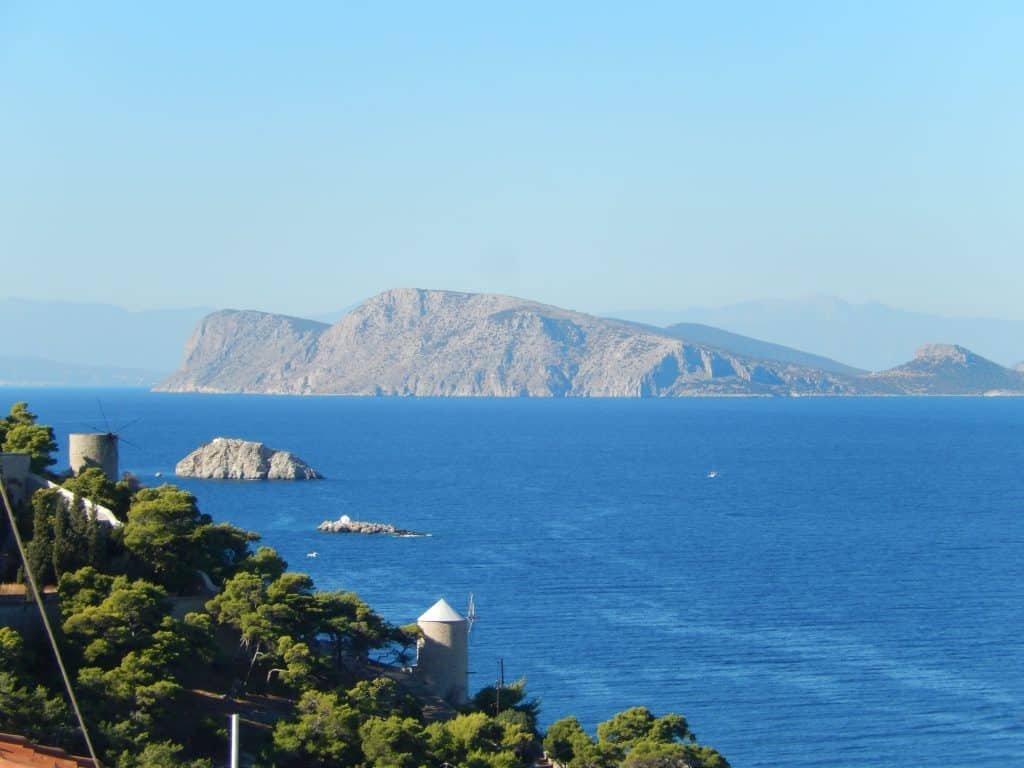
Long before Greeks formalized stone temples, Homeric verses in geometrically proportioned rhythms, and Euclidean geometry, the clear and permanent shapes of the landmasses standing out in the sunlight represented stability and well-being. Land within sight meant closeness to order, community, and farms.
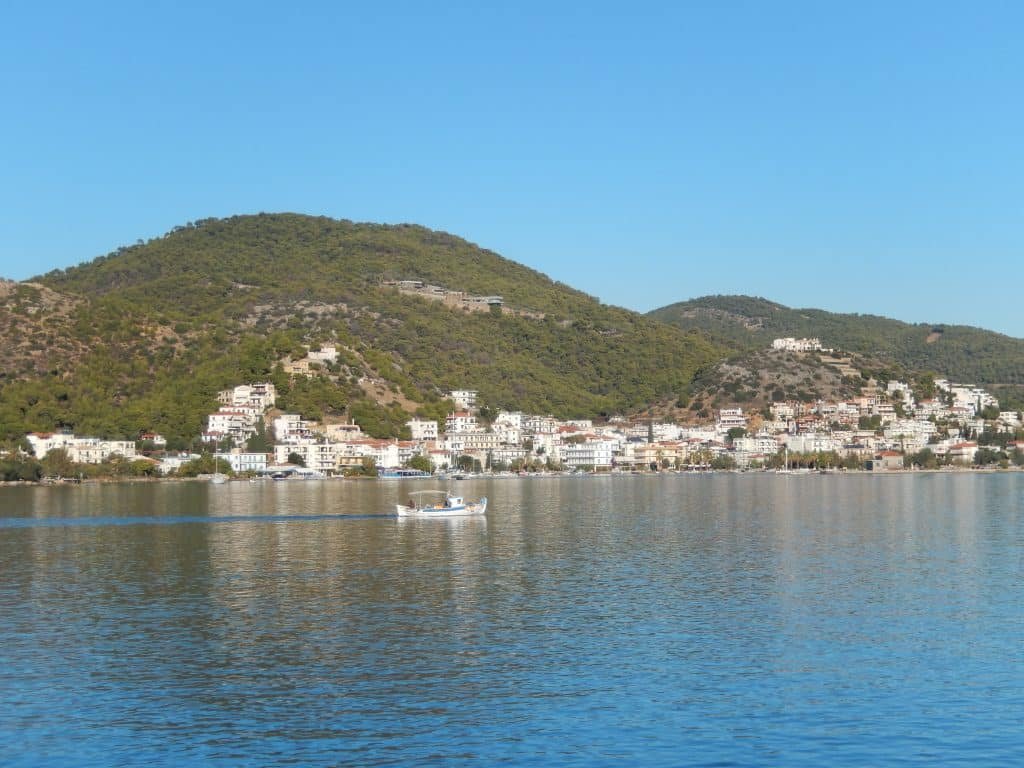
Although the sea was central in Greeks’ world, many distrusted it because it could quickly become stormy, and its fogs sometimes enshrouded people in a murky darkness called skotos, which took away the visual clarity people depended on. Skotos was often contrasted with fundamental ideas in navigation, including tekmor (the voyage’s destination, and in general, the goal of an endeavor) and poros (the pre-planned path of the voyage, and when fogged in, the shortest route out of the mist). A sailor trapped in a storm or a fog would look for the poros which would take him to his port of call, the tekmor.
So throughout the Greek world (on Turkey’s west coast, the Greek mainland, Aegean islands, the southern Balkans, Sicily, and southern Italy), people settled into little communities that were distinct, and they became used to focusing on visual details in the surroundings. They didn’t experience India’s monsoons, jungles, deserts, or Himalayan peaks which soar more than three times higher than Mt. Olympus. Would Zeus have been jealous or frightened there? He probably would have preferred to remain on his own mountaintop; it was close enough to human society to allow him to observe people and spot pretty women to pursue.
Throughout the Greek world, a shared way of perceiving and thinking developed. People focused on clear boundaries, distinct domains that were human-scale, distinct objects that were easy to visualize, and permanent abstract shapes and lines. These were sources of safety and standards of beauty. Early Greek literature expressed this kind of environment. Their opposites were often considered dangerous and ugly.
Another little Greek island showed me yet more facets of the origins of Western thought. Agistri rises about 25 miles north of Hydra, so I boated there to hike to its highest point and immerse myself in its natural landscape. The soil was thin and full of stones, as it is on many of the islands and the mainland. I could imagine an ancient farmer cursing as he stooped to pick up yet another heavy rock while the afternoon sun battered him.
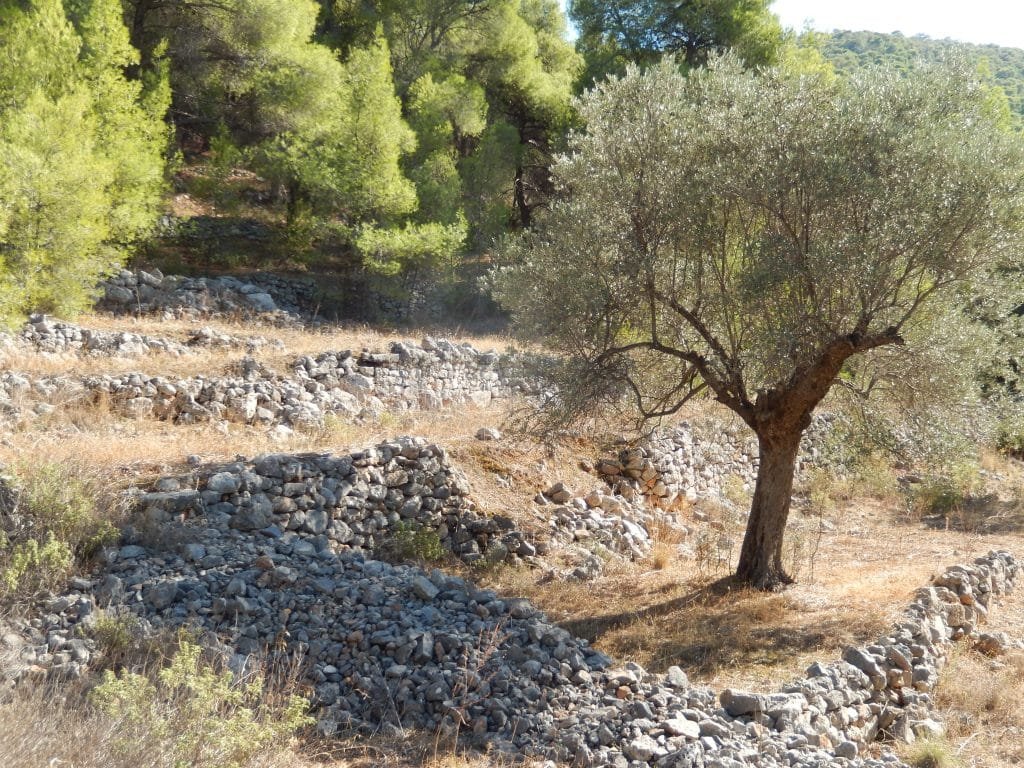
Because nothing around me was luxuriant, I found myself appreciating the beauty of little things more deeply. While hiking up Agistri’s hill, the sunlight shining on the back of a bee hovering in front of me made its little yellow hairs sparkle. The light on fresh green pine needles gave each one a crisp outline. The contrast between trees’ shadows and the footpath’s unshaded parts was equally dramatic. The nearly white stones and the reddish-brown earth that surrounded them were also in balance by occupying roughly equal areas which were clearly distinguished from each other.
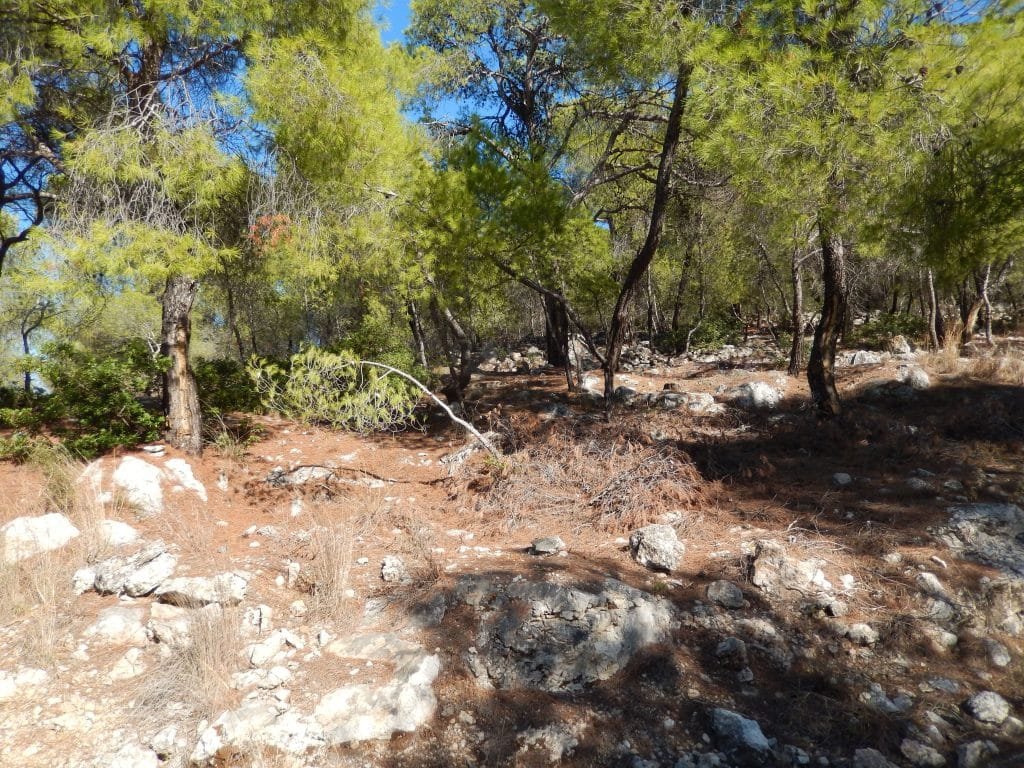
I also experienced this sacred balance through other senses. Instead of feeling enveloped by India’s density of energies and forms, I could enjoy each sensory impression on its own so that every stimulus seemed like a distinct object. The aromas of pine trees were sweet. Occasionally the horn of a ship or the chirping of a bird pierced the air.
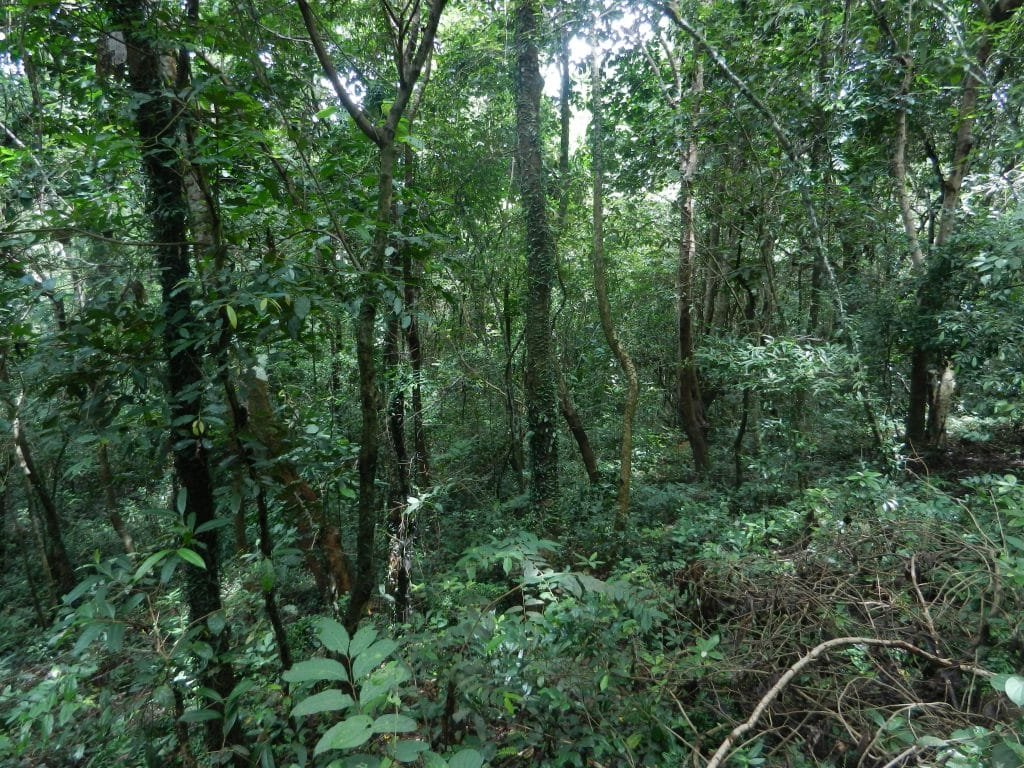
In Indian and Southeast Asian cities, jungles, and agricultural fields, the many sounds often fuse into a constant hum (the jungle in hills near Angkor, Cambodia is shown below).
Each sound is more distinct in Greece (outside modern Athens and Thessaloniki) and locatable in an individual object.
Those clear surroundings made my dinner after walking back to the beach more pleasurable. A lot of Greek cuisine has this simplicity. I’ve enjoyed Greek salads in Greece more than in California. Restaurants in my home state often add ingredients to the cucumbers, olives, onions, tomatoes, and feta cheese. A server in Athens and I agreed that this ruins them. The distinctness of all the ingredients should be cherished. Flavors should not be in copious blends, as they usually are in Indian curries. The calamari and the bread which I dipped in olive oil perfectly complemented the salads because their flavors were also simple and fresh.
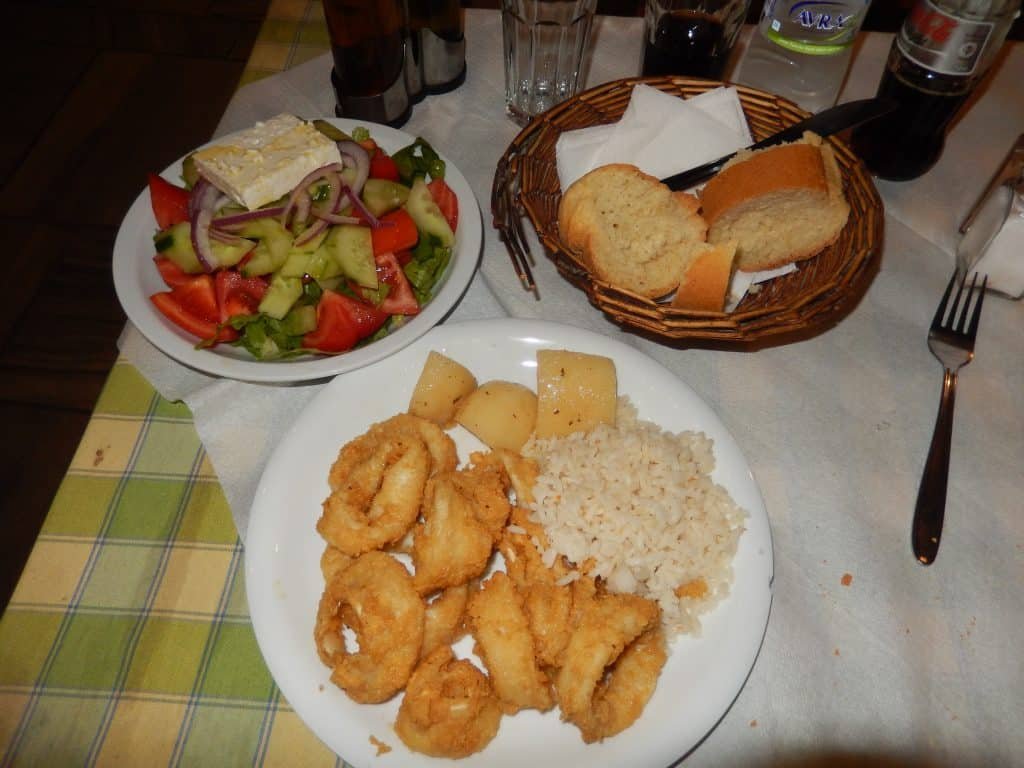
After a hard day’s work, ancient Greek farmers enjoyed similar fare (without tomatoes, which were later imported from the New World). They were proud of their ability to savor life’s little pleasures, and many felt disdain for habros (luxury). They saw it as decadent and unmanly.
It’s easy to take the West’s orientation to vision, distinct objects, static geometric shapes, and proportion for granted. But other cultures have developed equally fascinating ways of perceiving and thinking about their surrounding, including China, Southeast Asia, India, and Africa.