The road from Djoser’s step pyramid at Saqqara to Khufu’s Great Pyramid at Giza is one of the greatest stories in cultural history. Within 100 years of the former, the greatest pyramid ever was built. It proudly rises with straight edges, rather than steps, at a 52-degree angle, and it soars to about two and a half times the height of Djoser’s pyramid. How did this progression happen so quickly so long ago?
King Sneferu is the main link. He’s been called the greatest pyramid builder because his constructions add up to more mass in stone than the Great Pyramid at Giza. Yet he’s little known.
Energize your Ka! We’re about to explore his work.
1. Sneferu founded the Fourth Dynasty (2575-2465 BCE), and he reigned from 2575 to 2551. The builders of the pyramids at Giza were also from this dynasty.
2. In addition to founding a new dynasty, Sneferu built three pyramids that are much larger than Djoser’s step pyramid. Sneferu wanted to do monumental things that nobody else had done.
3. He built his first pyramid at Meidum, about 40 miles south of Saqqara. At first it was a step pyramid, with seven layers. An eighth level was then added. For some reason, Sneferu abandoned Meidum and began building a pyramid at Dahshur, about five miles south of Saqqara. He later returned and transformed the Meidum monument into a true straight pyramid, but he started construction at Dahshur first.
4. So when Sneferu surveyed Dahshur, only two pyramids had been built in Egypt, and both were in the step form. There was no blueprint for what Egyptians were about to do.
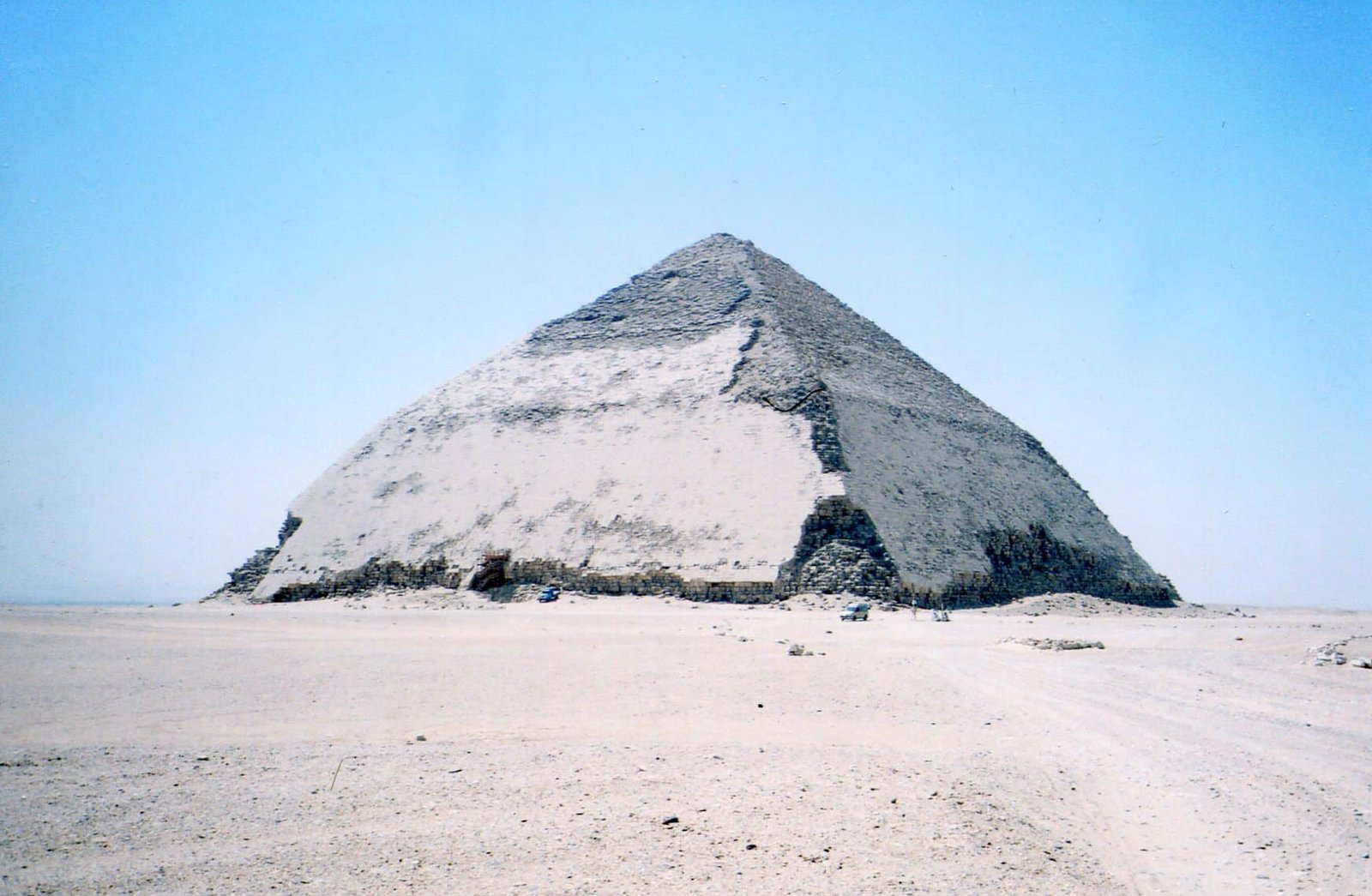
5. Sneferu began building what’s known as the Bent Pyramid.
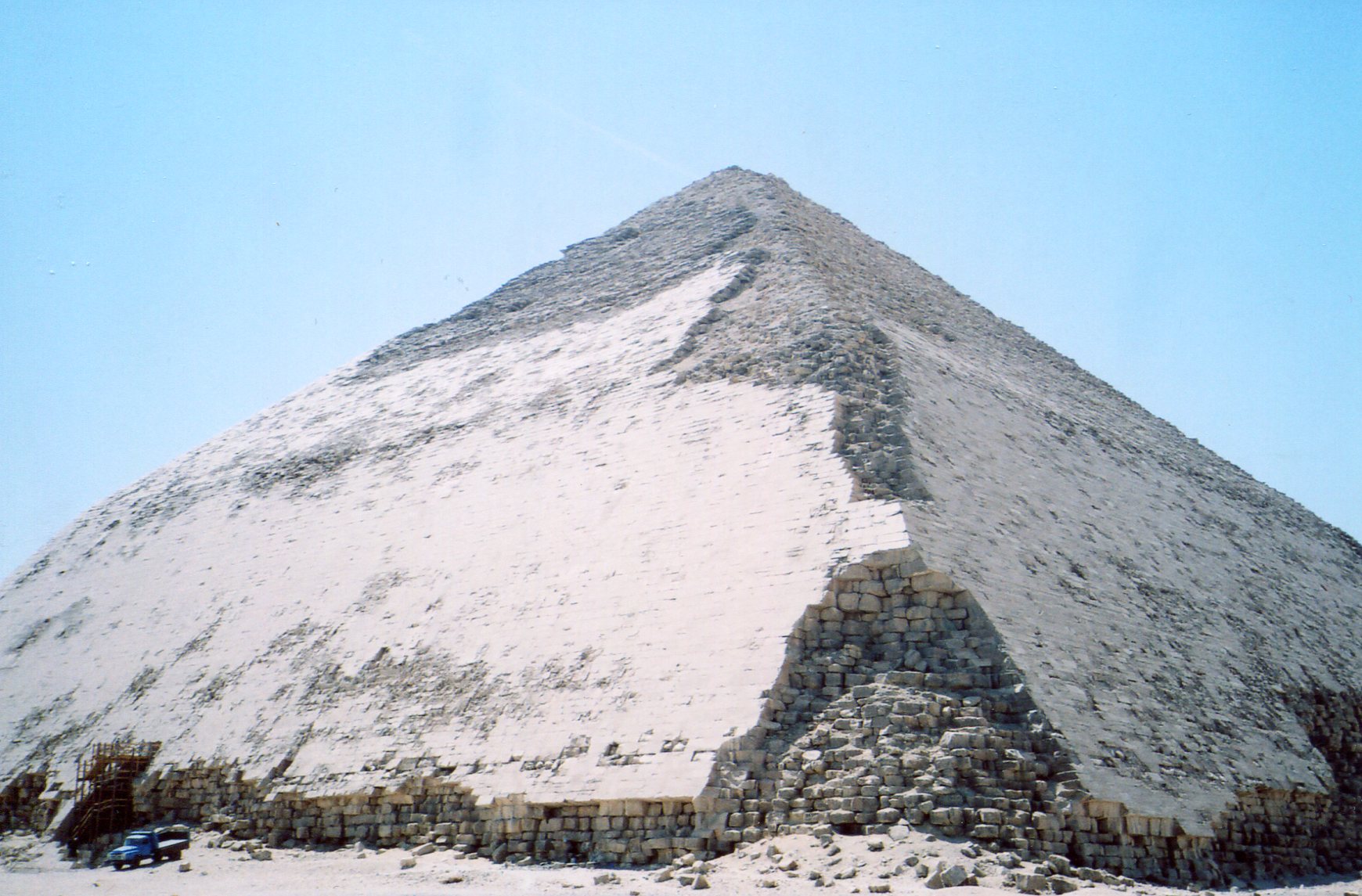
6. But the desert foundation was unstable. Some of the construction methods were also unsound. Stones weren’t evenly laid next to each other, and large spaces between them were filled in with limestone debris.
7. Gypsum mortar was only beginning to be used more frequently. It had to be prepared with fuel, unlike desert clay mortar.
8. So the combination of the unstable foundation and careless building methods made people realize that they had to shorten the angle of climb when they were half way to the top, since parts of the pyramid were beginning to crack. If Egyptians didn’t yet have the expression, “Oh shit!” they must have invented it.
9. So the road to the Great Pyramid at Giza was a trial and error process.
Though Sneferu’s Bent Pyramid looks clumsy, it was magnificent to behold. It rises to 345 feet–a heck of an improvement over Djoser’s Step Pyramid (197 feet).
But Sneferu was unsatisfied, and he didn’t take frustrations lightly. He went back to Meidum and transformed its step pyramid into a true one, and he also began building a pyramid about a mile north of the Step Pyramid. The latter, the Red Pyramid, is one of the world’s greatest buildings, and perhaps the most underappreciated pyramid. It was the last major step on the road to the Great Pyramid at Giza.