
The gods in the Rigveda were a colorful lot, and they made up a group that was uniquely Indian. The most frequently honored was Indra, a sky god associated with rain, thunder, and heroism in battle. He was a lusty fellow who loved feasting and his own honor, as Zeus did. He was often accompanied by the Maruts, who were lesser storm gods which rode chariots and sang war songs as they helped their leader in his frays. They were associated with storms’ tumultuous energy, including thunder and lightning. Indra and his Greek cousin were what male warriors dreamed of becoming.
Sri Aurobindo felt that Indra’s name also had inner meanings. On the surface, he was a warrior who overcame all obstacles, but on a deeper psychological level, he was the power of the mind to overcome distractions and reach spiritual enlightenment. Most historians think people prayed to him for wealth and victory, but Aurobindo felt that at least some invoked him for spiritual growth.
Agni represented fire, which consumed sacrifices and transformed them into smoke that rose heavenwards. He also dwelled in the home’s hearth and the tribal fires, and was thus an intermediary between people and the gods. Vedic composers also called Agni “water born” (apam napat). He existed in plants, and when people burned them, he rose into the sky. Plants fuel fire and water nourishes plants, so Agni was identified with the entire growth cycle. He was different from the Olympian gods by being an energy that was everywhere rather than concentrated in a single personage which was easier to portray in sculptures and paintings. His identities could range throughout the cosmos, and people could associate him with its all-pervasive energies.
Indra slew Vritra, a representative of primeval darkness who assumed the form of a giant serpent that blocked the rains from coming (the name Vritra meant obstacle). Indra thereby restored the monsoons which ensured that orderly society could thrive year after year. In How to Kill a Dragon; Aspects of Indo-European Poetics, Calvert Watkins wrote that fighting and conquering a dragon or serpent and thus ensuring cosmic order and human prosperity was a basic theme in ancient poems in many Indo-European languages from India to the Celts. The power of the Indian monsoons and their contrast with the oppressive heat and the parched land they drench gave this story extra dramatic force.
Varuna was especially mysterious. He represented the universe’s order (rta), including the coming of rain each year, just political rule, and the assurance of fair economic exchange. He ensured that days, seasons, and markets predictably revolved so that societies could exist, and was thus also associated with the sun and the rains. But his personality was often more aloof than Indra’s. People had to live in accordance with rta, and they needed to appease Varuna if they violated customs. Since he wasn’t as lively or as easy to visualize as Indra, he might have been more difficult to placate with food and drink. He was associated with the vast sky (a root meaning of the name Varuna is one that covers), and was thus all-seeing and more impersonal than a god imagined as a full-blooded warrior.
Several other gods in the Rigveda were also characteristically Indian by representing vastness. Savitar was associated with the sun and was seen as a catalyst for cosmic energies—his name means The Stimulator. As such, he energized and brightened the environment as the sun rose, when he impelled beings to action. Savitar was also associated with the starry night and thus helped prompt people to go to bed and generate offspring.
Aditi was The Boundless, and the first book of the Rigveda called this god the father, mother, and son. S. Radhakrishnan said that Aditi was all gods, whatever has been born, and whatever will be born. This deity empowered nature’s transformations and generated the energy in fire. Aditi pervaded the universe and was the source of life and an energizer of its processes.
The Ashvins were a pair of helpers who rode a flying chariot. They could bring agricultural abundance, victory in battle, births, and health. They were also associated with a spiritualized honey called madhu, and they carried it to other gods. Because their chariot could dart anywhere, they were present in the sky, the earth, the sea, plants, and mountains.
Soma was also impersonal and unbounded. This plant juice, which was probably either a hallucinogen or a stimulant, was mixed with water and often milk, and it inspired mystic visions in priests who recited Vedic verses. Soma could be consumed anywhere Vedic rituals were conducted, and it transported people’s consciousness beyond the here and now.
The Rigveda bespeaks a different world than ancient Greece’s Olympian religion, which often saw gods as super-sized people with beautiful muscled bodies who resided in specific places. Many of the Rigveda’s gods were imagined more as energies that range throughout the universe.
In contrast, fans of the ancient Greeks have often praised them for imagining the Olympian gods to be so realistic that they seem human. They were so vivid that I can imagine them having a Facebook conversation.
Aphrodite: I just updated my wall photo!
Zeus LIKES this.
Hephaestus: I’m going to see the doctor about my leg tomorrow.
Hera: I’m cooking spanakopita with mizithra cheese tonight. Zeus! Where the hell are you?
Hermes: Thanks Facebook for putting me out of a job!
Artemis: I’m going to relax with a nice bath now.
Zeus LIKES this.
Dionysos: I’m throwing a party this weekend. Pentheus won’t be able to make it because he lost his head at the last one. So there’s a space if anyone wants to go.
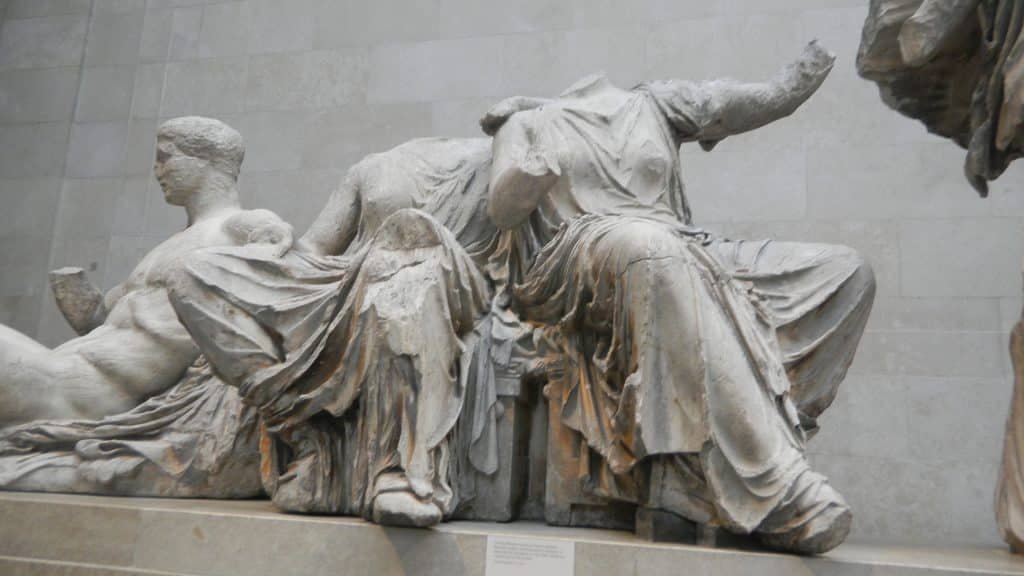
The Greeks saw their gods in such vivid and human-like ways that you can transpose them into the most modern settings and find them fully at home! Ancient Indians more often imagined their gods in terms of the universe’s vastness and its pervasive energies. Both civilizations in their formative periods already had highly developed ways of imagining divine powers, and these ways reflected their unique cultural landscapes.