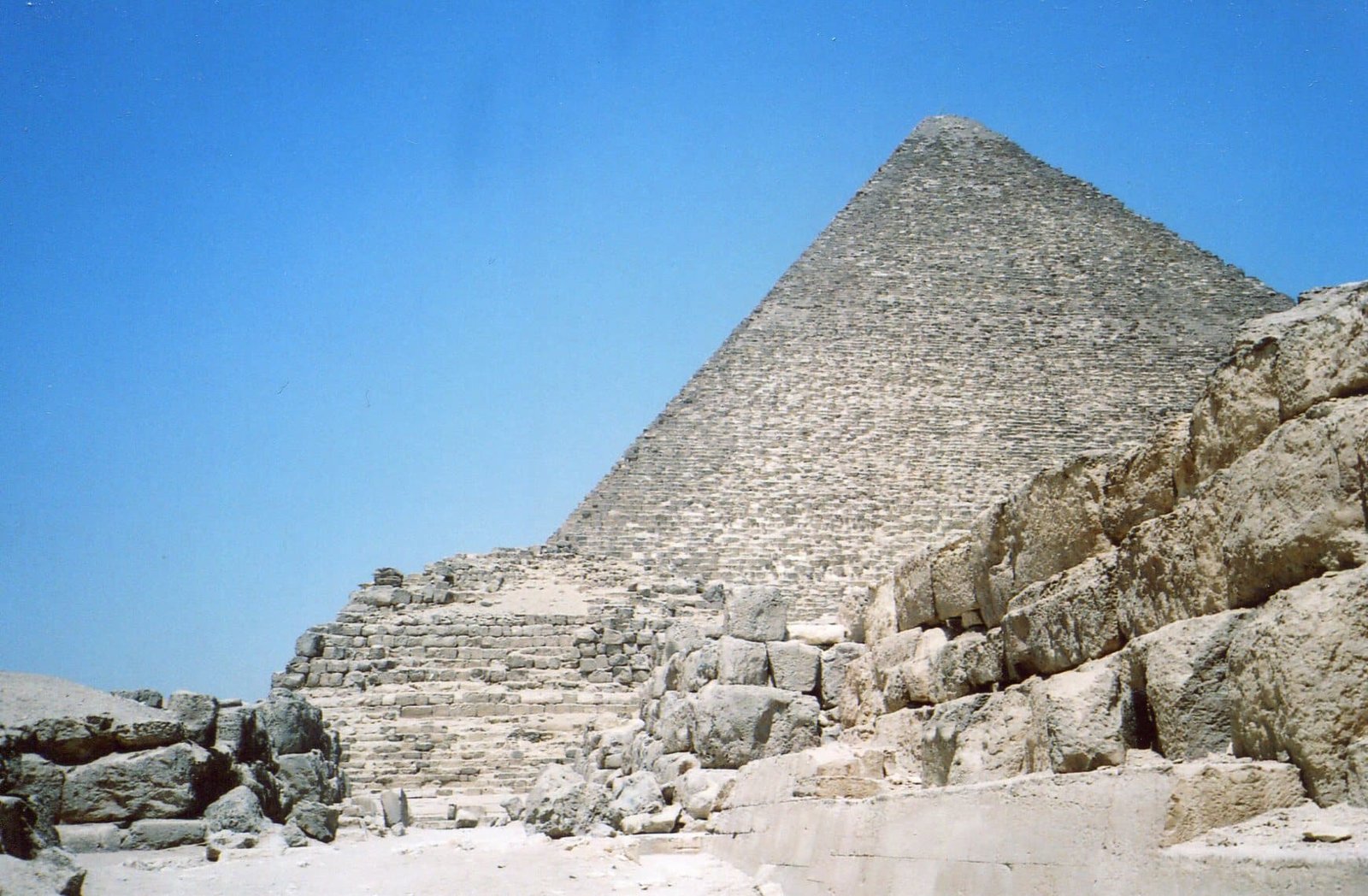
On the surface, the meaning of the pyramids at Giza can seem simple. Most historians have said that they represented sunrays that transported the king’s soul to the stars and that this preserved Egypt’s well-being. But a unique mixture of ideas converged with this belief into a fertile view of the world which set standards for Egyptian thought and art for more than 2,000 years.
One of the most influential Egyptian cosmologies came from Heliopolis. In the beginning, all was water. This primeval ocean was called Nun. The creator of the cosmos, Atum, emerged from the water and found a rising mound to stand on. Egyptians associated the expanding initial mound with the land emerging around the Nile after its waters receded. The soil was now fertile enough to allow the crop growth that sustained life and civilization. Priests at Heliopolis, Memphis, Hermopolis, and Thebes all claimed their cities as the site of this original hill.

Atum sneezed and spat (masturbated in other stories), and the first pair of gods emerged: Shu (the god of air and wind) and Tefnut (the goddess of moisture and mists)—their names mimic the sounds of sneezing and spitting. They conjoined and begot Geb (the god of the earth) and Nut (the sky goddess). The latter was sometimes imagined as a cow. She was also painted as a woman with the stars passing through her body and emerging from her womb. Geb and Nut then begot two pairs of consorts, Osiris & Isis, and Seth & Nephthys.
Osiris was associated with water, agriculture, the fertile lands around the Nile, and the afterlife, and Seth with the desert and raw power. Seth slew Osiris, but Isis wandered the land, seeking her brother. After reaching him, she helped revive his vitality, which empowered crops to renew. People conducted commemorative rituals for Osiris to enable the Nile to flood and crops to grow each year. As the river receded, they gathered on the shore, offered gifts, and expressed grief over his death. When it rose, they floated little shrines on it, and priests poured sweetened water into it, declaring that Osiris was found again.
Pyramids were associated with the primeval mound as the source of creation. They were also linked with the restoration of the land’s fertility and with renewal in general. But they were also associated with other ideas.
The horizon where land and sky meet when the sun rises and sets was also a central concept. Egyptians called it akhet. This was where the sun rose into the sky from the underworld in the morning and where dead people were transformed into the eternal afterlife. It was also where the sun set in the evening, and its hieroglyph represented the sun appearing between two mountains. Akhet was also where the king was reborn, and it was thus associated with his pyramid. Both ideas shared the meaning of ascending into the sky. The sun’s and the ruler’s regeneration were linked with the order of the whole universe.
This order was called Ma’at, and it promoted everything good, including the Nile’s flooding, the growth of crops, social justice, human fertility, and beauty. In general it meant cosmic, political, and moral order.
The king and Ma’at were fused; his rebirth ensured its continuity. All these ideas were closely associated with places, including the Nile, pyramids, and other prestigious tombs. They dramatically contrasted with the Rigveda, whose rituals could be conducted without being bound to specific locations.
Egyptians had a unique concept of the soul. The human spirit had several components. Ka was an energy that was associated with sustenance and vitality. It also acted as a guardian which protected the person in the afterlife. Its hieroglyph was an image of two arms rising upwards. It might have signified an embrace that transferred life-force between two people, or between gods and the king. It also could have meant the reception of energy from the sun or sky. People offered food at tombs to feed it. Tombs of many wealthy people had a false door at the inner chamber’s far wall; the ka passed through it to receive the gifts. When you take a lunch break, you’re nourishing your ka.
Ba was written as an image of a bird (sometimes with a human head), and it would leave the body and fly beyond the tomb and upwards to the sky. The bas of gods were imagined as stars and other natural phenomena. Shu’s ba was wind. Even temples’ pylons, tombs’ doors, and sacred texts had a ba. The human ba still needed a body in the afterlife, so Egyptians became such experts at mummification that flesh and hair still remain on the heads of several corpses that are more than 3,000 years old.
Akh combined light and power, and it was associated with the king. His radiance rose to the sky, and he joined the family of gods. The Egyptologist Mark Lehner wrote that the pyramid transformed the ruler’s ka and ba into a glorious akh that rose to the stars. According to Egyptologists Werner Forman and Stephen Quirke, akh was dramatically contrasted with death and destitution, mut.
So the king’s radiance was fused with his pyramid, the sky, the sun, other stars, the gods, and the state’s order. This network of ideas was associated with akhet, the horizon where life was renewed—where the sun rose and the dead were reborn.
All these ideas were associated with the Nile’s flow and its annual flooding, which gave life to the land. Whereas Vedic religion was more independent of specific places and landmarks, ancient Egyptian religion was intensely focused on the Nile; it was the central place in geography. Egyptians called the narrow strip around the river the black land (after its fertile alluvial soils) and the barren desert beyond the red land, and linked the distinction with the difference between life and death. I saw how dramatic this distinction’s fusion with the setting and rising sun (death and rebirth) was during dinners at the rooftop restaurant in my hotel in Luxor, which was one block from the eastern bank of the Nile. As the sun set over the western hills, it hovered like a red fireball above the barren landscape. Pyramids and kings’ mortuary temples were built at the edge of the desert on the western side of the Nile, where they would help renew the departed leaders’ vitality.
Most scholars have seen the pyramids after Djoser’s step pyramid as monuments to the sun. Texts that were magical chants carved on walls of some Fifth-and Sixth-Dynasty tombs associated pyramids with its rays and praised them as a ramp by which the king rose to it. In addition, steep shafts rise from the Great Pyramid’s central chamber and point to the culminations of Sirius and two circumpolar stars. The Egyptologist Toby Wilkinson wrote that Egyptians were fascinated with circumpolar stars because they were always visible in the nighttime sky. Since they never set, they were excellent metaphors for the king’s eternity. Pyramids thus allowed kings to achieve the permanence of stars after they died, thus ensuring the endurance of Ma’at.
So Egyptians combined a rich mixture of ideas with the theme of life’s renewal:
1. The Nile’s annual flooding and the rebirth of vegetation
3. The original mound of creation emerging from primeval water
4. The king’s rule
5. Pyramids
6. Permanent celestial bodies
7. Akhet, where the sun rose and set
8. Concepts of the soul becoming radiant and achieving eternal life
All these ideas were conceived in terms of a forward progression reaching a critical state which transformed into something highly desirable.
1. The Nile flooded after another year.
2. The sun rose after traversing the underworld at night in a boat and overcoming perils, including the serpent Apophis which tried to vanquish it.
3 Land emerged from primeval water.
4. The soul of the deceased king achieved eternal life.
These four concepts of a flow transforming into a state in which all good things happen were closely associated in Egypt. Pyramids were central places and loci of power for Old Kingdom monarchs’ attainment of eternity, and by association, the continued order/Ma’at of the state.
Though pyramid is a Greek word (derived from pyramis, or wheat-cake; the Egyptian word for pyramid was mer), it’s important to see these monuments through Egyptian eyes (leave it to prosaic Greek merchants and soldiers to associate them with buns). They weren’t just the abstract shapes that Euclid defined. They represented:
1. The energy from creation.
2. Transformation–the regeneration of life.
3. Forward motion–the Nile and the emergence of the sun and its path through the sky were main models of reality, and pyramids were seen in their terms–they empowered the soul to move through the gates of eternity.
4. The king and his central role in the continuity of the cosmic order.
5. Radiance–shining like the sun. The energy of life is golden, splendid, beautiful.
6. Eternity (djet)–worldly life was transformed into eternal life.
These ideas converged into an optimistic view of the world which still captivates us 4,500 years later.