Ancient Egypt and Mesopotamia intensely focused on maintaining the sanctity of the state’s territory and displaying it in spectacular temples and palaces. This focus on glorifying places as a way to unify a society can seem self-evident at first, but when you look at it in ancient India’s light, you can see the world from new perspectives that can grow increasingly luminous.
In the late 24th century BCE, King Sargon I invaded Sumer and united its main city-states for the first time. More conquerors came over the centuries, and each triumphant king claimed the title of the greatest ruler on earth and presided in an enormous palace.
The Babylonians later consolidated the largest Mesopotamian empire up to their time, and they celebrated their new year in the month of the spring equinox with a festival that glorified Marduk as the most powerful god and Babylonia as his resplendent city. Like Egyptians, Babylonians believed that the universe emerged from primeval waters, but they were strikingly different from the graceful Nile. Tiamat (the sea) and Apsu (fresh water) mixed to create the universe and the gods. But Apsu plotted against the gods and Enki vanquished him. Enraged, Tiamat continued the war and none of the gods could restrain her. Enki’s son Marduk then slew her and used half of her body to fashion the sky. He also set the stars and moon in place and crafted humanity from the blood of a god who had fought for Tiamat. Out of gratitude, the gods constructed a magnificent shrine for Marduk, enthroned him in Babylonia’s capital city, and turned the world over to him so they could relax in heaven.
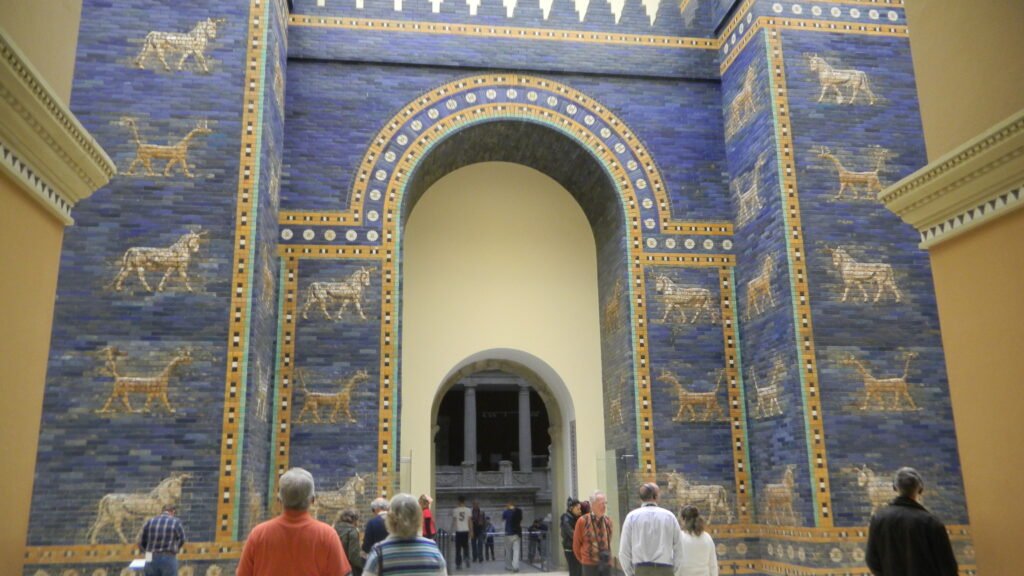
People exalted his rule during their new year celebrations with pageantry that rivalled Thebes’. Marduk’s temple, with its ziggurat towering nearly 300 feet, was sprinkled with holy water and holy oil. Effigies of gods of other cities were brought, and Marduk’s statue was placed on a jewel-studded chariot. The king led the procession along the spectacularly decorated Sacred Way, through the legendary Ishtar Gate which is now in Berlin’s Pergamon Museum (pictured below), and to a shrine on the Euphrates’ shore. Upon returning to the city, the king pronounced the realm’s fate for the new year.
Although Egyptians, Mesopotamians, and Hebrews held some different ideas about the world, they shared several basic assumptions and sensibilities that contrast with Vedic Indian society:
- There are special sites in the world that are concentrated sources of power and meaning, which are associated with the creation of the universe. Some of these places are urban and glorified with the most spectacular temples and palaces that people can build.
- Some of the most canonical events in history occurred at these sites.
- Written texts glorify and are recited in these places. The Pyramid Texts were recited in temples by kings’ pyramids, stories of heroes were kept and performed in Mesopotamian palaces, and scriptures detailed Hebrew history.
- Some of the most important religious activities are centered in the capital city, where everyone takes part in the same processions, experiences divine presence together, and celebrates it with feasts. People from all over the state make pilgrimages to the city to participate.
Hebrews lost their territory to the Assyrians and Babylonians, and this experience was so traumatic that several books in the Old Testament focused on it. The early prophets warned about the impending tragedy, and Jeremiah and the Book of Lamentations mourned the loss with vivid depictions of carnage. Ezra and Nehemiah then returned to their homeland after Persia became the Middle East’s dominant power and King Cyrus permitted the Hebrews to return, and they tried to raise their society’s standards of piety. The experience of exile encouraged Hebrews to reflect more on their obligations to Yahweh and conclude that He punished them for forgetting Him. He initially established them in their territory, banished them when they were ungrateful, and returned them to it to give them a second chance. This became the central narrative in the Old Testament. God is both benevolent and firm, and both aspects are expressed in terms of gaining, losing, and recovering the Promised Land. This story gave Hebrews a strong historical consciousness and an enduring sense of their national identity. Some events have stood out, and they have been repeatedly commemorated in rituals and recitations of texts, including the Exodus from Egypt and the Ten Commandments given on Mount Sinai.
But the Rigveda doesn’t focus on territories, cities, temples, or other landmarks nearly as much. It concentrates more on a multitude of gods and on energies that are more diffused throughout the universe.

It lists seven rivers as the territory that its people ruled, but without giving many details about the land they flowed through. It praises regions without describing their characteristics. It cites opposing tribes’ purams, which have sometimes translated as cities, but their meaning is controversial. Some historians have said that they were only forts, surmising that they were made of mud and wattle and that people lived in sheds (vimita) and portable lodgings (sala). Other historians have noted words that bespeak prosperous cities, including sahasrasthuna grham (house with a thousand pillars) and asmanmayi (made of stone). These wide differences in interpretation exist because the Rigveda doesn’t describe places in detail or vividly locate them according to specific geographic features that we can identify. The latter terms have not been convincing for all because they weren’t elaborated on, so they could have been mere poetic metaphors, and composers of Vedic hymns loved to glorify the gods by embellishing the verses.
Heinrich Zimmer noted that Vedic Indians didn’t focus on circumscribed locations to make pilgrimages to, where they could feel the gods’ heightened presence. Priests summoned deities in many places by piling sacred grass and building altars with bricks. Stella Kramrisch wrote that these altars were infused with magical power. They were mathematically complex in ways that harmonized them with the universe. For example, numbers of bricks were correlated with cycles of time. People could thereby create microcosms of nature anywhere they wanted to.
But the main states in the Middle East and Greece shared the fusion of political center, monumental temples, territory, humanized stories that express people’s relationships with divinity, and written texts that detail those stories.
Vedic ideas of the universe were not as limited by places, monuments, humanized figures, or historical narratives. They instead emphasized abundant energies and a multitude of gods that pervaded all of heaven and earth, which priests could marshal in any place by correctly performing rituals and reciting verses in the metaphysically charged Sanskrit language. These cultures’ assumptions continued to be expressed in many media and reinforced as basic over wide geographic areas.
Westerners have often assumed that reality is located in defined place. It has a topos (a specific spot, a physical area, or a mental position). But the Rigveda tunes people to copious flows of energy in the universe, which flow throughout its vast reaches.
Many aspects of ancient Indian thought converged with this way of seeing space, including language, narrative, music, and architecture.
We can now develop ways of thinking that are independent from any culture’s views of space, and see all cultures as reflecting each other within a field that’s luminous and highly conducive to creativity and love.