
The horrors of the sack of Ayutthaya in 1767 made old Thai traditions seem like a lost haven. The siege dragged on for more than a year and ended in Burma’s ruthless destruction of the city. The dreamscape of golden spires collapsed into heaps of burnt bricks. Siam was orphaned. She had no king, court, or capital. The sudden scarcity of food split up families. Many monks were unable to eat and had to disrobe and find employment in the lay world. People even ransacked wats’ libraries for cloth that had protected the hallowed scriptures. Survivors longed for their traditions.
Thais would soon have a new king to restore order by invoking their heritage, but they would first suffer another ordeal. A charismatic military leader named Taksin drove out the Burmese, who had gotten into a war with China which they had to divert resources to. He also moved the capital south, to the other side of the river from where modern Bangkok would soon rise. This area was closer to the sea and thus to international trade routes. Thais could more easily buy arms and escape if the Burmese invaded again.
Taksin is a complex figure for Thais. They admire him as a great general, but after taking the throne, he believed that he was a divinity. He forced monks to worship him and demoted those who refused. Taksin had hundreds flogged and cast into hard labor. French missionaries wrote that he spent his time praying and fasting in order to be able to fly. His conduct was especially disturbing to Thais because many believed that the impiety of Ayutthaya’s elites had brought the old kingdom down. Thais needed a ruler who embodied the best aspects of their past but got one who represented a world out of joint, which this mural from the time expresses.
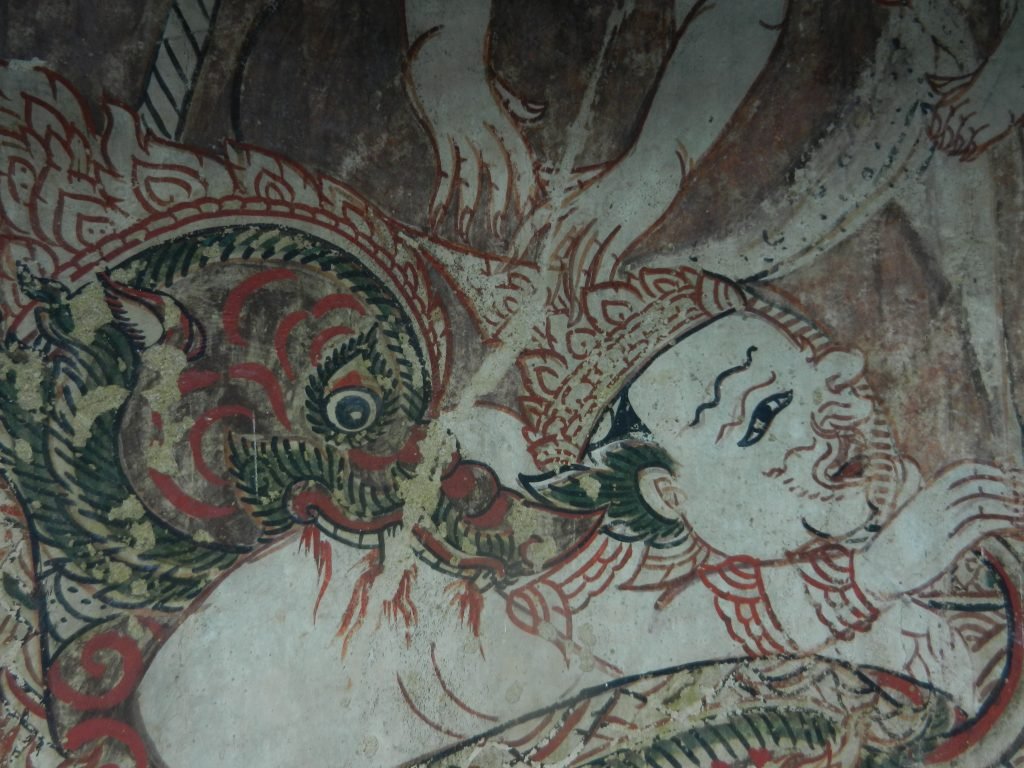
The people rebelled against the tax farmer of Ayutthaya for being especially rapacious. Because Taksin had appointed him, locals associated them with each other. The officer that the court sent to quell the uprising joined it and called for Taksin’s overthrow. The rebellion met little resistance, the old nobles spearheaded a palace coup, and the great fighter who saved Siam during its darkest hour was executed.
Thais then erected one of their country’s greatest pillars. They invited a man who had distinguished himself on the battlefield to be the king. Chaophraya Chakri reigned from 1782 to 1809 as Rama I, and he was the first in the Chakri Dynasty. Today’s king, Vajiralongkorn (Rama X), continues the line.
The new king immediately started to rebuild his country. After only one month on the throne, he moved the capital across the river to its current location on the east bank. Burma also had a new monarch and seemed ready to pounce again; the east side was easier to defend. It would launch another invasion in 1785, which the Thais rebuffed. The Chakri Dynasty’s prestige grew.
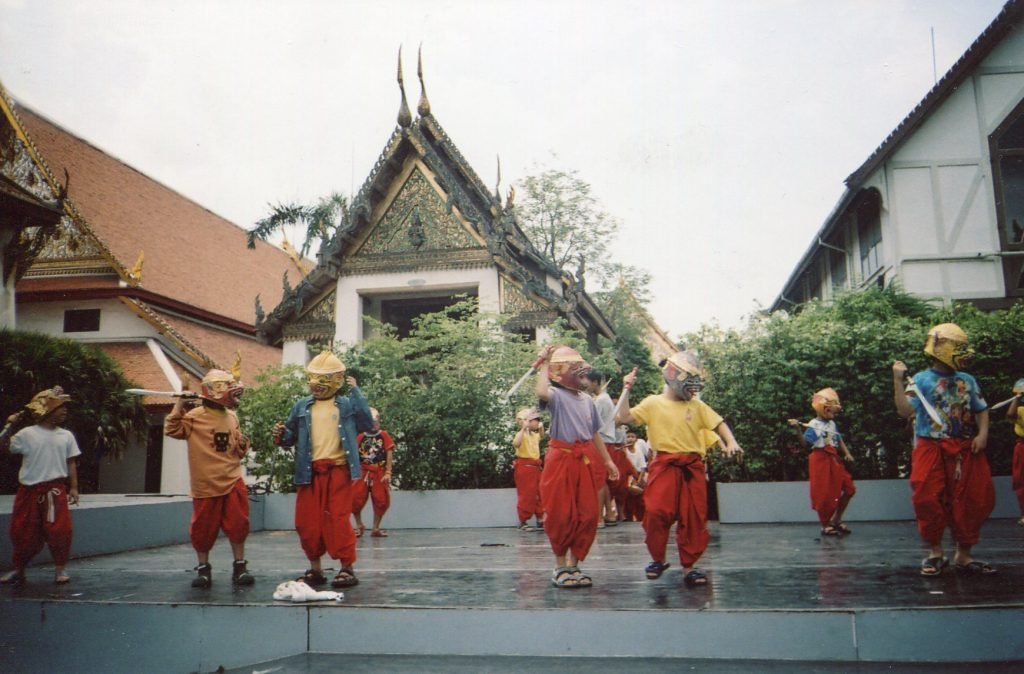
Rama knew that the old traditions were political unifiers. He thus continued associations between the monarch and Vishnu (the universe’s preserver), which Angkor Wat’s builder and Ayutthaya’s kings had projected. Since the mythological Rama was an incarnation of Vishnu, the king wrote a Thai version of the Ramayana and organized performances of it. The palace sponsored troupes of dancers who dramatized it. The kids below were rehearsing.
Rama also quickly strengthened the monkhood and ensured that the most pious and educated led its hierarchy. He built several monasteries in Bangkok and brought hundreds of old Buddha statues to them from Ayutthaya and Sukhothai. Because many animistic cults and rituals had grown into Buddhist practices during Ayutthaya’s history, Rama sponsored a grand council to establish a definitive corpus of Buddhist scriptures. He also had several Theravada works translated into Thai from Pali. For the lay world, he revived state ceremonies from Ayutthaya. The new monarch tried to revitalize the past and purify it from the decadence which he felt had weakened Ayutthaya.
Bangkok’s three central building complexes brilliantly reinforced Thai traditions as the new city developed. One is the Grand Palace, which stands next to the river and projects a shimmering skyline of golden spires (in the above photo). The second, Wat Pho (it’s more formally known as Wat Phra Chetuphon), spreads out immediately south of the palace so that it continues the ethereal forms. Wat Arun is the third, and it rises directly across the river. It’s dominated by a lofty stupa which begins as a broad base and steadily becomes narrower until it seems to dissolve into the heavens. In the midst of today’s smoldering traffic and concrete sprawl, this structure radiates enduring grace (below).
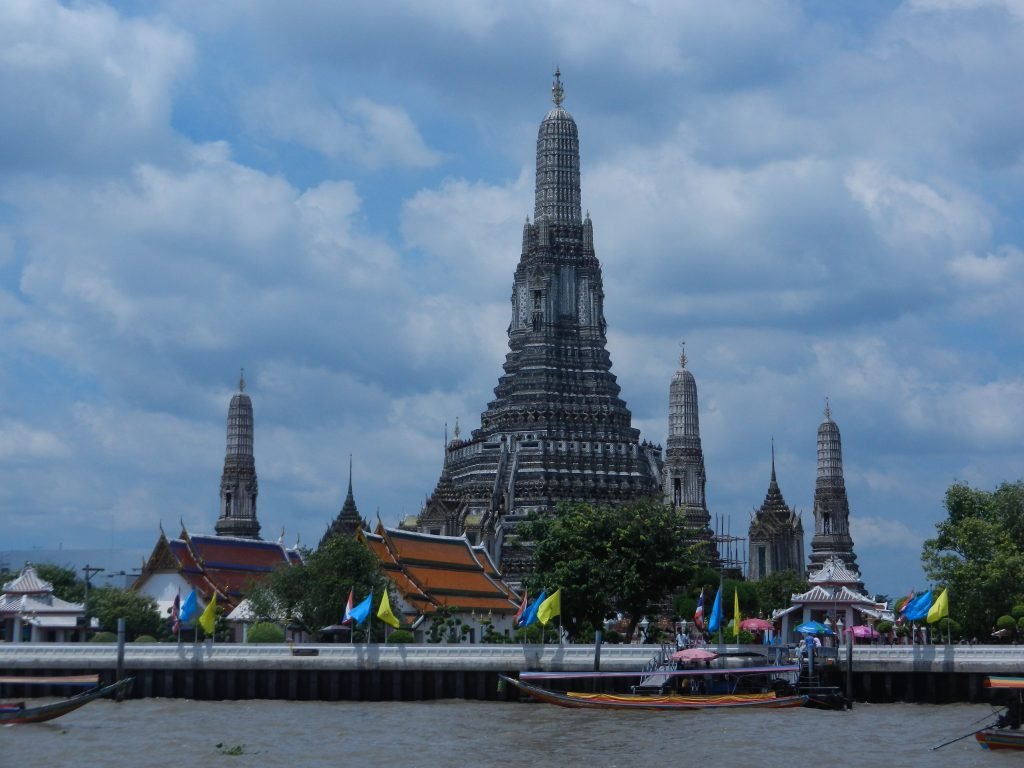
These three monuments have provided exemplary forms in the city’s heart. Rising within sight of each other, their towers flow together as people walk, boat, and drive by. Their lilting and glowing interplays straddle the river as it carries elegant longboats. So here is the old infinitely varied flow of graceful shrines, slow processions, and water from Ayutthaya, Sukhothai, and Lan Na. As in older Thai art, perspectives meander through slowly moving forms and images. Streets are often smoggy, congested, and loud, but this core of sacred buildings opens views into enchanted landscapes.
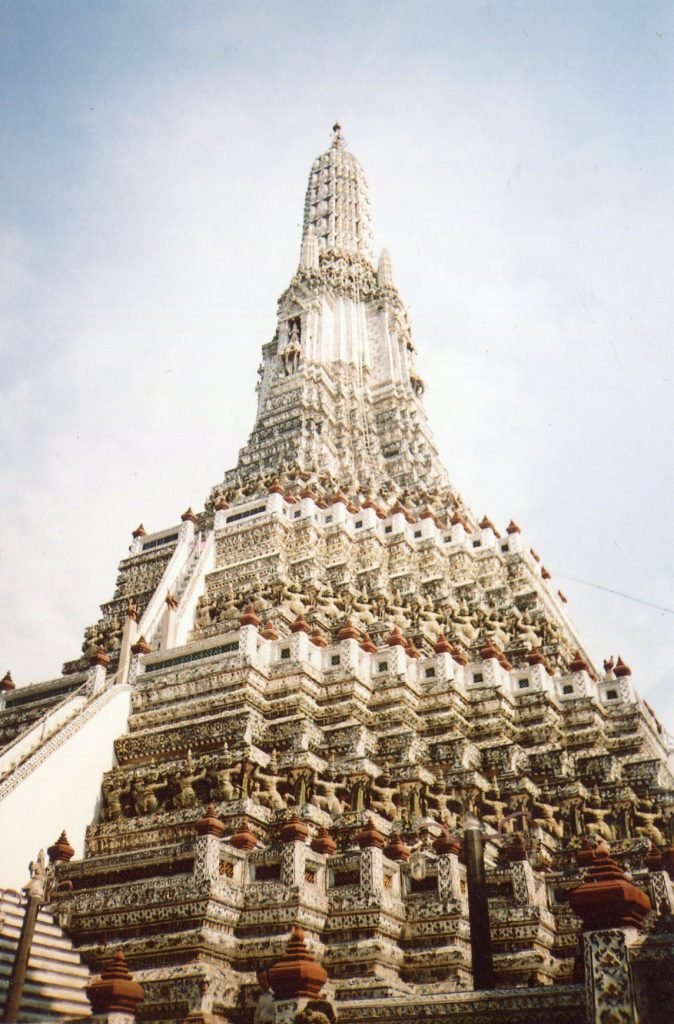
I stepped into a boat to cross the river for a closer look at Wat Arun, which presides by the dock. This masterpiece soars over 200 feet, and it’s surfaced with white stucco and covered with pieces of broken porcelain shaped as flowers with sinuous lines and long points. They add speckles of bright red, yellow, and green to its surface.
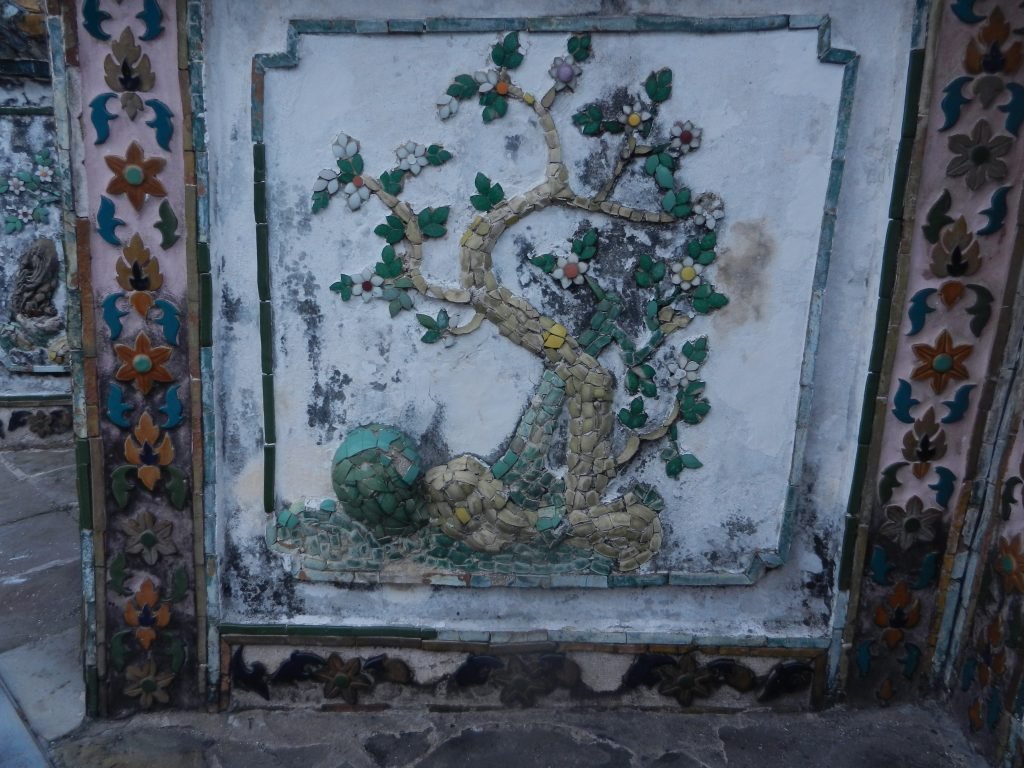
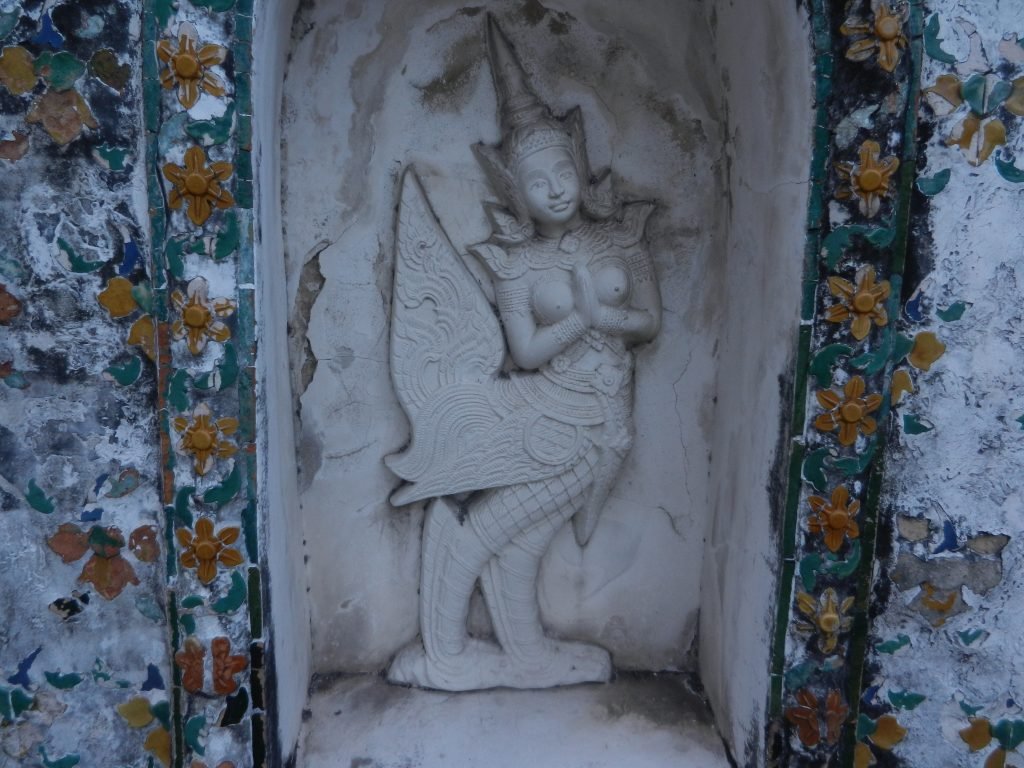
Below, they surround a kinnari, a half human-half bird female from Hindu mythology associated with music and romantic love. The temple’s immense, but these little details are worth lingering over.
Four smaller spires surround the central tower, and the contrasting heights make it appear even taller and broader.
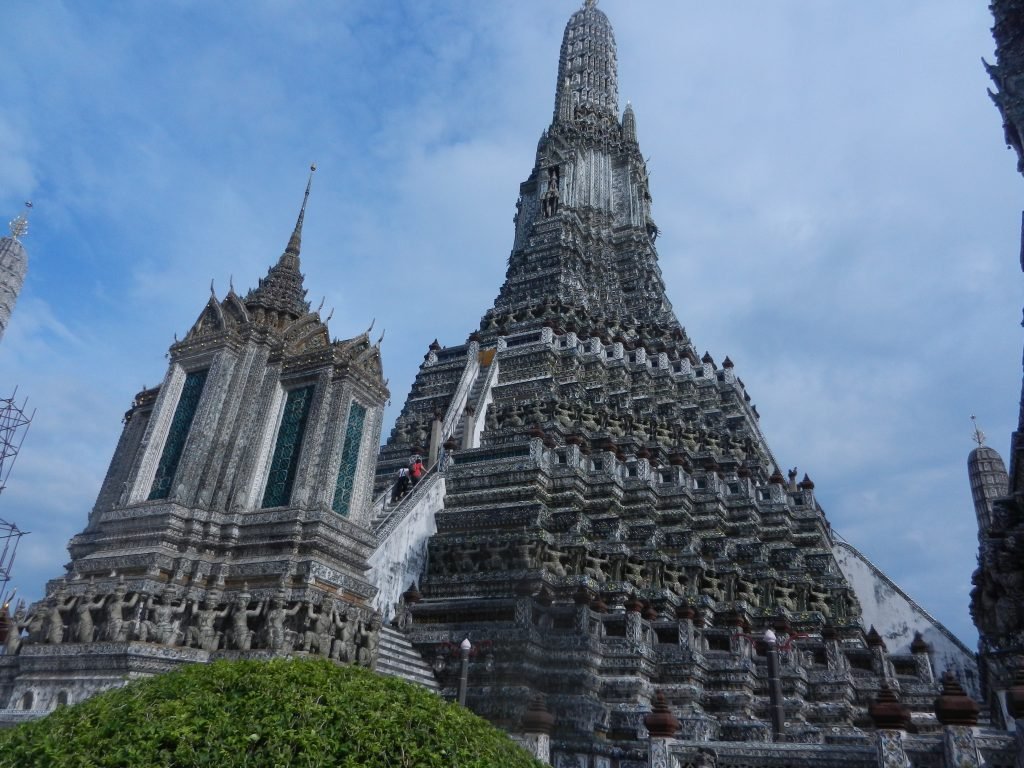
Wat Arun is both otherworldly and monumental, and since it balances heaven and earth while rising from the rippling waters, it integrates all domains. Many Bangkok residents consider it to be their favorite temple in the city.
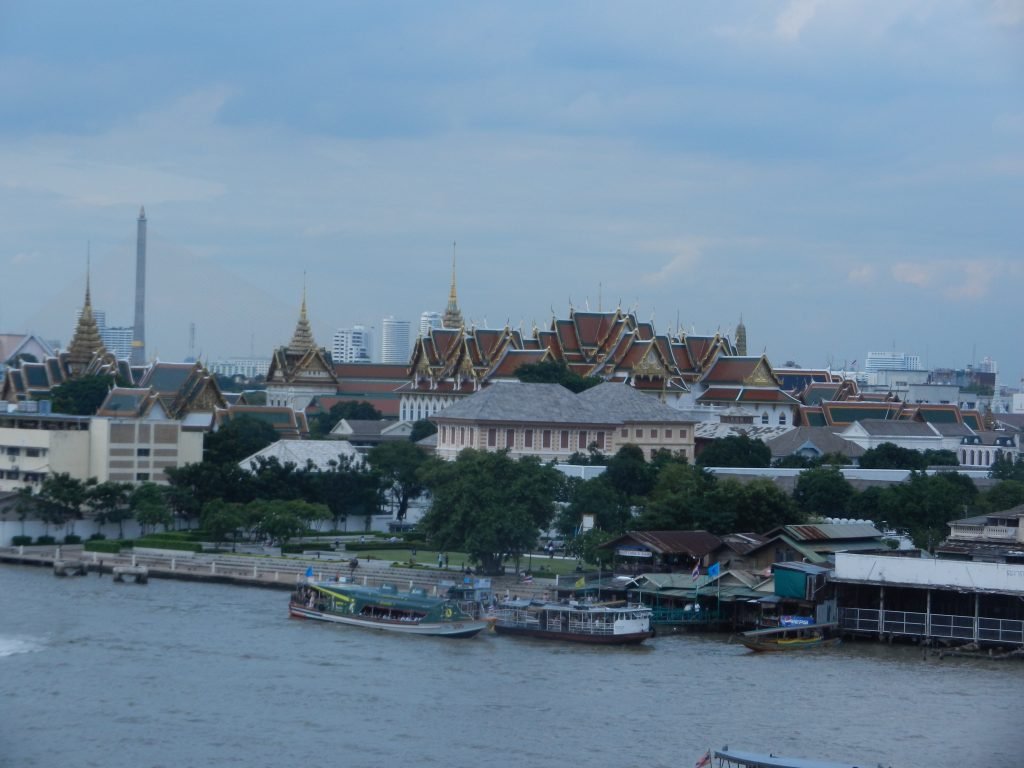
But it’s not treated as a distinct object that’s seen from a single, all-commanding vantage point. People have admired it on boats gliding by the royal palace (below) and Wat Pho on the other side of the river. All three monuments’ towers and gables mesh into a graceful field of graceful forms that slowly shift. This also happens when people conduct processions in or near them. Traditional Thai perspectives are kinetic and participatory rather than abstract, as three-dimensional perspectives that the West has often emphasized. The Chakri Dynasty’s first kings reinforced this way of perceiving the surroundings and established it in the middle of the new capital.
Bangkok quickly grew in the 19th century, and it developed a more modern character than Ayutthaya had. But a lot of temples retain traditional perspectives so that the city is layered, with multiple personalities that thrive side by side.

Modern schools treat Wat Arun as exemplary, so students are supposed to visit it. The return to earth from its middle spire is steep. These girls will be immersed in a city that has always fascinated me because of its many textures. The next few articles here will explore some of the blends of perspective in this unique place.