
In Florence around 1410, the artist and architect Filippo Brunelleschi created a sensation. He had painted an image of Florence’s baptistery (shown in the two photos below) and the surrounding piazza on a panel that was about 12 inches square, which had a small hole drilled in the middle. He stood about six feet inside the cathedral’s entrance, looked towards the baptistery across the street, held the panel up with the painting facing it, and peered through the hole. With his other hand, he held a mirror between the panel and the baptistery so that he was looking at a reflection of his own painting in the mirror. Brunelleschi encouraged his fellow Florentines to gaze through the hole, and they were astounded that the view was the same as it was when they looked directly at the building. To them, it seemed that he had performed a miracle.
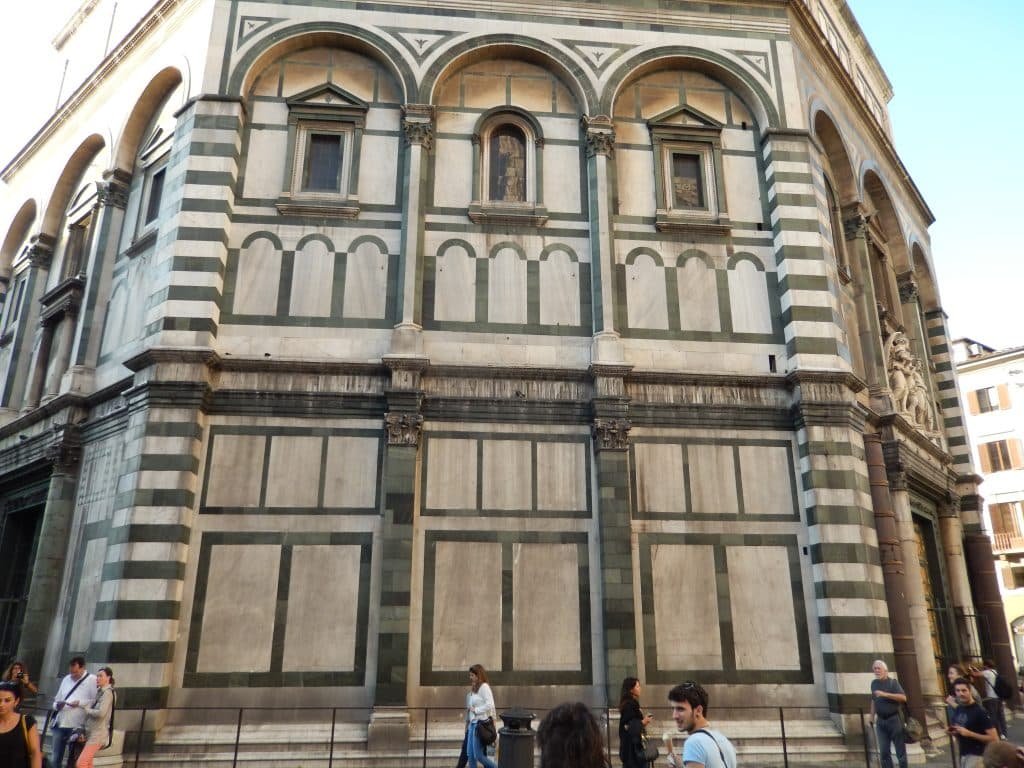
Brunelleschi chose a perfect object for demonstrating his discovery of three-dimensional perspective. Abstract lines dominate Florence’s baptistery from the ground to the roof.
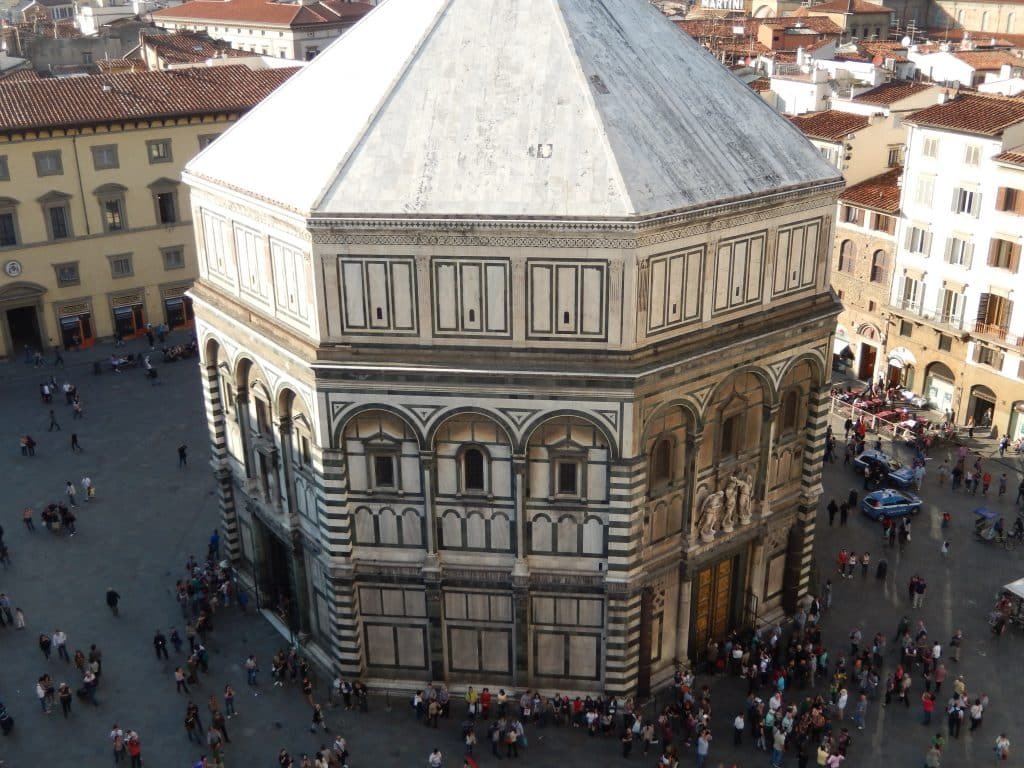
Its outer shape is an octagon, and each wall is sharply partitioned into rectangles, squares, and half circles by thick, dark lines. He wasn’t looking at anything that resembled a Thai wat’s multitude of forms and flows and treating it as the most exemplary place to demonstrate a new way to perceive. Instead, abstract lines and static shapes influenced his choice. These forms, which ancient Greeks assumed to be fundamental in nature, shaped the development of modern perspective.
His friend Leon Battista Alberti wrote a book in 1435 that theorized this perspective, and he translated it from Latin into Italian so that all Florentine artists could read it. Like Brunelleschi, he structured perspective according to Euclidean geometry, which treats the point, the line, and the plane as the basic ordering principles in the world. By standing on a certain spot in the cathedral and looking through a small hole in the panel, Brunelleschi showed that a perspective can be derived from a single point and straight lines.
Alberti explained Euclid’s geometry by saying that a point cannot be divided into parts and that several points in a row form a line. Several lines in a row make up a plane. The sides of the triangle from the eye to the object it views are thus lines, and they compose the frame of the perspective.
He also wrote that an artist can use points and lines to organize what a person sees. In a painting, all lines that project from the viewer’s side converge on a central point. From this point, an artist can draw a series of lines that extend down to the line at the bottom of the picture frame from one lower corner to the other. He can then draw another row of lines that are horizontal, which thus intersect the first lines. All these lines make up a checkerboard pattern on the painted scene’s ground. In this way, he can accurately depict complex scenes in which all things are properly placed. He and the viewer thereby command everything in the picture.
This ability to analyze and control appealed to Florentines. Many of their leading citizens were bankers and merchants and they commissioned artists, so patrons were already inclined to quantify things. Europeans increasingly adopted this precise three-dimensional perspective over the following centuries.
This perspective doesn’t convey all the rich flows of forms and colors in Thai temples, palaces, neighborhoods, and processions. Most Thai art forms are not static like Euclidean geometry. Instead, they flow and gleam as you saunter around them, and they often intermesh. They’re often experienced in a relaxed procession or a walk with family and friends.

Both cultures have held different assumptions about what the most exemplary acts of perceiving and the most meaningful perspectives are. The graceful Thai procession, the river’s gentle flow, the amiable group of people, and the relaxed amble are not reducible to a stationary viewing point that commands the whole scene.

They’re dynamic—they slowly glide. They don’t as sharply focus on objects one at a time and analyze their details as though they’re muscles and facial features of a Greek sculpture. The blending of all things into a congenial flow is often more important than the single entity.
Straight lines don’t dominate the views in Thai temples, paintings, and sculptures. Many forms bend and undulate, sometimes like gently rippling water and sometimes sharply into needle-like points. Mellow and dramatic energies are thereby balanced. Both cultures have held different assumptions about how things within a scene are connected.
The West’s emerging focus on three-dimensional perspective already had deep roots; it didn’t suddenly emerge in the 15th century. Dante vividly described his characters when he wrote his Divine Comedy in the early 14th century, and he said that his contemporary Giotto was the world’s greatest painter because he portrayed people with more realism than any predecessor had. In a scene that Giotto painted in the Scrovegni Chapel in Padua, an aged Anne and Joachim (the Virgin Mary’s parents) kiss and she caresses his bushy grey beard. He was a master of dramatizing biblical stories with people that were lifelike and monumental.
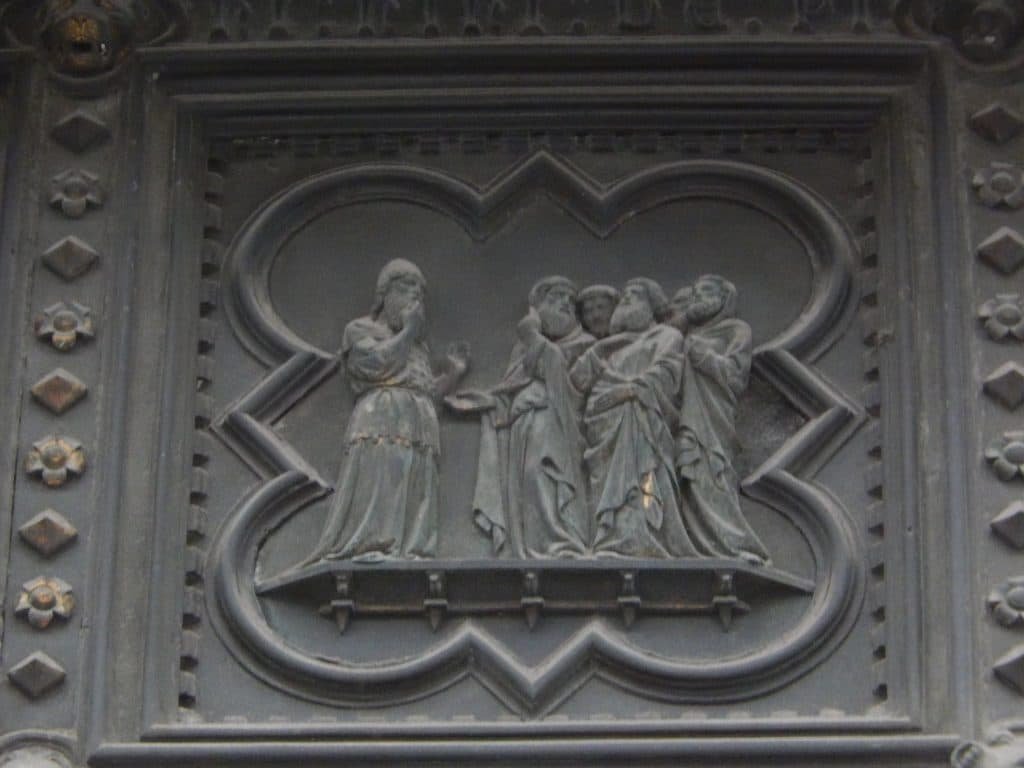
In the early 14th century, the sculptor Andrea Pisano fashioned realistic figures who were linearly related in his cycle of John the Baptist’s life on the south doors of Florence’s baptistery (above and below). He was heavily influenced by Giotto, who completed his frescos in Santa Croce’s Peruzzi Chapel a short time earlier.
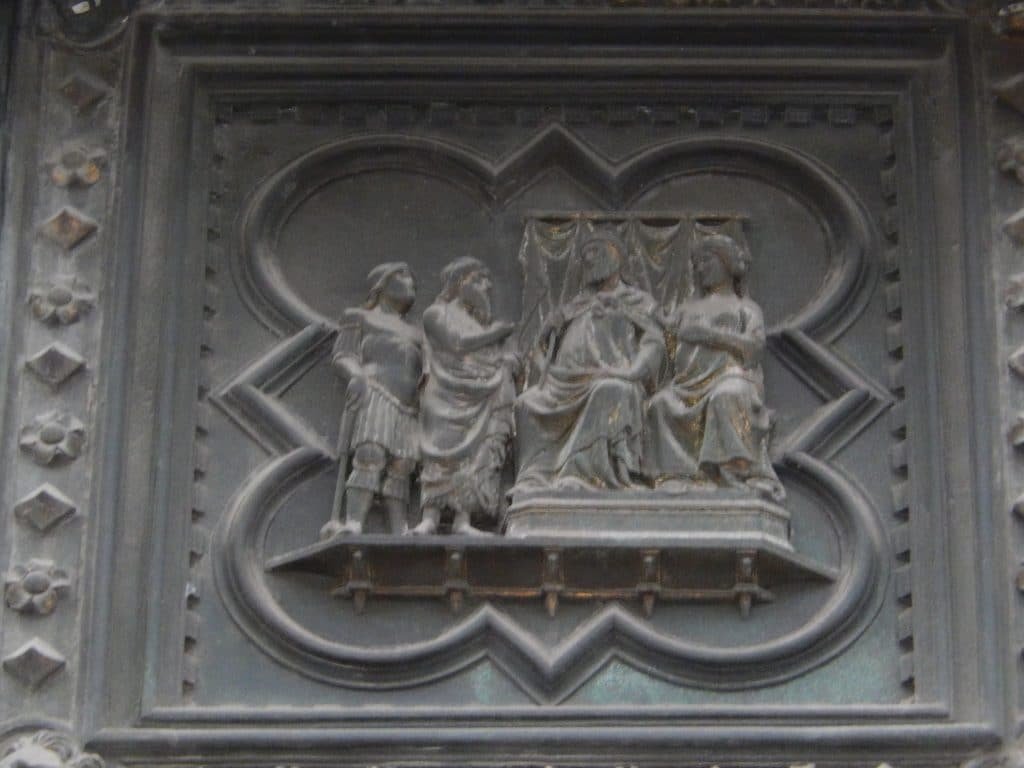
Why was Florence already so advanced in realism?

Florence developed its republican government in the 13th century. Members of the city’s guilds were elected and chosen by lot into office, but they held their posts for a very short time to avoid corruption, and some were in office for only two months. Electoral processes were often complex, and this encouraged people to look beneath impressive facades that candidates and their familial networks projected and analyze the hard facts.
Florence also began to develop its legendary wool industry in the 13th century by importing the raw material from England, washing it in the Arno River, weaving it, and dying it in brilliant vermillion and yellow hues so that it became the most widely desired fabric in Europe.

This industry was large, employing 30,000 workers in and around Florence at peak times, and its production process was complex. Wool making had roughly 30 stages, and specialized laborers worked in each one. Sorting the different grades, beating, dying, combing, spinning, and weaving were some of the steps in the making of fine cloth. Many were carried out in large workshops, while spinning was often done by peasant women in their homes in the country. Managing this industry which the city’s livelihood depended on required attentiveness to many details.
To manage the wool trade, people entered more business partnerships and set up complicated systems for transportation. People’s wills kept pace with their increasingly complex commercial relationships because their assets were distributed in more places. Now that they could sue each other for more reasons, the legal profession grew. Legal conflicts show up so often in public records that litigation seems to have been a favorite pastime.

Florence thus developed into a city of many groups which constantly collaborated or competed with each other. People had to keep track of the doings of their fellow citizens as they did business with them. They also had to manage complex logistics, and at the same time, keep an eye on their competitors. Florence’s citizens became increasingly used to watching things in several places.
Florentines became increasingly mathematically literate at the same time. They were interested in import and export statistics, populations, prices, and volumes of containers that held goods. The city started to issue the gold florin in the 13th century, which became Europe’s most trusted currency. Money, numbers, and commerce grew more prominent in people’s thinking, and there was no king to assert his glory over everyone’s affairs.
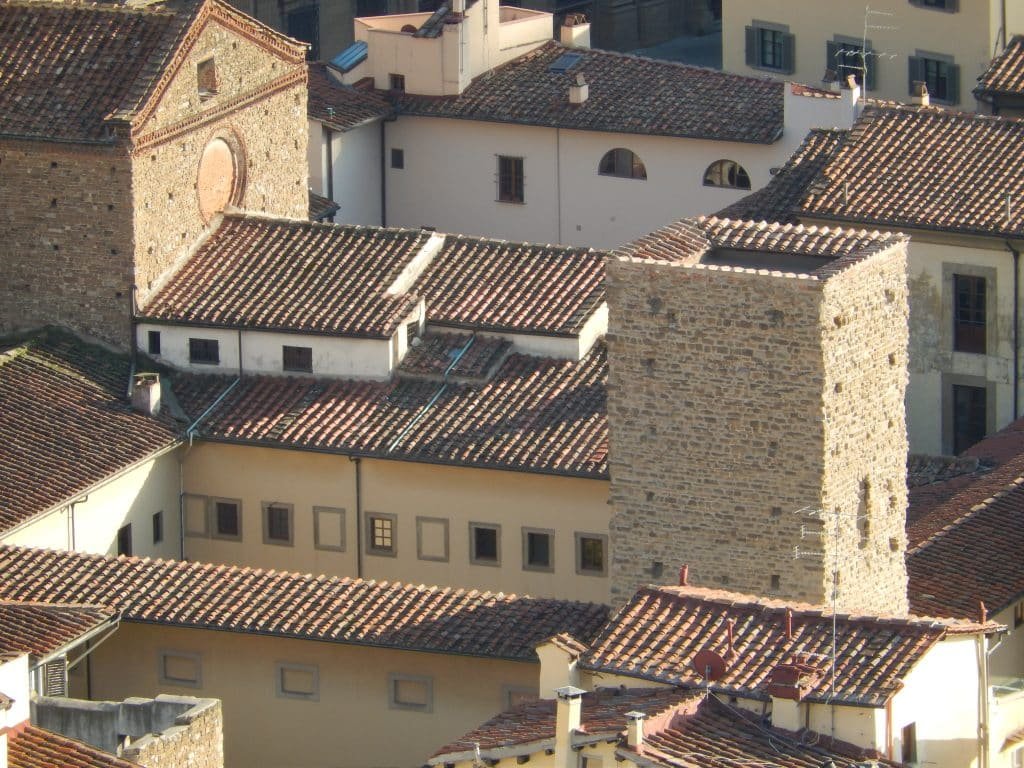
A building boom ensued as commerce increased. A massive ring of walls was erected around the city, and people began its cathedral in 1296.

They also built the governors’ palace (above) and started to construct Santa Maria Novella and Santa Croce. Paintings from the early 14th century show that buildings already cluttered the entire area within the walls.
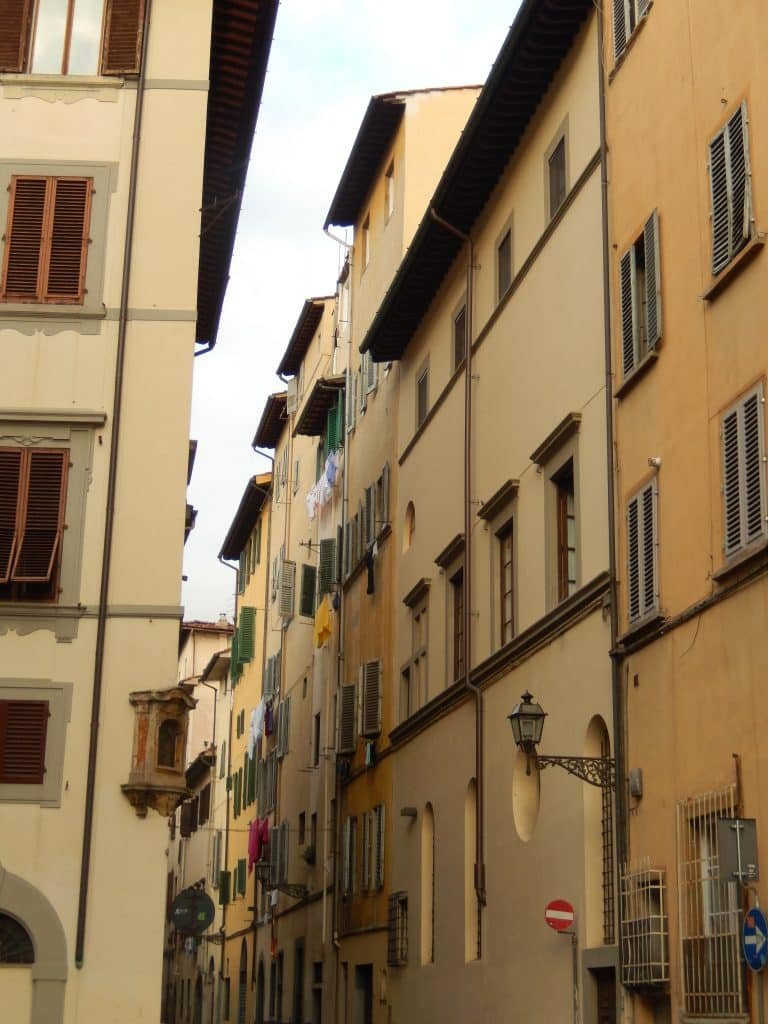
Tragically, this crowded city by a river became an ideal breeding ground for contagious diseases, and the bubonic plague carried off as many as half of its inhabitants in the mid 14th century. Florence was spooky after the epidemic subsided. Towering stone houses that were once full of children playing and adults proudly displaying their furniture, paintings, and tapestries were now silent with the sick and mourning. The poet Boccaccio wrote that locals were so used to seeing corpses that they paid no more attention to a dead person than to a goat’s carcass. But people remembered the illustrious past and built on it when the artistic miracles emerged in the early 15th century. They were already accustomed to managing complex spatial and temporal relationships and quantifying things, and they were eager to get back to business and pleasure as the town grew again.
Florentines thought mathematically as they rebuilt their city. Michael Baxandall, in Painting and Experience in Fifteenth-Century Italy, wrote that their educations emphasized the mathematics that merchants used. One of the most commonly studied techniques was gauging (calculating the volumes of three-dimensional shapes, including barrels and ships’ hulls). This was important to know because containers’ sizes weren’t standardized. People needed to calculate the amount of oil or wool that a barrel could hold when they could only measure its height and its circumference at the middle and ends. Citizens were thereby trained from childhood to see objects as static, measurable geometric shapes.
Children also learned what was called “the rule of three.” Today’s high school students preparing for their SATs know this as the problem: A is to B as C is to D. People in Florence reduced many things to this comparison of two entities in terms of geometric proportion, including the sizes of containers and buildings, the areas of parcels of land, price discounts, and currency exchanges. The proportioned scenes in paintings were probably influenced by ways in which people were trained to visualize and think about objects.
People recorded their commercial transactions with equal precision. Bankers increasingly used double-entry bookkeeping, and merchants made sure that they kept accurate account books. The ways in which Florentines represented objects in their art reflected their ways of keeping financial records. Both emphasized proportioned relationships.
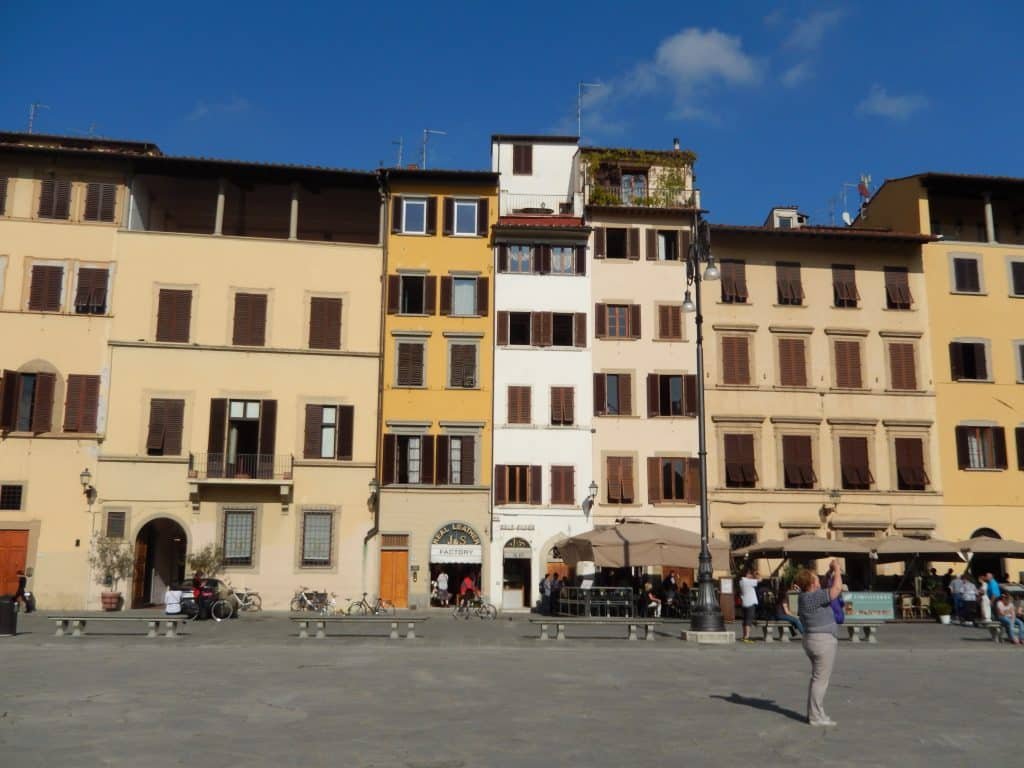
In the early 15th century, Italy’s geography was likened to a fish’s skeleton. The mountains that run north and south comprise its spine, and the ridges that adjoin them and proceed to the coasts are the ribs. The land is thereby sharply divided into small valleys where people in ancient times settled and formed communities. Italy is surrounded by the sea on three sides. As in Greece, the environment is composed of distinct regions separated by clear boundaries. Sea and land, fertile valleys and rocky uplands—domains are clearly distinguished and they are proportionate with each other so that these features have seemed like nature’s fundamental order. Ancient Greeks and Renaissance Italians usually preferred limits, distinctions, and clear definitions, and they often reduced art and ideas to their most essential forms. The idea that Platonic forms and ratios are divine was a refined expression of those preferences, which had deep roots in geography.
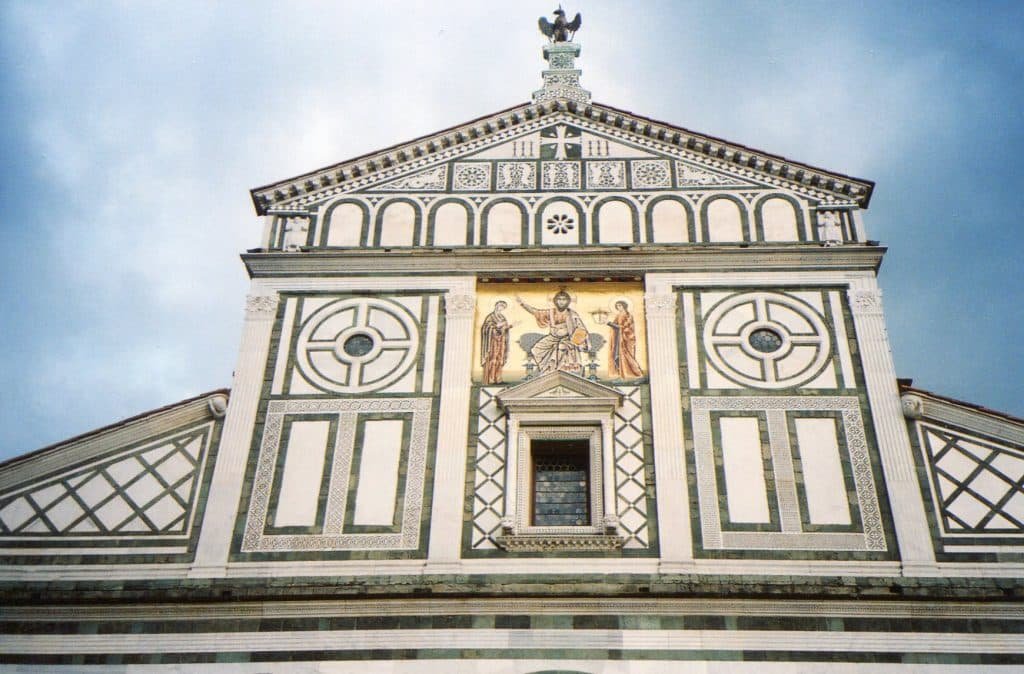
Florence nestles by one of the fish’s ribs. Even before ancient Romans colonized the area, tribes decided to leave their more protected hilltops and settle by the Arno River, perhaps to trade. Rome took it over in the first century BCE and built a rectangular military fort which the town expanded from in the Middle Ages. The early Christian buildings that survive also project nature’s most essential forms. The first two levels of the baptistery were built in the late 11th and early 12th century, and the abstract rectangles and semicircles separated by black lines that cover its outer walls attest that the focus on static geometric forms long preceded the 15th century. One of Florence’s most prominent churches since the 11th century, San Miniato al Monte, also has these sharply delineated shapes on its front (below). Since it overlooks the town from a hillside across the Arno, everyone could gaze towards it as another example of divine order.
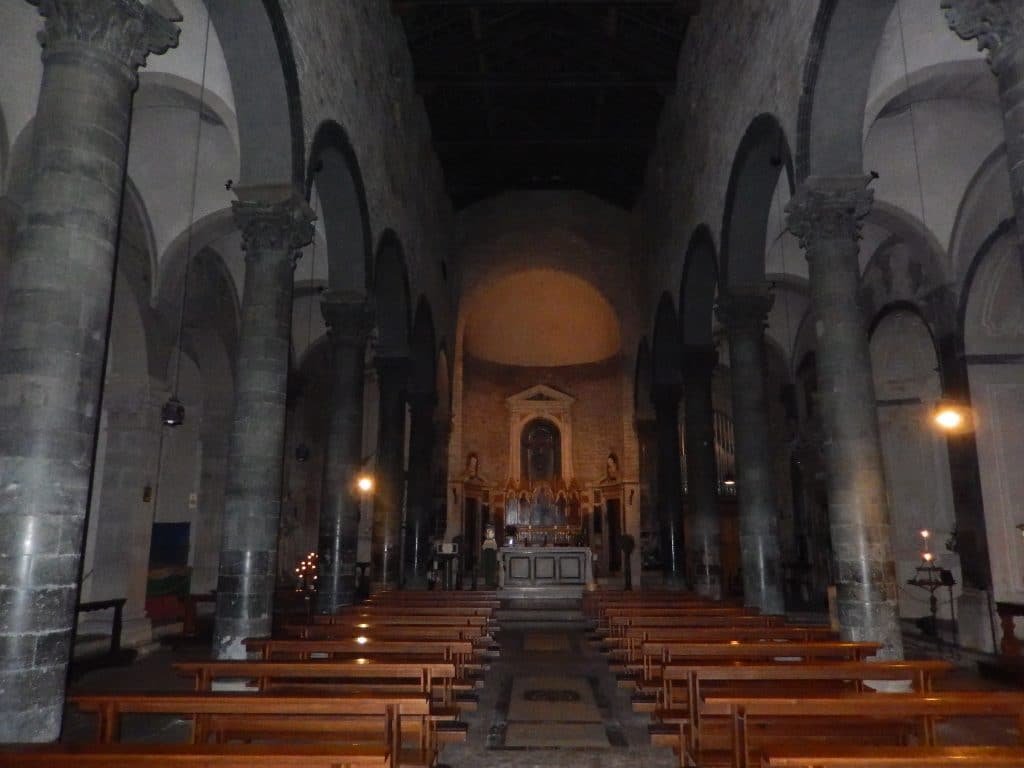
In the middle of town, the 11th-century Romanesque church of St. Apostoli surrounded worshipers with abstract proportioned forms (below).
So the cultural environment in which three-dimensional perspective emerged was shaped by traditions from antiquity and the Middle Ages, and also by the natural surroundings. The 15th century artists who articulated this dimension had very fertile ground to build on, as Thais did when they formulated their ways of seeing the world. The line’s fundamental importance in ordering reality might seem obvious to most Westerners, but it has converged from many cultural currents over the century, as perspectives in Thailand have. We’ll explore more of these currents in the next article.