
Her cultural heritage gives her a huge space for dreaming. Satischandra Chatterjee and Dhirendramohan Datta, in An Introduction to Indian Philosophy, said that the sense of a vast space-time world formed a common background that ancient Indian thinkers shared. Buddhism and philosophic schools that have tried to ground thinking in logical rules also inherited this sense, and it shaped their assumptions about the types of objects of knowledge.
Buddhists found a way to think more in terms of the universe’s vastness than the single object and demarcations between distinct entities. Contrary to Upanishadic teachings, there is no self—no eternal atman. The idea of the self is only a mental habit; it’s a chain of thoughts and desires that reinforce each other. A person is actually formed by five skandas, which is a Sanskrit word for a tree’s trunk, and more generally, a group of aggregates. We consist of these five aggregates and they are always in flux: material form (rupa), feelings and sensations (vedana), perceptions (samjna), activities that create karma (samskara), and consciousness (vijnana). What a person calls I or me is not an independent object; it’s a figure of speech that doesn’t correspond with anything that objectively exists in this field of dynamically interacting aggregates. Holding onto the concept of the self is a mental habit which Buddhist schools try to overcome.
This habit becomes hard to liberate yourself from because it’s reinforced by desires. You see an object, enjoy it, desire more of it, identify with your desire for it, pursue more of the same types of objects, and identify with your pursuits so intensely that you confuse them with your self. These are some of the 12 phases of dependent origination. They form a circle that reinforces itself. Each phase is a causal link that ties the whole cycle together so that people are condemned to suffer ever more miseries until they become enlightened. The goal of life for Buddhists is liberation from this cycle which creates the illusion of the self and other distinct objects.
Both Buddhism and Vedic traditions share a common sensibility: The self (for followers of Vedic traditions), or the perception of the self (for Buddhists), is not concentrated in one entity. The experiences of it come from interconnections between a huge number of influences within a vast field.
In the Upanishads, this web leads you back to the universe’s origin and the equation of yourself with it. For Buddhists, it’s merely a circle of mental attachments that reinforce each other. But for both, the vast field in which all exist extends far beyond the single thing.
“There is a lizard in my bed! How did it get in here?” So complained a fifty-something man named Ramesh, who slept next to me in the school’s men’s dormitory in Chennai. There were no beds in the hall, only reed floor mats with mosquito nets tied to horizontal poles above us. But the insects kept poking through my net so that within 24 hours of arriving at the dorm, my feet, ankles, hands, and forehead burned with fiery red bumps. As my dormmate shoed the lizard away, he jokingly said, “Let him crawl into your bed!” I said, “Hey, I’ll trade you: your lizard for my mosquitos!” Two days later a tall, thin thirty-something man from Nice, France told me, “You are mosquito pie!” That sounds funnier than hell in a French accent. I was finding that living with many closely packed life forms can make it harder to retreat into yourself. Things keep breaching your personal boundaries in India. But this creates so many opportunities to share discomforts that they lighten and you bond with the people around you into something larger than your ego. And the experience is often fun.
The first time I went to India, I was afraid of getting sick. I knew others whose guts had gone into whirls, and they described it as though a firing squad would have been a relief. I thus took every medicine I thought I’d need. Cuts in the tropics become infected more easily, so I packed Neosporin and skin-replenishing cream. I had my antibiotics, malaria prophylactics, and enough stuff for indigestion to sooth a whole village. My personal pharmacy almost filled half a suitcase. A dorm mate said, “I notice that you have a lot of medicines. My sister has gas. Do you have anything for her?” I dispensed some Tums. A young man accidently gashed his hand, so my Neosporin helped him. I stopped worrying about myself, enjoyed helping others, and trusted that they would take care of me if I needed anything. We all seemed merged into a larger field. By the early first millennium CE, Buddhist philosophers called this field pratayasamutpada (dependent origination). Everything’s existence depends on everything else. Nothing is an independent object.
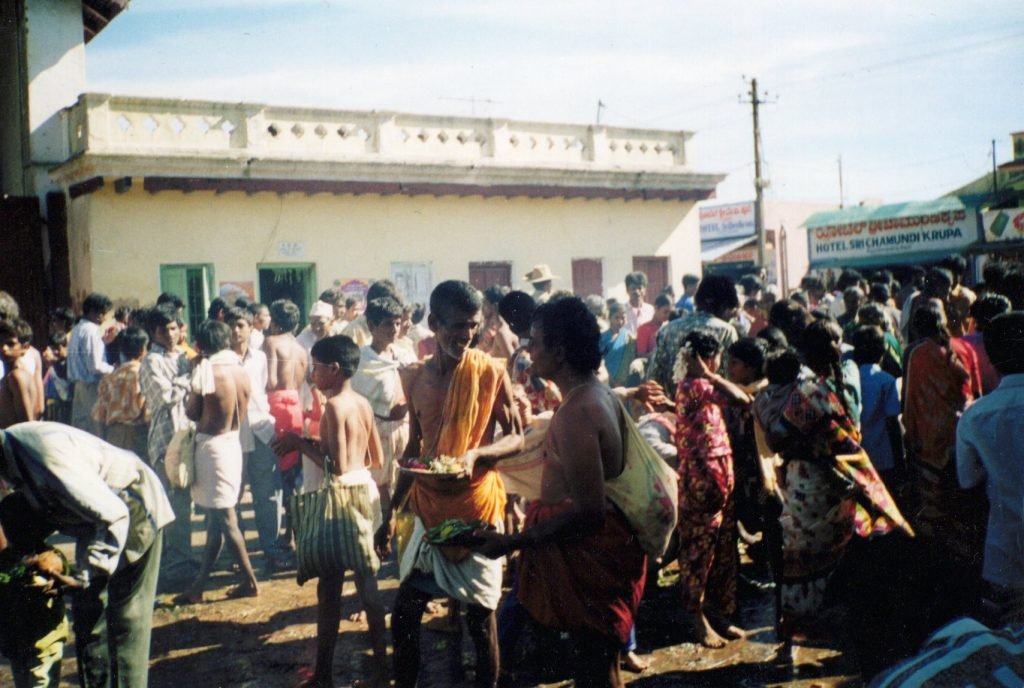
One of the most embarrassing moments in my life happened in India. All able-bodied men in the Chennai school were asked to move a large pile of stones. I was wearing thin trousers I had just bought in Bangalore; I had found the jeans I brought from home too hot for Chennai’s Septembers. I bent over to pick up some rocks, heard a ripping sound, and felt a breeze on my behind. “Oh oh! I hope that’s not what I think it is!” When I reached back, I found a wide-open split up the inseam and a five-inch horizontal tear across one side of the upper part. My pants thus had an open flap that exposed a large part of my shorts. The dorms were a long walk away, the grounds were crowded shoulder to shoulder, and supper was being served. I could have gone to bed hungry if I had gone there and changed clothes. I felt uncomfortable, but nobody seemed to notice my pants. So many folks were milling around that no one thing stood out. The throngs of people, the din of their chatter, the sultry evening air, the profuse foliage that surrounded us, the ever-voracious mosquitos, and the aromas of spices and freshly cooked rice blended into a larger web of life which we were all absorbed in. My self-consciousness seemed trivial. India’s dense landscape can give people one of Buddhism’s key teachings: Take things lightly.
Jainism also emerged in the mid-first millennium BCE, and its leaders also defined their faith’s main principles in terms of an enormous field. It still has more than six million followers around the world. Jains believe that there are seven main truths:
- Souls exist
- Non-souled realty exists (matter, time, space, and media of movement and rest)
- Contact occurs between the soul and non-souled reality, which infuses karmic forces into the soul
- The binding of karma to the soul
- Stopping the karmic inflow
- Breaking established karmic bonds
- Liberation from karmic bonds
The interaction between the first and second truths is profuse and constant because highly subtle material particles of karma fill the universe. Our environment is pervaded by particles that bind our souls to the physical world.
Our world is also highly interconnected so that all sentient beings have moral obligations to each other. Jains have thus adopted non-violence (ahimsa) as a central principle, and some have gone to extremes to refrain from killing any creature, including covering their mouths with cloth to avoid inhaling insects.
The assumption that this vast and integrated cosmic field is primary encouraged the Jainist doctrine of non-absolutism (anekanta). All knowledge that ordinary people can attain is merely a partial truth from a particular viewpoint. From one perspective, I am a living being; I have feelings, thoughts, memories, aspirations, interpersonal relationships, and bodily needs. But from an equally valid perspective, I’m constantly dying. Every minute brings me closer to death, and all the experiences I use to define myself as a living being are impermanent. From one perspective, the table I’m writing on exists as a solid object. From another, it’s an assembly of microscopic quantum particles, and it will ultimately dissolve. Jain logic often begins, not with P is either A or not A (which Aristotle emphasized), but with P is both A and not A. When you expand your perspective from the distinct entity to the vast field that all beings share, contrary statements can be equally valid. Each is true, but partial.
Ideas that ancient Indian philosophers pondered were diverse, and some teachers didn’t believe in vast and unseen metaphysical realms. The Charvaka sect emphasized pure materialism. There is no afterlife, because no soul exists after the body perishes. People are entirely made of matter, which consists of four elements: air, fire, water, and earth. Perception is the only valid source of knowledge. Most other Indian philosophies held that there are at least five elements, with akasha (infinite space, which has sometimes been translated as ether) as the other, but Charvakas only accepted elements that people can perceive with the five senses. They also said that the existence of God is a myth, since God cannot be directly perceived.
But this hardcore focus on materialism was rare in ancient India. The Charvakas were an exception that had limited influence. All six of the ancient Indian philosophic schools that have derived authority from the Vedas have seen the universe as vast, including the two that have most explicitly tried to establish logical ground for thinking. One, the Nyaya school, has held that the objects of knowledge are the self, the body, the senses and their objects, cognition (buddhi), mind (manas), activity, psychic defects (dosas), rebirth, the feelings of pleasure and pain, suffering, and freedom from suffering. So instead of only focusing on visible objects made of the four tangible elements, they expanded their objects of knowledge to our inner psychologies, states of our souls, and our rebirths into more existences. The Nyaya world is highly moral, and God is central in it. Its followers have felt that adrsta is the universe’s unseen principle, which influences all things (including material atoms) to align objects and events with moral values to maintain harmony.
The other logic-focused philosophic school, the Vaisesika, has also believed in God, adrsta, and the central importance of liberation from rebirth. Its followers have also expanded the use of logic to an immense variety of things. There are nine kinds of substance (dravya): air, fire, water, earth, akasha/ether, time, space, mind, and soul. Mind is eternal and infinitely small. Soul is eternal and all-pervading, and it’s the substratum of all consciousness. So instead of emphasizing distinct objects and proportion as ancient Greeks did, the Vaisesika school saw the infinitely small, the infinitely vast, and consciousness as basic substances.
Ancient Greeks, used to living in human-scale valleys and by coasts and public agoras, were usually more comfortable with spaces that were proportionate with human dimensions. This shaped their philosophic ideas. India had two heritages that were already ancient when Buddhism and the philosophic schools emerged, the Rigveda and the local natural environment. Both seemed enormous and incalculably abundant, and they converged into assumptions that things happen within a vast field. This shaped Indians’ ideas of geography, narrative, religion, art, emotion, music, language, and politics. All these aspects of experience converged into a culture that has inspired people all over the world.