The Oglala Lakota holy man Black Elk recounted a vision he had at the age of nine, when he suddenly became ill. Lying down in his family’s tipi, he looked out through the smoke hole at the top and saw two men coming through the clouds. They said, “Hurry! Come! Your grandfathers are calling you!” They led him to where white clouds were piled like mountains on a wide blue plain.

Thunder beings lived in them, and they leaped and flashed. Black Elk and the two men were then suddenly alone in the middle of a great white plain with snowy hills and mountains around them. He then saw a bay horse, who spoke, “Behold them! You shall know their history.” He looked and saw 12 black horses abreast with manes of lightning, thunder in their nostrils, and necklaces of bison hooves. They wheeled to the north and said, “Behold!” There were 12 white horses abreast. Their manes flowed like a blizzard wind, and white geese soared and circled around them.
The bay horse then turned to the east, where Black Elk saw 12 sorrel horses with manes of morning light, eyes that glimmered like the morning star, and necklaces of elks’ teeth standing abreast. The bay then wheeled to the south, where there were 12 buckskins abreast with horns on their heads and manes that grew like trees and grasses.
The bay horse then said, “Your grandfathers are having a council. These horses will take you there, so have courage.” The horses went into formation, four abreast with one black, white, sorrel, and buckskin. The western sky suddenly darkened with a storm of plunging horses of all colors, which shook the world with thunder. The northern, eastern, and southern skies then became filled with horses of all colors. The whole sky was full of horses in an uncountable number, dancing around Black Elk.
Suddenly the horses transformed into animals and fowls of every kind, they sped back to the four quarters of the world where the horses came from, and vanished. A heap of clouds ahead then turned into a tipi, with six elderly men sitting in a row inside the open door. They were the grandfathers. Before meeting them, Black Elk had that beautiful infinitely expansive vision of the sky as a prelude to their teachings.
Westerners have often seen ancient Greeks’ ideas of a proportioned human-scale environment as the basis of thinking.

Pythagoreans thought the finite is good and the infinite is undesirable, because the former is defined and fathomable. But some cultures treat vastness as a more basic model of reality.
Ancient Indians also often looked to the sky when they composed the Rigveda’s hymns. Like America’s Great Plains, lands in Central Asia where the earliest Vedic composers originated were under an open sky that would have been very dramatic.
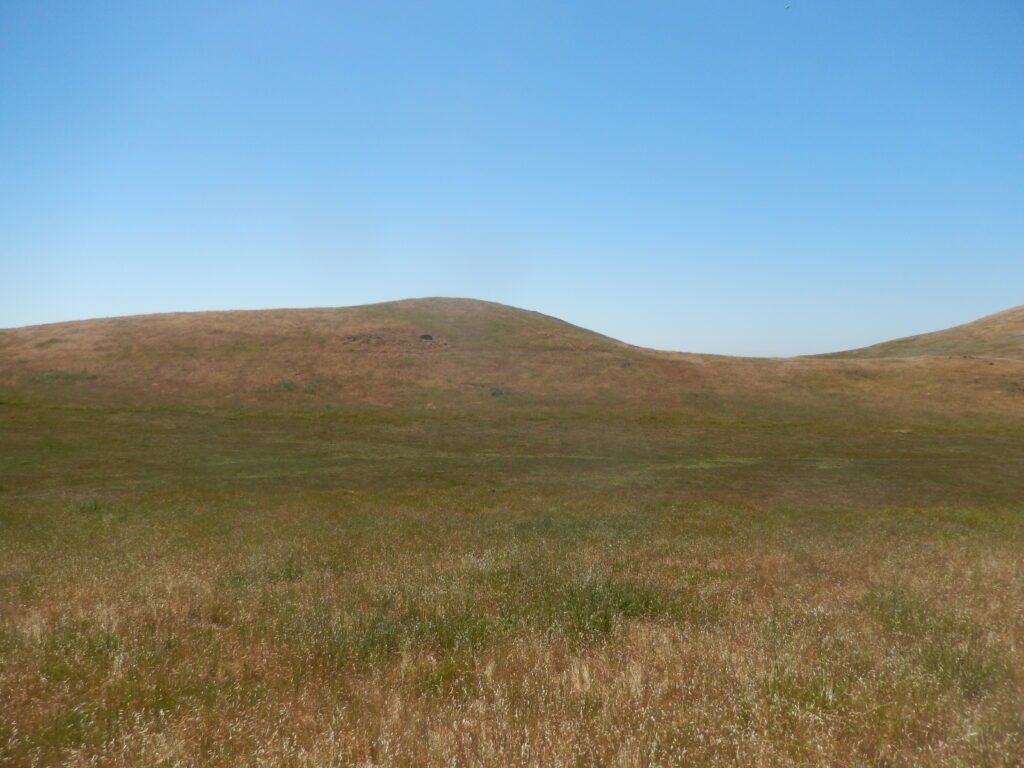
Causality in both regions often comes from above. The sun is ebullient on clear days, grey clouds look ominous before storms, lightening is sometimes intense, and windstorms can be violent. It can thus seem that the main forces that affect people are in the sky, so they have looked there to align themselves with them.
Many Indians by the first millennium CE saw space as incalculably vast, and their expansive concepts of it converged with other ideas, including time, language, and music.
Most Indian philosophies began with assumptions of an extremely vast space-time framework. Mainstream thought in the West is only starting to realize how big the universe is. Galaxies outside the Milky Way were discovered by Edwin Hubble in 1923-24. It was recently thought that the universe contains 100-200 billion galaxies, but the most current estimates now suggest 2 trillion or more. If Western thinkers had begun their inquiries with ancient Indian assumptions of a vast space-time field rather than ancient Greek focuses on what can be seen with the human eye, their ideas of the universe’s size might have been more accurate.
A lot of cultures in Southeast Asia have focused on environments that are more human-scale. Many art historians have admired ways that they adapted art from India. The Indian Shilpa Shastra said that correctly fashioned images of gods should be proportioned in an idealized way according to a complex system of ratios. The focus was less on realistic representation of human beings and more on aligning images with vibrations that the enormous universe emerged from.
But Southeast Asians have appreciated a human-scale environment. Many traditional societies have sharply distinguished what is safe from what’s dangerous. People associate the former with the family (especially Mother, who is often seen as a paragon of virtue), the temple, and the rice-farming community. They envision them within a circle of safety and identify the latter with zones beyond its embrace, particularly the howling forests and mountains. Within the safe world, they have created an endless variety of beautiful rituals, artistic objects, and rules of etiquette to maintain the ties that keep people together. Although Buddhist temples are supposed to connect people with ultimate reality and facilitate liberation from the cycle of births and deaths, many are full of pleasing images and little objects that provoke smiles, like these two fellows that greet visitors in a northern Thai temple.
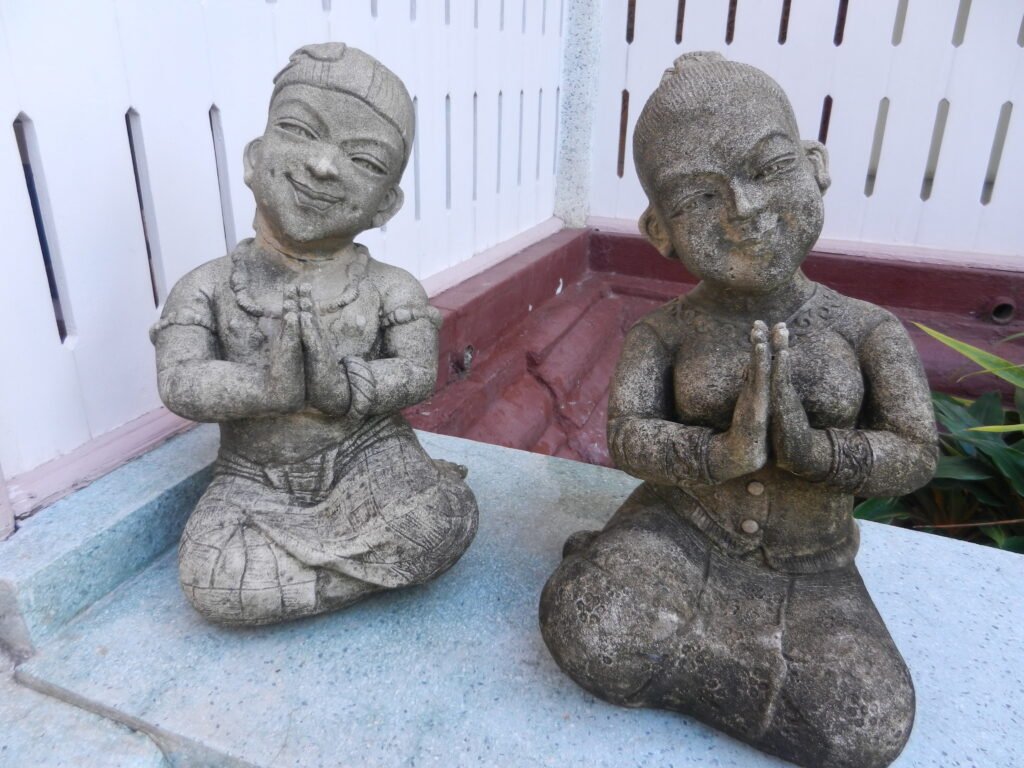
These folks impart a message that resonates in Thai and a lot of other Southeast Asian cultures: Don’t take things too seriously.
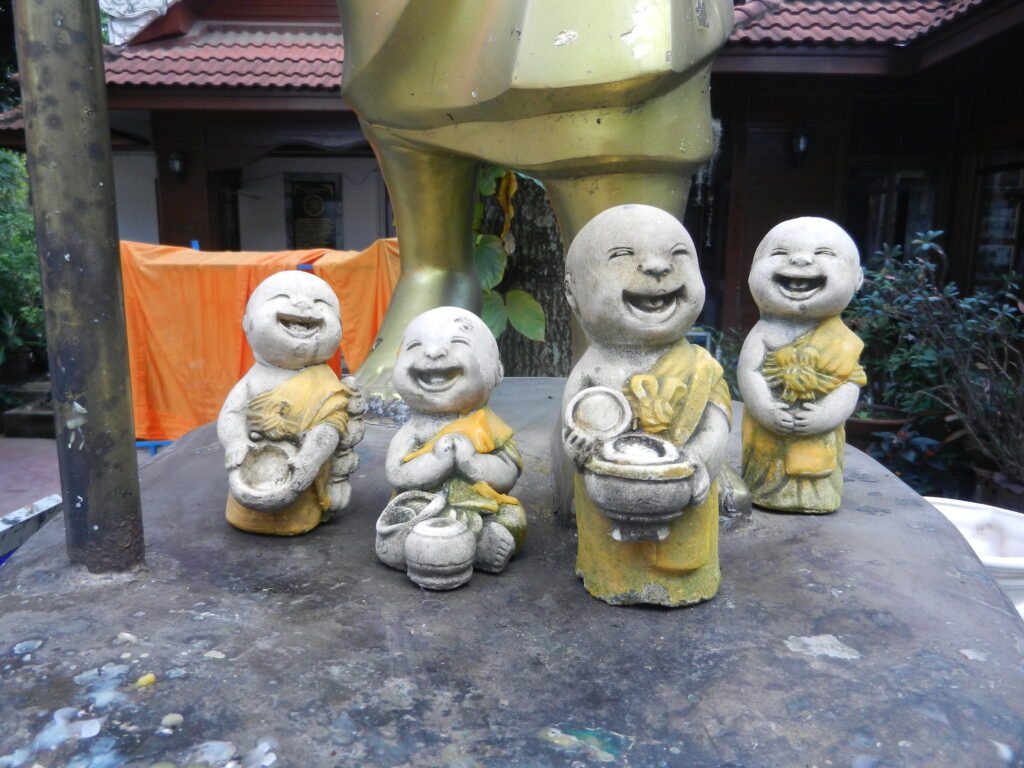
Architecture that surrounds them is often equally delightful.
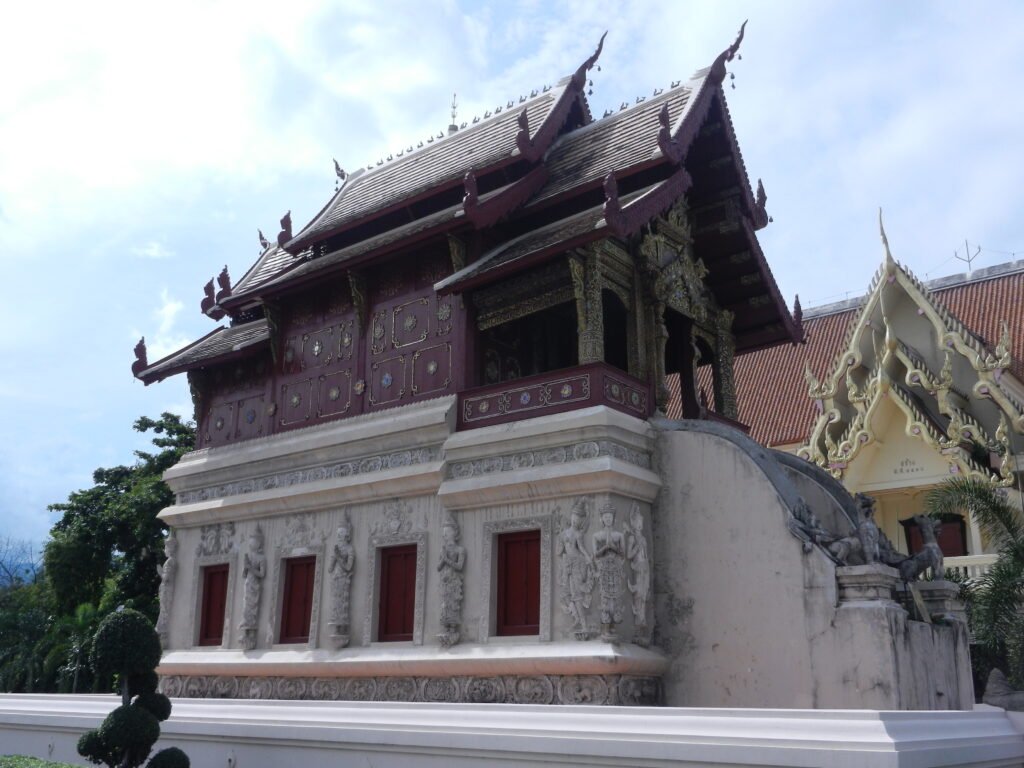
You can savor details of this manuscript library in Chiang Mai in this article.
Different cultures can emphasize seeing large or seeing small. Each way of thinking can provide a valid way to integrate experiences and inspire beautiful art. We can now look At/With/Beyond to enjoy the best of both worlds. As we keep exploring more ways to appreciate the field of connections we all share, our perspectives of it can become ever more vast. At the same time, we can revel in an increasing variety of ways that people have beautified daily life. The vast and the intimate can keep growing richer together.