In the last post, we walked towards Angkor Wat’s center and explored some of the carvings on its central section, beginning with the west wall. The panel on the east wall portrays the universe’s creation, and it is one of Angkor’s most famous works of art. Its 150-plus-foot-long carving shows gods and demons (asuras) pulling a giant serpent from both ends.
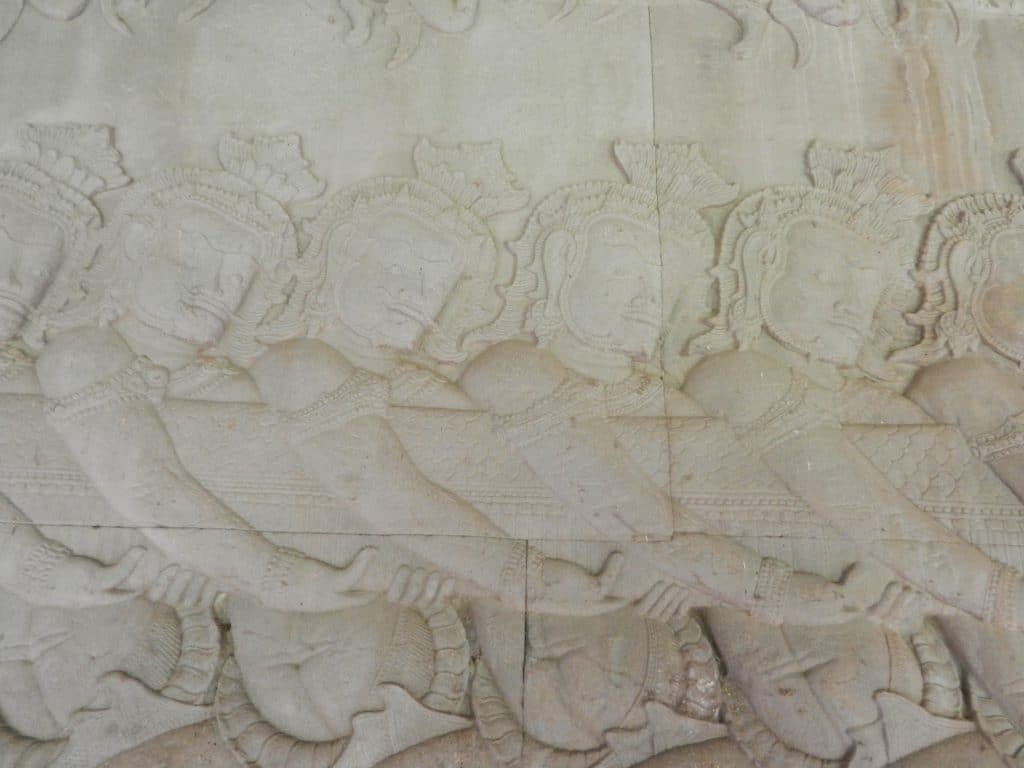
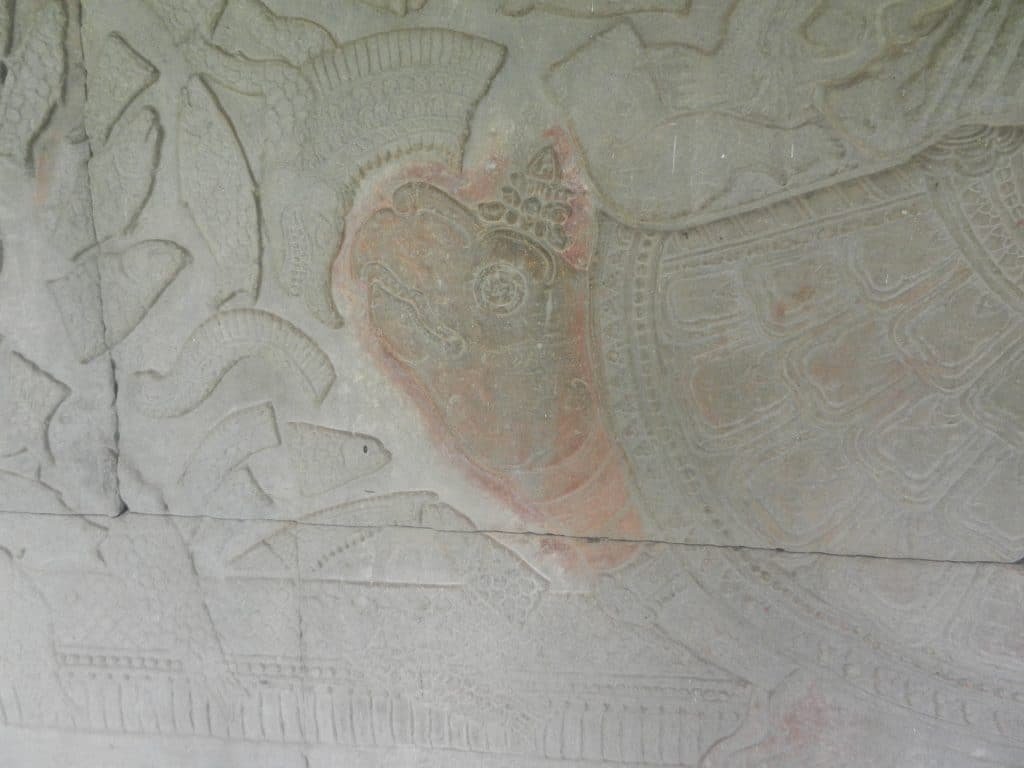
In Hindu mythology, this tug-o-war churned the sea of milk at the beginning of creation. Vishnu became incarnated as a tortoise to support the mountain that the serpent wrapped itself around.
By pulling its body, the gods and asuras rotated the mountain.
This panel is so symbolically rich that it has been read in another way. Though some see it as another message about Suryavarman’s power, others think that it has a more spiritual meaning and that the viewing of all the walls might begin with this scene. If so, the judgment of souls on the previous wall might climax the end of a cycle of creation and destruction. The process then begins anew with the churning of the sea. The suffering in hell and the horrific battles on the west wall represent the cosmic transformation as one era ends and its material structures dissolve.
But why stress the cruelty of the hells’ torments so vividly if they only illustrate a cyclic change? The graphic punishments provoked the historian Tony Day to see Angkor Wat as both beautiful and violently centralizing. He noted that Suryavarman II’s reign was taxed by wars with two powerful eastern neighbors, the Dai Viet in northern Vietnam and a federation of people in southern Vietnam called Chams. The latter soon invaded Angkor, and they might have conquered and sacked it. They at least took over much of the empire’s eastern territory. Suryavarman II needed to marshal as many troops as possible to march in the searing heat and risk having their stomachs ripped open with spears. Does Angkor Wat embody spiritual growth or violent politics?
I think it expresses both. This culture saw the world less in terms of precise definitions according to Aristotle’s law of the excluded middle (P is either A or not A, but it cannot be both) than Westerners have. Khmers thought more of the harmony of the whole universe and society, and they often fused several meanings. To them, the king’s key role in the cosmic order and his honor on the battlefield were inseparable. Both ideas blended in images of Suryavarman defeating disorderly forces and restoring prosperity. He had deposed and killed his uncle before taking the crown, and thus might have used scenes of Hindu gods overcoming demons and establishing the dharma to justify his own rule. I’ve found Angkor Wat captivating because it projects incontestable power and ethereal grace at the same time. You can see it in either way and be equally awed.
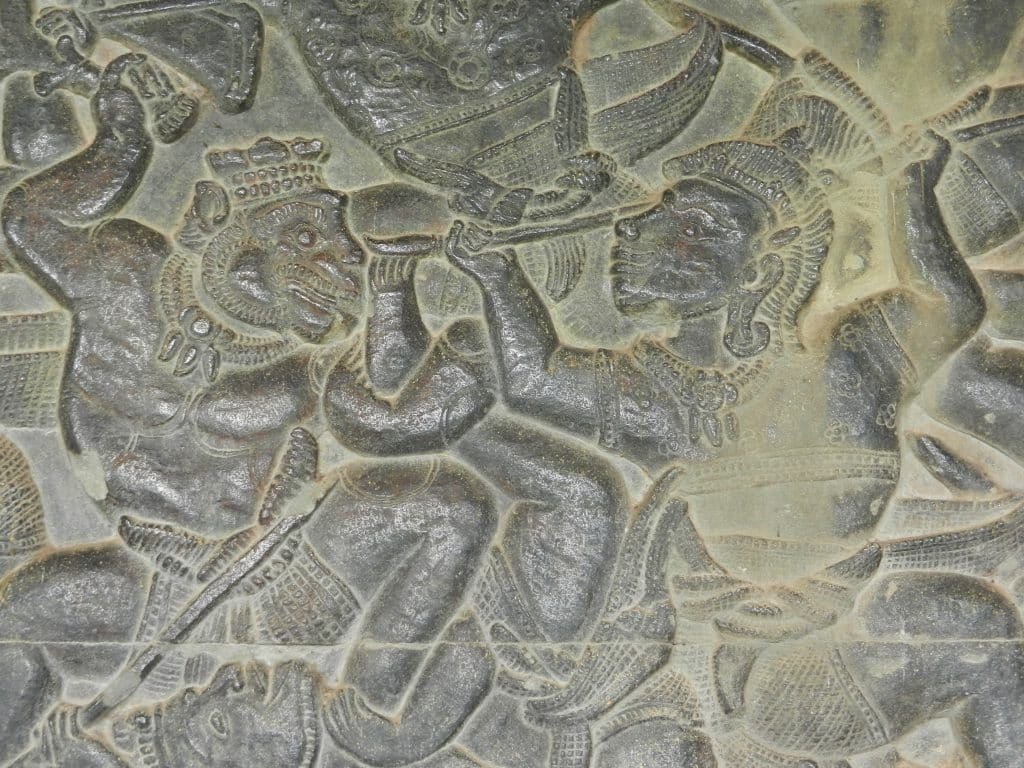
The carvings on the rest of the walls are mostly of battles between Hindu gods and their foes, and they include one of the most violent scenes in Asian art. This depiction of the Ramayana’s final combat climaxes in a whirl of destructive energy that flings bodies around like twigs.
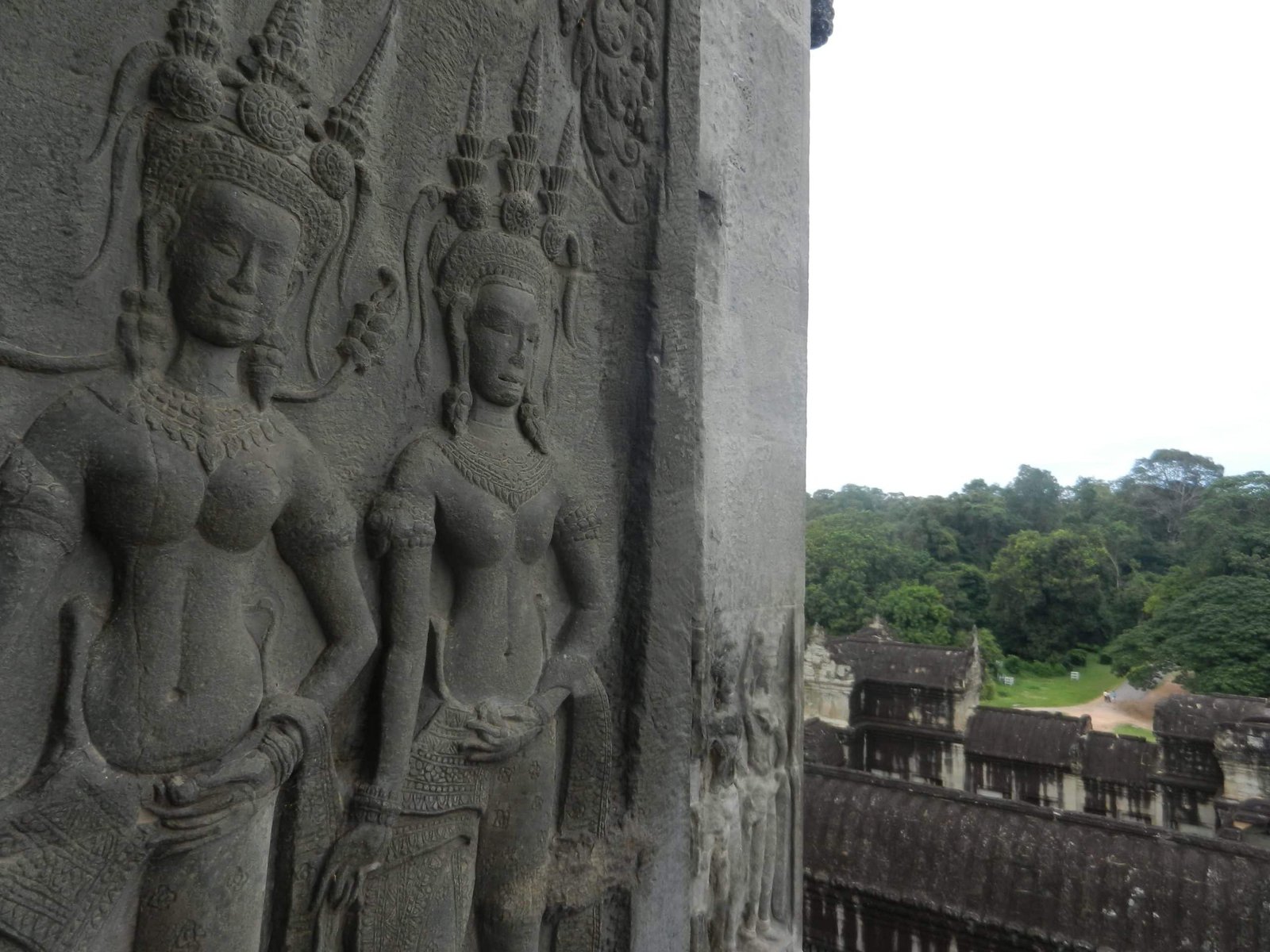
Female dancers who entertain gods balance the war scenes. Some are called apsaras and they reside in the heavens. Others are called devatas and they stand rather than fly. Both are the height of elegance, and they adorn courtyards, walkways, and towers throughout the temple.
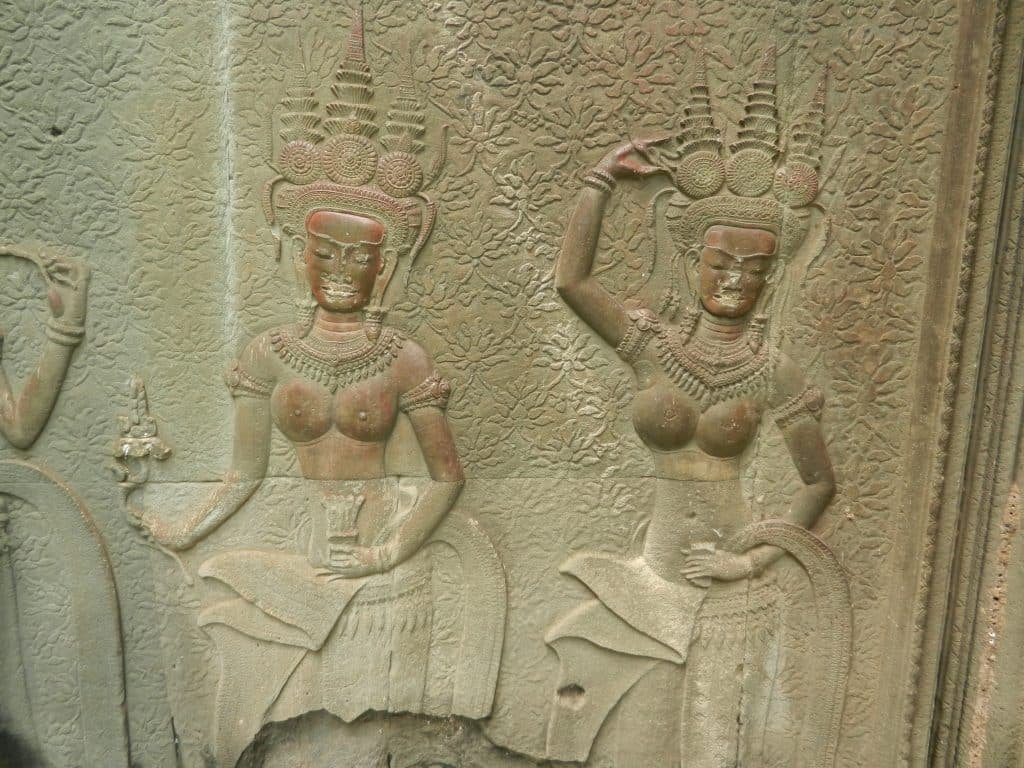
Hundreds are unique, with different hairdos, crowns, and outfits. They have narrow waists, slender limbs, round breasts, and the coquettish grin of a teenager who just discovered that she can turn the head of every male in the room. Some might have represented real dancers at the Khmer court.
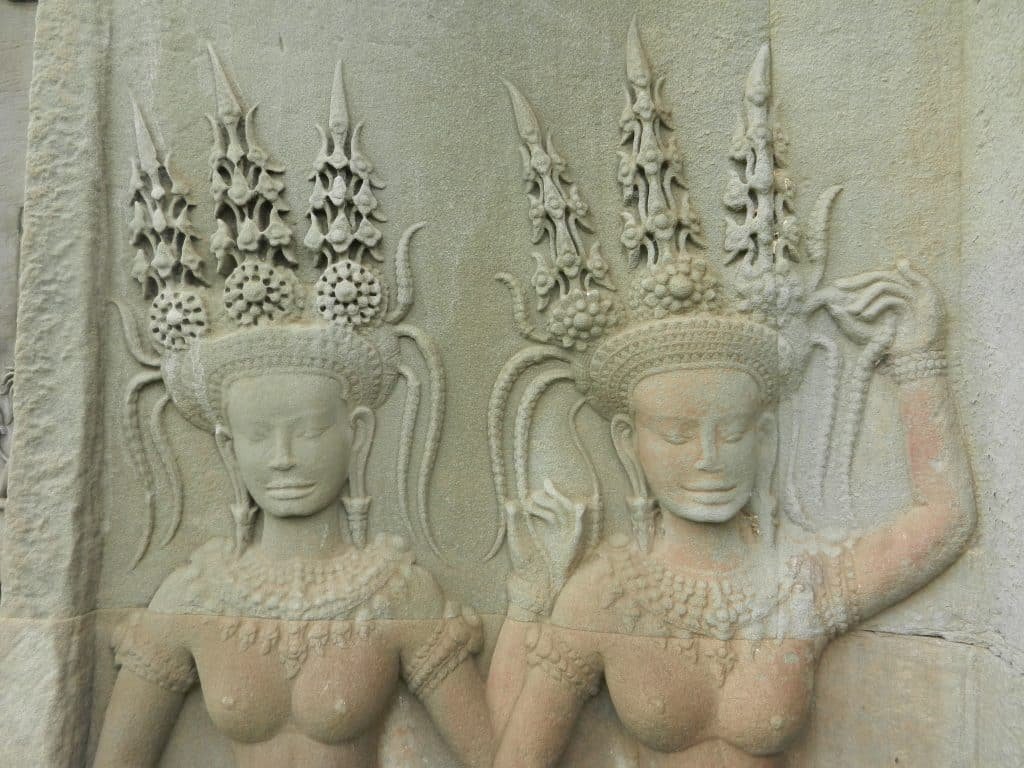
But they must have had more spiritual meanings because they catered to the gods. Paul Cravath and Denise Heywood noted that dance was a key art form for the Khmers. Performers might have enacted archetypal patterns of creation and honored ancestral spirits at temples and the royal palace.
Cravath, in Earth in Flower, wrote that Angkor’s dancers regularly performed to help usher in the monsoons each year. Khmers associated female dancers’ movements with feminine patterns of energy that bring fertility to rice fields. He said that Angkor’s king represented masculine power, and that the court dances harmonized the feminine and masculine aspects of nature. He also wrote that Khmers staged dances to commune with ancestors and nature spirits. So ritual performances integrated many domains and types of beings that enabled society to flourish. These carvings impeccably balance sensual beauty and celestial grace, and they’re justly some of the most popular Khmer works of art.
Back at the entrance portico, I ventured closer to the source of creation by ascending the stairs towards the central tower. This was a key transitional zone—I was leaving the area where worldly images predominated and entering more mysterious domains.
At the top of the stairs, I entered a square courtyard with a large pool in each corner. Colonnaded walkways lie between the four basins and form a central cross. The columns create interplays of light and shade that would have danced in the sparkling waters and on the walkways.
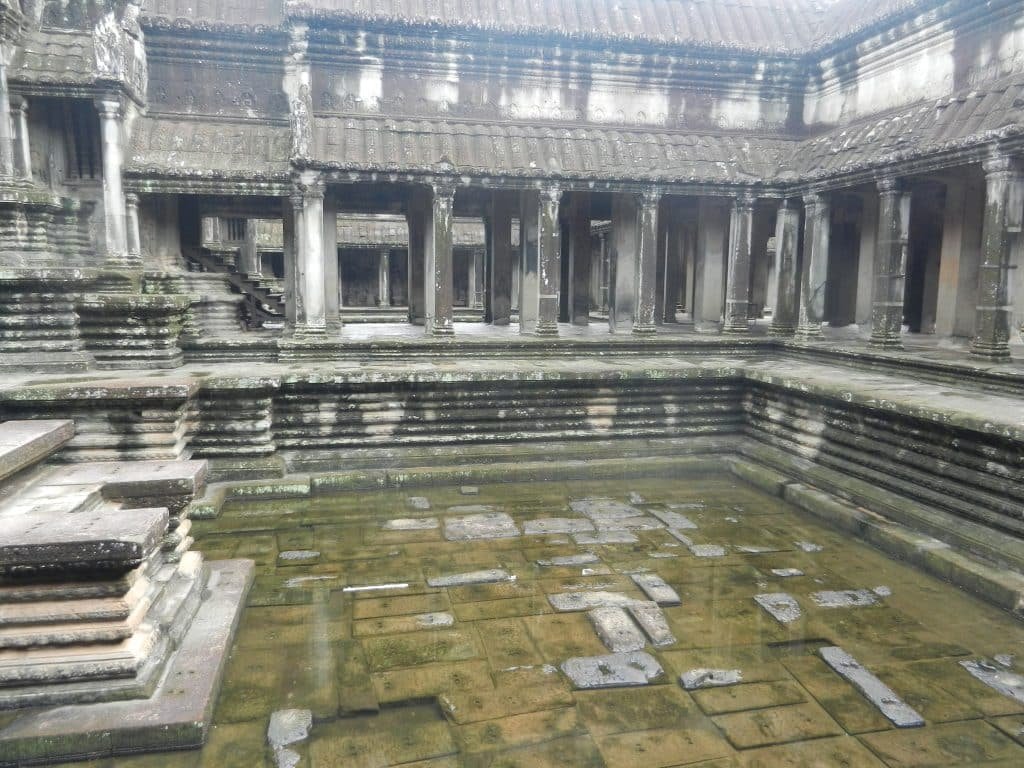
The pools were dry when I was there, but locals had placed large arrangements of orange flowers and banners in front of Buddha statues because Angkor Wat is now a Buddhist temple. The bright colors of ancient religious rituals and the interplays of light, water, and stone must have made this a ravishing place.
I then climbed a long stairway to one last corridor that surrounds the central towers. Its halls lack carvings and they are narrow and enclosed—they’re darker than the first corridor. Mannikka proposed that their circuit around the center represents the moon’s orbit and the constellations. Khmers believed that the central towers symbolize the universe’s center, which the heavenly bodies orbit. The halls’ dimness heightened the splendor I was about to bask in.
I walked out the other side of the corridor and looked up at the celestial towers that have been the most famous images of Angkor. The sudden change from darkness to sunlight was stunning, and some art historians have thought that this shift is supposed to inspire a spiritual experience.
The towers rise from a 40-foot-high platform—a spectacular climax of the journey which began on the road. Even the most level stairways ascend at a 50 degree angle. Here the path is so steep that it seems as though only gods belong at the top.
I ascended the stairs that soar to the southwestern tower. “Wow! I’m at the top! I’m finally here! This is one of the most magnificent human-made places in the world!” I proceeded through the doorway to this most sacred realm, and . . .
SPLISH!
“What the hell is . . . ?”
I looked up as I wiped the mysterious clear liquid from my face and glasses. I was just christened by a bat relieving himself who, along with several buddies, hung from the ceiling. They sometimes congregate in temples in southern Asia. During a later trip up there, I heard an English-speaking guide warn his group, “Be careful or the bats will drop you something.” A Mandarin word for bat, fu, also means good luck. I’ll take it, but I wished an apsara had kissed me instead.
The summit immediately made me think of the glory of the gods and the king. The place is stunningly symmetrical, with four corner towers that surround the central spire. They are supposed to represent peaks that encircle Mt. Meru. Colonnaded passageways line all four outer walls and run through the corner towers. Perhaps priests once walked through them with incense, chanting hymns to invoke the cardinal directions and the gods that represent them—holy men might have harmonized cosmic powers before approaching the central tower.
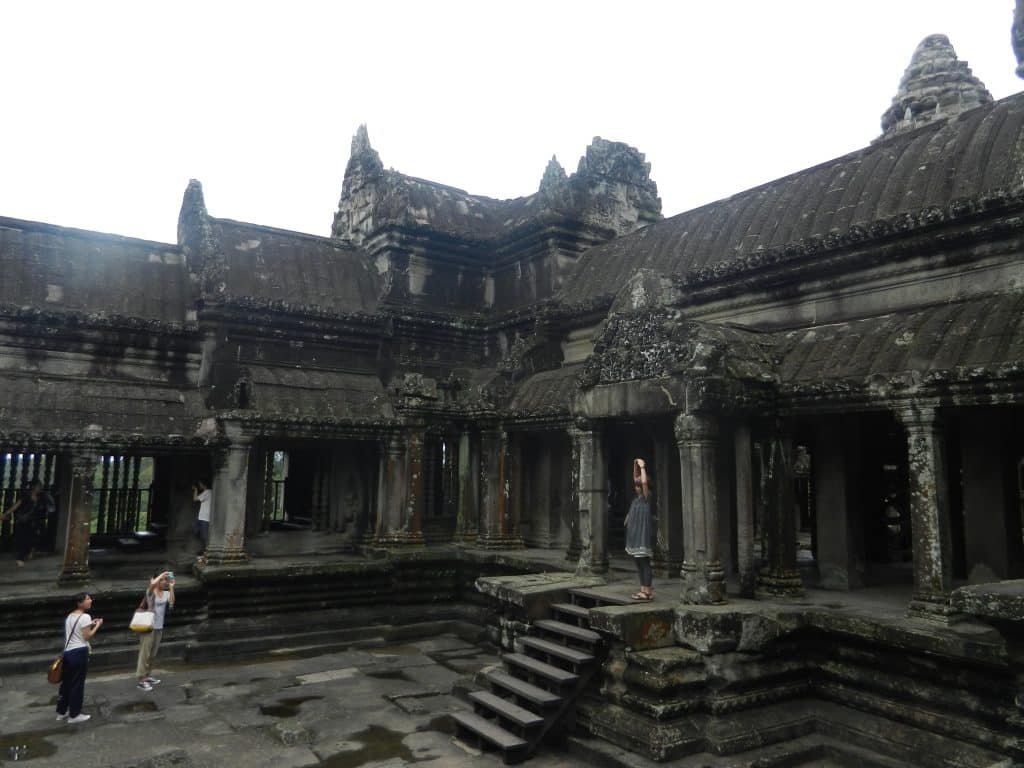
Each quadrant has a dry pool that’s four to five feet deep (like the lower courtyard, but the upper basins are larger). They probably symbolize oceans that surround Mt. Meru. A colonnaded walkway projects from the middle of each passageway lining the outer walls, proceeds between the two pools that adjoin it, and ends at a shrine in the central tower.
Vishnu’s statue no longer presides in the central tower, and its chamber was sealed in the 14th or 15th century when Angkor Wat was converted into a Buddhist temple, but I saw wonders on the upper terrace that even Suryavarman’s architects didn’t imagine.
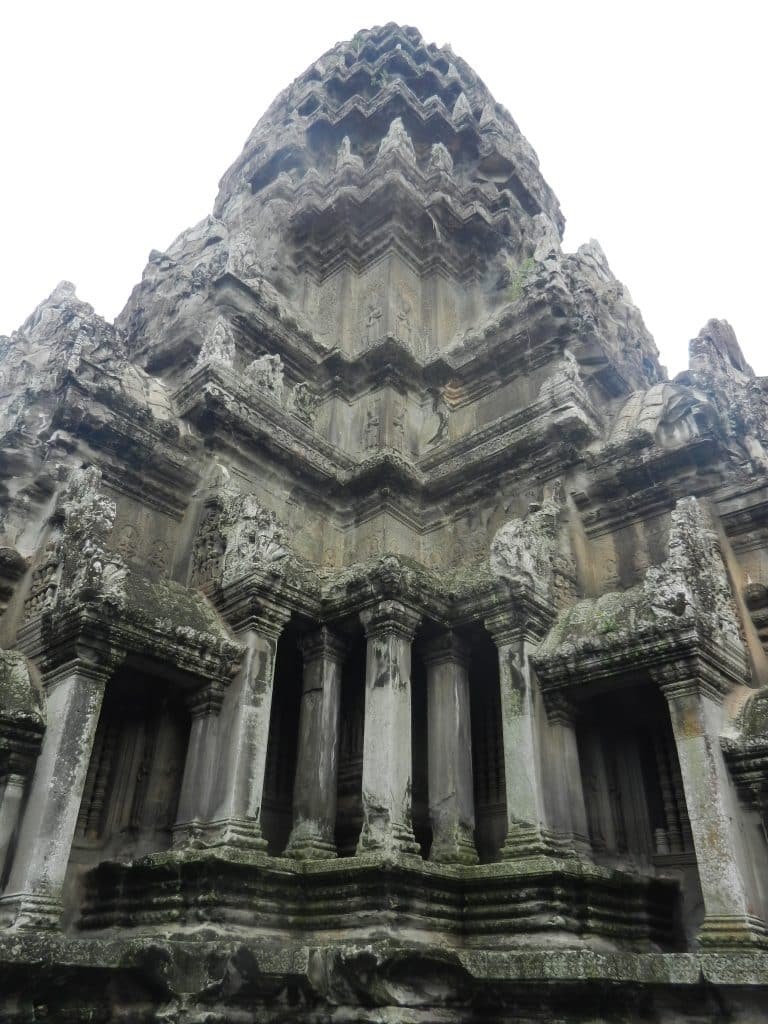
Languages of visitors from around the world mixed with ornate carvings of gods, stacks of tiled roofs, lilting devatas, the chirping of birds and bats, and soft breezes rustling through the window slats.
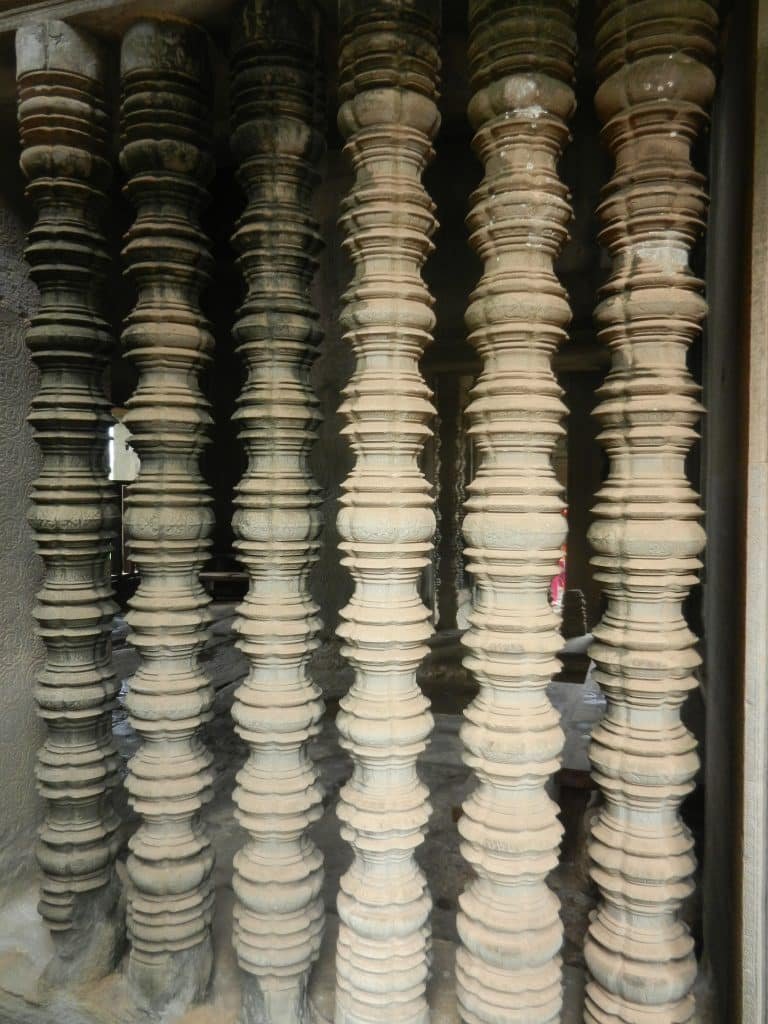
Thousands of forms and the sounds from nature and cultures from all over the globe comingled.
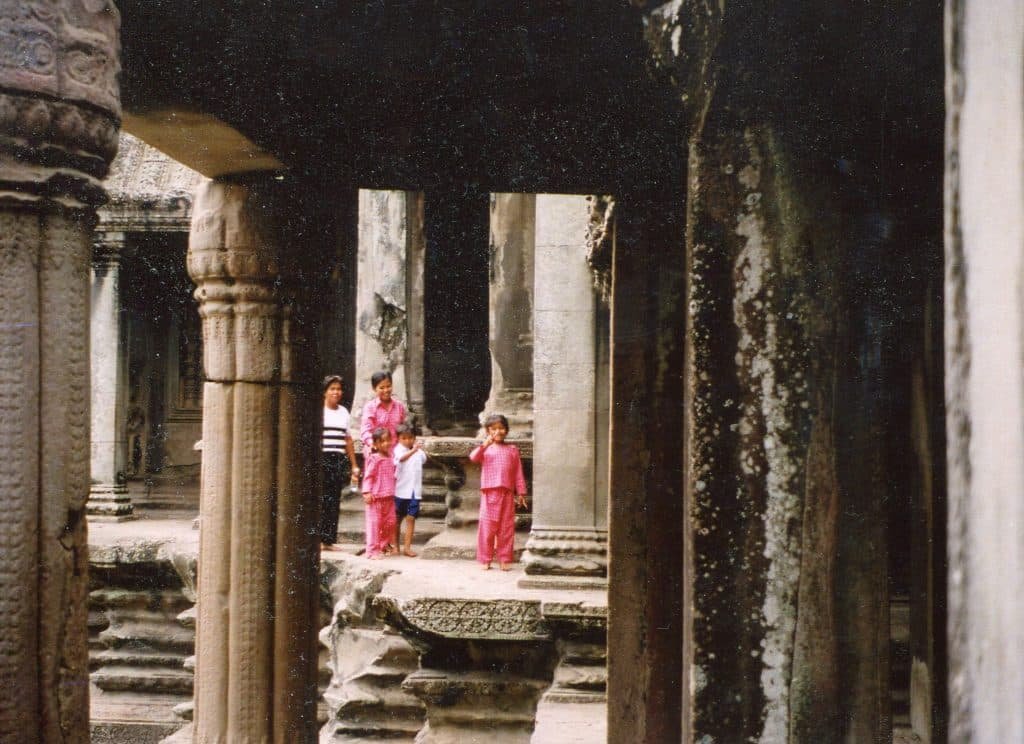
Gentle Cambodian families enhanced the harmony. Two local women and two five-or six-year-old children sauntered around the central tower, on top of the plinth that it stands on. Both kids smiled at me when they noticed that I was watching them. The conviviality, elegant architecture, breezes, and sunlight made everything around me sparkle.
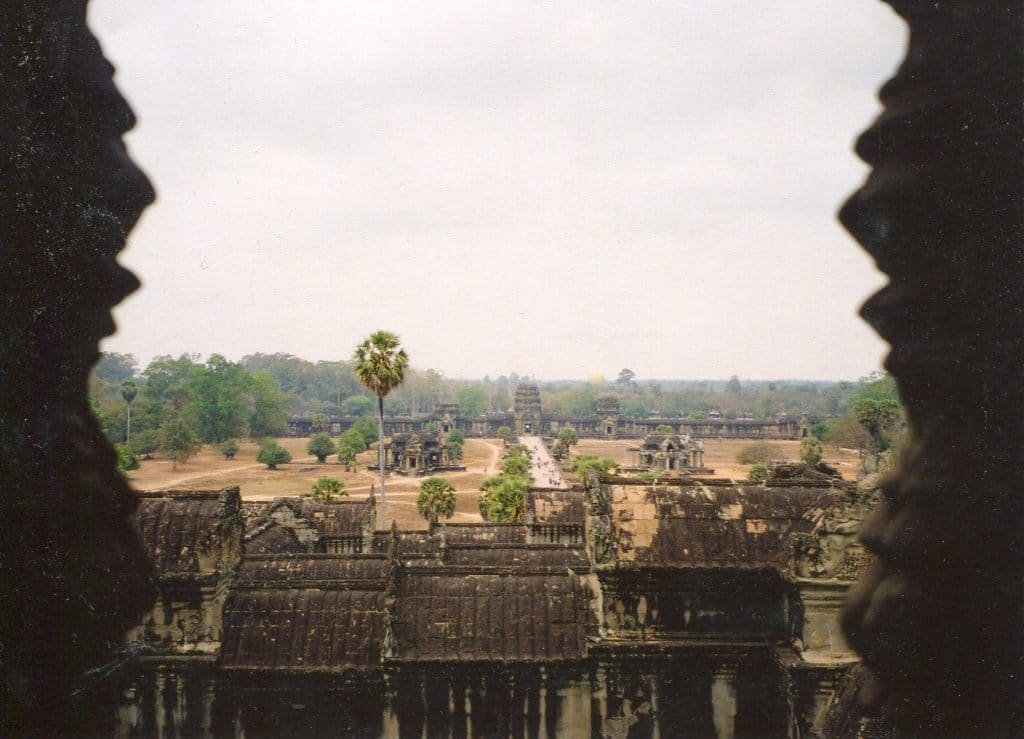
Even the bats were beautiful now (sadly, there was a 30-minute time limit on the upper terrace when I returned in 2012—increasingly large crowds were clogging the steep stairways and making them dangerous).
This monument displays contrasting personalities so well that you can spend years savoring it. On one hand it’s full of graceful and spiritual images that include elegant floral patterns that adorn lintels, lithe devatas that sway on walls, towers that rhythmically balance each other, and the top level embodying paradise. But its massive frontage and violent reliefs project centralized power with a jackhammer force. Suryavarman II extended the Khmer empire farther than any previous king had—all the way to the fringes of the Burmese empire. He went over the top to express its sacred and lordly sides in the same monument.
Angkor Wat is symmetrical, but not in the way that ancient Greek architecture is. Later in that trip, I visited several ancient Greek cities on Turkey’s west coast, including Miletus, where the first known Western school of philosophy emerged in the sixth century BCE. The temples and stoas that surrounded its two agoras immersed people in an order that inspired dialog (the extant buildings are from Hellenistic and Roman times because the Persian Empire leveled Miletus in the 490s for leading a rebellion against it). Those open spaces with clear vistas of proportioned colonnades and human-sized buildings encouraged Greeks to feel that the world is fathomable, and that everyday language can express its fundamental order. These assumptions are key foundations of Western civilization and modern science.
But Angkor Wat’s symmetry is so complex and its scale is so vast that it silences people. It only could have been built by beings with far more power than my puny biceps can muster. Its regularity and the refined carvings may reassure folks that the kingdom is in harmony, but it seems like an order centered on gods and the king. I often felt mixed emotions there because the building was both inspiring and oppressive.
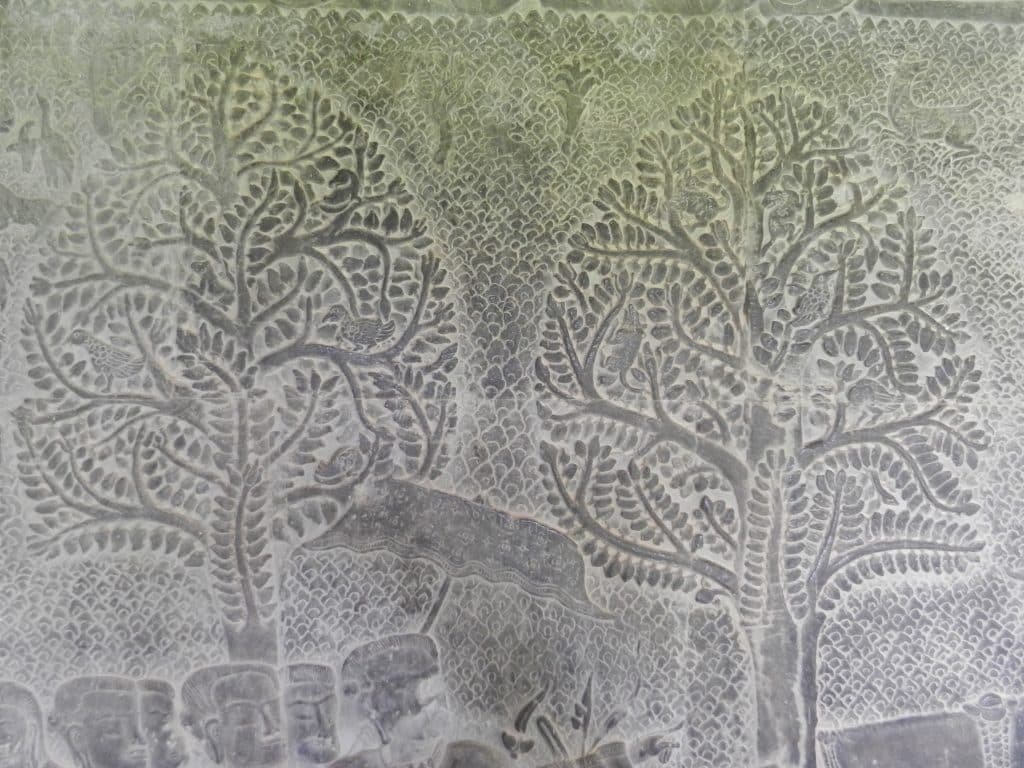
The reliefs’ styles also mix grace and force. Angkor Wat’s sculpture has been called classical because it’s elegant and elevated above daily life. Devatas are suave and charming, and some warriors in battle assume postures from classical Indian dance. But other figures have angular faces and they seem absorbed in their mythic worlds and detached from our concerns. Trees in many scenes bristle with dense and animated foliage as though they’re full of nature’s energy. The carvings are thus both courtly and infused with mysterious power.
This power envelops many senses. When I was leaving the temple at sunset during the rainy season in 2012, it became noisy with crickets. They weren’t concentrated anywhere, but instead pervaded the whole area. Birdsong filled it during other visits. These all-encompassing sounds, along with the tropical heat and the monsoons, meshed with the overpowering architecture and sculpture to create a feeling of energy coming from the center of the universe.
Angkor Wat radiates both divine grace and bone-crushing authority. The variety of scholarly interpretations of it reflects this diversity—it’s too big for one view. You can see it from many perspectives, and they’re all magnificent. Approach this embodiment of the Khmer universe closely enough and you may either feel transported into the heavens, or pulverized by its size and power.