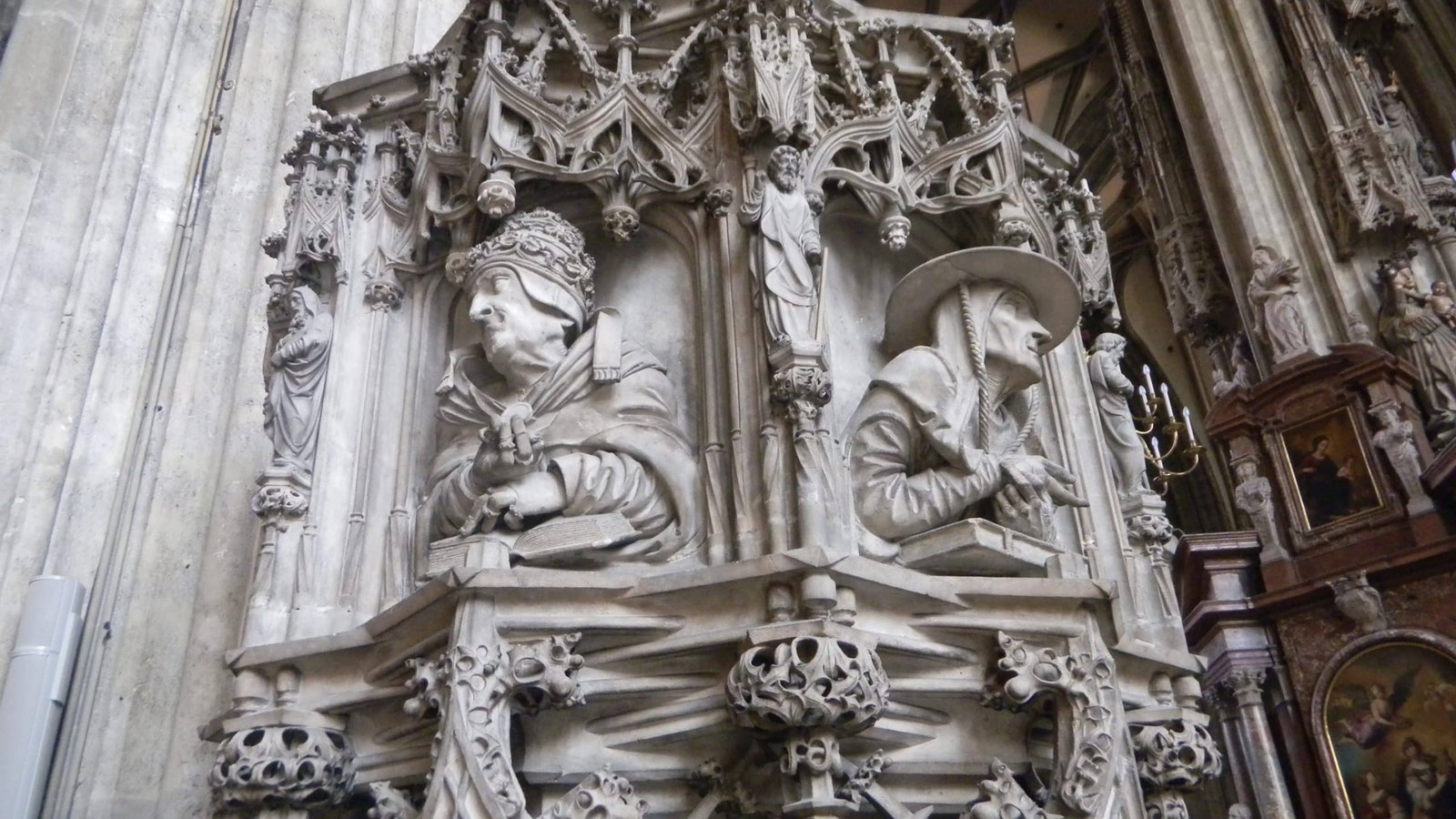
The last article here explored the transition from thought in the Middle Ages to the modern world, but the medieval world was much more dynamic than what many people have realized. It also created many roots that modern science emerged from, so we’ll explore some of its dynamics here.
Storms were brewing in the 12th century that shook Europe. Many took place in neighborhoods that were increasingly noisy. Towns had been growing in Europe since the late 10th century. The barbarian raids (Viking, Saracen, and Magyar) had subsided, and people were improving farming methods. They made heavier ploughs that dug deeply into hard northern European soils. The newly adopted harness enabled horses to pull plows by putting the stress on their shoulders instead of their windpipes—this multiplied their pulling power. It also enabled more inland trade by making large horse-drawn carts possible. Farmers developed a three-fold system of crop rotation that produced more from the land by using two fields each year and letting the other lie fallow and replenish. People also used more manure to fertilize soils. Watermills were being built in northern Europe, and they allowed grain to be ground more efficiently than older mills powered by animals or humans. Communities cleared forests and drained marshes, putting more land under cultivation. All these quiet labors enabled a steady population increase, and some historians have found evidence that Europe experienced a general rise in temperatures which would have prolonged the growing seasons. Its population growth created profound social changes.
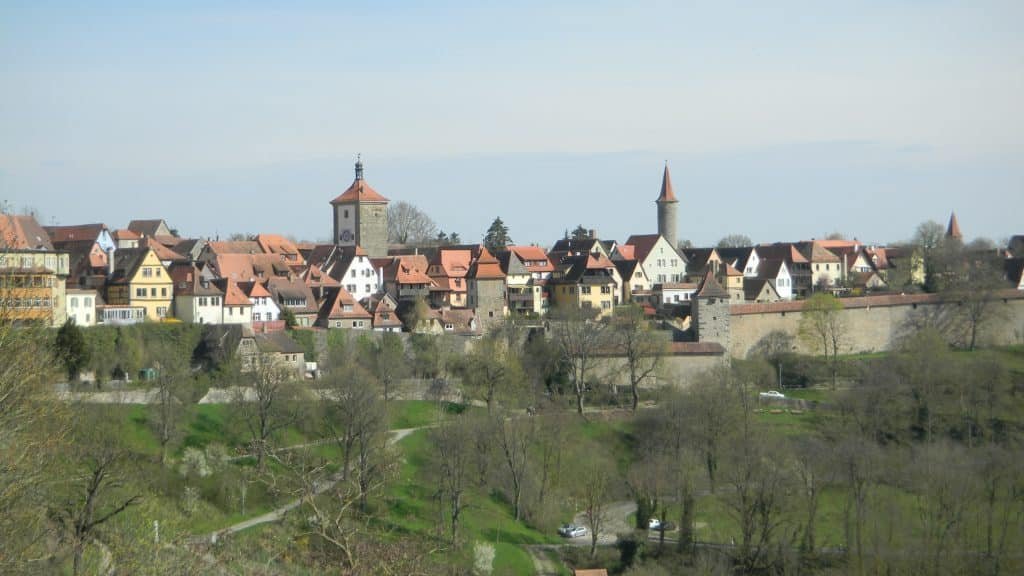
Towns throughout Western Europe received their own charters for governance by the 13th century, and in many a person could become free after living there for a year and a day. The population rise created competition for land. Younger sons in noble families who couldn’t inherit the family estate had to make a hard choice: Let your older brother wipe his feet on you because he came out of the womb first; fight that bastard to the death; find religion and live a dull life in a monastery; or move and forge your own place in the world. Many young men chose the last option (the below photo is of Rothenburg, Germany).
So did many in the under classes. Nobles competing with each other were squeezing all the goods they could from their peasants. So both callous-handed farmers and angry younger sons packed their bags, hit the roads, and headed for the town gates. Money was increasingly used, and this allowed many serfs (or their new urban patrons) to buy their freedom from the old feudal bonds.
Others came too. Semi-professionals, such as notaries, looked for employment. The more enterprising landowners were enticed by business opportunities.

As the cities grew, they became more complex and created spaces for more types of people to settle into. Many came, including traders, artisans, entertainers, wandering scholars, itinerate preachers, orphans, and prostitutes. They all shared the same streets, like the one in Assisi (above). Proud and independent merchants emerged and displayed their new wealth with multi-story homes, sumptuous tapestries and gowns, banquet tables piled with beef and venison, courtly dances, glittering rings, and prancing horses. They resented tax-happy kings, popes, and lords. All these classes of people jostling each other in the dense streets forged identities that were increasingly independent from royalty (Regensburg, Germany is shown below).

People specialized in different trades and formed guilds. Many of today’s common English last names emerged from them, including Smith, Clark, Baker, Cook, Miller, Hunter, Barber, Carter, Wheeler, Mason, Tinker, Weaver, Potter, Tanner, Farmer, Fisher, Chandler, Page, Foster, and Roper. Others were named after their towns, such as York, Lincoln, Dover, Wells, and Winchester. Some people were named after places where they lived or came from, like Hill, Wood, Rivers, and Dale. Others received last names based on personal characteristics, including Sharp, Fox, Dull, Armstrong, Little, White, Brown, Black, Long, Short, and Freeman. People’s own identities apart from royal majesty were strengthening.
The growing towns did allow kings to gain power at the expense of the landed nobility. The latter relied on their own lands for wealth and didn’t participate as much in the growing monetary economy. As more money went into circulation, they were hit by inflation at the same time that they were losing laborers to the towns. But monarchs relied on urbanites for their taxes and administrative skills. Kings were able to marshal more resources, but because they relied on townspeople for money, they had to respect them. Urbanites had good reason to be proud.
I immersed myself in medieval town life in Regensburg, which is one of the best-preserved northern European towns from the 13th century. It stands on the Danube in an area that has been a ritual center and trading hub for at least 3,000 years. The town became the seat of the Bavarian dukes in the sixth century, but they moved west to Augsburg in the 14th century, and Regensburg became something of a backwater. I felt lucky because its medieval townscape didn’t get the Renaissance makeover that Augsburg had in the 16th century. I wandered through it, surrounded by narrow winding streets with tall wood-framed houses on each side, crowned by steep gabled roofs. A few homes are square stone towers over 100 feet high. Some of the town’s wealthiest lounged in their upper chambers and looked down on their neighbors.

Urban streets back then were elbow to elbow with hawkers, urchins, preachers, laborers, and cut purses. Dogs, cats, pigs, rats, mice, and fleas shared the same space with them. There was plenty of dung to step in. Germany had a bedbug epidemic when I was there, and I often had to stop to scratch the fiery bites swelling on my shins. I thought, Hey! This is too much immersion!
Fortunately my medieval immersion was incomplete. Homicides were common back then. Town registers all over Europe brimmed with accounts of deaths from fights that flared from insults in taverns and disputes over the prices of goods. Blood feuds often raged as well.
But people kept coming to the cities anyway. They considered the liveliness and freedom worth the dangers. Cathedral squares bustled with markets, ballgames, acrobats, and plays. Some actors carried a bucket of blood from a local butcher to make scenes more real—Black Hawk Down is gory, but medieval special effects included real goo and smells. In morality plays, actors playing devils ran through the crowd, pinching spectators. Today’s peaceful town centers, like the one in Bratislava (below), were much livelier and sometimes dangerous back then.

A brilliant and hot-headed young man happily plunged into the turbulence when he arrived in Paris. Peter Abelard was born into a minor noble family in Brittany. His father saw the growing importance of literacy in the growing medieval towns, and he couldn’t help noticing that his son was as quick as a fox. Peter entered Notre Dame’s cloister school and publicly disagreed with his teacher, William of Champeaux–the most renowned theologian in Europe. He was used to getting his respect, but Abelard quickly challenged him and cast diplomacy into the dunghill.
Abelard told him that his reasoning was wrong and that his conclusions were ridiculous. Since William’s honor was at stake, the two squared off in a debate. The older man believed that the general is more real than the specific. In other words, God created the category Tree before He made any single tree. William also thought that the essence of all people is the same so that individual differences are merely accidental. The brash youth bested him. Abelard was more in tune with the increasingly sophisticated world of the growing cities, whose multitude of cultures and nonconforming personalities couldn’t be cobbled into a simplistic scheme of categories.

He left to start his own school and many of his classmates went with him. Silicon Valley’s start-up culture emerged on the medieval Seine.
Abelard was armed with Aristotle’s logic. Aristotle’s works were being translated into Latin in Spain and Sicily in the 12th century, and people in Europe were discovering the power of analyzing their knowledge. Aristotle taught techniques for thinking about how folks categorize things, relationships between words and reality, and how to identify faulty arguments. Bright-eyed young students were discovering the power of his reasoning techniques, and older folks were shocked.
Abelard wrote a book called Sic et Non (Yes and No) by compiling contradictory statements by founders of the Church about 158 different issues. Medieval Europe’s newly urban and literate people were pioneering ways to see things from multiple angles, and to question ideas that reality is all top-down (which Romanesque cathedrals expressed). Many young men were eating these new ideas up like figs dripped in honey.
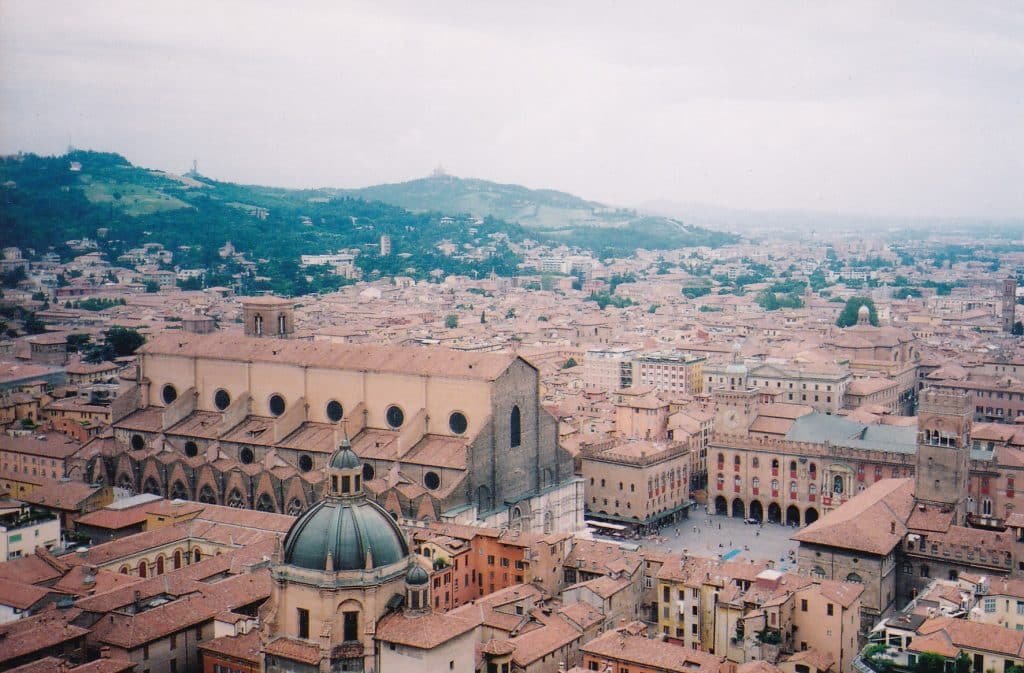
Europe’s first universities were emerging. Scholars were congregating in cathedral cloisters and town squares. As the gatherings became regular, universities in Paris, Bologna, Padua, Salerno, and Oxford were established, and they awarded degrees. (Bologna is shown below, from the top of a narrow 310-foot-high tower house).
Young men flocked to them. They lived in special residences, struggled on low budgets, got drunk whenever they could, and were known for rowdiness–the college experience was born.
Saint Bernard was not amused. Those lusty young men were applying their new intellectual techniques to the deepest spiritual mysteries, like the Trinity–a subject that one can only approach after decades of devotion and study. Bernard claimed that faith does not dispute, it believes.
Always cocky, Abelard challenged the old buzz-kill to a public debate in Sens (in northern France). But the fanatical and manipulative Bernard arrived first and used his political clout to rig the debate into a form that accused Abelard of misconduct. Still a fox, Abelard quickly realized he couldn’t win and walked out.
But students in all universities were excited by the power of their new reasoning skills, and they tussled with the Church over freedom of thought for the rest of the Middle Ages. When the Khmers were building Angkor Wat to stupefy all who came within sight of it and the Islamic world was on its way to suppressing open philosophic inquiry, Europeans were developing techniques for questioning authority.
Medieval Europe was thus peculiar. People dreamed of a unified cosmos under God but bickered about its nature from many perspectives. I saw this knotty mindset in Regensburg when I stood on the main bridge over the river that the town straddles. I viewed the dense jumble of steep, high gabled homes and could almost hear the shouts from windows, share the excitement of markets and saints’ feast days, and feel the fear of epidemic and famine, which lurked like wolves ready to sink their fangs into the townspeople’s flesh.
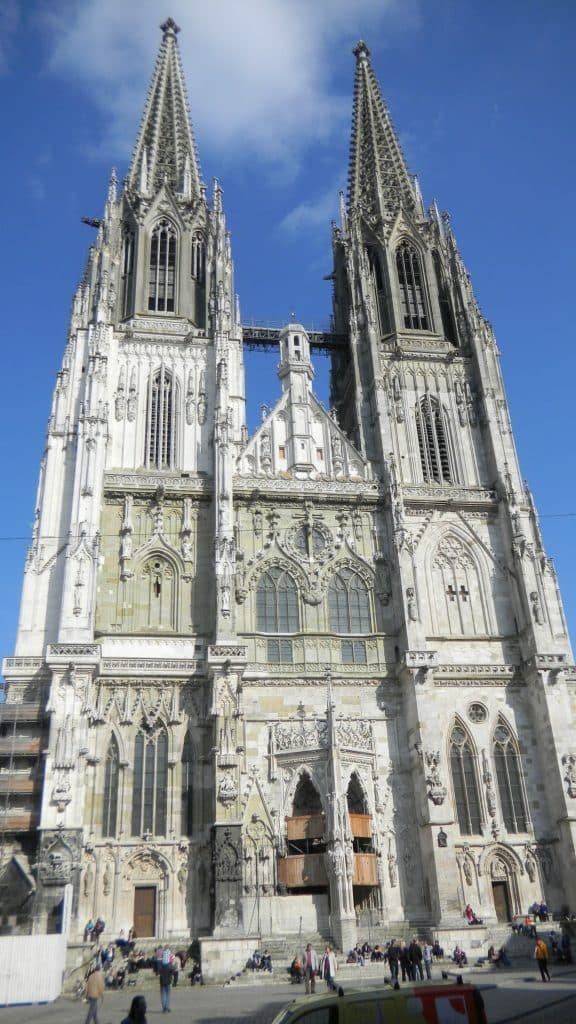
But towering over this jostle of dreams and terror was the cathedral. It is in the classic French high Gothic style, which emerged in towns near Paris. This style emphasized proportioned relationships between buildings’ components.
People in Europe’s growing towns resurrected the classical Greco-Roman love of static ratios, but now used them to express Christian ideas.
In the nave, rows of columns and arches repeat static geometric forms, but they lead the gaze towards the altar and Christ (the photo below is from the cathedral in Bourges).
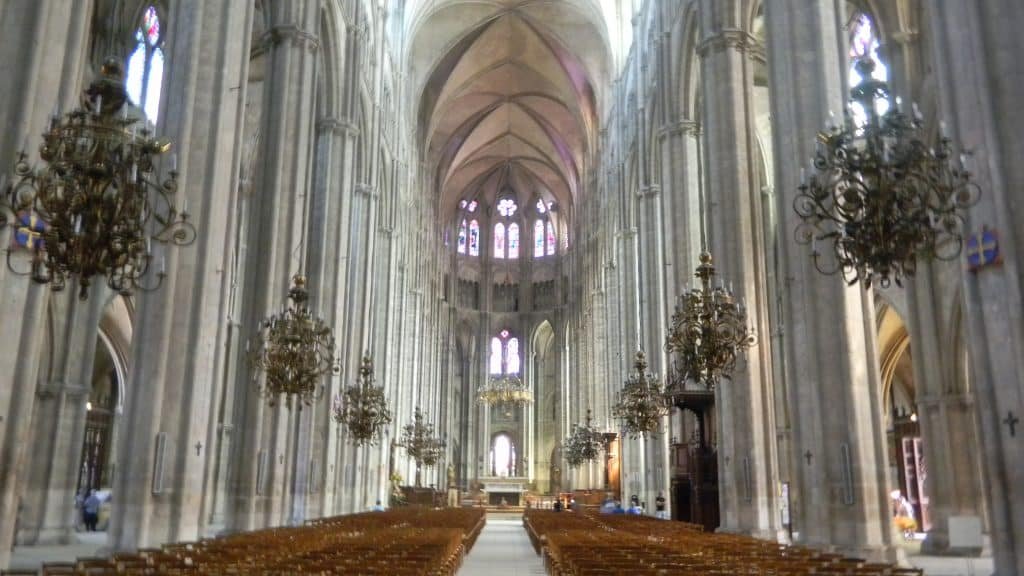
They thereby highlight his life and death as the central events in history.
Though the part of Regensburg’s cathedral that I could see from the bridge (its west façade) was constructed after the 13th century, its geometrically ordered design rising above the chaotic streets was a site that dominated many cities by 1300. Europeans in the 13th century believed that God created a fixed universe with everything in its place in a divine hierarchy. According to this view, nine levels of celestial beings soar above us and the beasts grovel below. The cathedral shows the universe’s sacred order in stone, as Dante’s Divine Comedy does in words. So I saw two different worlds in Regensburg. In the Middle Ages, motley crowds cluttered winding streets, and God’s divine plan arched over them. This sacred order rising above the bustle of everyday life captivated people in the 13th century (Regensburg is in the shot below).

European societies from the 11th through the 13th century tried to unify the world with a system of eternal ideas and forms, and they embodied them with Romanesque and Gothic architecture, yet they had a multitude of voices which were too diverse and able to express themselves to be shoved under one simple framework. They tried to define the order of things but were quick to argue over the intellectual status quo. This situation encouraged intolerance at times, but it also fostered a lot of creative art and literature, and much of modern Western culture descends from it. The West has combined the assertion of a permanent and abstract order of all things with open rebellions against it. Many people in modern times have expounded the fundamental laws of physics as the all-ordering principles, yet a wealth of modern artists and poets emerged that have looked beyond rationality and conventions for alternative meanings. They’re all following footsteps that our medieval predecessors took in those rambunctious town streets.
The Khmers were were undergoing one of their most creative periods at the same time.