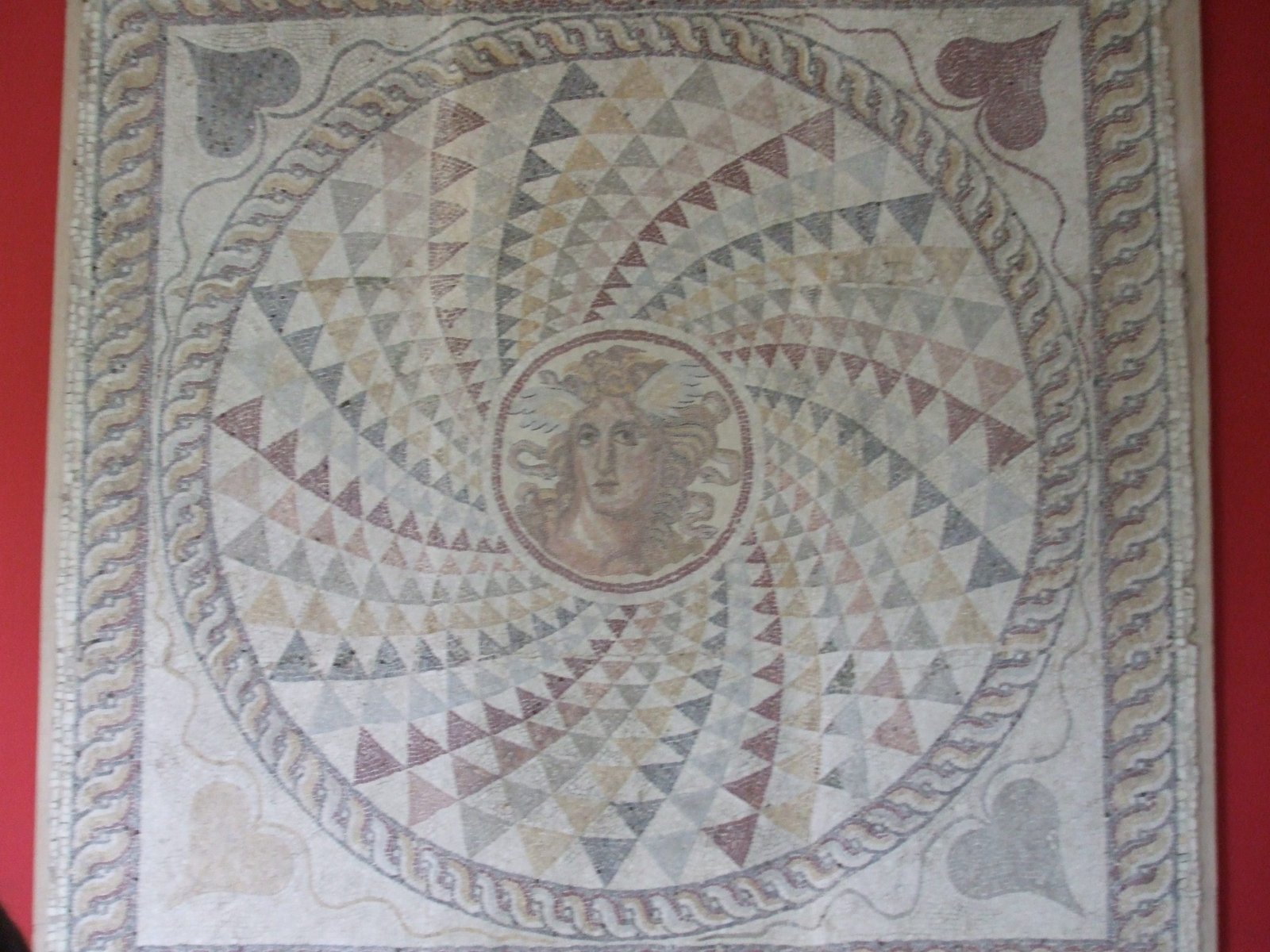
She can be sweet or cruel depending on her mood. That’s a pretty capricious goddess to place in the center of the universe, but this image resonated with a lot of people in the Roman Empire. My history teachers back in college treated Roman world and the Middle Ages as two dramatically separate periods, the former focusing on secular life and the latter on metaphysical realms presiding over a mutable and uncertain world. But the latter view was already highly developed in ancient Rome.
As the world expanded after Alexander the Great’s conquests in the fourth century BCE, so did people’s visions of the universe. More ideas besides the old community of Olympian gods became common, and astrology spread from Babylonia throughout the Mediterranean in the late first millennium BCE. Babylonians had developed the 12-house horoscope and used it to correlate the regular motions of heavenly bodies with events in the world. Instead of human-like Greek gods feasting and fighting, the universe’s main forces were impersonal celestial bodies. The sun, the moon, planets, and constellations that composed the zodiac were the divinities that presided over the world. Many Greeks’ ideas of the universe had expanded from the independent city-states’ popular view of a three-part order of heaven, earth, and underworld. This cozy cosmos fit a pantheon that had human appetites. Gods in the sky and people on earth mirrored each other, and the two Homeric epics portrayed this intimacy.
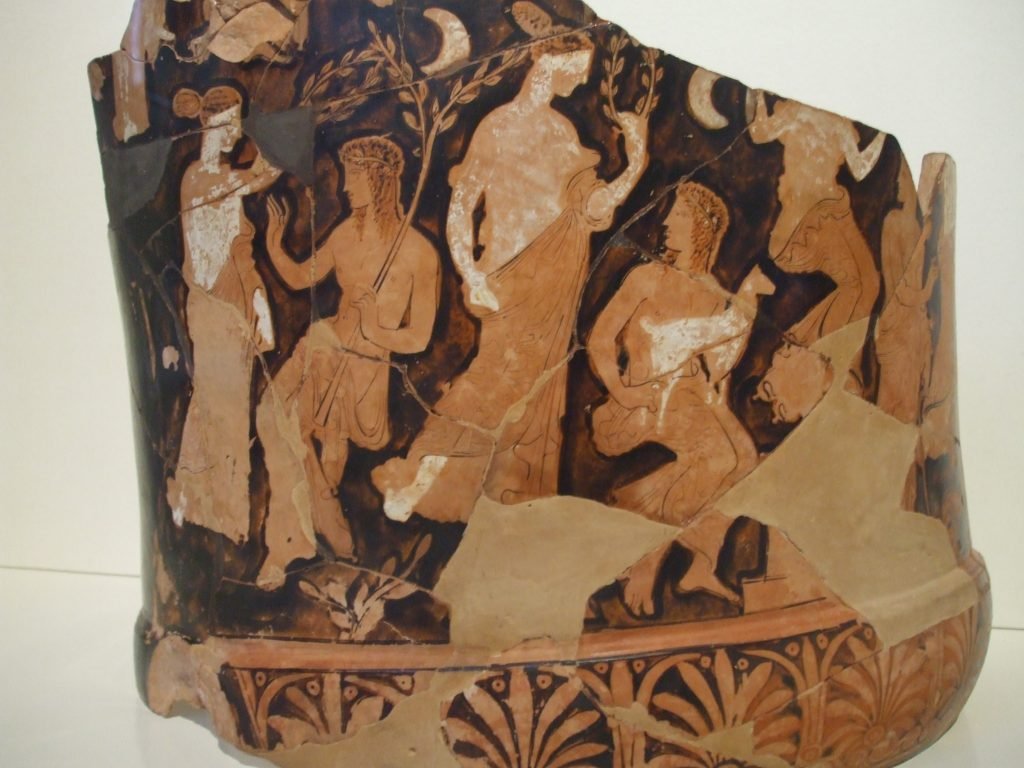
But the regularity of the stars fit the newly enlarged world, and the heavens were now so big that their forces seemed less personal and more mechanical.
In the third century BCE, Aristarchus of Samos discovered that the earth orbits the sun. However, Claudius Ptolemy (100–178 CE) still saw the earth as the center of the universe, and this idea stuck until Copernicus challenged it the 16th century. But Ptolemy’s cosmos was also larger than the older one, as well as more differentiated. His earth rested in the center of a system of spheres that were nested within each other. The moon was the closest to the earth, and progressively farther out were the spheres of Mercury, Venus, the Sun, Mars, Jupiter, and Saturn. An area of fixed stars surrounded all the planets. Westerners held onto this view of the universe until the Renaissance. Ptolemy thought that a nationality’s traits are partly come from the zodiacal signs that influence it. He thought that Britain and Germany are most related to Aries and Mars, so their people are more fierce, headstrong, and bestial. Italy and Sicily are in touch with Leo and the sun, so their inhabitants are more cultured, benevolent, and cooperative.
Babylonians had applied astrology to the fortunes of their state, but Greek intellectuals in Alexandria combined it with a wider range of ideas and synthesized a view of the world that dominated the time between the independent city-states and Christianity’s rise. The heavens’ mechanics were applied to human lives, and a big network of ideas became associated with their orbits. Each celestial body had certain characteristics. The moon and Venus were feminine and the others were masculine. People associated each with a substance. They connected the moon with silver, Mercury with its namesake, Mars with fire, and Saturn with lead. The celestial bodies also had personalities. Mercury was unpredictable and playful, Venus was amorous, Mars had a temper, and Saturn was dull and lethargic. But how did all this stuff fit together?
Many people thought things were related by cosmic sympathy (sympatheia). In the third century CE, Plotinus (a philosopher who lived in both Alexandria and Rome) wrote that things that are alike have a natural concord. Things in different parts of the universe resonate with each other if they have the same characteristics. People are thus in synch with the celestial bodies that they’re most like.
This was how a lot of people thought magic works, and its popularity increased in that uncertain age. All levels of Roman society practiced it. Julius Caesar uttered a spell three times to ensure a safe trip when he entered a carriage. Apuleius’s interest in magic reflected his life—he had to defend himself against a claim that he had used it to make a rich widow marry him. Many people believed that they could affect another person from a distant place, and some tried to do this by manipulating things that had the same or opposite traits that he had.
Others applied words and formulas that supposedly compelled a god or planet to do their bidding. Some people specialized in this and they carried papyri with long lists of spells. Anyone could hire them to manipulate the supernatural to increase their wealth or health, or to harm a foe.
Both types of magic (manipulating objects and chanting powerful words and formulas) were more mechanical than the older Greek Olympian religions. The latter had appealed directly to gods by offering a sacrifice, and people ate some of it in front of a temple in a shared feast (eranos) with the deities. But magic workers tried to force nature’s hand—people resorted to less personal tactics than Greeks had used.
Some even wanted liberation from all of the universe’s mechanics. A person who endures a workweek full of office politics, computer glitches, and cranky customers says, “I’m outta here!” when Friday afternoon comes. Some ancients began to think like this, but on a larger scale. By the second century CE, some people saw the whole cosmos as an impure form of a more spiritual reality. Gnostics had negative opinions of creation and thought it was a degeneration from original cosmic unity. The salvation of one’s soul depends on knowledge (gnosis) of this unity, which is deeper than what the five senses can perceive.
Christianity clamped down on these ideas as it asserted that salvation comes only through Jesus and the Church. The new faith emerged within this cultural setting in which people were already envisioning an enlarged and impersonal cosmos and seeking deliverance. Isis, in Apuleius’s The Golden Ass, appealed to this need when she rescued Lucius (the main alter in her large temple in Pompeii is shown below).

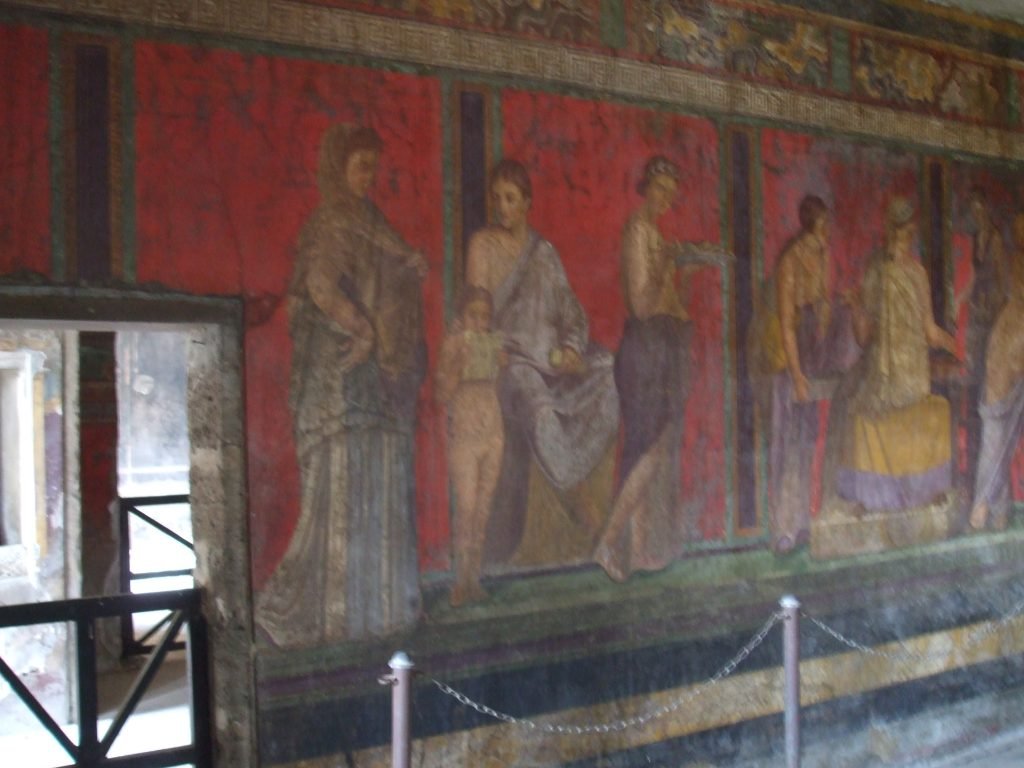
Isis was the divinity of one of the mystery religions that people in Hellenistic and Roman times embraced. Greeks had already developed their own mystery cults, particularly for Demeter, the goddess of agricultural growth. Some people associated her annual regeneration of vegetal life with personal salvation, and they conducted huge festivals near Athens for this. Orphic cults had grown back in the fifth century BCE, and some followers wrote about human souls joining the gods in the afterlife. People entered a mystery religion through an initiation rite that linked them with a god who was associated with dying and returning to life. By the third century BCE, people imported many more mystery cults from the East, and this made the West’s spiritual landscape even more colorful (an initiation rite is painted below, on the wall of a villa in Pompeii).
Magna Mater (the Great Mother; she was also known as Cybele) came from western Turkey, and Rome’s political leaders officially adopted her in 209 BCE when they were in an exhausting war with Carthage for control of the Mediterranean. Mithras came from Persia. He was an ancient god of the sun, justice, and war and was thus popular with Roman soldiers. His followers saw the planetary spheres as a hierarchy of ranks of people’s souls, which become increasingly spiritual through self-discipline. So mystery religions appealed to many mentalities in the varied Hellenistic and Roman worlds:
- Do you feel a need for feminine gentleness? Then come to Isis.
- Do you want undiluted male bonding? Hang out with Mithric dudes.
- Want to walk on the wild side? Cults for Magna Mater and Dionysos sometimes feature orgiastic dances, and some people who honor the former lacerate themselves with knives.
- Do you want quiet contemplation instead? Gnostic traditions, Plotinus, and the Corpus Hermeticum train people to look beyond the world’s uncertainties and towards a more subtle spiritual unity.
But many folks just wanted company. A lot of women and immigrants joined mystery cults to have a group of friends in the midst of Rome’s crowds and quick changes of fortune (the inner courtyard of a crowded apartment building in Ostia is in the below photo). They could now dine together and support each other when times got tough.

People’s views of the universe thus expanded into metaphysical domains in several ways between 500 BCE and 100 CE, and they expressed them with many media. A spiritual cosmos became a big part of Western thought—the great chain of being which medieval thinkers emphasized had many roots, and it thus became a basic idea. But the emerging Christian faith was different. The next article will explore its emergence in the Roman Empire.