
Thais and Cambodians share a long border, but like French and Germans, their cultures have dramatically different traits. Some of Sukhothai’s temples blend both. Wat Si Sawai proudly stands about 350 meters from Sukhothai’s ritual center, Wat Mahathat.
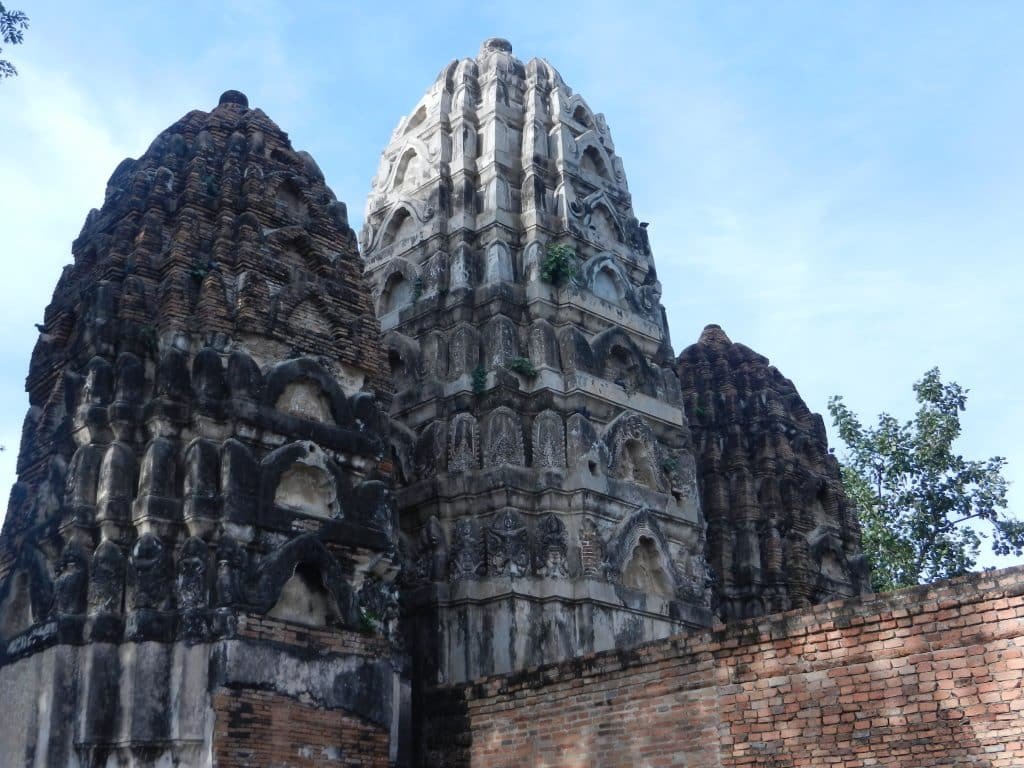
The Khmers originally built Wat Si Sawai in the late 12th or early 13th century as a Hindu temple–carvings of Vishnu have been found there. After Thais liberated themselves from the Khmers and founded Sukhothai in the mid 13th century, they converted Si Sawai into a Buddhist temple and transformed many of its features. It’s a very pleasant place to explore because it shows Thai art emerging from Khmer influences.
The temple is entered from the south, and Thais added a line of two assembly halls before the towers and converted the central tower into a stupa.

So people approaching the temple entered this stately columned hall.

The Khmer towers no longer dominated Si Sawai. More ground space was devoted to halls where people assembled and paid respects. Most Khmer temples were for Hindu gods. Thai temples give people a more prominent place in the scheme of things.

Here’s the inner assembly hall. A visitor would have walked through two dignified halls with handsome proportions before coming to the central towers The experience of Si Sawai would have been softer than one dominated by the towers glaring under the sun.
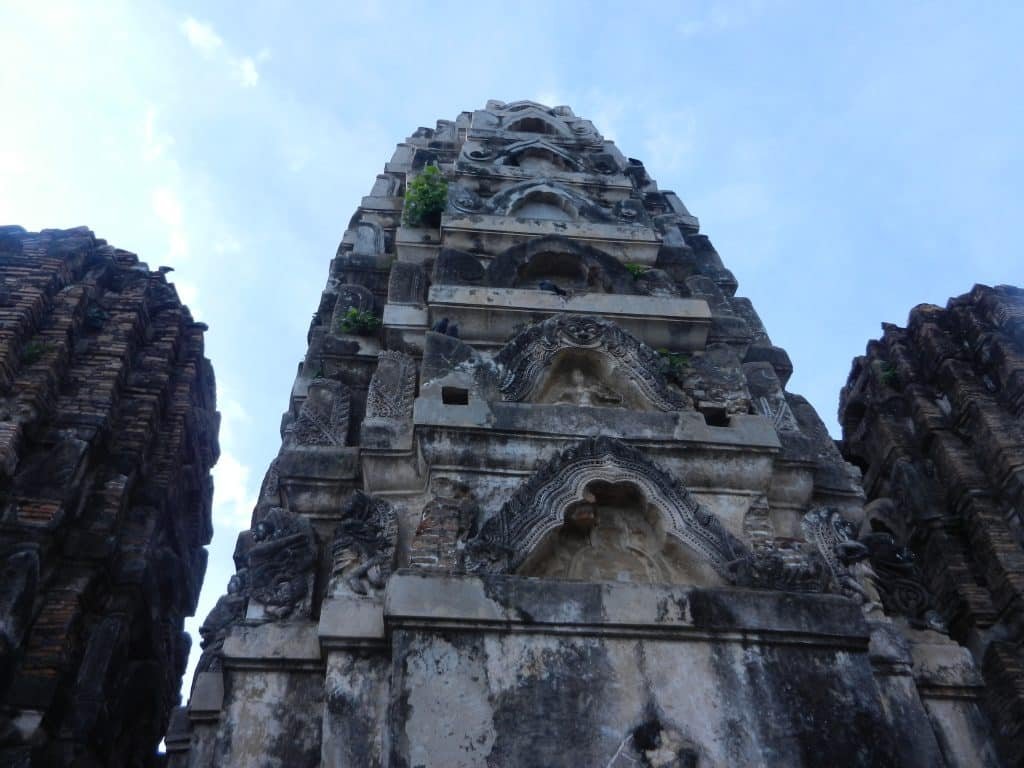
Thais also softened the central towers. Carol Stratton, in The Art of Sukhothai, wrote that Thais added height to the three towers by building brick on top of the older lower story which was made out of laterite. They then emblazoned the stupa with graceful stuccoed forms.
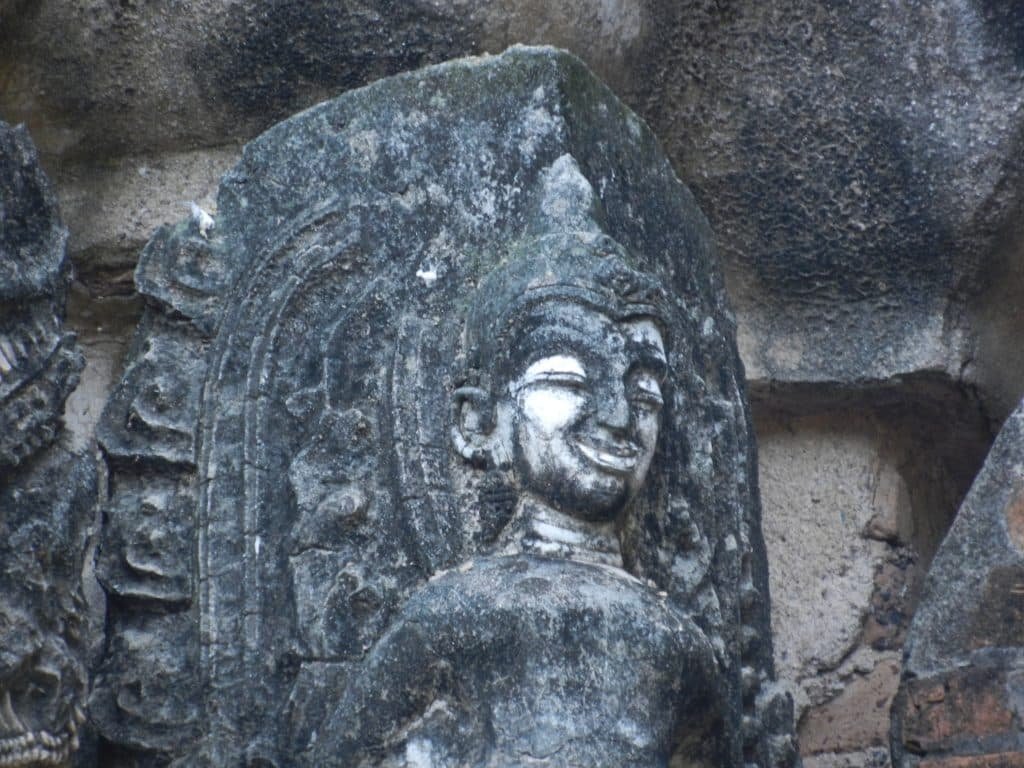
Though this deva’s chin and right cheek look reconstructed, the rest of the face and the upper body, curve as gently as Sukhothai Buddha statues.
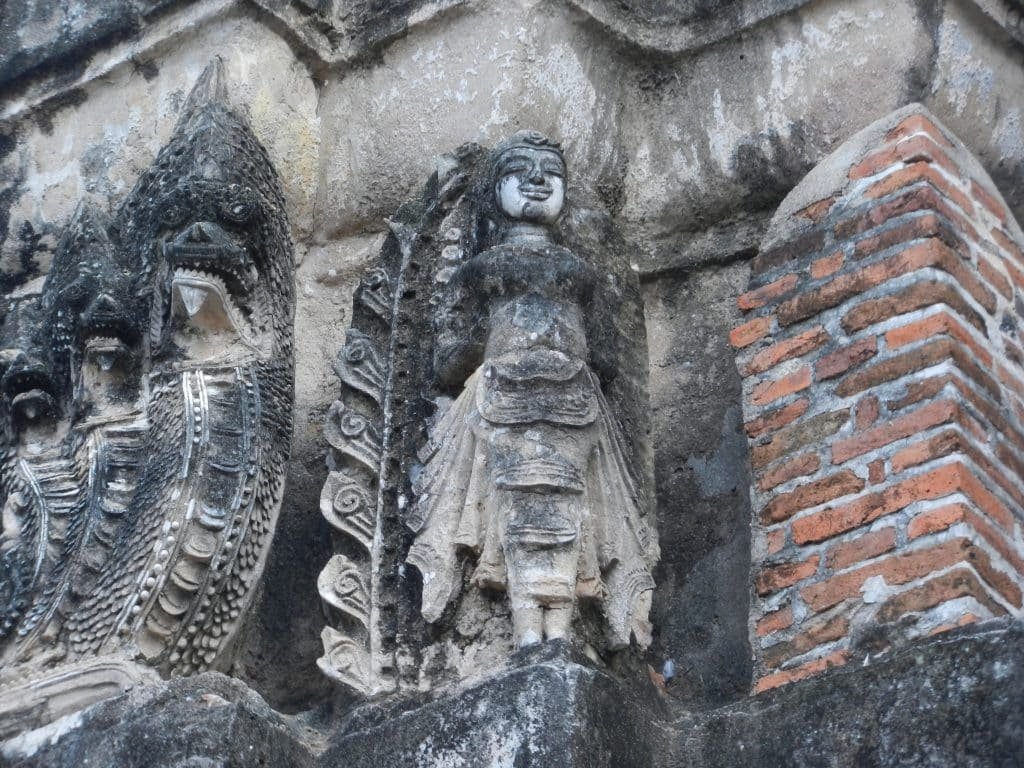
This figure’s face also seems to have gotten a modern makeover, but–
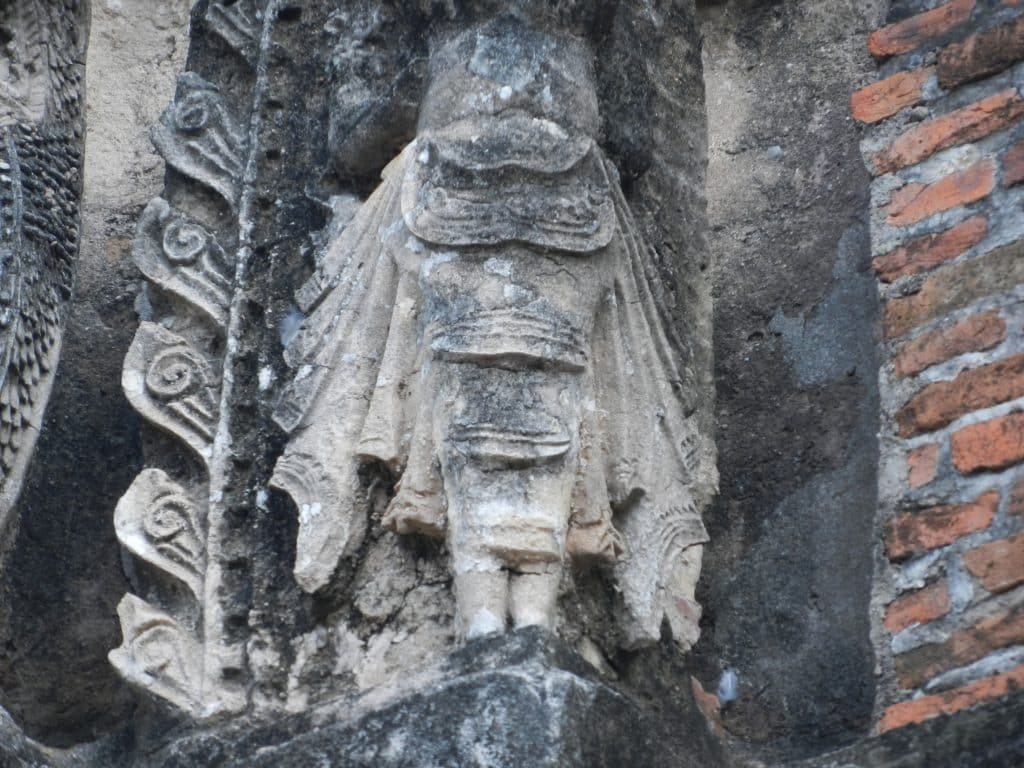
the clothing flows in equally elegant patterns.
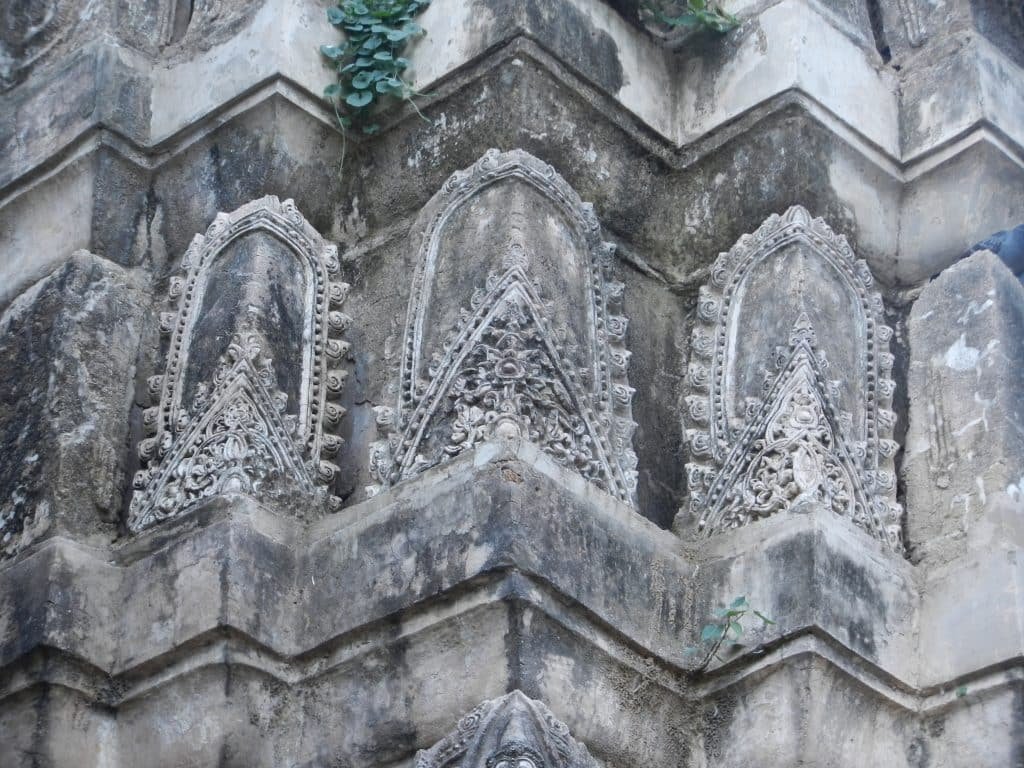
So do these abstract designs.
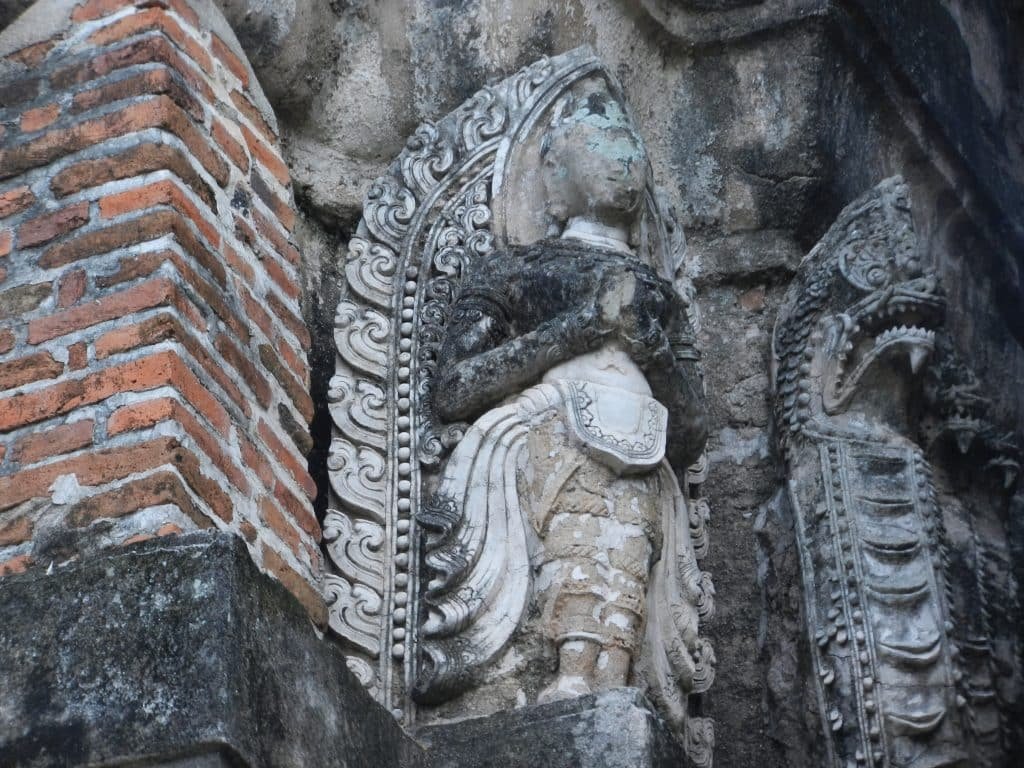
The clothing of this figure does as well.
So Wat Si Sawai began life when the Khmers dominated the Sukhothai area. When the Sukhothai Kingdom emerged, it was transformed into a Thai work of art. No single form imposes on the others. All blend into a flowing and tolerant landscape that reflects the Buddha’s compassion and Thai grace.
The Khmers’ ritual center at Sukhothai was Wat Phra Phai Luang (below).

When Thais liberated themselves, they built Wat Mahathat about one kilometer south and made it Sukhothai’s main ceremonial area. But Wat Phra Phai Luang was still considered important, and they turned it into another great example of Khmer art transitioning into Thai art.
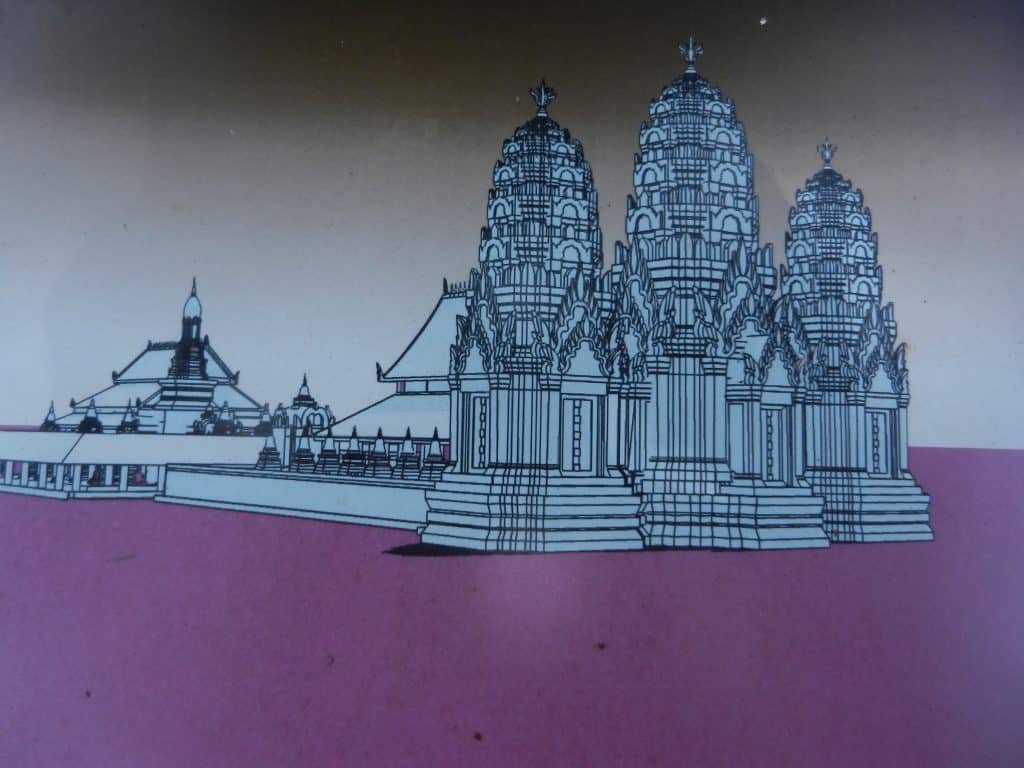
Most of Si Sawai’s towers were built by Thais. The Khmers constructed the towers at Wat Phra Phai Luang, probably during the reign of Jayavarman VII–between 1181 and 1219. Like Si Sawai, it has three, but only one is well preserved. The levels of Khmer-built towers are usually more distinct. Thais turned their stupas into a more continuous flow. They thereby began to soften the surface at Wat Phra Phai Luang.
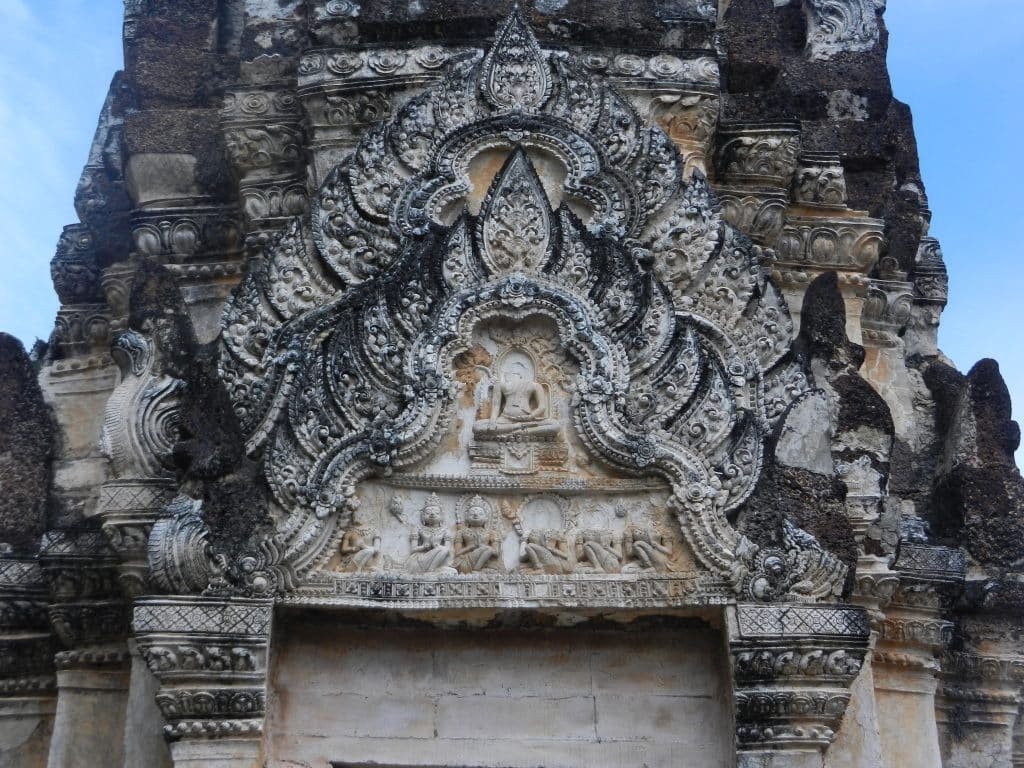
They added elaborate stucco designs in or near the 15th century, with thin and flowing patterns that look like both leaves and flames. Many Thai art forms were becoming long and sinuous at that time.
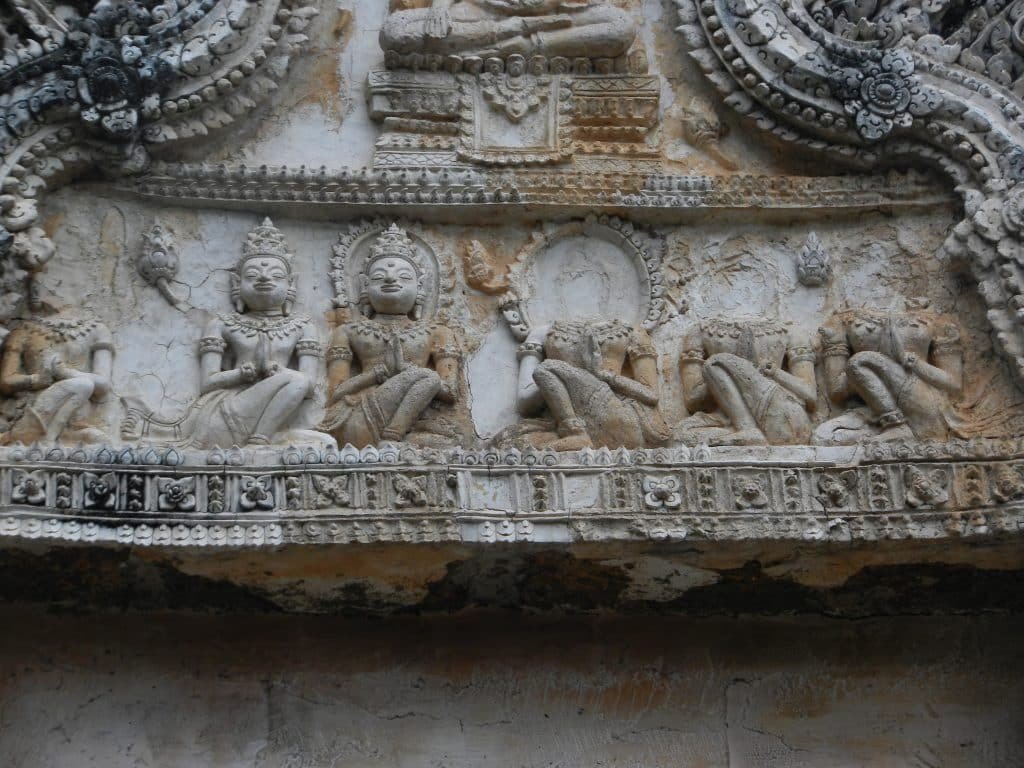
Thais also added scenes from the Buddha’s life, but softened the dignified theme. Devotees worship under him while he meditates and subdues the demon Mara. Their smiling faces look like modern reconstructions, but they fit the comical bodies, Sukhothai Buddha statues, and ancient Dvaravati sculpture. All have soft, human touches.
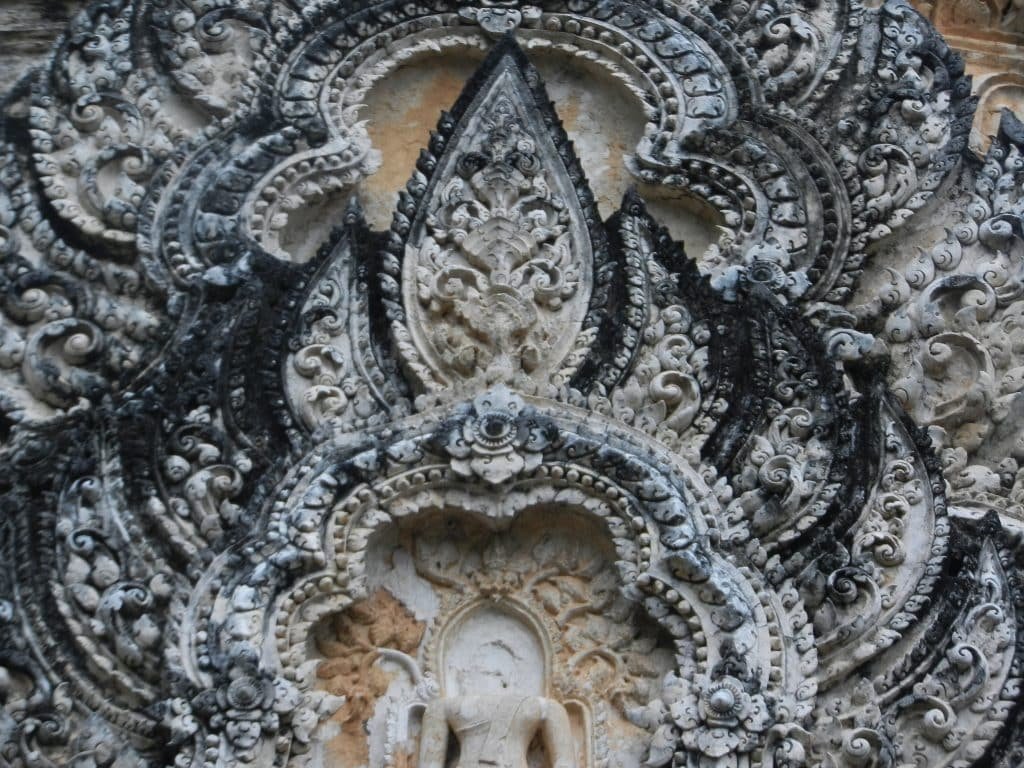
They add humor to the energetic stucco patterns over the meditating Buddha.

Thais used a lot of flowing and sinuous patterns to soften art forms.
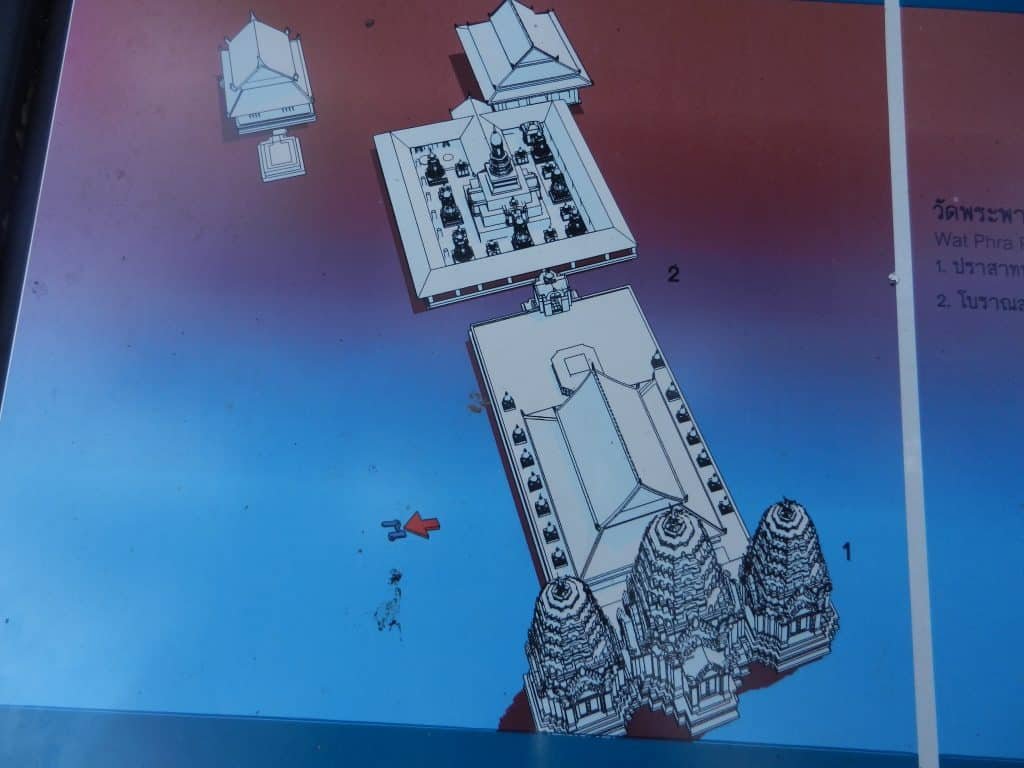
They constructed several buildings behind Wat Phra Phai Luang’s Khmer towers.
Here are the remains of the assembly hall immediately behind them.
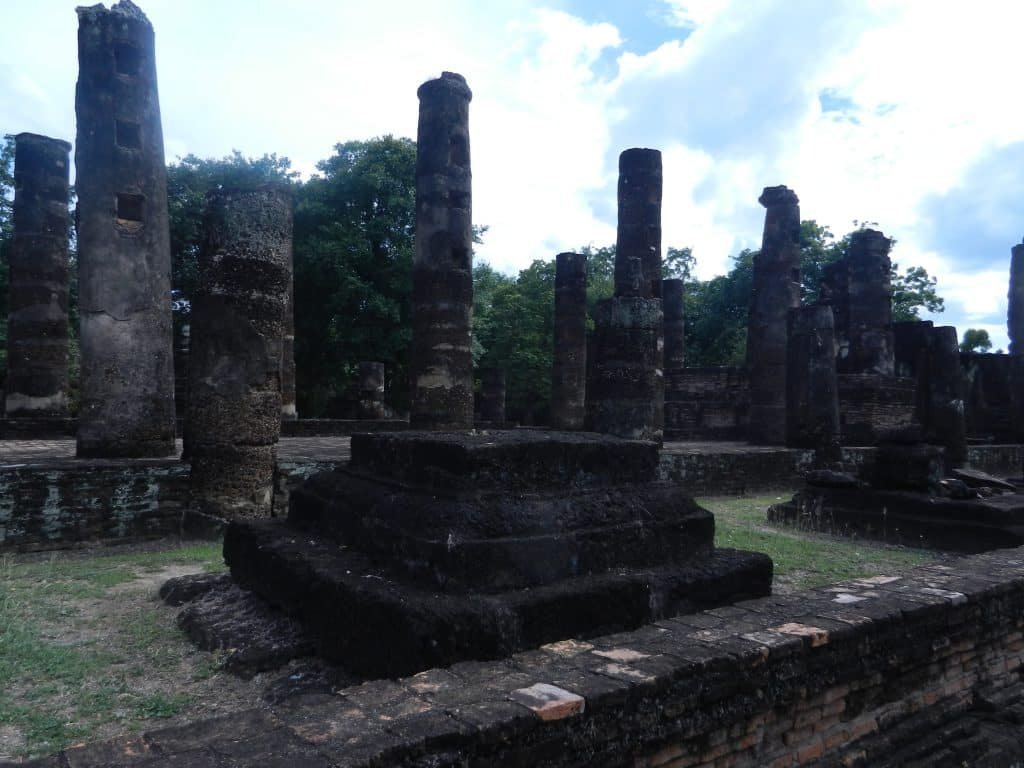
On the other side of the hall, Thais built a monument that rose in tiers. It was probably influenced by earlier towers that Mon people erected (I’ll write an article about Mon architecture soon, since it had a lot of influence on Thai art, and it’s very attractive).
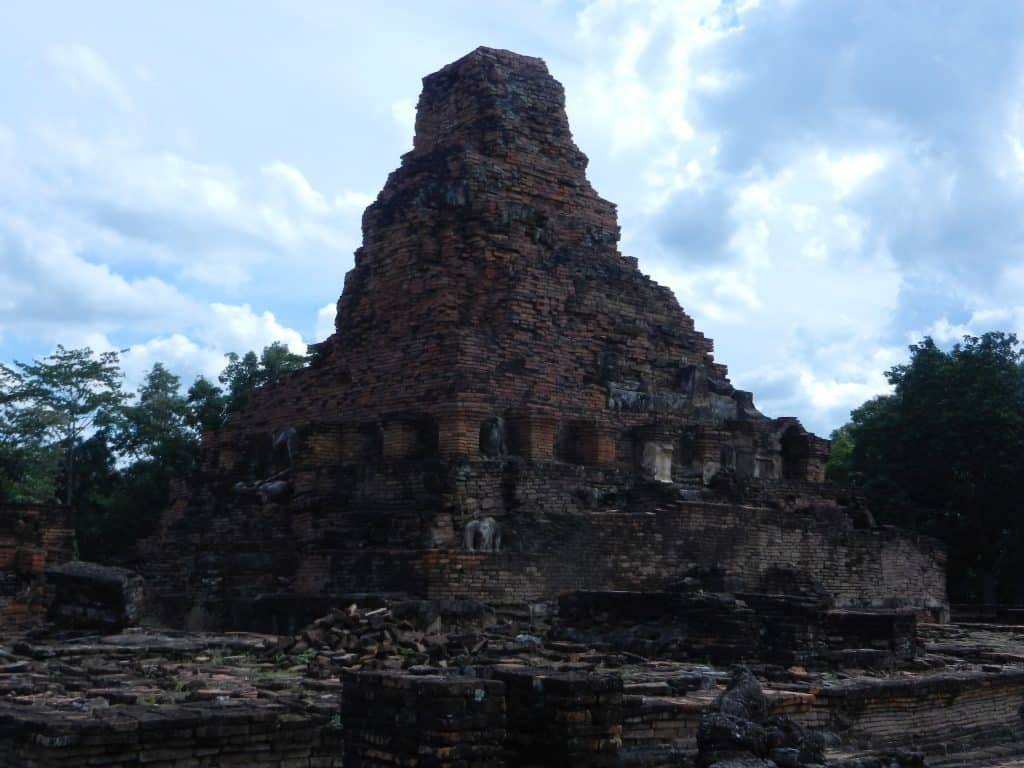
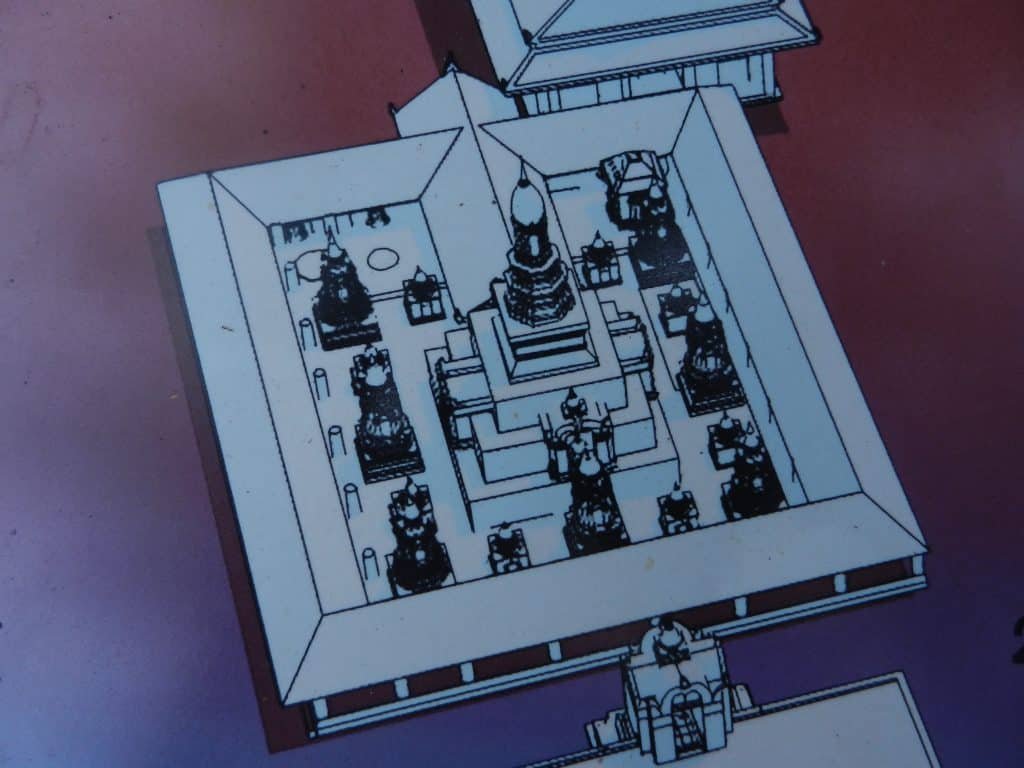
It looks imposing in the above shot, but Thais built a compound around it and created shrines on all sides. They topped the monument with a tall, thin prang. So the view from inside and outside the compound would have been of a graceful mixture of forms, and a procession around the shrines would have been enchantingly beautiful.
When Thais liberated themselves from the Khmers in the 13th century, Europeans were softening their cathedrals’ designs. But they did it with linear forms rather than wavy Thai patterns–Notre Dame Cathedral in Amiens is one of my favorites. Each culture used different basic patterns and created immensely rich artistic traditions and world-views.