Common objects are not so common. Our perceptions, concepts, and experiences of objects are interlaced with a culture with limitless facets. I can immediately recognize some of the objects on my desk as Thai.
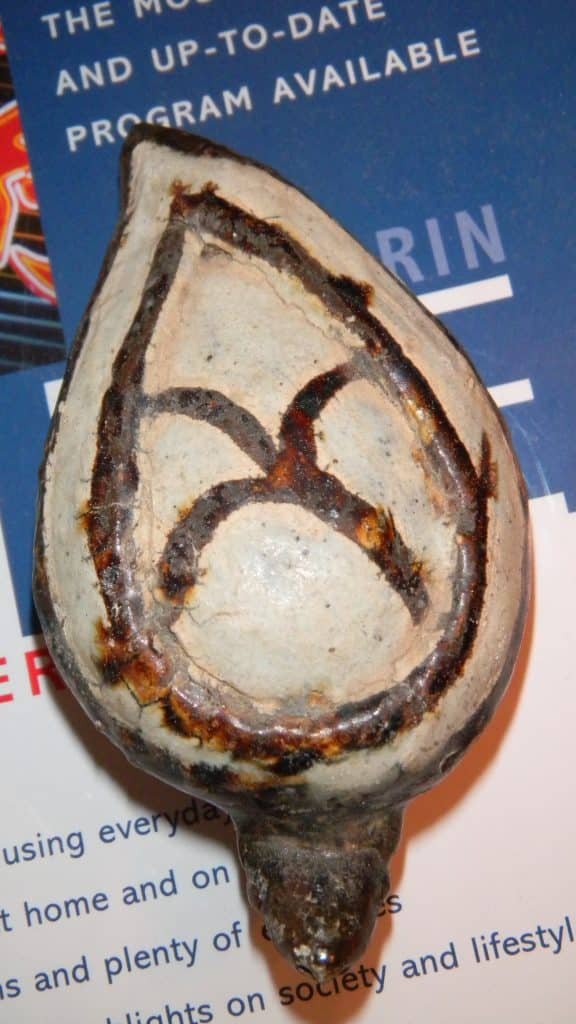
The small ceramic turtle from the ancient Sukhothai kingdom and the picture on the cover of an art book, which shows a sculpture of a row of five female musicians from the ancient Dvaravati civilization (which thrived in central Thailand more than 1,000 years ago) don’t have a single straight line.
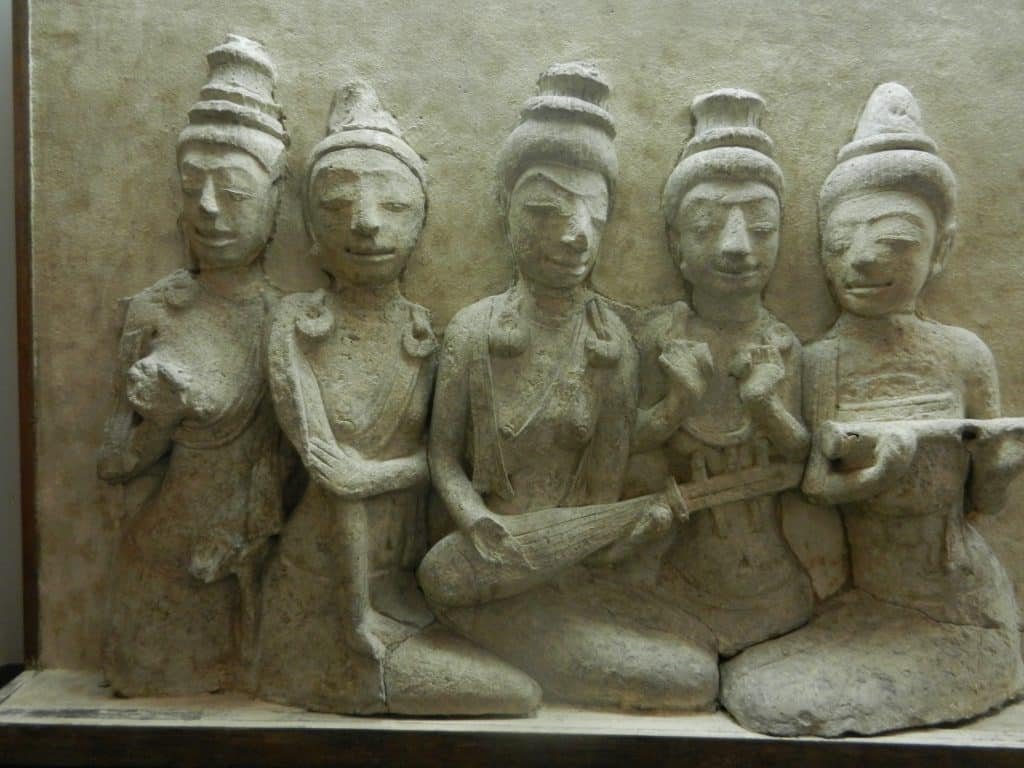
Their limber silhouettes gracefully curve so that they seem like gently undulating energies that remind me of Thai temples, Thai Buddha statues, and relaxed strolls through markets and villages. The two statues of Krishna playing a flute on a bookshelf in front of me and the Rajput painting of Krishna and Radha behind me seem to project the abundant flows of energy that are expressed in the Rigveda, ragas, curries, and many other products of Indian civilization.

The small ceramic Greek temple on another bookshelf is immediately recognizable as Greek. The straight lines of its columns and roof sharply distinguish it from the objects from Asia.
A lot of objects in traditional homes in China and other East Asian countries reflect people’s assumptions of continuity throughout nature and society, including the afterlife. Many traditional courtyard homes have a main building with a central hall, where the family participates in rituals and invites distinguished guests.
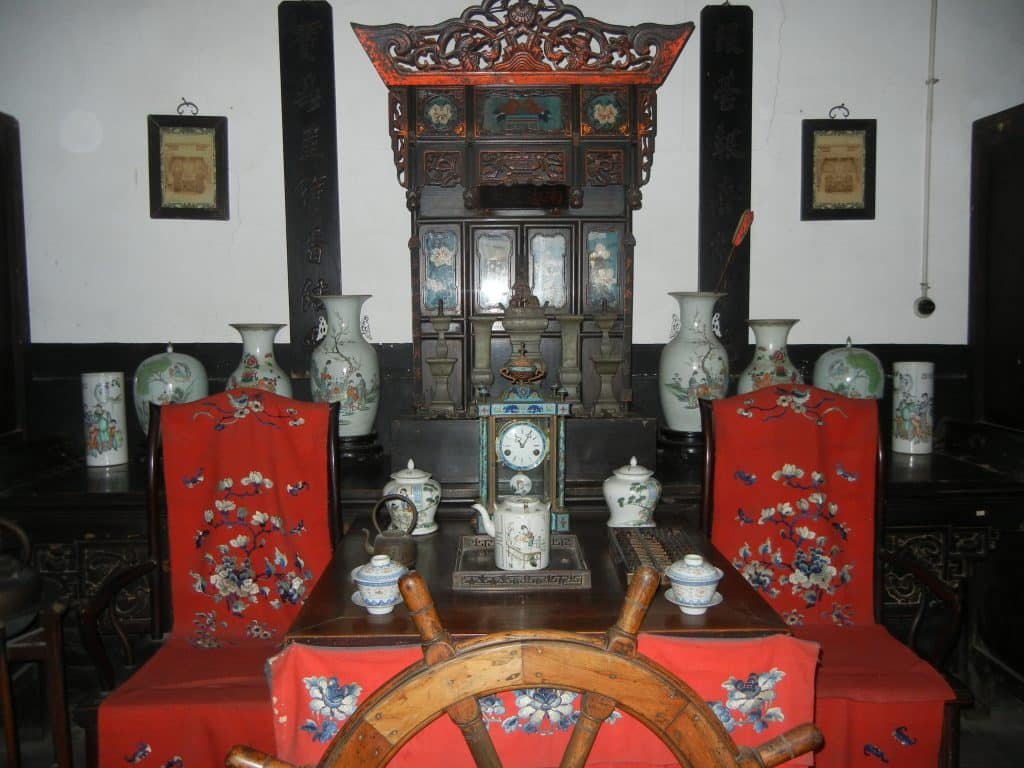
The above photo is from a wealthy 19th-century home in Pingyao. Many of the ceramics contain images of images with double meanings in Mandarin. Many words in the language have several meanings which seem to make the image resonate in many fields. Studies have shown that Chinese people process things more in terns of their contexts than as separate objects.
What objects does a society create and replicate so much that they become exemplary? In what forms does it create them? What objects do people most readily notice and most deeply appreciate? Objects we live with aren’t atomic things; they’re convergences of experiences that people in a culture widely share.
The philosopher Martin Heidegger saw a lot of depth in the answers to these questions in the 1920s, when he wrote Being and Time. He examined Western philosophers’ questions about the nature of existence and concluded that ideas about being depend on deeper experiences than identifying objects as separate entities. We don’t primarily exist as separate things; we live in an environment in which we’re closely related to objects that we regularly work with. All exist in a world, which he called Dasein. Within a world, objects don’t exist on their own; they’re meaningful to us because we are living beings who use them regularly, we depend on them, they help shape our destinies, and we care about them.
They also exist within a network of other objects that people live with. Heidegger sometimes used farmers’ tools as examples. They live with their ploughs, hoes, shovels, hammers, axes, barns, seeds, fertilizers, and fields of crops on a daily basis, and they have thus become ingrained in their perspectives of the world. No object exists on its own; all are meaningful within a system that characterizes a person’s Dasein.

Heidegger also said that the pen, ink, ink stand, paper, and table exist together in a writer’s world; all formed a system that was inseparable from the life of a European writer in the 1920s.
Heidegger felt a lot of affinity with his rural Black Forest area, and he was highly concerned about modern life’s and technology’s abilities to uproot people from their traditional worlds. But people today have deep relationships with modern technologies. I recently heard the joke, You know you’re a single Asian female when your devices have their own side of the bed. Many of us deeply bond with the high-tech devices we regularly use. Some people associate their cars and cell phones with their personal identities. Digital assistants such as Amazon’s Alexa, Apple’s Siri, and Google’s Assistant also become deeply ingrained in people’s lives as they regularly use them.
I share Heidegger’s concerns about technologies colonizing our lives’ meanings, since corporations aggressively use them to hold our attention and market products. But we still interact with their products within networks of objects and multifaceted webs of meaning. Moreover, the corporations that produce them originated and grew within the same societies and political systems we live in, and they have roots that extend back to the rise of modern capitalism. Our uses of high-tech objects, the meanings we derive from them, the entities that produce them, and the economic systems in which they’re made and exchanged are parts of these networks.
The late-twentieth century French philosopher Gilles Deleuze studied more aspects of networks of objects and meanings that people live with. In Difference & Repetition, he wrote that things from DNA up to cars and suburban homes become replicated and that no two are exactly the same. For example, your brand of cell phone has been made and sold many times. Your device is one of millions of the same brand, but you have installed your own unique mixture of apps on it. You have taken your unique photos with it and have held particular conversations through it. The content in its memory is about your own network of personal relationships, personal likes, professional projects, hobbies, and entertainments.
Most modern musical instruments are mass-produced, but each has a slightly unique sound. The acoustics of the wood on each guitar are unique. A friend of mine never replaced the Gibson SG he lost because he never found a model that sounded as good to him. Another man I knew took 10 months to replace a Les Paul Custom that was stolen. I didn’t enjoy its sound as much as my Les Paul. The latter is warmer, but he liked the greater clarity of his instrument’s tones.
Because of an object’s uniqueness and connections with a limitless number of other objects, Deleuze thought that these connections can enable unbounded creativity.
Many other objects are deeply ingrained in our patterns of living, including our clothes, foods, furniture, athletic equipment, and decorations. All reflect an infinitely multifaceted web of life and meaning which extends back many centuries and outwards to all the people we interact with. The modern West has often considered reality to be fundamentally made up of objects which are atomic. But it’s often more accurate to see objects as convergences of experiences throughout a culture which has ancient roots and which is integrated with a unique natural environment. We’ll further explore the concept of convergences in future articles.