
Thailand’s artistic heritage in Sukhothai enchanted me the first time I went there, in 2007. It impressed me as much as Angkor Wat, which I saw for the first time two weeks before. Seeing them in rapid succession was especially rewarding because they’re opposites in key ways. Angkor Wat’s size overwhelms, but nothing at Sukhothai is large. All buildings flow together into an atmosphere that makes the site one of the most beautiful places I’ve ever seen.
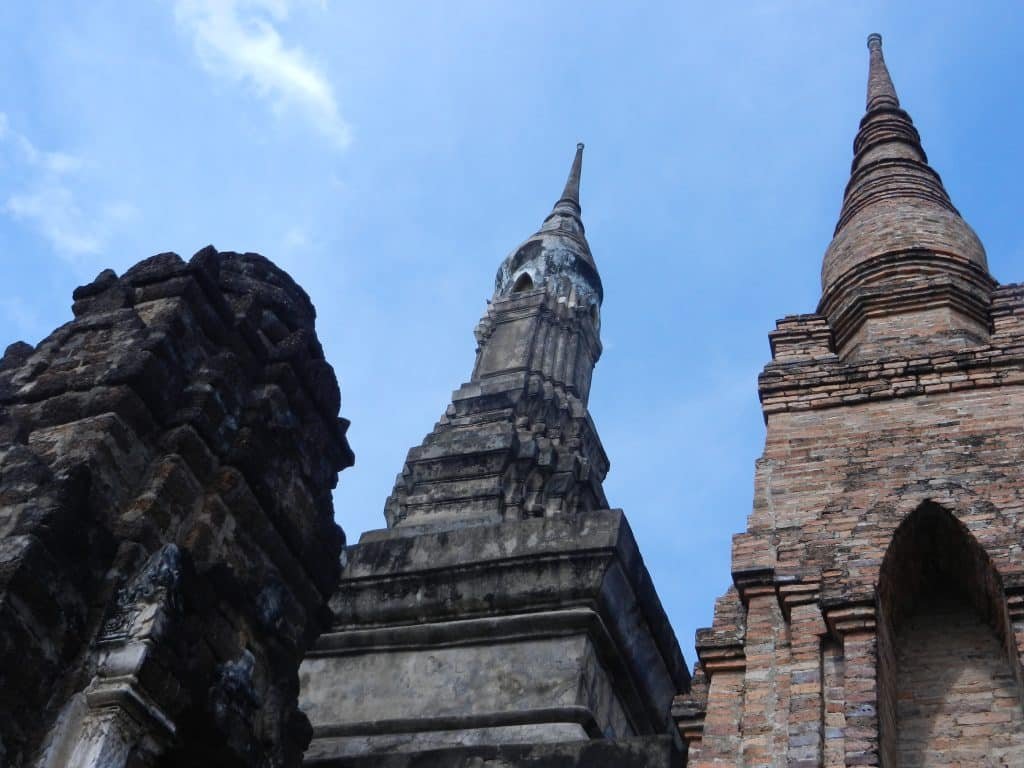
Sukhothai’s art forms were so graceful that they seemed like flying in a golden dream–a much more appropriate color than the blue in the guitarist Joe Satriani’s song.
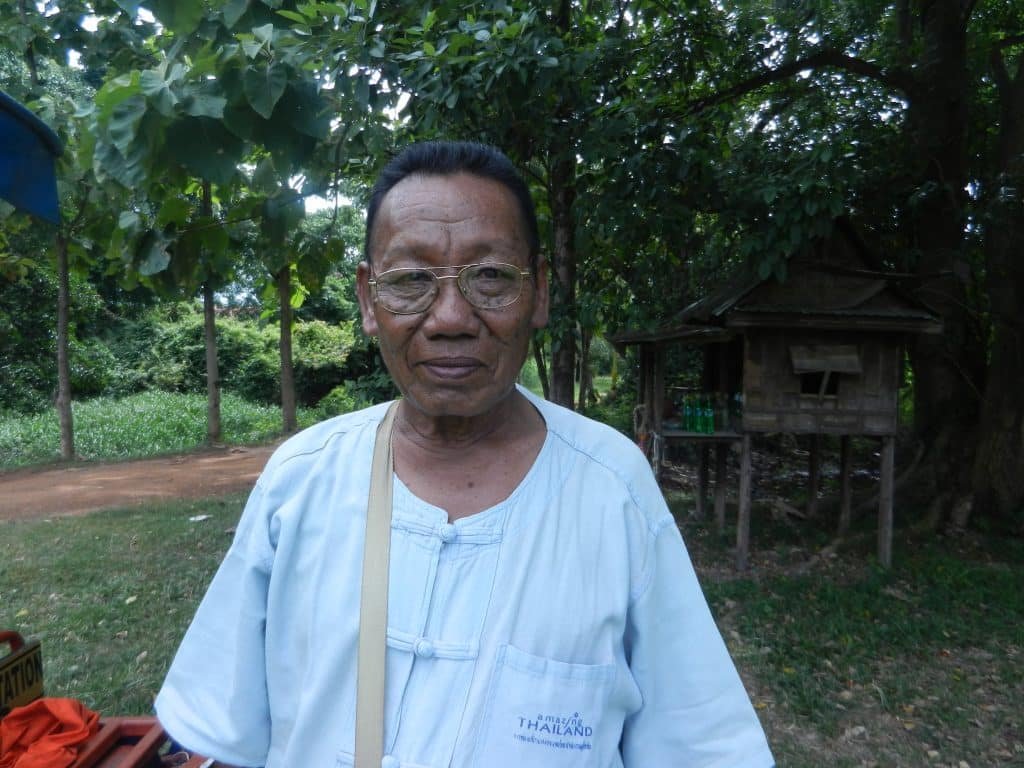
Thais call the most important wat in a town Mahathat. It means great relic. Sukhothai’s Wat Mahathat was the kingdom’s ritual center. It soars in the first picture, and its graceful forms integrated the world of the above gentleman’s ancestors.

A line of assembly halls approached the shrine from the east. The one on the far right was probably built after the kingdom of Ayutthaya made Sukhothai into a vassal in 1378. Its floor is on a brick platform that’s several feet high. Ayutthaya often went for more grandeur than Sukhothai did. Perhaps the new rulers wanted to give a message that they were in charge.

The above shot is of the old assembly hall from the newer one’s raised floor. Pilgrims, monks, and local folks gathered between these stately columns when they visited Wat Mahathat.

They joined in a community which embodied the Buddha’s compassion, as they do today in Chiang Mai’s Doi Suthep (above). People who went to Angkor Wat gawked at its otherworldly size. But folks in Sukhothai experienced a more human scale setting.

Wat Mahathat housed the above statue. It was the largest cast bronze image of the Buddha in Thailand: Phra Sri Sakaya Muni. The first king of today’s Chakri Dynasty, Rama I, took it down to his new capital, Bangkok, and installed it at Wat Suthat when he reigned between 1782 and 1809.

A procession through Wat Mahathat’s assembly halls climaxed at this statue. It’s regal enough to embody the power of Thai kings shortly after they liberated themselves from the Khmers, yet its forms are soft and flowing enough to represent compassionate rule–a blend which Thais have honored in their best kings.
Wat Mahathat was Sukhothai’s ritual center from the time when it liberated itself from the Khmers in the 13th century. Its graceful forms created a standard that Thai artists have measured themselves by ever since. They also provided a model of how the world coheres.

I saw several groups of impeccably behaved schoolkids in spic and span uniforms ambling around Wat Mahathat. Many Thais still consider it an archetype of how the world hangs together.
Most of Wat Mahathat’s look was created in the 14th century. In the 1340s King Lo Thai rebuilt its central shrine to house hair and neck bones of the Buddha, which were brought from Sri Lanka. An inscription from his reign said that the original platform had collapsed.

Lo Thai repaired the platform (made from laterite) and restored the brick towers on it, but he added features which have been examples of Thai grace ever since.
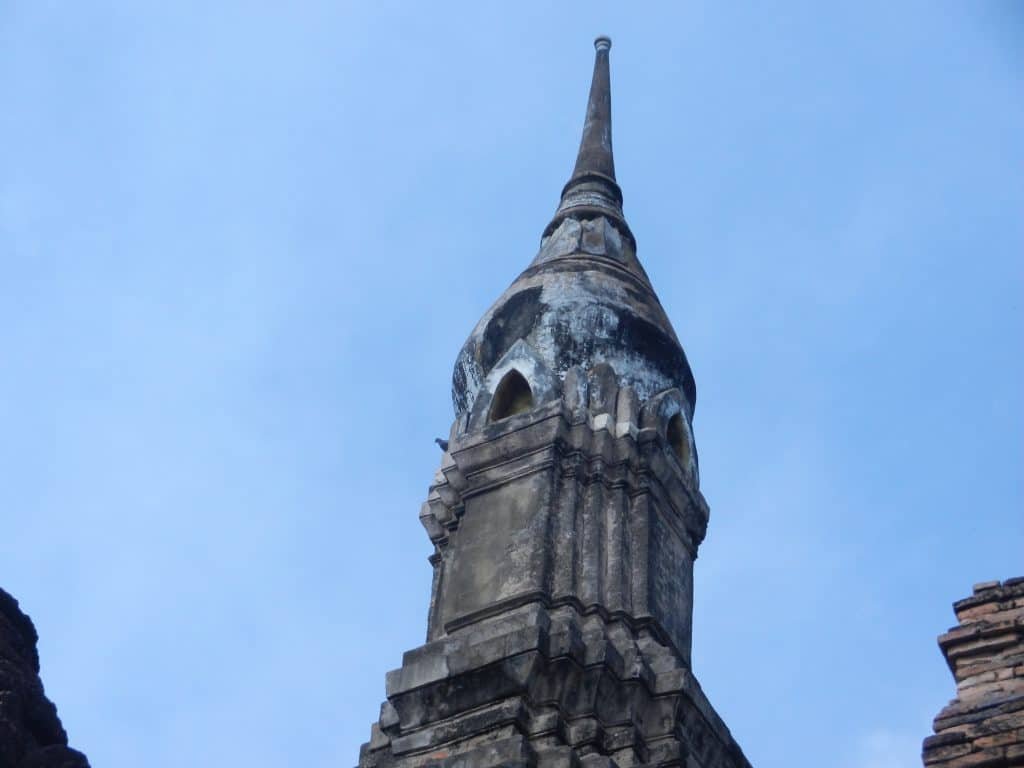
One of Sukhothai’s most admired forms is the lotus bud shape of Wat Mahathat’s central spire. Carol Stratton and Miriam McNair Scott, in The Art of Sukhothai, said that Lo Thai might have gotten the idea of using a lotus bud shape from Pagan. They said that he wanted to give Wat Mahathat a soft and spiritual look. But the way this form was adapted at Sukhothai was an original expression of Thai culture.

The tower’s slender and slowly tapering form fuses with the bud at the top into a web of ideas that blends spiritual energies, grace, and vegetal growth–Sukhothai depended on irrigated rice farming. The indentations in each corner make the energies look like the gently flowing water in rivers and canals.

Wat Mahathat’s central spire tapers in several sections. Its refined mixture of plant forms, the flow of water, spiritualized energy, and the Buddha’s compassion became an example of how the society is ordered. Stratton and McNair Scott said that the lotus bud tower became a symbol of political and religious power throughout the Sukhothai kingdom. Sukhothai replicated it in other town’s ritual centers.

Although I took the above photo in Luang Prabang’s royal palace, Sukhothai staged courtly dances too. The Khmers prolifically did before Sukhothai liberated itself from them. Laotians are ethnically Thai, and Luang Prabang and northern Thailand had close relations when their kingdoms flourished before devastating wars with the Burmese in the 16th century. The graceful movements from Thai court dances and religious processions meshed with the emerging architectural forms into ideals of beauty and tolerance which I don’t think any culture has surpassed.
Many Thais still see Sukhothai’s ritual center as a model of how society and the world are held together.
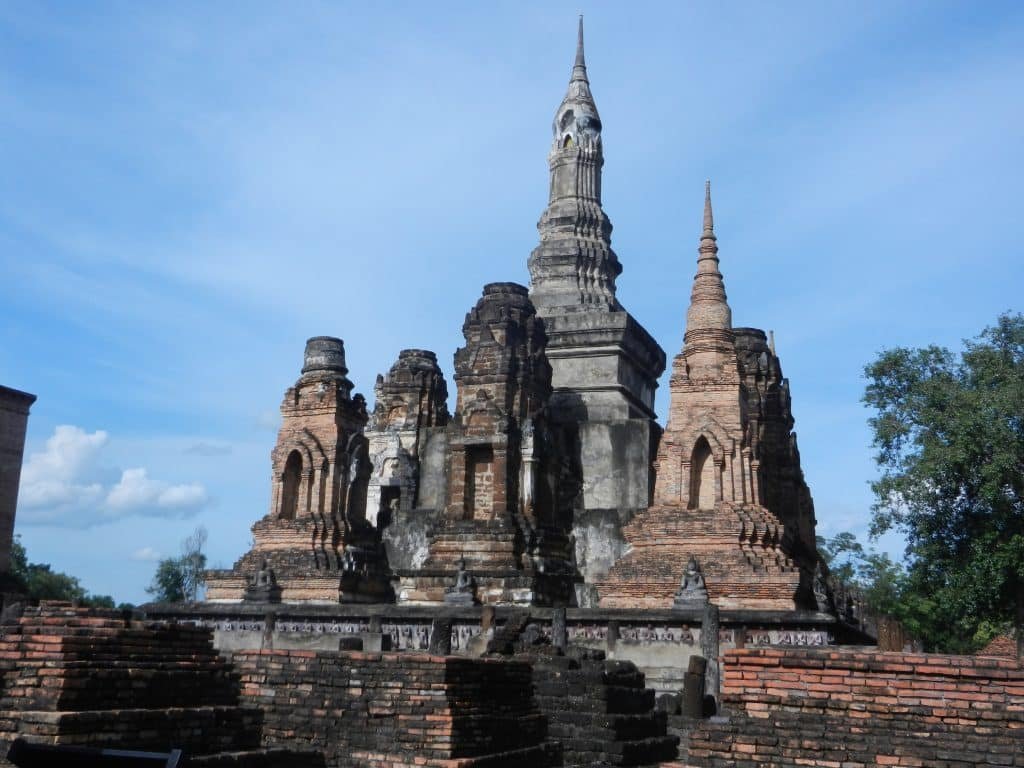
Like Angkor Wat, Sukhothai’s Wat Mahathat has a system of a central spire and towers that surround it. They symbolize Indian mythology’s Mt. Meru and the peaks that surround it. But Sukhothai turned this Indian and Khmer schema into a work of Thai art. Sukhothai’s Wat Mahathat has eight towers surrounding its central spire. The middle four (in the cardinal directions) are Khmer in style. But in the 1340s King Lo Thai helped turn them into a Thai style.

Stuccoed carvings bedeck three sides of each Khmer tower, and the middle of each frieze has a scene from the life of the Buddha. Only two are preserved.

The above two shots are of the birth of the Buddha. Their humanity makes me wish the other ten scenes were extant.
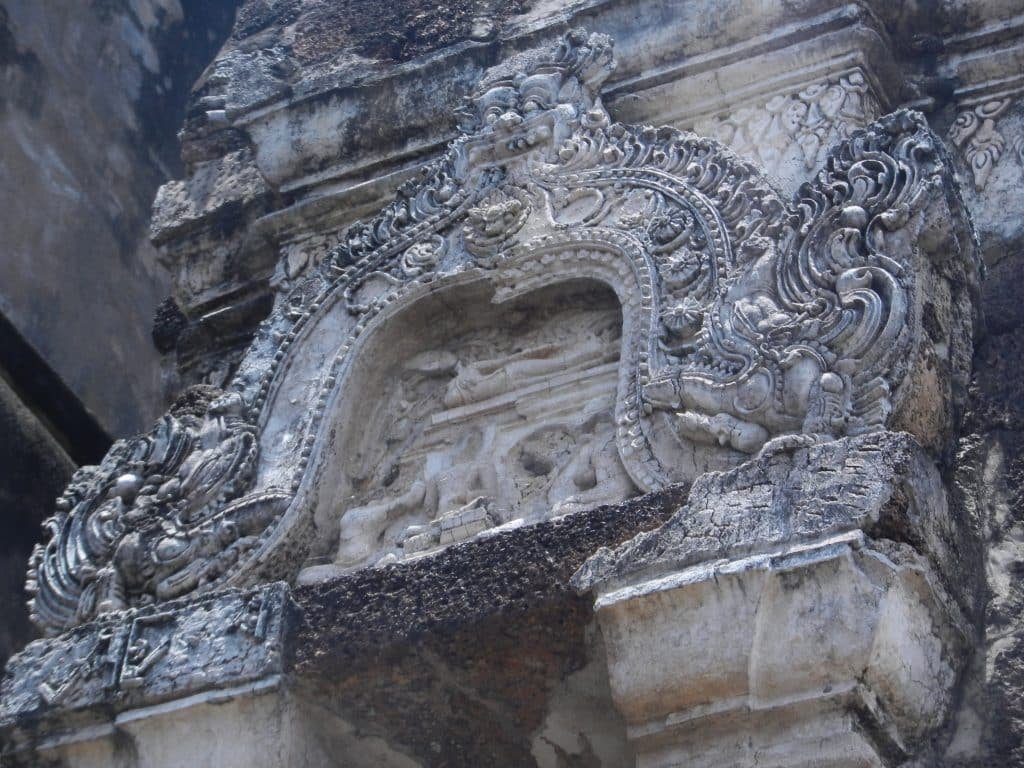
The other scene (above) is of the Buddha departing this world and passing into nirvana.
Though this scene graces a Khmer-style tower, the fancy frame around it has a lot of influence from Sri Lanka. Craftsmen accompanied the relics from Sri Lanka, which Wat Mahathat housed. The inward turning crocodile heads (makaras) are more Sri Lankan than Khmer–Khmers usually made them facing outwards after the 7th century. But Wat Mahathat is even more multicultural.
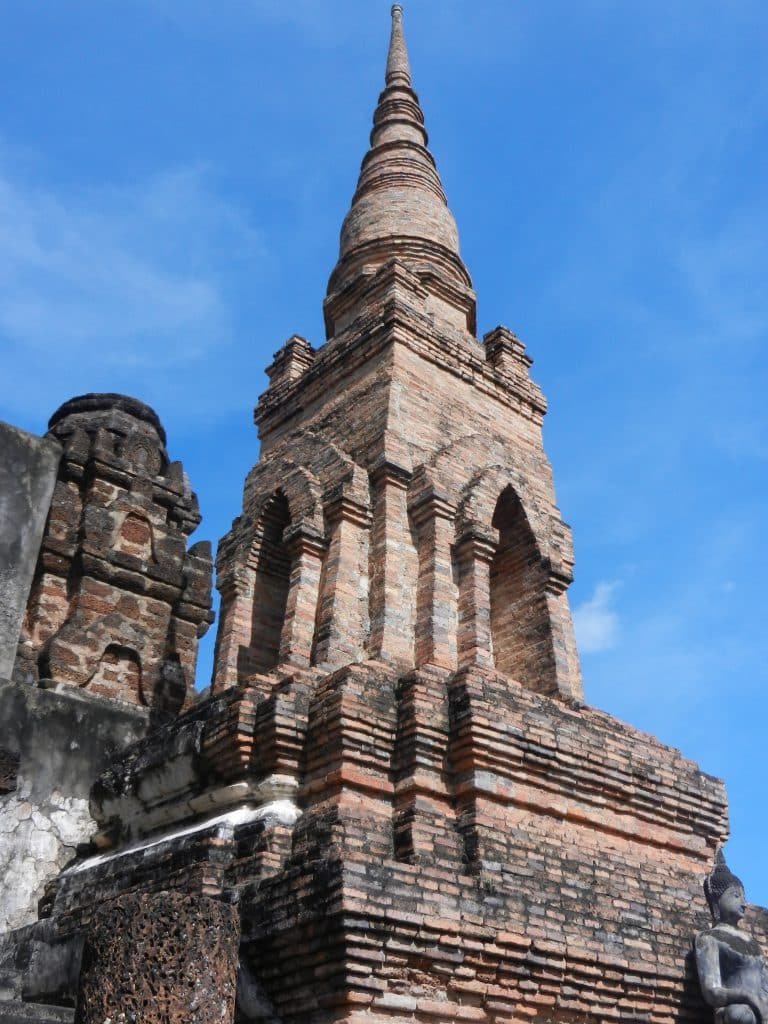
The four corner towers are more Sri Lankan than Khmer. They’re largely modern reconstructions, and they don’t have the original stucco decoration. But Carol Stratton and Miriam McNair Scott thought that their motifs were influenced by designs from the Khmers and from Pagan. So all the towers meshed into a tolerant flow of different cultures’ forms.
Stratton and McNair Scott wrote that the stucco designs and the lotus bud on top of the central spire were probably covered in gold leaf. The whole building was covered in white stucco.

Sukhothai’s Wat Mahathat has been compared to both Mt Meru and Mt Kailasa, which was Shiva’s Himalayan abode. Stratton and McNair Scott thought that the ponds around Sukhothai’s ritual center represented the oceans around Mt Meru. If they did, Thais transposed these big ideas from India into their own art forms and make them more graceful.

A line of devotees of the Buddha was carved around the bottom of Wat Mahathat.
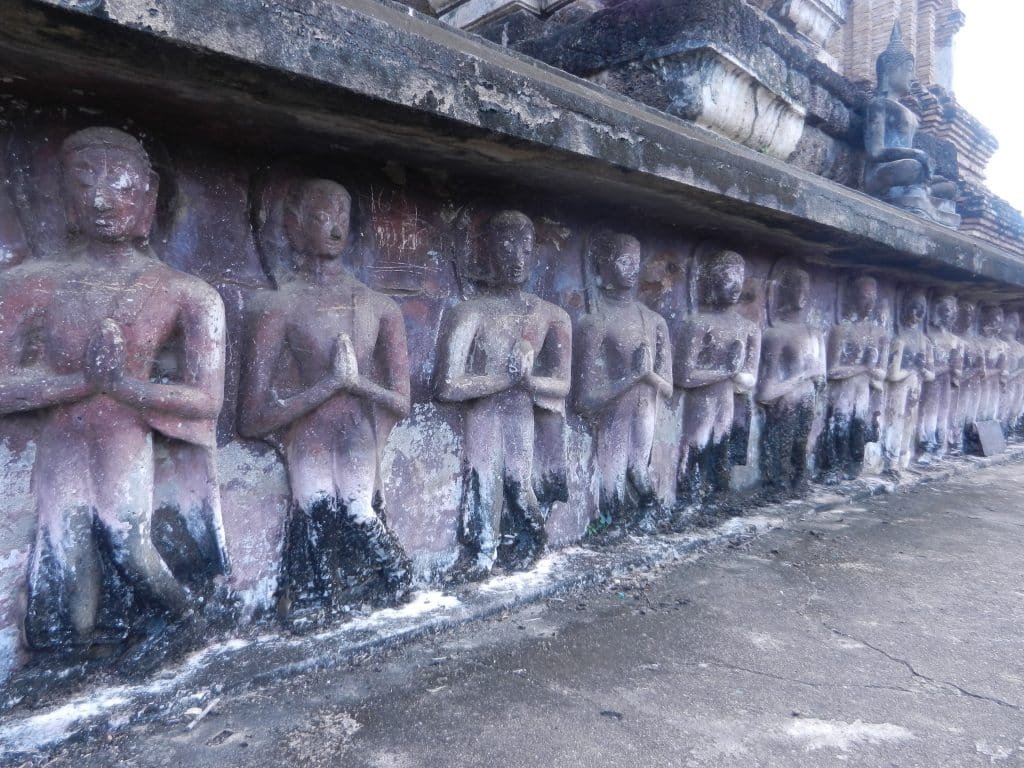
The figures you see are restorations, but the originals also walked around the central shrine with slow and placid steps, as pilgrims in those days did. Wat Mahathat was meant to be experienced in a relaxed stroll. Its slender spires, gold leaf lotus bud, and stucco carvings would have slowly shifted, and they would have been reflected in the waters. All these images would have gently flowed like a rippling river.
Some historians have seen Sukhothai’s Wat Mahathat as a magic square. Its nine sections, with the highest spire in the center, might symbolize the creation of the universe and the emanation of its energies. Indians had developed a school of architecture called Vastu by 500 CE, and it saw a building as composed of 81 squares. Many of the squares are occupied by a different Hindu god, and the Vastu Purusa (the cosmic self which represents the universe’s unity) lies across the whole design, with his head in the northeast corner. Most Southeast Asian societies already had ideas of spiritual energies in temples and political rulers’ before Indians came to the region in the late first millennium BCE. But the people who built Sukhothai’s Wat Mahathat refined these traditions into an expression of the Buddha’s compassion and the Thai king’s benevolence.
Sukhothai set one of the most influential standards in Thai art and culture. We’ve only seen its central wat. To really get a feel for the place, you need to amble around it and savor the surrounding shrines as well. Most visitors miss most of its enchantments, so we’ll explore it further in the next articles.