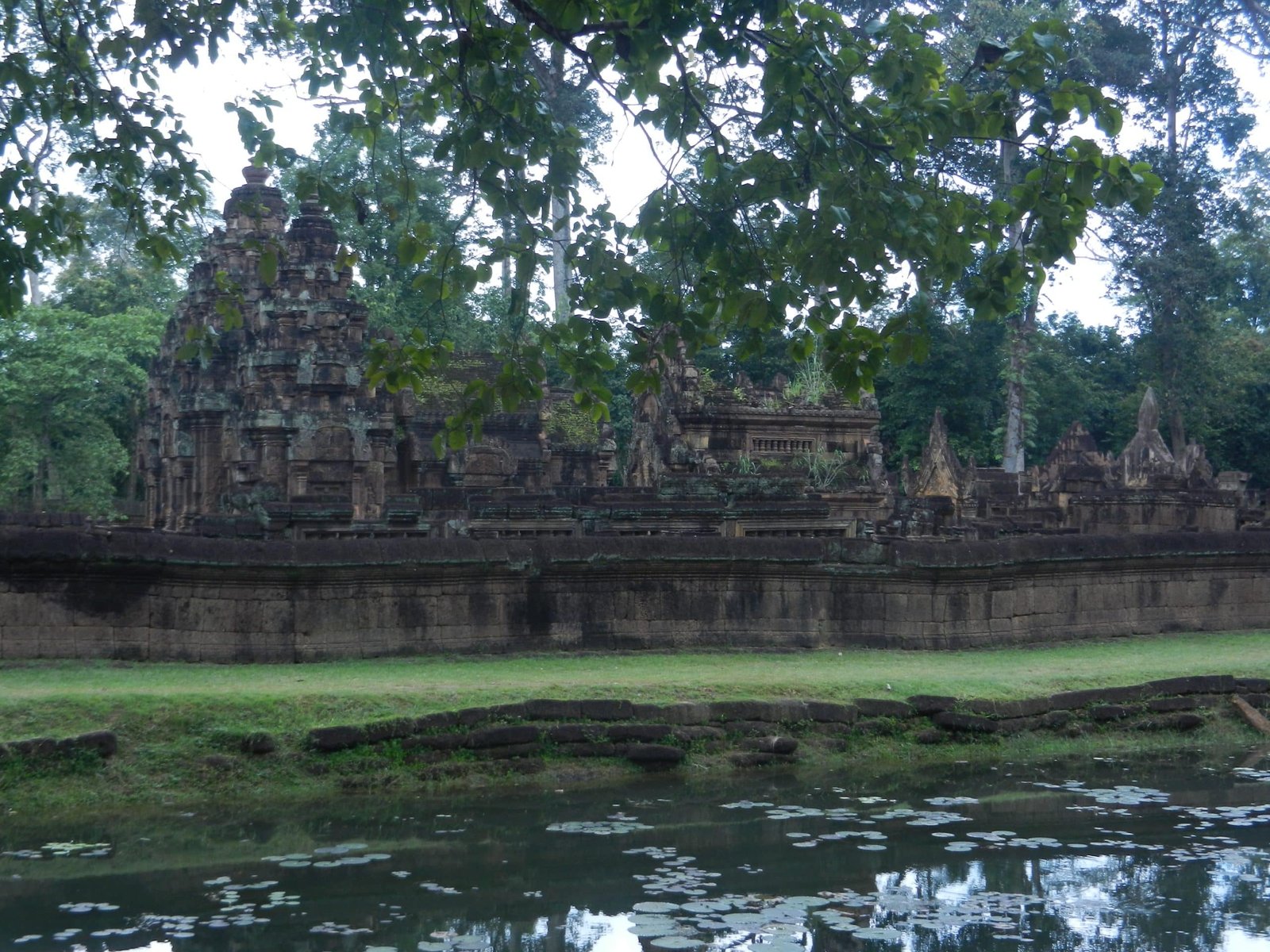
Angkor Wat awes, but Banteay Srei wins hearts. Many visitors to Angkor say that Banteay Srei is their favorite Khmer temple. It was built late in the reign of Rajendravarman II by two religious dignitaries and wealthy landowners, Yajnavaraha and his younger brother Vishnukumara. Rajendravarman had been extending the Khmer Empire, and he punctuated his authority with a grand temple called Pre Rup. Now that the Khmer Empire had a strong backbone, its elites could experiment with new ideas and art forms. The builders of Banteay Srei achieved new levels of realism and elegance. Here are some of the things that make it special:
1. Banteay Srei wasn’t built by a king, but by two pious and learned Hindus. Yajnavaraha became the guru of the next monarch, Jayavarman V, whose reign is known for religious tolerance and for importing many Buddhist ideas. So, Banteay Srei wasn’t built by a chest thumping monarch, but officials who were religious, and it was used for more personal devotions. It thus has an intimate atmosphere. An inscription at the temple said that Yajnavaraha was foremost in the doctrines of several Indian philosophies (Nyaya, Vaisesika, Samkhya, and Patanjali’s school of yoga) and Buddhism. Banteay Srei reflects the outlook of a highly educated and cultured man.
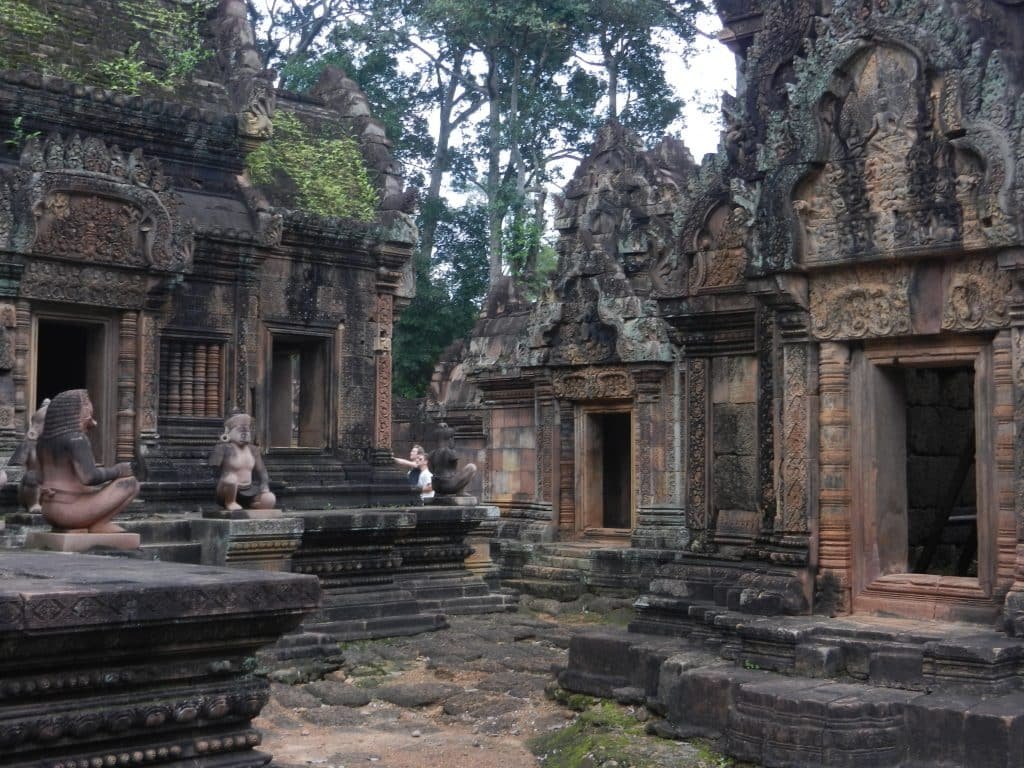
2. The temple’s scale is small–the door to the central shrine is only about four feet high. Many travelers find its gentle size a relief from Angkor Wat’s sensationalism.
3. Banteay Srei was constructed from pink sandstone. It was relatively easy to carve, and it thus helped Khmers develop new standards of realism.
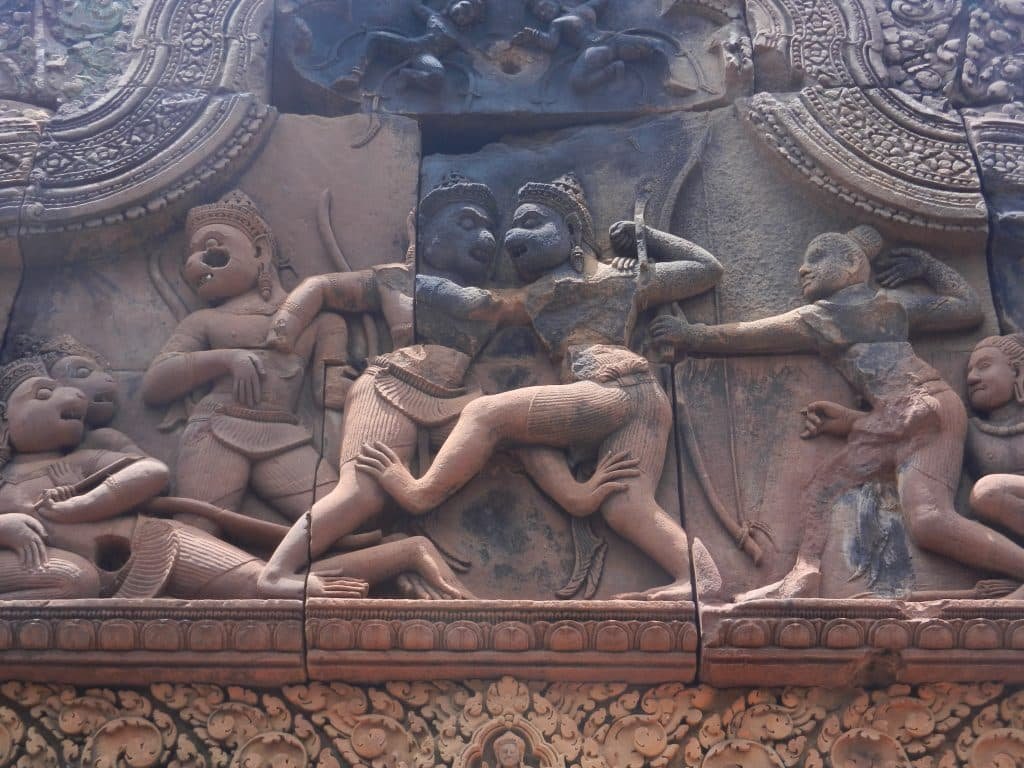
Some of the temple’s sculptures are among the most expressive in Khmer history. Above is the dual from the hallowed Ramayana, in which two monkey brothers, Valin and Sugriva, fight to the death. Their bodies are carved so deeply that they seem about to leap from the temple. The fury in their faces can make any seasoned traveler shutter.
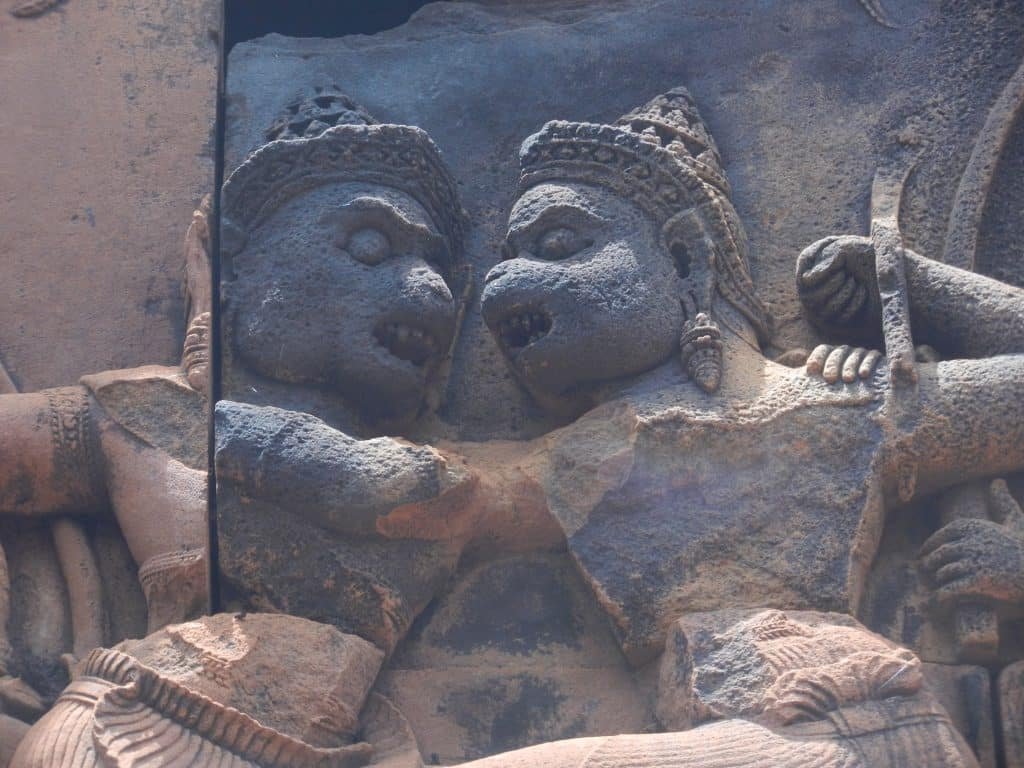
Banteay Srei also has the first Khmer carvings of large narrative scenes. Temples could now dramatize great epics like the Ramayana and advance towards the glories of Angkor Wat and the Bayon.
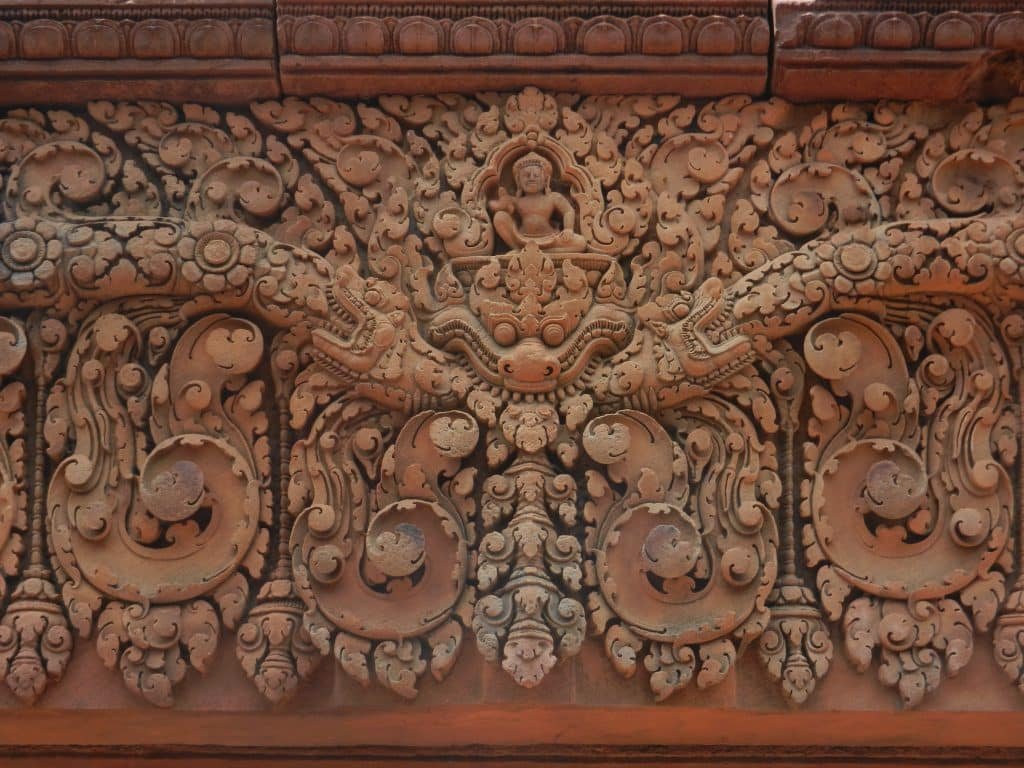
4. The pink sandstone allowed traditional Khmer forms to be carved more deeply. Above, we see the lintel form with dense foliage that earlier temples like Preah Ko had. But now its depth makes it more three dimensional.
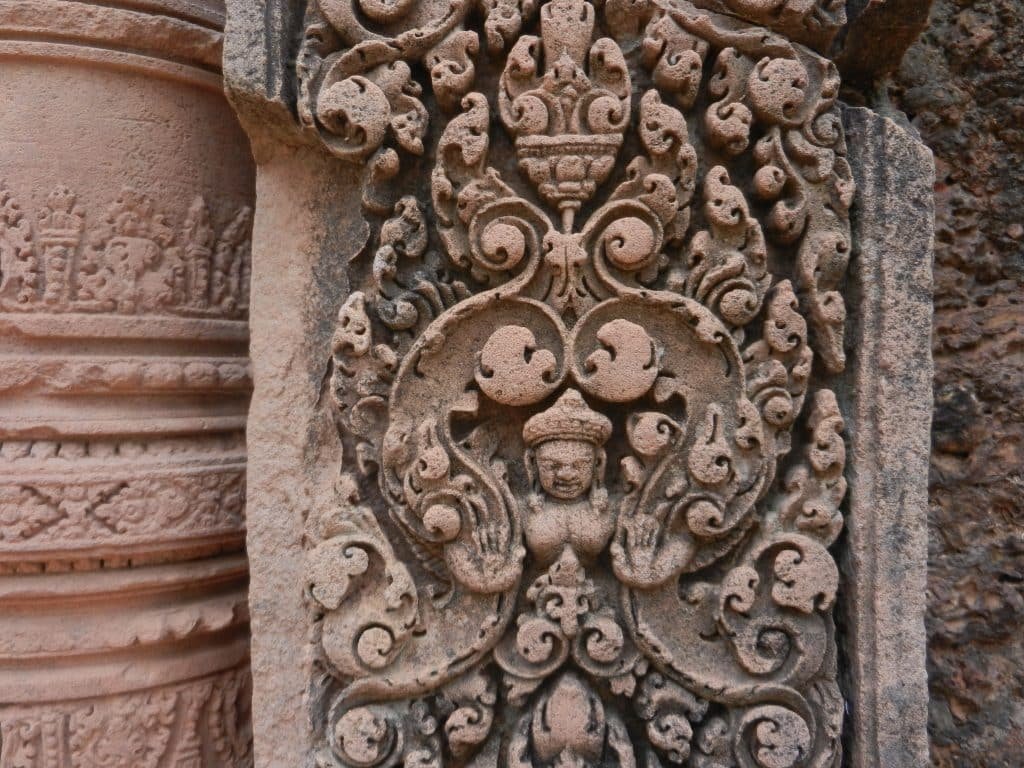
Khmer elites had also made surfaces and lines on columns and door posts as elegant and animated as possible at Preah Ko. The builders of Banteay Srei took this love of the ornate to new heights so that they also seem more three-dimensional.
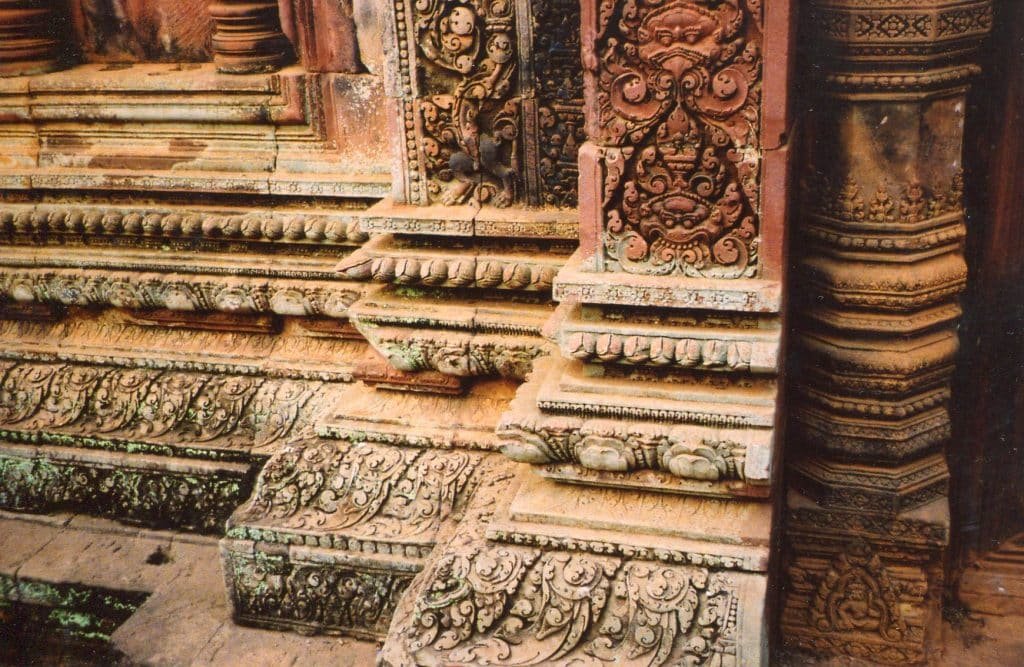
And they applied their love of making every square inch ornate to the base.
So all of Banteay Srei’s surfaces and lines glitter. They avoid the Euclidean clarity and simplicity that ancient Greeks emphasized so that every inch sparkles. They radiate a mixture of aristocratic elegance, intimate private devotion, and animated power.
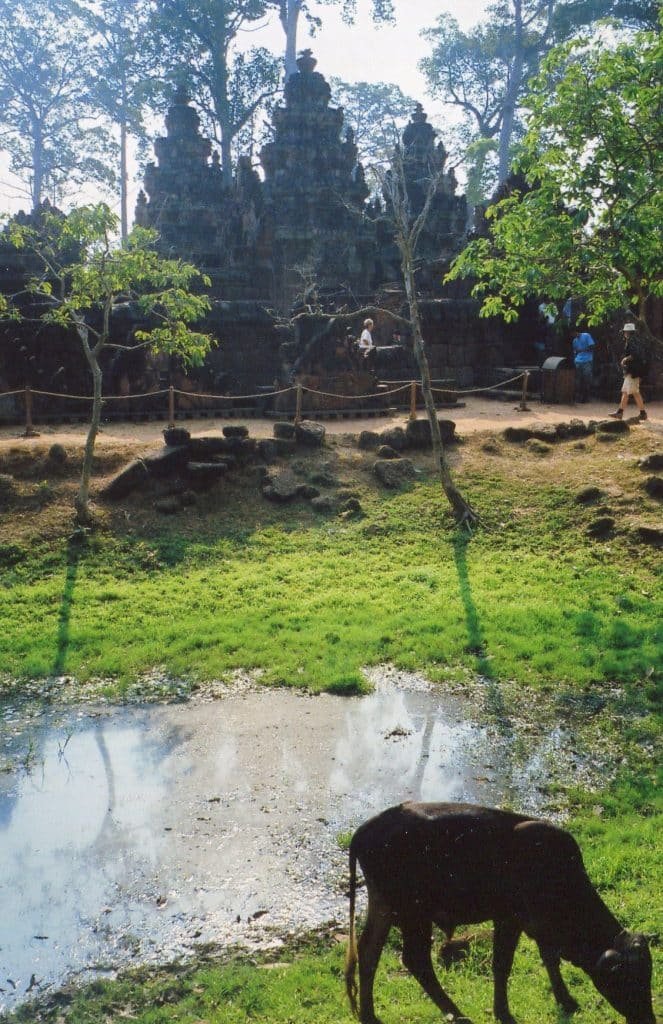
We’ll now enter Banteay Srei more deeply and explore some if its inner mysteries.
1. You proceed to Banteay Srei on a straight causeway that approaches it from the east.
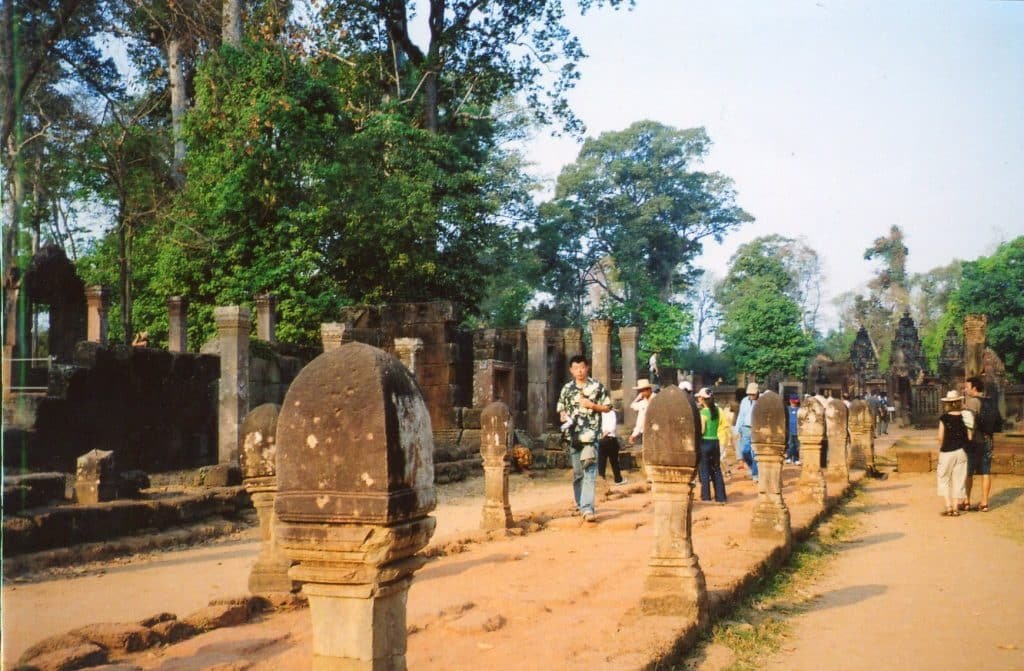
A causeway also leads to the central towers at Angkor Wat, but what a difference. Banteay Srei’s is small and intimate, and Angkor Wat’s is sensational. Both are arrow-straight, but Banteay Srei uses this symmetry not to awe people with the king’s power, but to enhance a more gentle piety.
2. A moat once surrounded the temple. Like Lolei, Prasat Kravan, and East Mebon, Banteay Srei once sparkled in the middle of limpid waters. The cow in the previous picture seems oblivious to the heritage she grazes by.
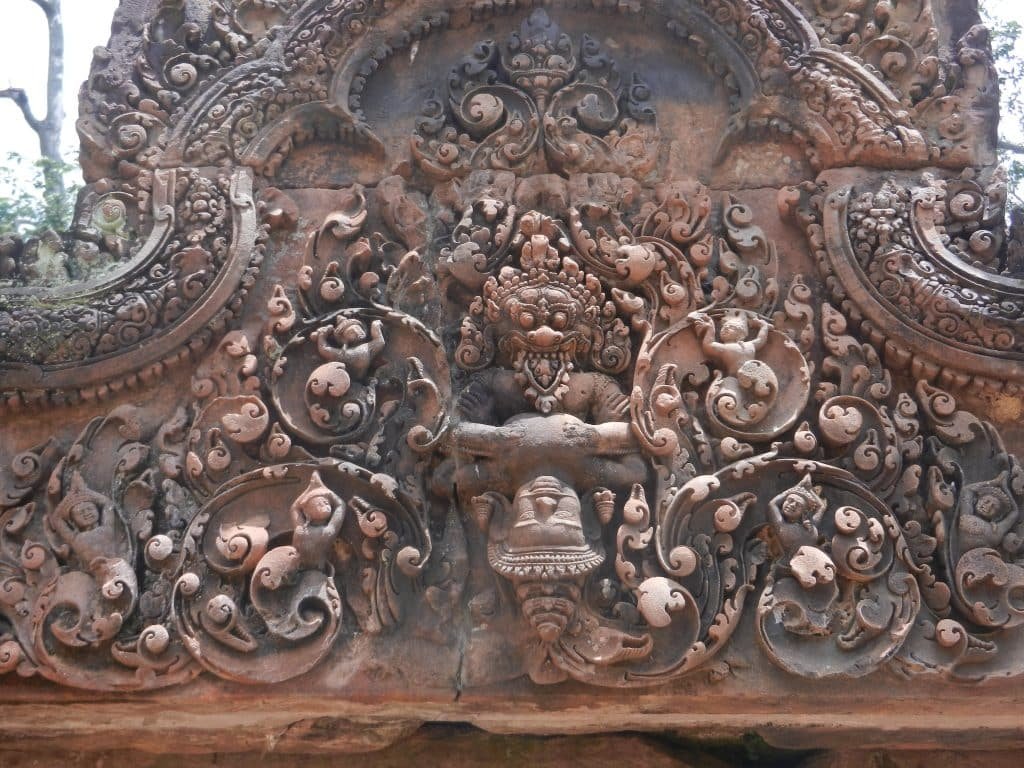
3. Now we have some action! Khmers loved lively scenes, and India provided material that matched the monsoons’ abundance. Here Vishnu has assumed one of his ten main incarnations. He’s Narasimha, a lion who conquered some of the world’s nastiest beasts. Here, an asura (demon) king called Hiranyakasipu gets the business end of his fangs. This idea follows the Khmer tradition of identifying the king with Hindu gods and thereby bolstering his image as a pillar of order. Banteay Srei projects this motif with new standards of realism and elegance.
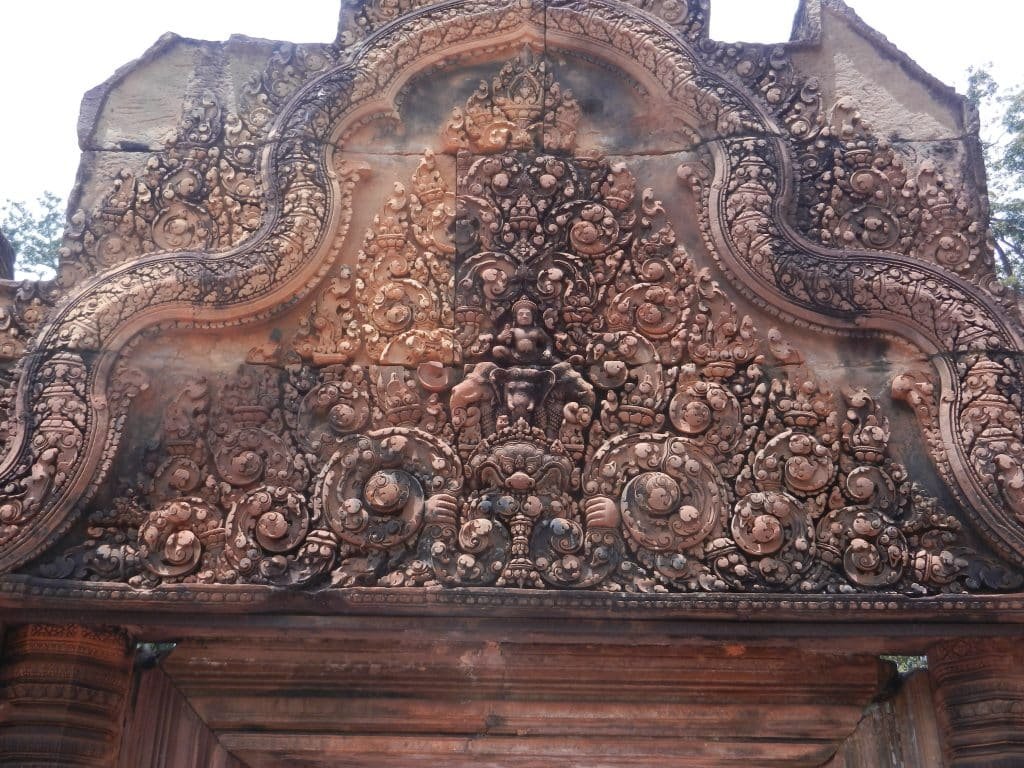
As you approach Banteay Srei from the east on its causeway, you come to this carving over the gate (above). Indra is driving his BMW.
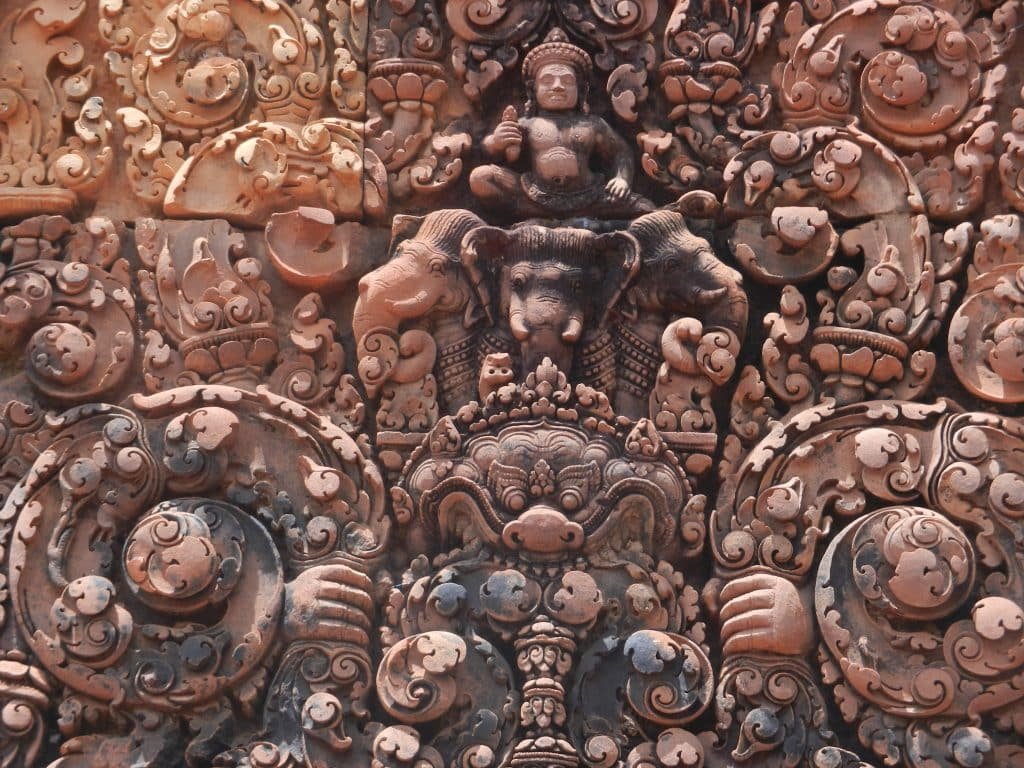
At least it was Indian mythology’s version of the vehicle that many Indians today meditate on. But in ancient India, Indra and the elephant were both associated with rain from the monsoon. The Khmers carved several images of Indra on his mount at Banteay Srei. The dense garlands around Indra look like animated clouds as though this carving will bring the rains with sympathetic magic.
But this image only hints at what’s on the other side of the gate. After entering, you find a library on your right and left, and the three central shrines preside on a platform behind them. The central shrine and the south library were dedicated to Shiva. The north library honored Vishnu. The friezes carved on the libraries approached a revolution in perspective.
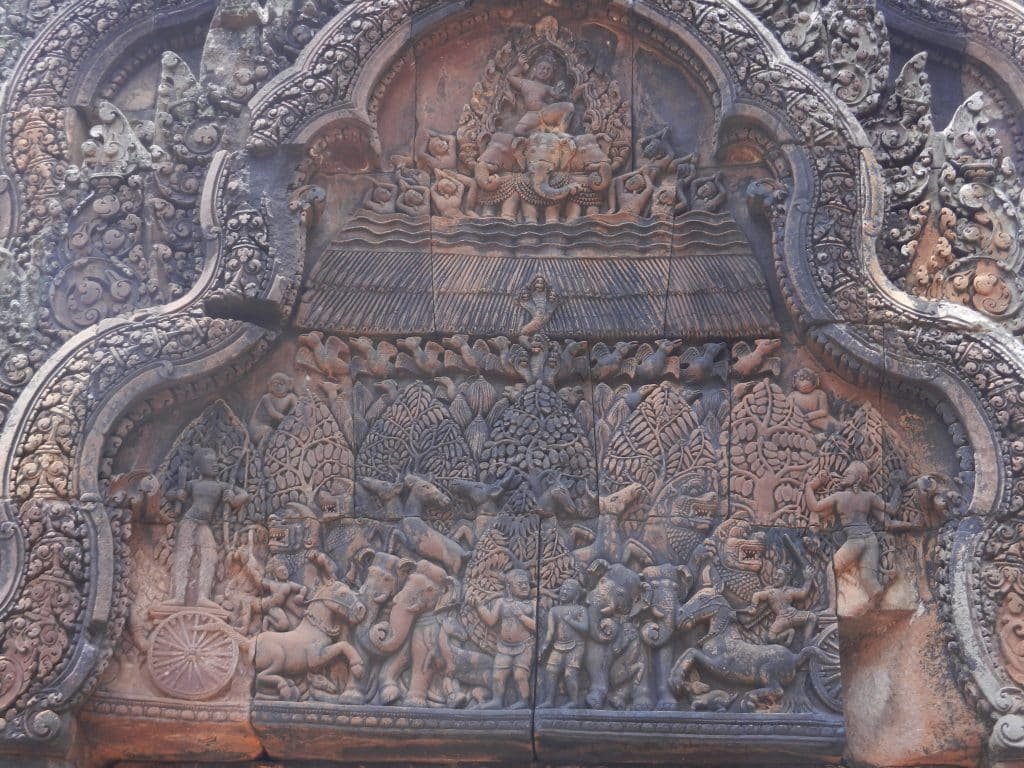
Above is a frieze on the north library. We see Indra on his elephant again, and the wavy horizontal lines under him represent rains that he’s sending to the forest.
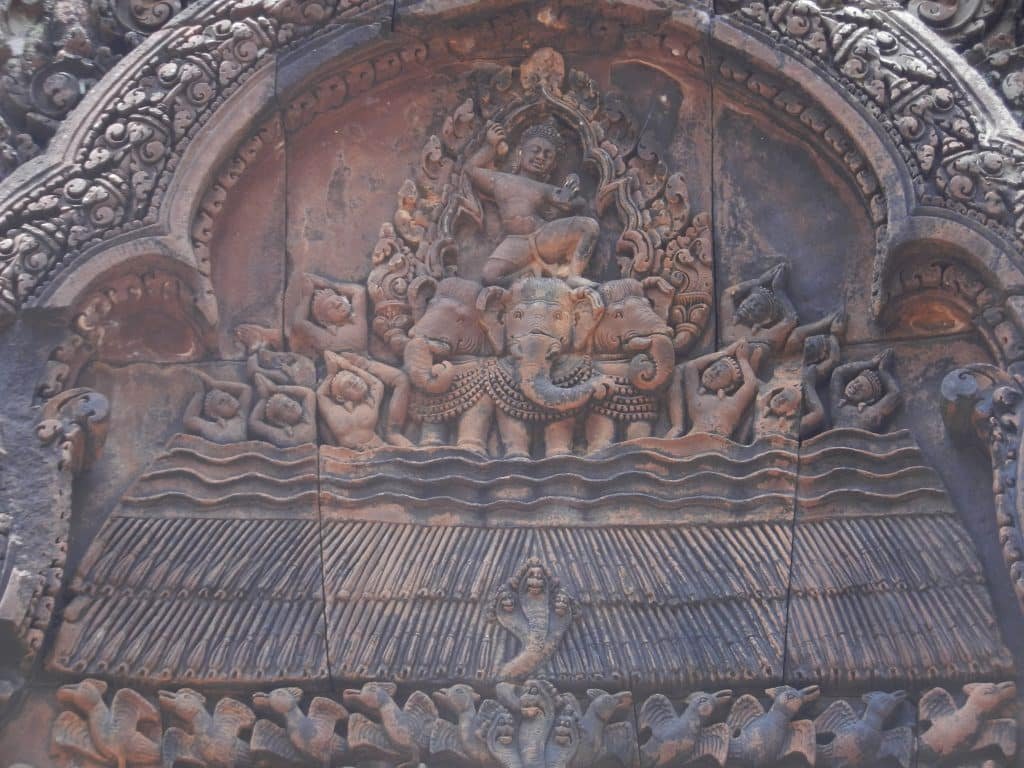
But this carving expands the perspective to a complex narrative scene underneath.
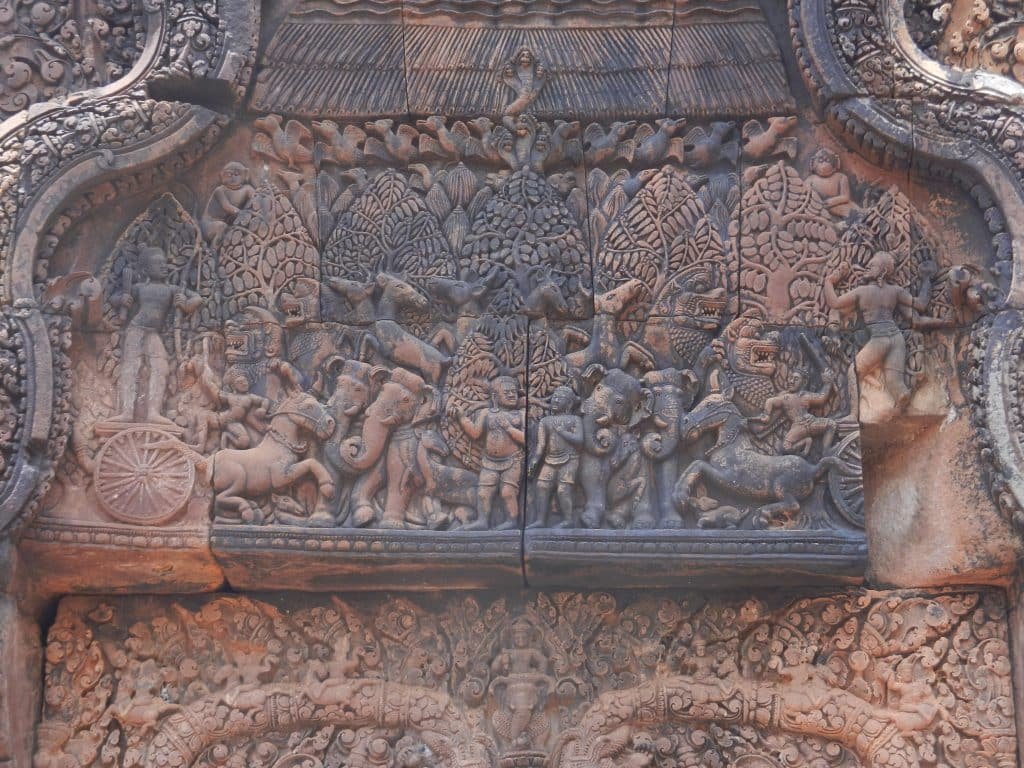
Vittorio Roveda, in Images of the Gods, wrote that it’s from the Mahabharata, Book I. Krishna and Arjuna (the two main protagonists in the Bhagavad Gita) were resting in the forest when the god of fire and Vedic sacrifices, Agni, approached them. He was famished but couldn’t consume anything in the forest because Indra kept sending rain. Krishna and Arjuna then fired arrows skyward. You can see them as the densely packed straight lines pointing upwards, just under the water. Many gods tried to stop the barrage of arrows, but they ultimately admitted defeat. They accepted Krishna and Arjuna’s invincibility, and Agni ate his fill.
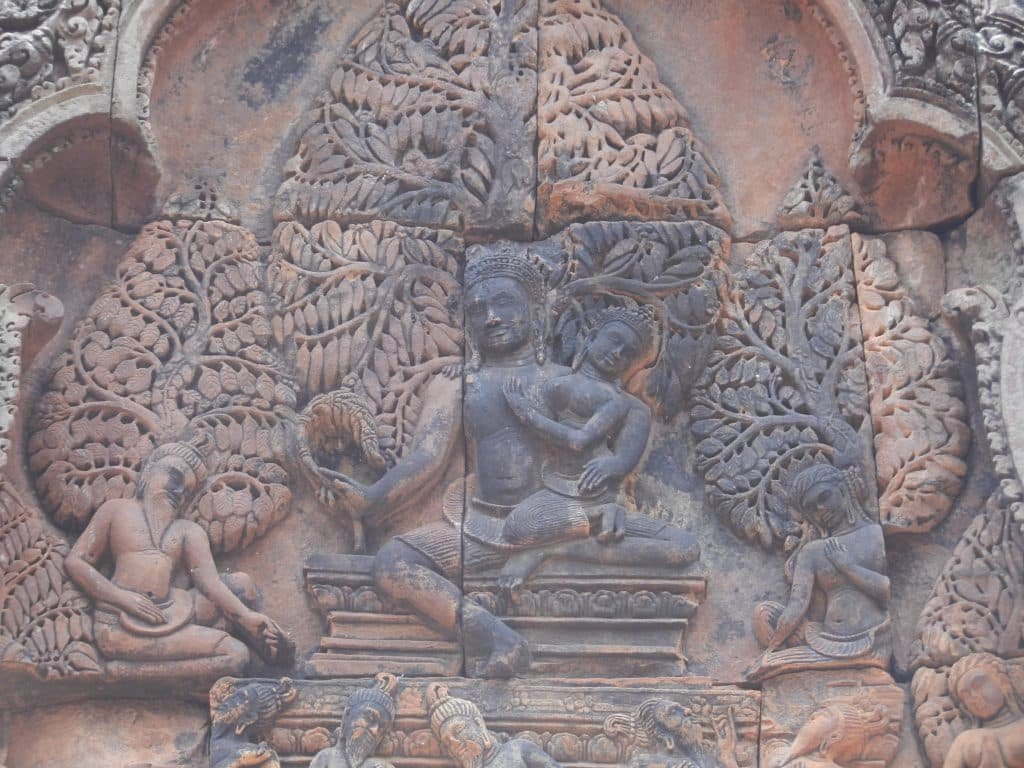
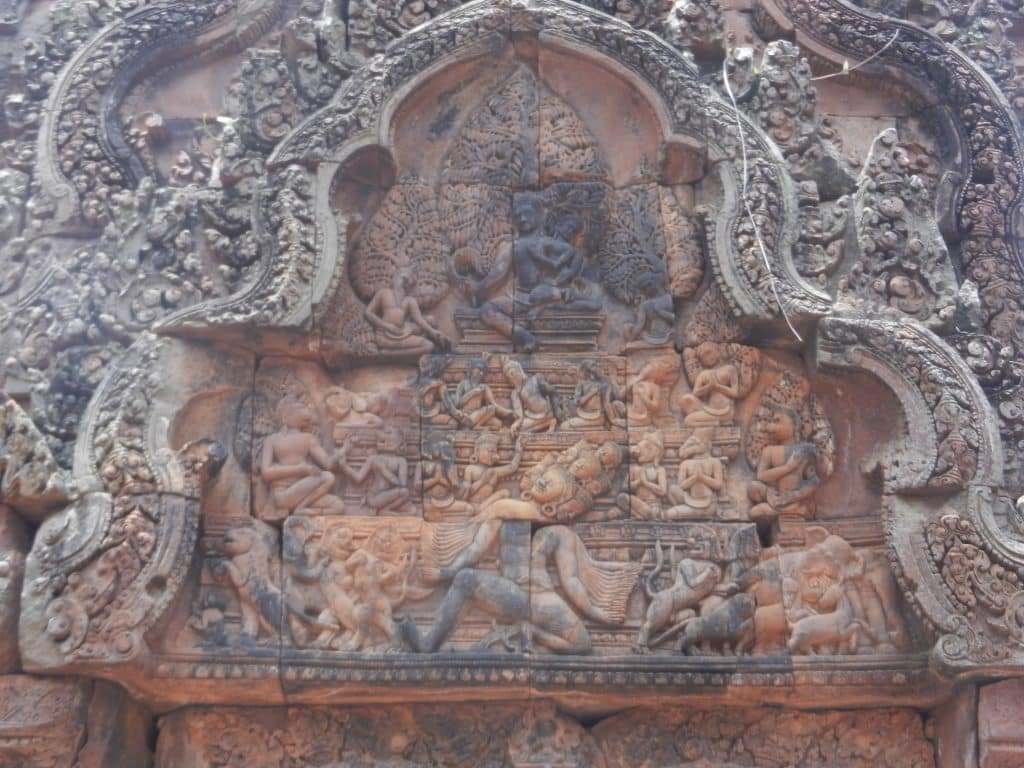
Banteay Srei was dedicated to Shiva, so we better give him equal honor. The above image is from the south library, Here, he and his wife, Parvati, recline on Mount Kailasa, their traditional abode. Underneath, Ravana tries to disrupt them by shaking the mountain.
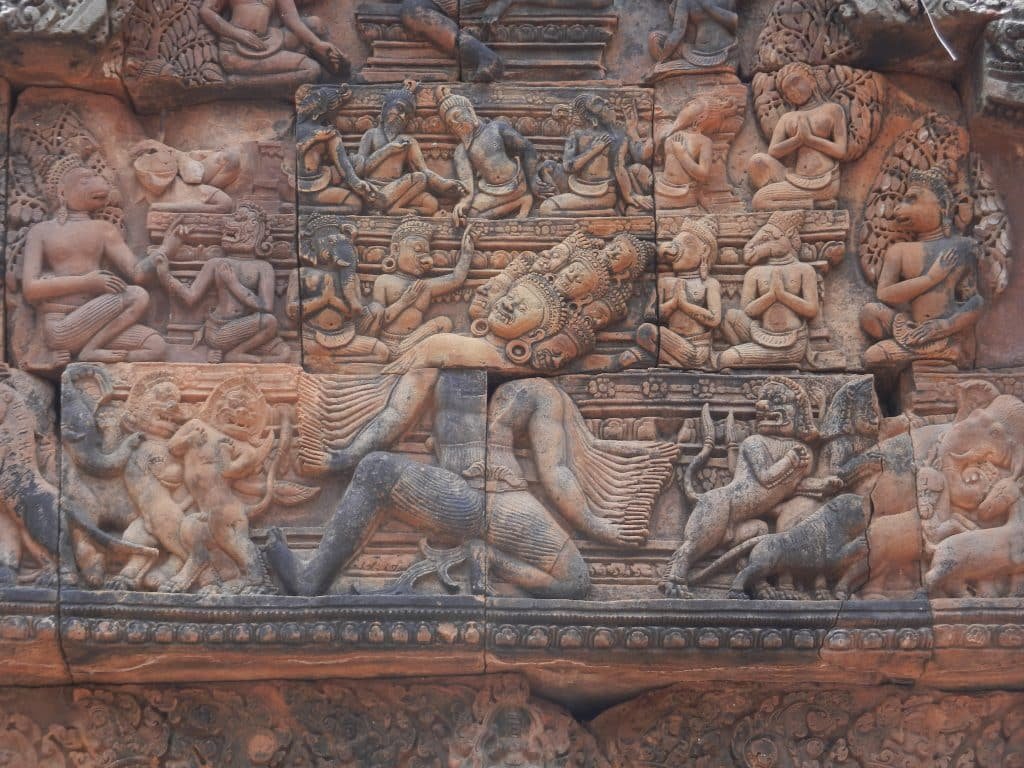
Shiva presses his foot on it and stabilizes it, while the frightened Parvati clings to her husband. Under them, ascetics and supernatural beings appear agitated.
Both of these panels use sweeping perspectives to show the gods upholding the cosmic order. In the first, Krishna (an incarnation of Vishnu) checks the power of the monsoons and balances the forces in the universe. In the second, Shiva preserves the order from the cosmic mountain he lives on.
Khmers adopted these panoramic stories from Indian texts like the Mahabharata, the Ramayana, and the Puranas. These narratives are much longer and include more fantastic characters than most Western texts. They’re concerned with the biggest of the big: the creation, preservation, and ultimate dissolution of the universe.
Khmers adopted these ideas of vast cosmic cycles and used them to project the powers of royalty and the gods. So Banteay Srei is a convergence of two cultures’ favored ways of representing reality. Both often preferred the cosmic over the specific. The temple’s pink sandstone allowed artists to realize these visions in expressions of universal harmony.
Khmers later put these epic perspectives in Angkor Wat’s friezes. They were useful for kings keeping a huge kingdom of rice farmers in line, and they were easily associated with the power of the monsoons and the annual flooding of Tonle Sap.
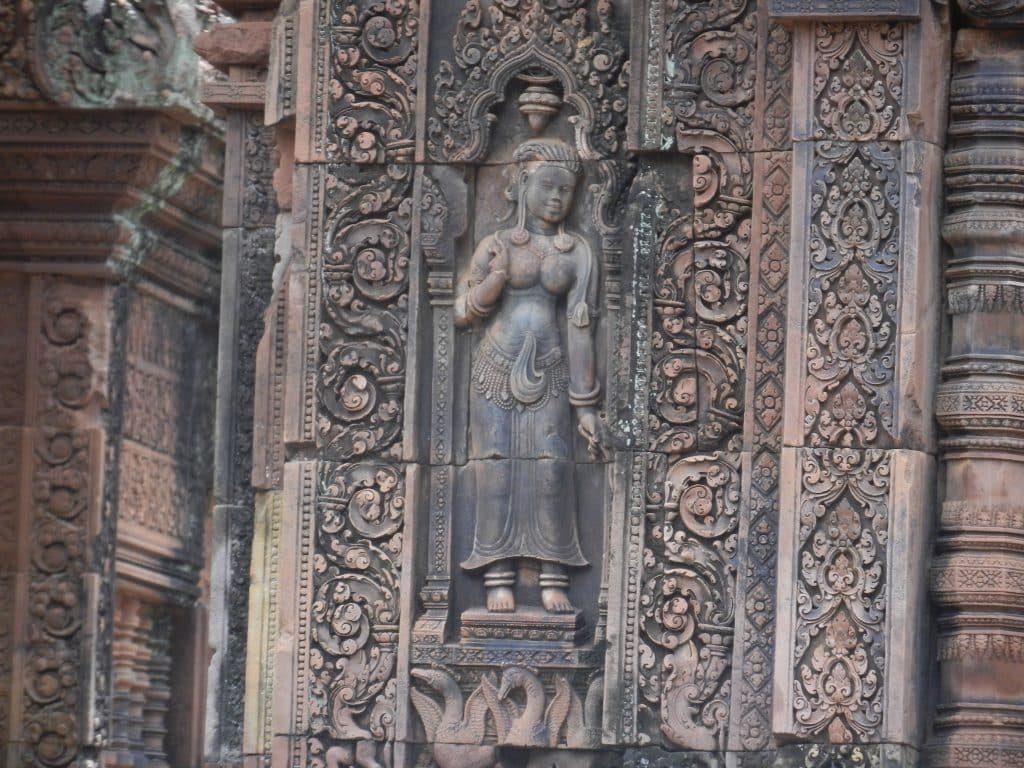
But Banteay Srei’s dainty size and elegant carvings balance the epic perspectives. Here are two of the female guardians on the inner shrines. Banteay Srei means Citadel of the Women, which locals in modern times have called the temple.
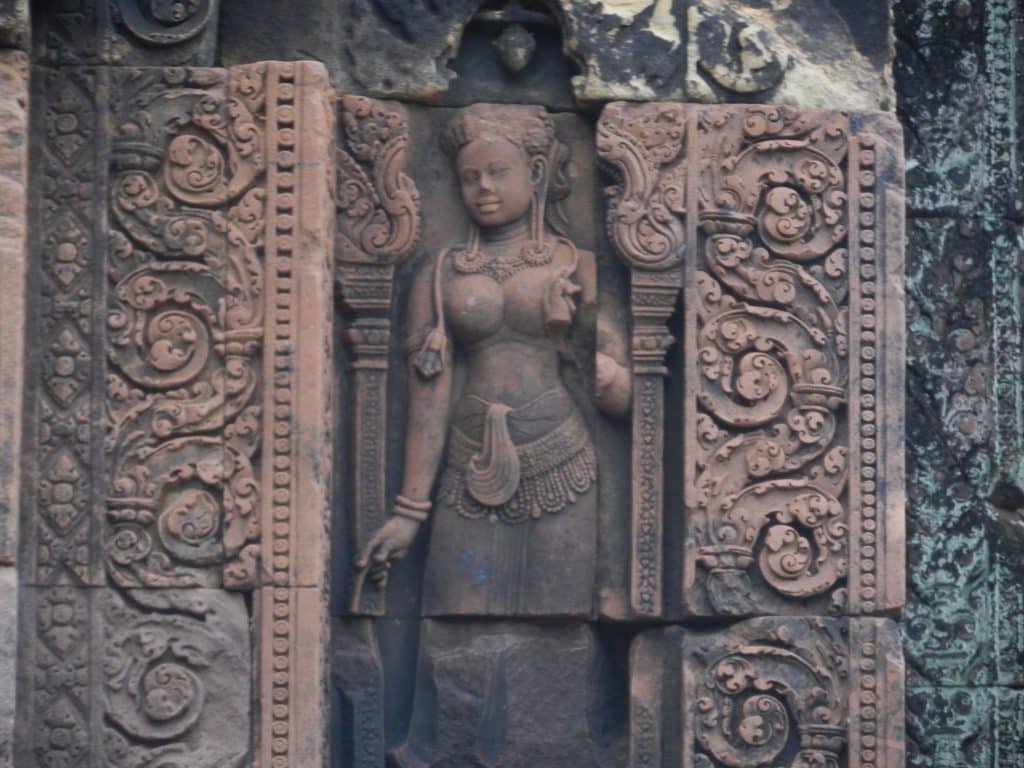
The human-scale of the shrines make the whole complex seem even more gentle.
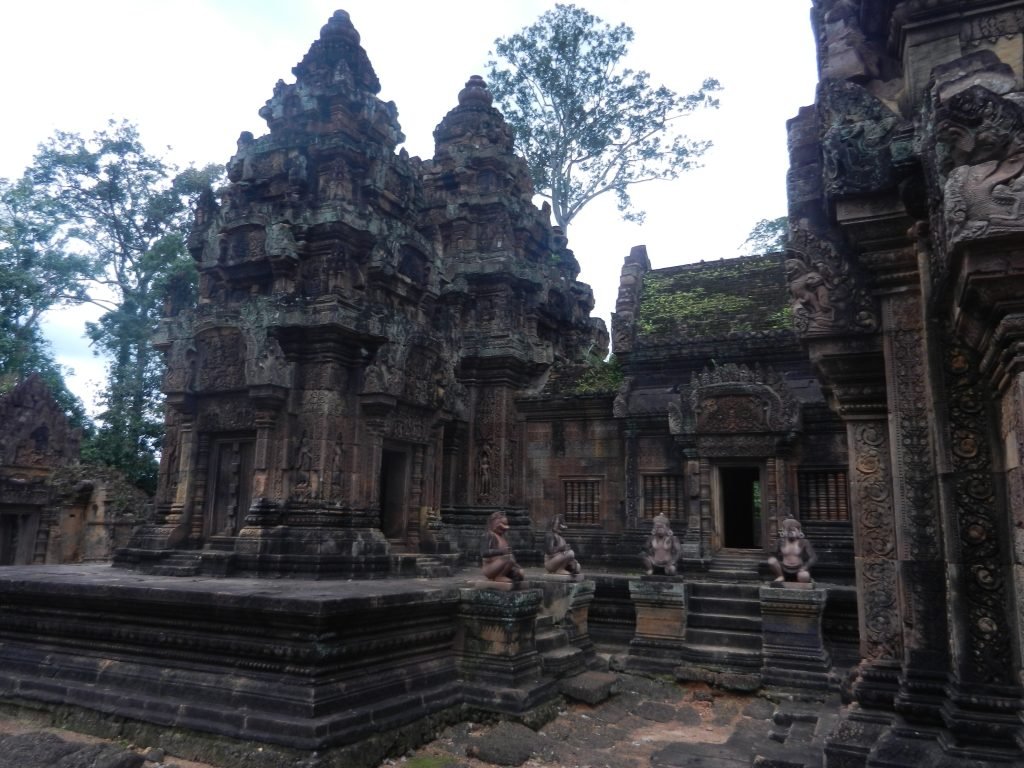
Below, you can see them from the back (west) side.
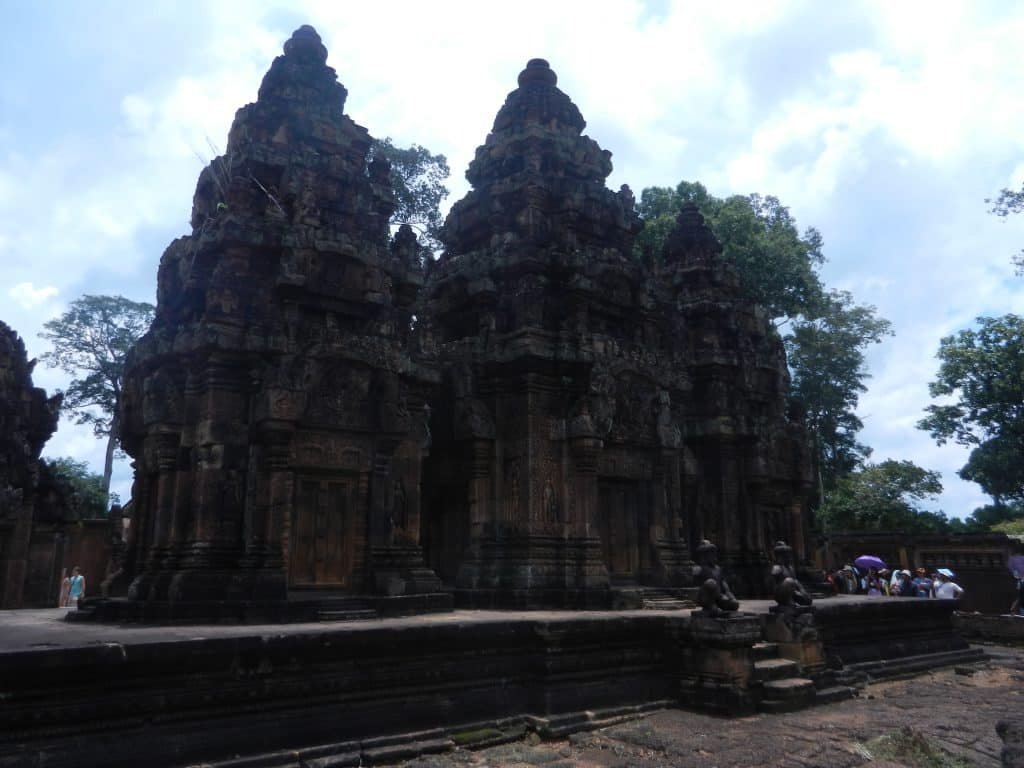
Banteay Srei’ carvings show artists’ new ability to create dramatic scenes that have cosmic importance. At the same time, it projects the tenderness and piety of a devoted Hindu official. Both together make this one of the finest temples in Asia.
Please note that Banteay Srei is very popular. Rajendravarman’s armies of laborers have been replaced by tour buses. The jam-packed bodies in wide-brimmed hats can detract from this small temple’s intimacy. Get there as early or stay as late as you can (the pink sandstone is sublime in the afternoon sun), screen out the crowds, and linger over every detail. Banteay Srei will reward your efforts many times over.