
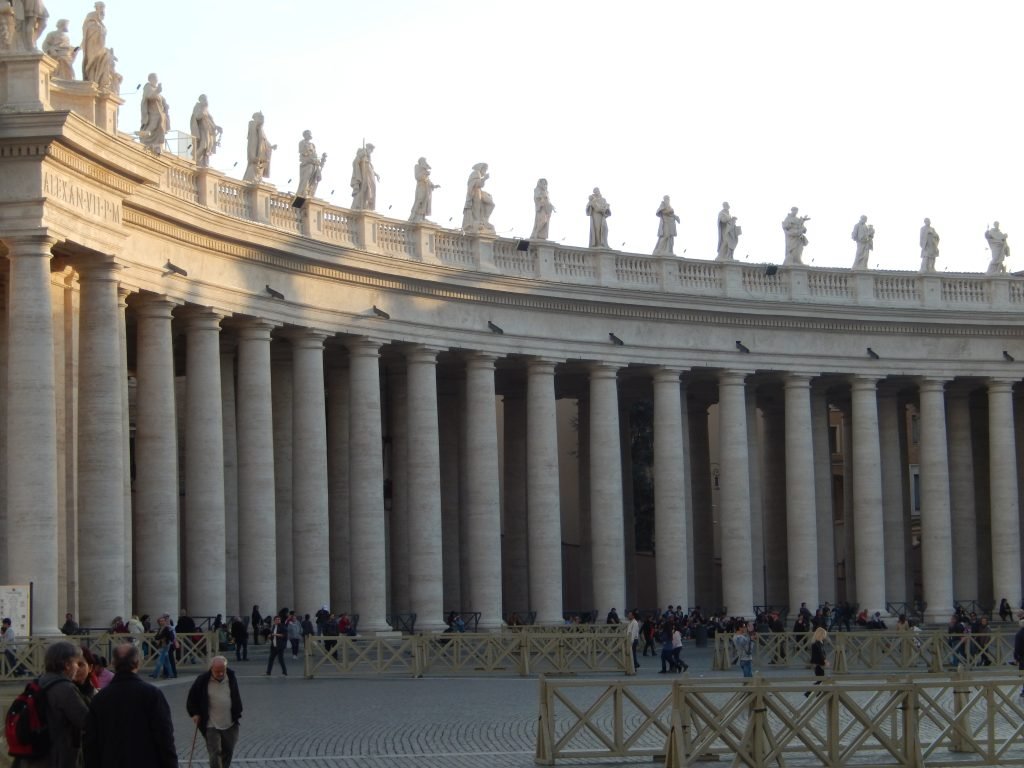
Western scientists in the 16th and 17th centuries increasingly conceived space as a void that objects move around in. At the same time, architects were designing public areas that made people all over Europe concretely feel that this what space is. Gian Lorenzo Bernini’s design for St. Peter’s Square (below) immerses visitors in a large open area bounded by an abstract perimeter with columns and statues with all the gravitas of being in the presence of their religion’s earthly leader.
But people in a lot of other cultures have seen space as more dynamic than a passive void that surrounds objects. For example a common Sanskrit word for space, kham, means cavity, vacuity, emptiness, the axle of a wheel, and cave. It also means Brahman, the creator of the universe. Kham is thus not merely an absence of objects, but is also associated with a creative energy that everything in the universe differentiated from. Like the idea of a point/bindu, kham expands from initial creation and differentiates into the whole universe. Kham thus reflects a world-view that ancient Indians shared.

Another common Sanskrit word for space, akasa, has an incredible combination of meanings that also reflects ancient India’s cultural landscape. Nyaya and Samkhya philosophers saw Akasa as one of the five basic elements in nature and an all-embracing principle of unity. It means emptiness and void, but it also means consciousness and the potential for the emergence of all forms. It is also a subtle center of experience, and it can mean movement from inner to outer as well as from outer to inner. It also means movement between the subtle and the gross and between the sacred and profane. It is within and without the self, it interpenetrates all other elements, and it is also primordial sound. All these meanings together give Indian ideas of space a unique flavor, which is not focused on distinct objects and their absence, but on the projection of the whole universe from its origin and into a vast field which integrates creative energy, matter, consciousness, spirit, and movement between several domains. This single word expresses many facets of a unique world-view.
Other words that have been related to space also have several meanings, which are interlaced with many dimensions of the cultural landscape that they emerged in. The Sanskrit word ma (to measure) has been associated with maya (illusion), matra (meter in music), and matr (mother). The musicologist Prem Lata Sharma wrote that this complex has been associated with ideas of creating and giving birth, and with ideas of giving form and definition.
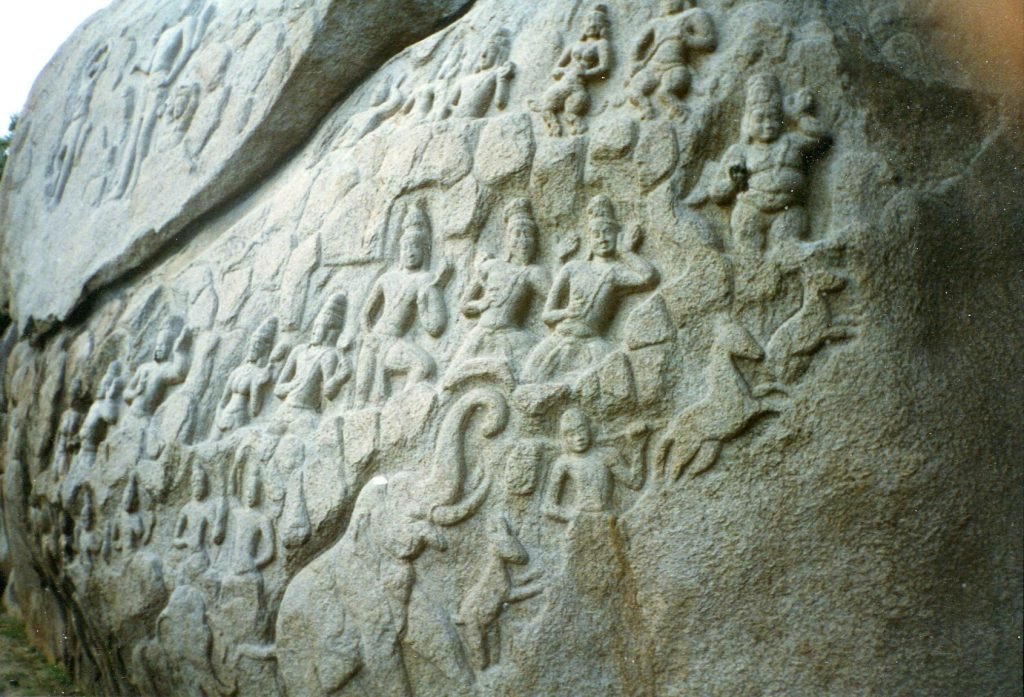
Westerners have usually seen these two types of ideas as distinct—creation and equilibrium have usually been assumed to be two distinct states. But followers of the Vedas in ancient India more often saw nature as a vast and dynamic flow, which emanated from the origin, rather than primarily as static forms and abstract laws. Distinctions between static measurable and dynamic and spontaneous aspects of nature thus haven’t been as sharp in India as they have often been in the West. Many traditional Indian thinkers have seen both as secondary to the origin of the universe. Both are unified with each other because they came from the same source and still contain its essence. Measurements of distinct things, spatial magnitudes, and static forms have thus not been treated as primary. Merging one’s consciousness with the source of the flow of nature has often been stressed. While modern Westerners have often apprehended space in terms of distinct objects and a static perimeter, many ancient Indians conceived it in terms of the universe’s origin, which expands from the center. Sanskrit words for space and measurement thus get their meanings from the entire Indian world-view as much as from one usage.
Considering the world’s cultural diversity, we can apprehend space as an infinitely creative field, where we can make forays into other people’s ways of integrating the world around them. You can explore other ways of integrating space here, including Chinese, Thai, and African.