The concept de had a wide range of meanings in ancient China, which together encouraged assumptions of a highly resonant universe which was conducive to yin-yang cosmologies.
Confucians have defined it as virtue and ability, and it has also been closely associated with power. D. Howard Smith, in Chinese Religions, wrote that the oldest meaning of de (during the Shang Dynasty, from the 17th to the mid-11th century BCE) was a potency, which gods, spirits, and important people could wield. He compared it to the Polynesian idea of mana, which refers to an unusual amount of power that special people and things contain. Smith wrote that during the early Zhou Dynasty, de became associated with virtue as well, and it thus made a king acceptable to heaven. Because he was virtuous, he could retain his power.
David Shepherd Nivison, in The Cambridge History of Ancient China, wrote that de’s meaning grew out of the feeling of gratitude—if you do something nice for me and I thus feel compelled to do you a favor, you have de from me. This characterized the king’s relationship with the gods and spirits that he sacrificed to.
Donald J. Munro, in The Concept of Man in Early China, wrote that back in the Shang Dynasty de might have referred to consulting a god or a high-ranking ancestor about what to do in a given situation, and that in the early Zhou Dynasty it was extended to a human ruler’s bestowal of bounties to his subjects.
Similarly, Yuri Pines, in Foundations of Confucian Thought, said that de meant the ruler’s charisma or psychic power (which was so great that it made him worthy of ancestors’ and heaven’s support) during the Shang Dynasty, and that Zhou Dynasty writers extended it to refer to a king’s kindness in dealing with his subjects, and then further expanded it to refer to the virtue of all people in the noble classes and their retainers.
The concept de helped the early Western Zhou Dynasty achieve political unity after it conquered the Shang. Its first kings used it to consolidate their state. An emperor who sacrificed to the gods and granted favors to his subordinates acquired a lot of de.
Shang Dynasty and early Western Zhou Dynasty kings and nobles exchanged bronze ritual vessels in formal ceremonies. This solidified their bonds as they extended their rule through the area that encompasses the Yellow and Yangtze rivers and beyond.

These vessels thus became common symbols of unity throughout China, and their circulation was associated with the flow of de. Civilization and harmony extended as far as these vessels were exchanged.
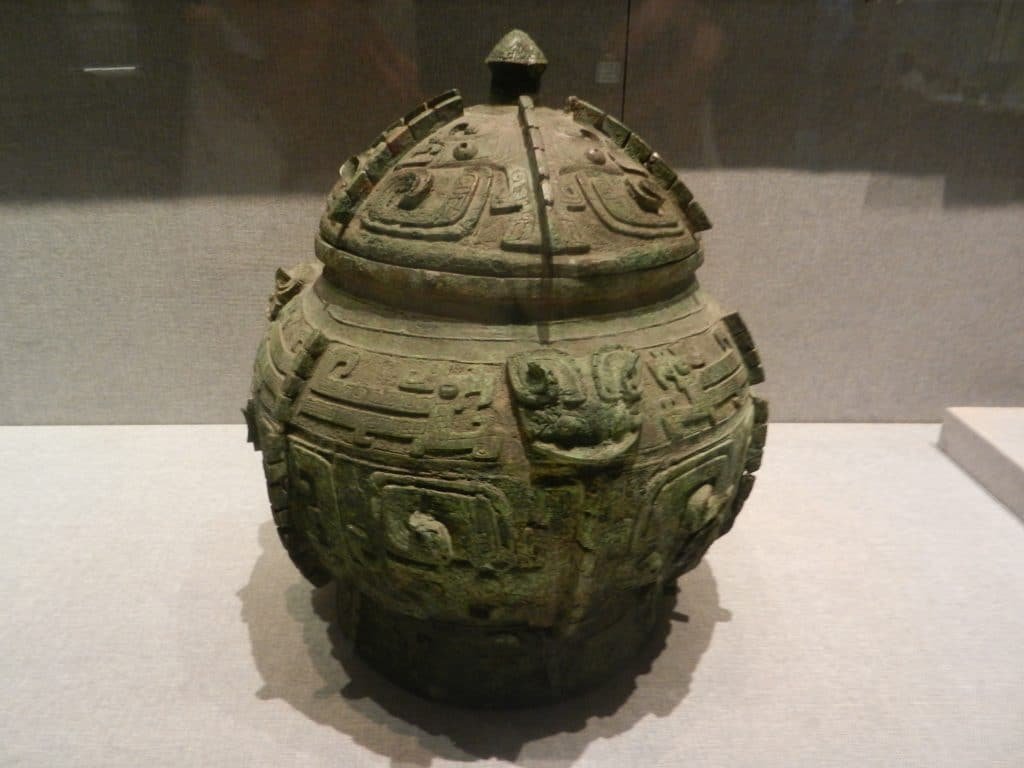
We can note two key characteristics that this circulation of bronze vessels reveals about ancient Chinese thought:
- Power, virtue, the state, and civilization are closely interwoven. The idea of a single god who is the only source of causality, which became foundational in the Middle East, is very different. In traditional China, the main locus of causality was not one all-glorious god, but diffused potency throughout the whole environment. Gods, kings, and noble subjects possessed various amounts of de. No one had all of it. Emperors possessed the most among humans, but others had some as well, and its circulation integrated society. The most basic reality is not one god, but the harmonious flow of potency between all beings.
- Power and virtue essentially circulate. The exchange of bronze vessels throughout the land became a model of reality. Well-being is attained when power and goodness flow smoothly throughout the whole system. These ideas of smooth flow and resonance throughout the whole later became foundational in medicine, ideas of yin-yang patterns, and concepts of wu xing. All these ideas reinforced each other as the basic nature of reality.
Basic ideas in ancient China, including yin-yang, had deep roots with many dimensions. You can see even more dimensions in them in concepts of wind.