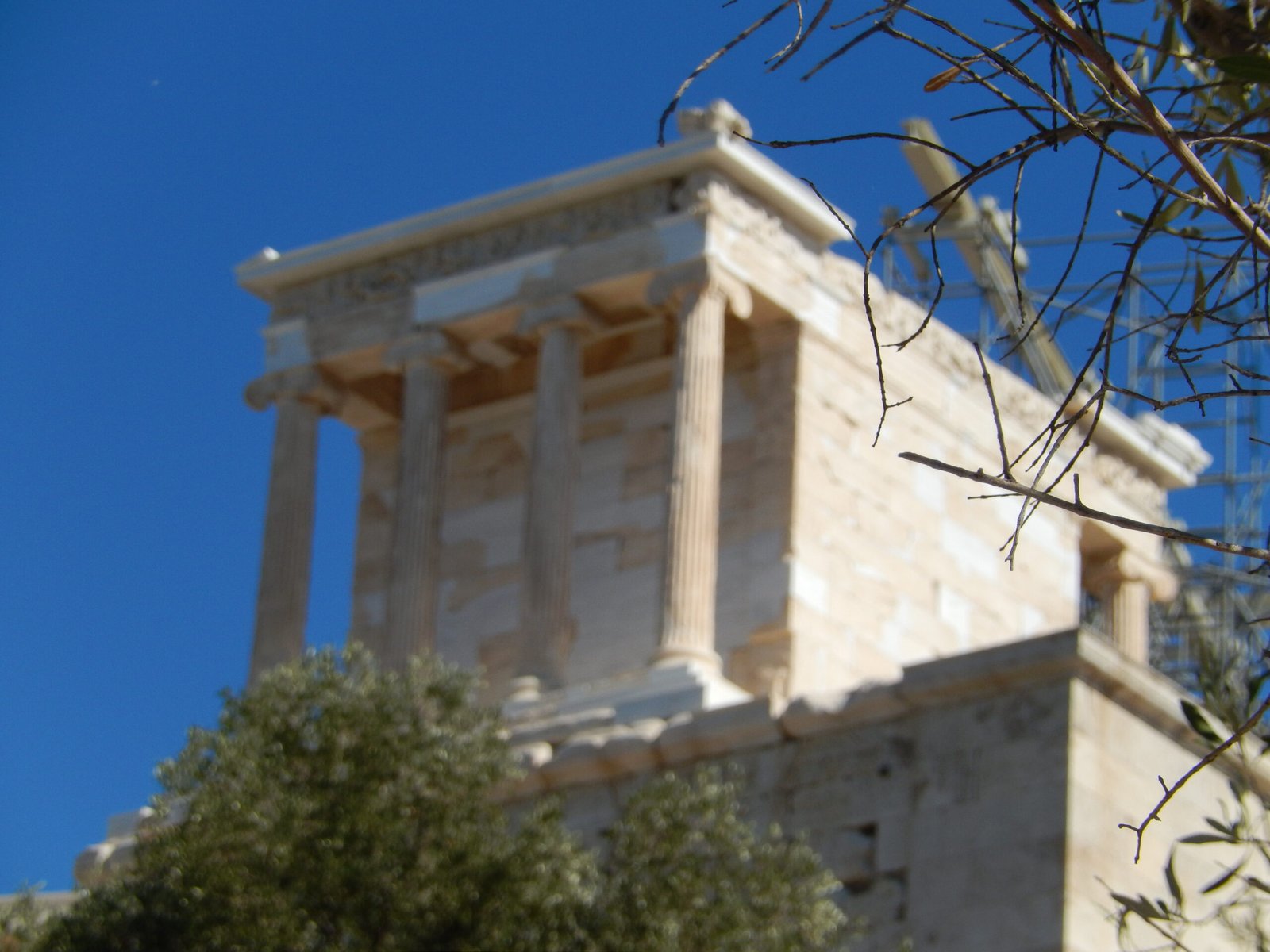
Some historians of thought have called it humanity’s most influential period. The philosopher Carl Jaspers called the time between 800 BCE and 300 BCE the Axial Age because, from Europe to China, philosophy, religion, political thought, and art emerged in forms that people around the world still consider most exemplary. Several of humanity’s most revered teachers lived then, including Socrates, Plato, Aristotle, the Upanishadic thinkers, Gautama Buddha, Confucius, the Daodejing’s composers, and the biblical prophets. In Athens, the Parthenon was built, Western theater emerged, sculpture and painting set some of history’s highest standards for realistically portraying human beings, and Plato and Aristotle defined the main hallmarks of Western thought. People today still look to those past masters for the deepest insights about life and death.
Why did that age generate so much creative thinking? The Mundaka Upanishad’s question “Through what, when known, does all become known?” summed up its spirit. People were asking questions about ultimate reality in a more self-conscious and systematic way than before. An increasing number of thinkers no longer took their traditional views of the world for granted. The Homeric mythic world and the ritualized society of the Vedas now didn’t satisfy everyone. Several developments encouraged this.
First, societies began to trade more and use money. This allowed people who weren’t in traditional aristocracies to rise in the social order and challenge their privileges. The new standardized currencies enabled their holders to do business with a wider variety of people by giving them a medium of exchange that everyone wanted, which was easier to carry than physical goods.

Folks could thus more easily expand their relationships beyond their current networks and encounter new ideas. They could also benchmark their own well-being with quantified monetary values that were abstract and independent from any particular person or social class.
Second, people forged more iron to make weapons and ploughs. This metal was relatively plentiful and harder than bronze, so groups that were not the wealthiest could now wield as much force on the battlefield as aristocrats. Folks also used it to make stronger plowshares, sickles, and scythes to clear more land for farming. The larger amounts of food enabled more people to specialize as craftsmen who made more goods to trade.
Third, the greater number of iron weapons enabled larger armies to form so that warfare became more bureaucratic and less dominated by personal loyalties than conflicts in the Homeric epics were. More people experienced long campaigns in foreign lands, and an increasing number of soldiers were paid with money. For many, loyalty was less determined by life-long personal relationships and more by a medium of exchange with abstract values that were independent from any specific person. Ultimate meanings increasingly seemed impersonal.
Fourth, literacy was spreading.

The prophets in the Old Testament could now criticize customs they found morally offensive and assert new standards of piety, and their fiery protests could reach larger audiences through scriptures. Greek thinkers could ridicule older myths and set more minds on fire. The early fifth-century BCE poet Xenophanes of Colophon (a commercial town on Turkey’s western coast) asserted that people’s ideas of divinity are mere projections of their own self-images, saying that horses would imagine their own gods as horses. He instead identified God with the entire universe, which he saw as a single entity that set all things in motion by mind and thought. This entity doesn’t need to move around to accomplish things, like the hot-headed and hedonistic Homeric gods. Instead, God is motionless and can shake anything without toil.
The Vedic hymns were not yet written down. The earliest known writing in India is from the sixth or fifth century BCE, but extant inscriptions indicate that writing didn’t become common until the third century BCE. Of course inscriptions on palm leaves would have disintegrated long ago, but even if Indians prolifically wrote before the third century, ancient Brahmins thought the Vedas were sacred and based on sonic vibrations, and thus considered writing them down to be a defilement. Many also wanted to limit access to them to other Brahmins. However, the Vedas were being consolidated into collections by 600 BCE, so some people were thinking about them systematically in settings that were distant from the sacrifices they used them in.

The preceding four causes converged into what the historian Robert N. Bellah saw as a mental disengagement from conventions. More people were thinking and communicating outside the centers of power. This enabled them to see them more objectively so that they could institutionalize criticism of long-held beliefs. Jaspers wrote that second-order thinking became more common. In other words, some of the more reflective people were less immersed in a tradition, stood back from it, and thought about thinking so that it became its own topic. They didn’t treat an idea as part of a ready-made order of things, like Egyptian Ma’at or the Sumerian me. They now self-consciously searched for the foundations of thinking, the universe, and society.
So several currents encouraged people to question their old ideas about cosmic and social order.
However, Jan Assmann challenged the ideas of an Axial Age as a momentous time in all human history and as a single process that all cultures shared. He instead saw cultural change as evolutionary and diverse. As an eminent Egyptologist, he pointed out high levels of creativity in earlier ages, and identifies Imhotep and Akhenaten as individuals who stood back from conventions and conceived the world in new ways. Imhotep was the probable architect of King Djoser’s step pyramid (below) in the 27th century BCE.

Akhenaten was an Eighteenth Dynasty king who rebelled against the authority of Amun’s priests parading in the temple in Thebes and made religion monotheistic by focusing on the sun as the one god, which animates the world. The next kings and the priestly old guard reestablished the many gods and temples after he passed away, but Assmann saw his monotheistic influence in some Nineteenth Dynasty texts. He also cited the Mesopotamian epic of Gilgamesh as a highly reflective literary work. My own experiences in Southeast Asia and Africa, as well as with Native Americans in my own country, have shown me that cultures that the Axial Age didn’t encompass have been as wise and creative as any that Jaspers admired.
But the combination of all five of the above trends was new, and ideas from several great teachers from the mid-first millennium BCE were canonized into literary corpuses that have been treated as axial ever since. Their attempts to express the ultimate principles of nature, thought, and politics with more certainty and comprehensiveness have often been treated as some of the highest standards of thinking.
But most people then based thought on limits that they treated as all-encompassing. They asserted that all valid knowledge must be constant to a limit, such as a philosophic doctrine, a system of basic concepts, a literary canon, or the laws of a jealous god. Even Daoism, Buddhism, and Vedic studies, which originally taught that nature cannot be completely conceptualized, sometimes became dogmatic in the hands of followers of the original teachers. Thought often became based on the assumption, “It is this way, and no other.” Since then, truth has often meant keeping knowledge constant to one’s favorite limits. As mainstream thinkers focused on one way of apprehending reality, they became addicted to one way of looking At. As ecologies, economies, and cultures have become more interdependent, this habit has become increasingly primitive, and dangerous for both ecological and political survival.
There is much more richness in us and more possibility for meaning and creativity than what past teachers identified. We can become independent from any society’s conventional thinking, see the world’s whole ecosystem of cultures and their roots more fully, and build a much larger inventory of ideas so that we can have conceptual breakthroughs and synthesize larger perspectives on a regular basis.
We can now look At/With/Beyond in a circle that continues to expand so that expansion becomes the main idea that we hold thought constant to. Thought can be based on expanding beyond its own assumptions as much as affirming them. We’ll explore this more in the next article.