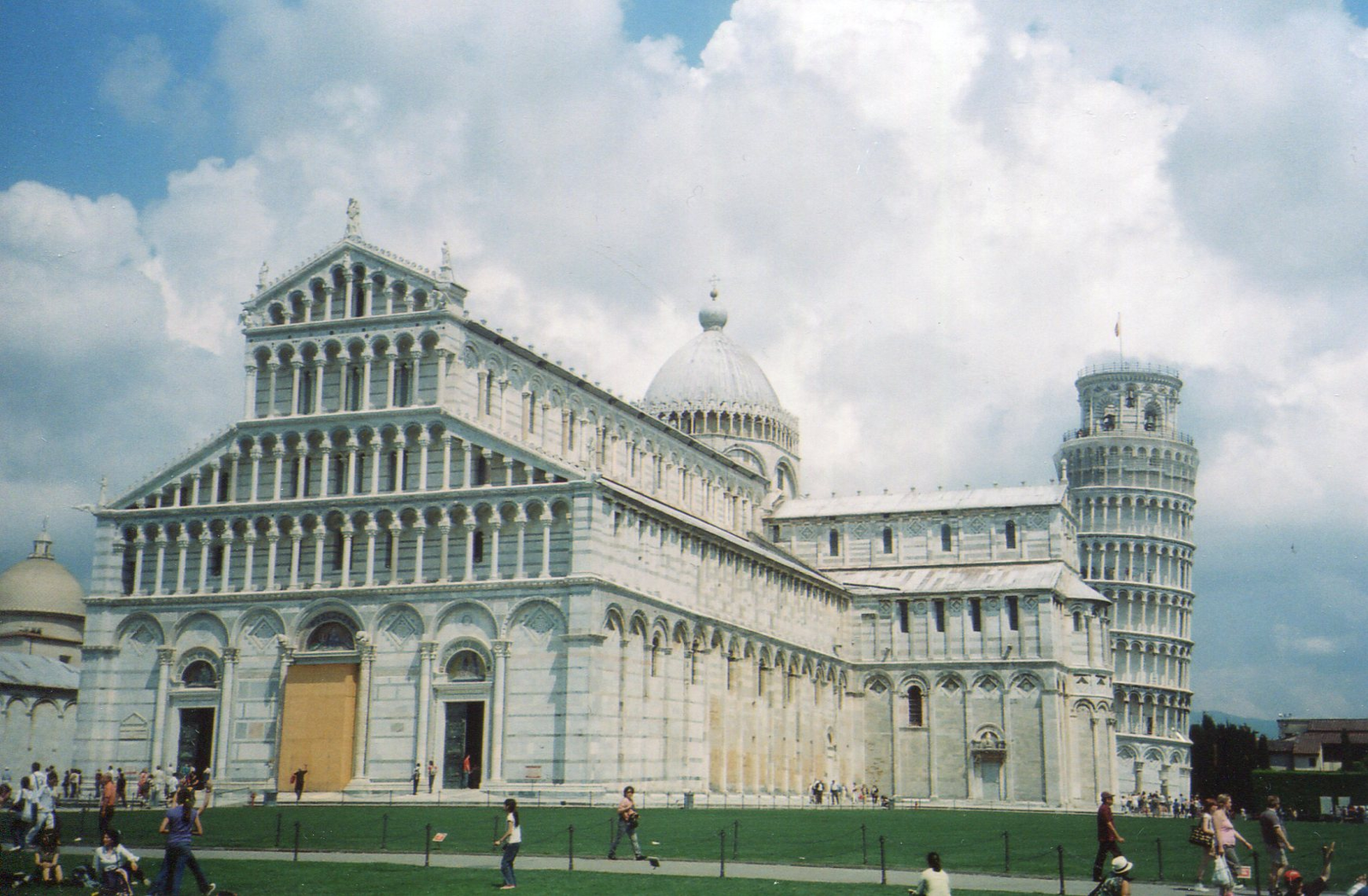
So it leans, big deal. They practically charge you a Lambo to go to the top, but I knew that there is much better stuff in Pisa to see than this tourist trap.

The leaning tower is part of the Campo dei Miracoli (Field of Miracles). Pisans had good reason to call it that. An inscription on the cathedral’s exterior says that they had won four naval battles with the Islamic Saracens in Sicily and Sardinia between 1005 and 1034. Another inscription says that Pisa took booty from another victory over the Saracens in 1064. Pisa emerged as one of the great sea powers in Europe’s expanding economy.
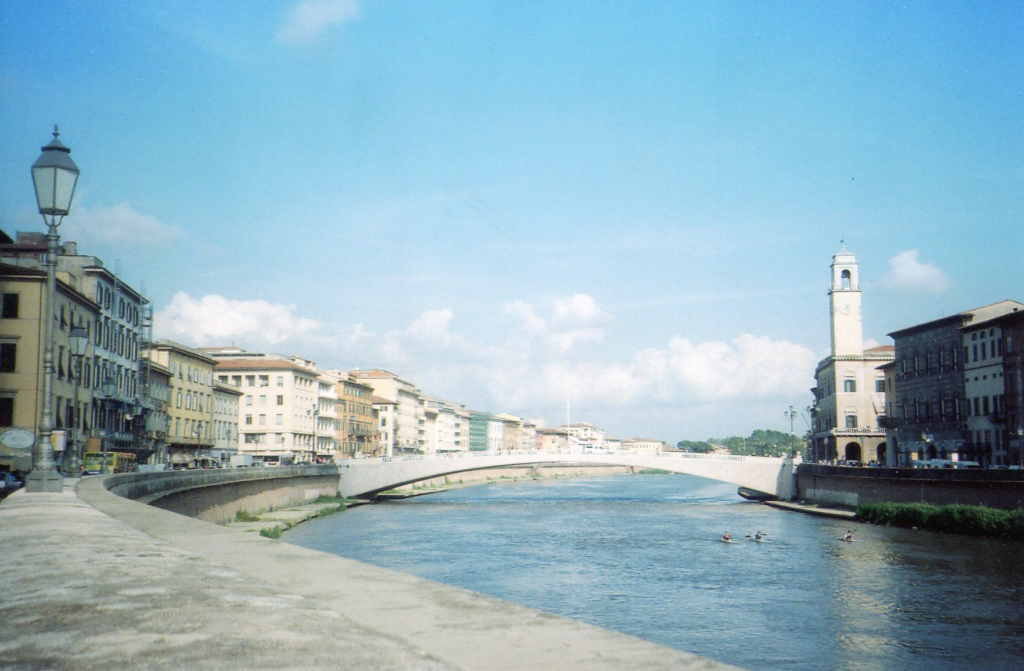
Pisa would rival Florence and Genoa for dominance of the Mediterranean. Florence ultimately won and took over Pisa in the early 15th century, but Pisa would first build many glories, including one of the great universities in the Middle Ages–it’s still going strong. Most buildings in the above shot next to the Arno River are from the 16th and 17th centuries, but-
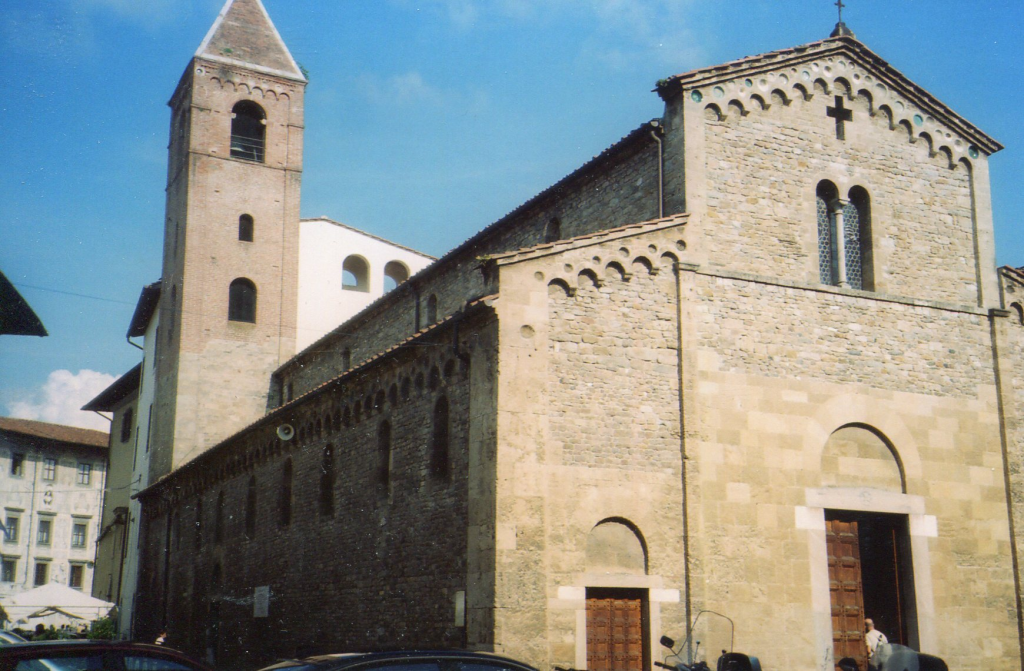
-this handsome Romanesque church in Pisa’s center is from the 11th century. The main section of town is well worth exploring, but Pisa’s greatest glories are in the Field of Miracles. Pisa’s cathedral was begun there in 1063 and enlarged in the early 12th. Its people were thankful for their 1064 naval victory and their growing wealth, and they spared no expense to glorify Jesus and the Virgin.
They could afford it, since trade grew rapidly and the city became increasingly autonomous. in the late 11th century, King Henry IV renounced jurisdiction within the city and promised to name no new marquis in Tuscany without Pisans’ consent. By 1085, the city had its own counsels, and there was a small inner counsel by 1164. This structure of great and “secret” counsel became common in northern Italian cities. By 1162 the hearth tax was replaced by the more sophisticated property tax; this happened in other Italian cities in the late 11th century and in the next.
Life on Pisa’s streets was often raucous. Dyers were legally forbidden from hanging clothes so low that a horse rider could hit his head on them. In the 1160s, the traveler Benjamin of Tuleda wrote that the city had about 10,000 houses with a tower from which families battled each other. The number is surely an exaggeration, but even by 1100 there were so many of them that there was an attempt to fix a maximum height to control the fighting.
But the cathedral rose above the turbulent crowds. Citizens spared no expense to glorify Jesus and Mary. And they beautified their house with handsome Romanesque columns and arches. Westerners had seen lines and arches as models of divine truth and order since ancient Greece, and ancient Rome was one of Pisa’s main inspirations. The sculptor Nicola Pisano carved Christ’s Passion on the pulpit of Pisa’s baptistery around 1260. His figures are massive and stocky rather than enshrouded in long Gothic robes, and they take up most of the framework. Their stateliness makes them resemble images of ancient Roman senators. Ancient sarcophagi with classical friezes were heaped around the cathedral, which stood in front of the baptistery. Architects had used ancient Roman arches and columns on both buildings. Pisa looked back to Rome’s glory for her identity as her wealth increased and her citizens grew conscious of being independent urbanites.
Jerusalem’s Dome of the Rock was the other model, which was also designed in terms of lines and arches. These static geometric forms on Pisa’s cathedral thus signified both earthly dominion and divine order. But as the above shot shows, Pisans made these stately forms thinner and more elegant as they rose. Florentines designed their most prestigious buildings with harmonic geometries, including Santa Maria Novella (below). Static shapes balance each other in linear arrangements.
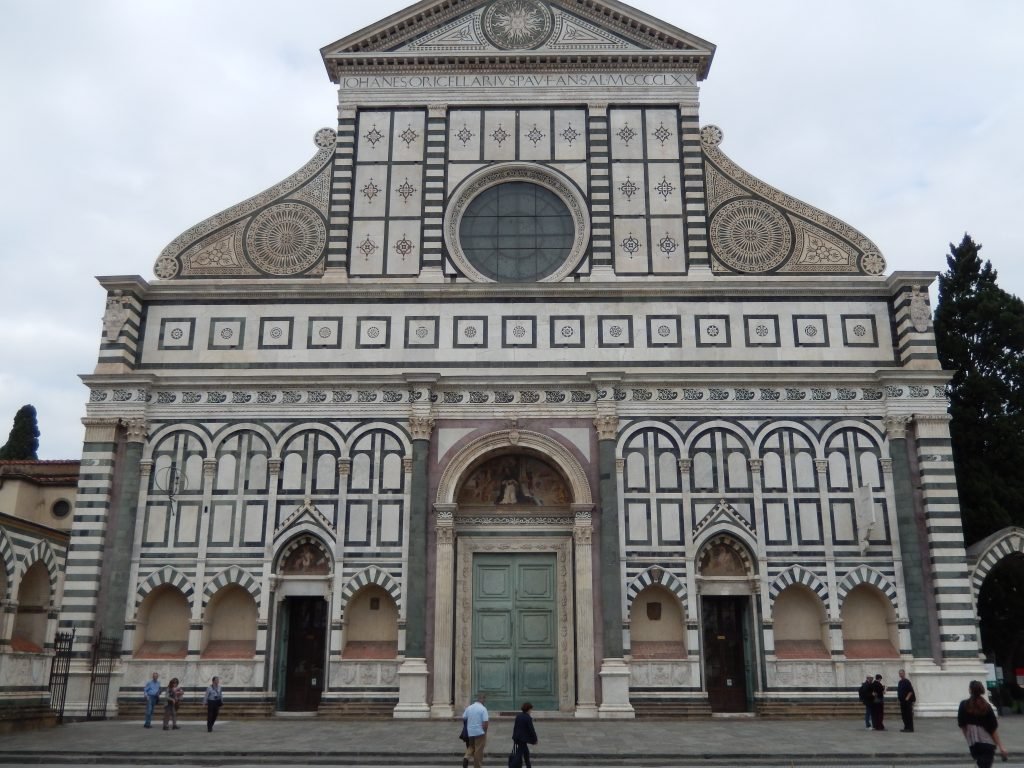
But Pisans built several levels of continuous rows of narrow arches that are so gossamer that the stone seems to dissolve into the heavens.
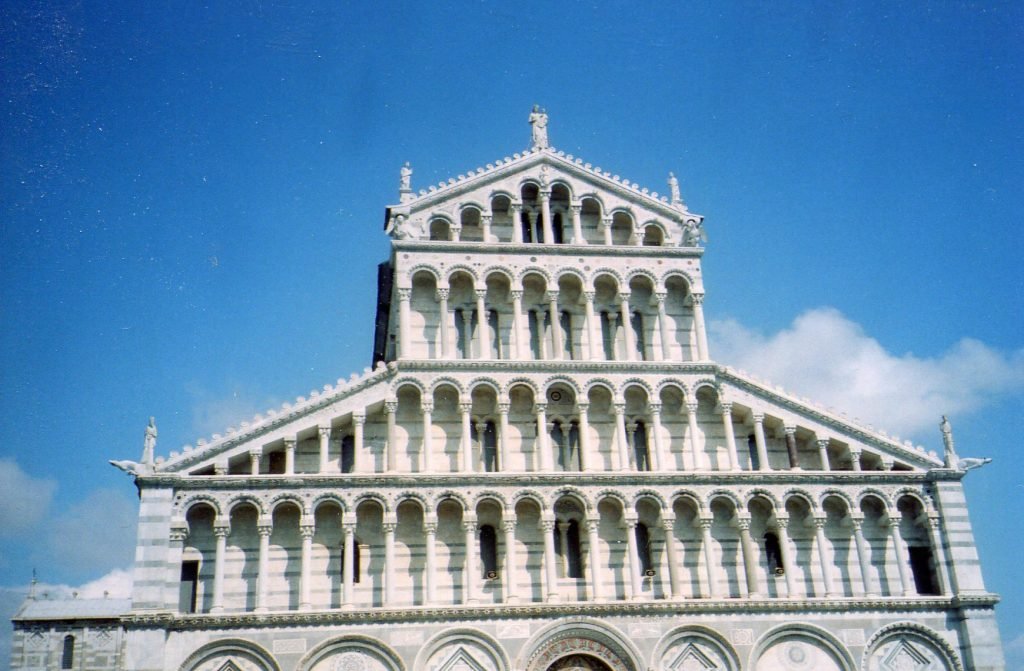
The apex of their cathedral’s roof is crowned with a statue of the Virgin holding the Child. Geometry thus leads to the two who set Pisa on her path to wealth. Italian architects and artists used abstract lines and arches to express enduring truth throughout the Middle Ages and Renaissance. But if you spend enough time at Pisa’s cathedral, you might conclude that nobody ever did it better.
Cologne’s Great St. Martin is another fine Romanesque church from that also uses lines and arches to make visitors feel close to divinity. Gothic cathedrals in France also used lines in spiritual ways.
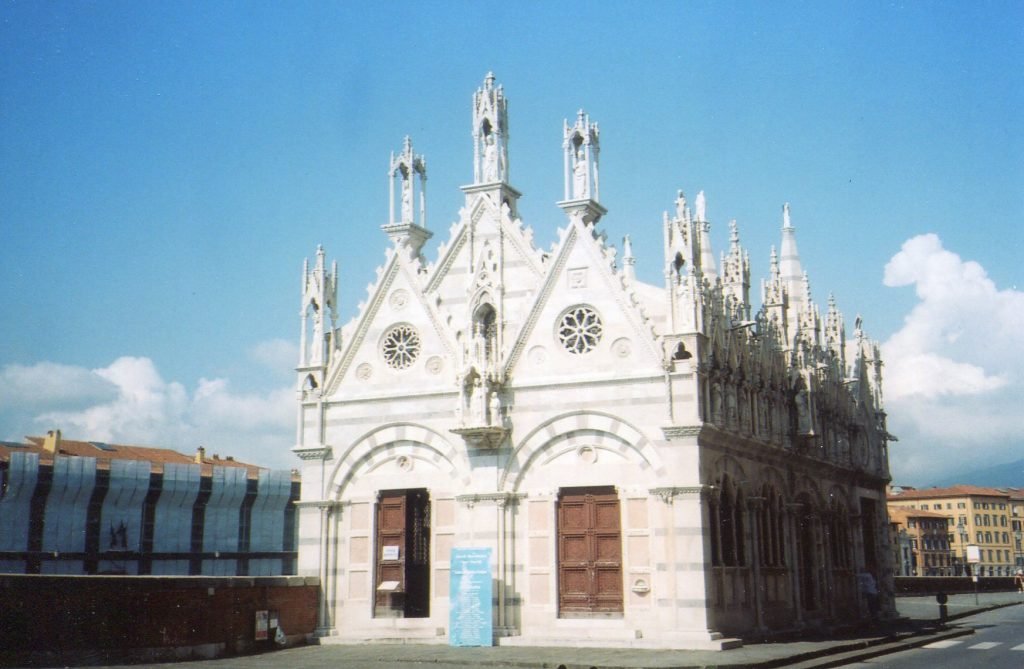
In the 13th and 14th centuries, Pisans built late Gothic-style church of Santa Maria della Spina next to the Arno River. It began life as an oratory and was transformed into a church to house a thorn from Jesus’ crown. Graceful lines make the biblical figures below seem to reside in the heavens, and they’re almost close enough for pedestrians to touch.

Other cultures did different things with geometry at the same time, including Indian, Islamic, and Khmer. Basic geometrical ideas actually aren’t so basic. Geometrical concepts that are considered most meaningful converge experiences that people have shared over many generations. Comparing cultures around the world can make us all feel that we’re in an earthly paradise.