
I once drove a friend from Bengaluru (then called Bangalore) and his mother up to San Francisco to sightsee. As a conservative elderly Hindu, she firmly covered her mouth and nose with her scarf as we walked through Fisherman’s Wharf to avoid inhaling molecules from the crabs and fish being cooked on the sidewalk. We then stood at the edge of the bay and gazed over the water. Since boyhood, I’ve identified with the ships in San Francisco Bay and admired the hardiness of the people who sailed across an ocean or around South America in the mid-19th century to prosper in the bustling new city. The image of a ship on the water has long resonated with me as a model of the self, as it did for many ancient Greeks.

But she had a different view of reality. I never mentioned the ship metaphor, but she suddenly said, “We all came from the ocean, and we will all merge back into it.”
The Upanishads had already expressed this idea, and Indian politics reinforced it while Romans strengthened Greek assumptions about the world as more centered on politics in the here and now. Indian politics resembled an ocean by being vast, relatively fluid, distributed in many places, and less concentrated in one city. Most of India was unified in the third century BCE by three successive kings, Chandragupta, Bindusara, and Ashoka. The last spread Buddhism throughout the land after many years of warfare. He lamented the suffering from his early reign’s combats and decided to establish compassion as a governmental standard. He is still highly honored in India, but his successors were much weaker. A minister called Pushyamitra killed the last king of the empire that Ashoka built, founded the Shunga state, and restored Vedic religions’ prestige. About 110 years later, the minister Vasudeva overthrew the king, set up the Kanva state, and moved the political center to the northwest (Ashoka had ruled his empire from a city in the eastern Ganges region, called Pataliputra, which was one of the world’s largest cities in ancient times). Invaders then swooped down from Afghanistan and assumed sovereignty, and Indians were too politically fragmented to form a united front. But this turned into a cultural strength that reinforced the sense of a vast metaphysically oriented universe. A comparison with Rome shows why.
Rome unified itself with a monumental political center. Its grand urban architecture and secular literature became centers of meaning that Westerners structured many of their experiences around. Large cities did grow in India in the late first millennium BCE and early first millennium CE, especially Pataliputra. Jatakas (stories of previous lives of the Buddha, which were mainly written from the third century BCE through the fourth century CE) mentioned goods that certain cities were famous for. Silk, fine muslin, and sandalwood came from Varanasi; Gandhara was famous for red blankets; and Kashi and Madurai were honored for fine cotton textiles (Madurai is shown below; it’s still known for textiles and gold jewelry).

According to the historian Upinder Singh, the number of trade guilds increased during this period, and Jatakas mentioned 18 of them. But Indian cities didn’t have Rome’s many monumental venues in which all citizens could share ideas and discuss politics. The Arthashastra described the ideal city, which had separate sections for each caste and no grand forum, theater, gymnasium, academy, or bathhouse where all residents could come together.
The Maduraikkanchi, a Tamil poem written by the fourth century CE, praises Madurai’s beauty and prosperity. But it mainly describes temples, religious rituals, markets, tall mansions, the king’s administration, and bustling streets with rivers of people speaking different languages. Public buildings from Greek and Roman cities, in which people in all classes could share ideas and decide on public policy, were lacking.
And no city dominated all of India. It was always a multitude of states, even when one held political authority over most of it. In addition, no empire controlled most of India for more than 250 years. Ancient India’s lack of one central metropolis with a network of civic institutions that remained dominant in people’s consciousness for a millennium helped enable much of its thought to remain in immense cosmic realms which weren’t as bound by the world’s observable limits. No ancient city remained central in Indian culture for as nearly as long as Rome and Athens did in the West. Meanings were more connected with vast universal domains and the caste system and less hemmed in by permanent cities.

As one invader after another was absorbed into the subcontinent, India synthesized more of its own traditions from them. Shakas (Scythians from Central Asia) conquered its north in 80 BCE and introduced forms of sun worship that had been practiced in their homeland. Then came the Parthians, and they too brought Persian influences. Both societies introduced the riding horse on a larger scale and improved the cavalries.
The Kushans added even more cultural variety in the next century. They were originally nomads from an area in China’s west who were driven westward and southward by nomadic societies called Xiongnu. Kushans then migrated into what is now Afghanistan, and in the early first century CE, consolidated all the neighboring societies into an empire. Their greatest king, Kanishka, extended their realm from Afghanistan to central India. It straddled several key trading routes and thus became a crossroads between India, China, and Central Asia. He honored Buddhist precepts and built a stupa near Purusapura (City of Great People, which is now Peshawar, Pakistan). It was about 300 feet in diameter and possibly much higher. At the same time, he patronized Greek and Roman religious customs, Persian Zoroastrianism, Vedic religions, Jainism, and Confucianism. Coins from his reign included images from all these traditions. India drank up all the cultural wealth like a thirsty elephant. Greek-style sculptures of the Buddha and bodhisattvas with powerful bare torsos and Western faces became the Gandhara style’s most famous art. This was one of the first schools of Buddhist sculpture.
The list of subsequent Indian kingdoms can seem as vast as its pantheon. Guptas, Satavahanas, Vakatakas, Chalukyas, Pallavas, Cholas, Pandyas, Cheras, Rashtrakutas, and Palas governed large swaths of land for a while. Each added more artistic styles to the sub-continent. At the same time, many smaller communities existed independently. A lot of ganas also existed, which were tribal formations led by elite families. They sometimes paid tribute to kingdoms when the power of the latter expanded, but were still mainly independent. India always comprised a multitude of politically diverse societies.

Because Indians lacked a single urban political center that integrated them for a prolonged period, they developed an idealized spiritual geography. A previous article here explored their concept of the cosmic mountain. They envisioned other places in idealized ways as well. Some cities on the Ganges, including Varanasi and Prayaga (where the Ganges and Yamuna rivers meet; the modern city is called Allahabad), were touted as gateways to liberation. By visiting one of them and piously conducting rituals, people could cleanse their souls of all past karma. Sacred sites like these, rather than political and cultural capitals like Athens and Rome, became pan-Indian icons, and they unified the sub-continent in a spiritual geography.
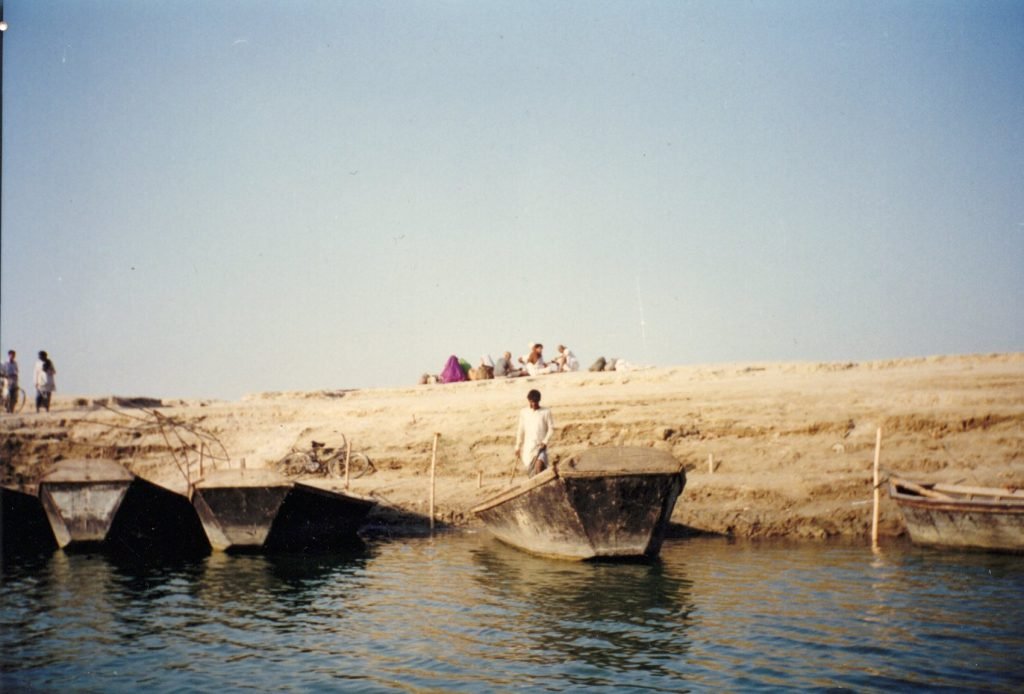
This geography still lived in many hearts and minds when I visited Krishna’s birthplace, Mathura. Two thousand years ago this was a prosperous commercial city and the southern capital of the Kushan Empire. Krishna became identified with Vishnu, who was a Vedic deity associated with the sun and its life-sustaining energy. The latter’s stature grew into the sustainer of the universe’s order, and people saw Krishna as one of his ten incarnations. The Yamuna River runs through Mathura, where flights of steps climb its banks. As in Varanasi, people bathe in it for the water’s blessings.
An enormous temple complex sprawls nearby, and it contains a room where Krishna is believed to have been born. When I entered, it was full of people sitting on the floor, singing devotional songs while clapping their hands. I continued farther into the complex and discovered a two-story hall with a shiny marble floor and two levels of serrated Moghul-style arches around its sides. Swaying multi-colored saris, garlands of flowers, aromatic incense, and offerings of sweets mixed into sensual feasts in the temple complex.
I found another site associated with Krishna strikingly different. Vrindavan is about ten miles away; a large corpus of literature emerged about his teenage exploits there. He and admiring female cowherds called gopis frolicked in the sparkling water. He played melodies on a flute and the girls danced, with their silky hair and tinkling jewelry dangling over their breasts. But what I saw dramatically contrasted with this enchanting image.
The town had several large temples and some rose in many tiers like giant wedding cakes, but some were surrounded by hawkers, muddy streets, and garbage which dogs and cows rummaged through. I entered one complex and it turned out to be a home for abandoned widows. The main hall was so crowded with residents that there was little room for anyone to sit down. None spoke or smiled, and some darted around like hungry animals. Mice shared the floor space with them.
I mentioned Vrindavan to an elderly man that I later met down in Bengaluru, and he said, “You went there? What did you think of it?” We had a lot of rapport so I felt that I could be frank. “I thought it was a dump.” He chuckled, “It destroyed my idealized impressions the first time I went there!”
Many Indians grew up with idealized images of a handsome young man with long flowing hair and a broad chest surrounded by beautiful women. All relax on a rolling green field strewn with shiny flowers. I’ve seen paintings of these charming scenes in several Indians’ homes. All images combined beautiful people and scenery; together they mixed spiritual love and sensuality. This mythical scene has been a more effective integrator of India’s geography than any city or building from ancient times (the Taj Mahal wasn’t built until the 17th century, and it didn’t become a pan-Indian image until the 19th).
Compared with most ancient Greek and Roman thinkers, ancient Indians imagined reality as a vast space-time field. This inspired them to treat narratives, music, and artistic images in a different way so that domains extend far beyond Mediterranean cities’ human scales. Indians’ assumptions have deep roots which go back to the Rigveda. In the next article we’ll how they shaped Buddhist and other philosophical ideas.