A recent article here explored Hatshepsut’s temple in the Thebes area. But the grandest New Kingdom temple was Amun’s at Thebes, which modern Luxor surrounds. It’s across the Nile from Hatshepsut’s shrine. Amun was a locally popular god associated with the sun and fertility, so Thebans had built a shrine for him during the Middle Kingdom. Ahmose I, who co-founded the first of the New Kingdom’s dynasties, the Eighteenth, was from Thebes. Amun was now fused with the sun god Ra into the national cult, and Ahmose I’s successor, Amenhotep I, moved Egypt’s ritual center south from Memphis to Thebes. The center of town was leveled, and the old temple for Amun was replaced by one of the most majestic buildings ever built. Nearly every monarch over the next 200 years added to it until it occupied an area of roughly 400 by 500 yards. It also controlled vast agricultural lands and was administered by a huge bureaucracy of priests and other officials. The photo below is from the first court that visitors enter. The three-chapel shrine on the right was built by the Nineteenth Dynasty king Seti II.
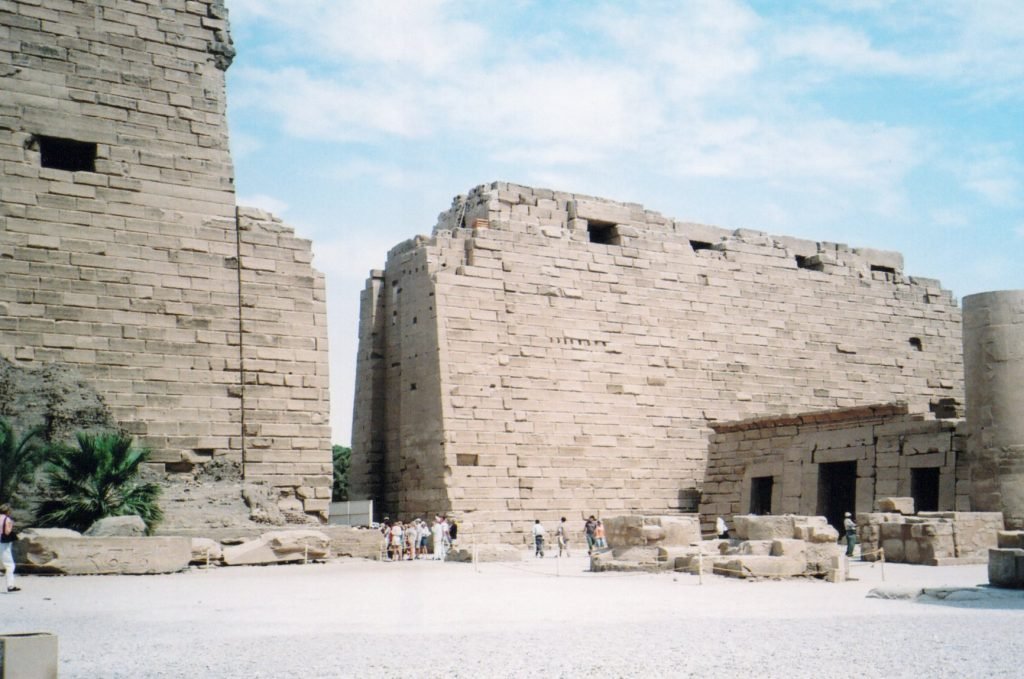
The temple grew on the site of the Middle Kingdom’s shrine, beginning as buildings around a courtyard. On the courtyard’s opposite side from the Nile, Hatshepsut’s successor, Thutmose III, built a large rectangular hall with four rows of massive inner columns, where festivals were conducted to glorify him. On the other side (towards the Nile and the temple’s main entrance), a succession of monarchs built enormous pylons that spanned the courtyard’s entire width (the above photo shows the latest pylon). One of the most splendid rooms ever created spreads between the second and third pylons, the Hypostyle Hall.
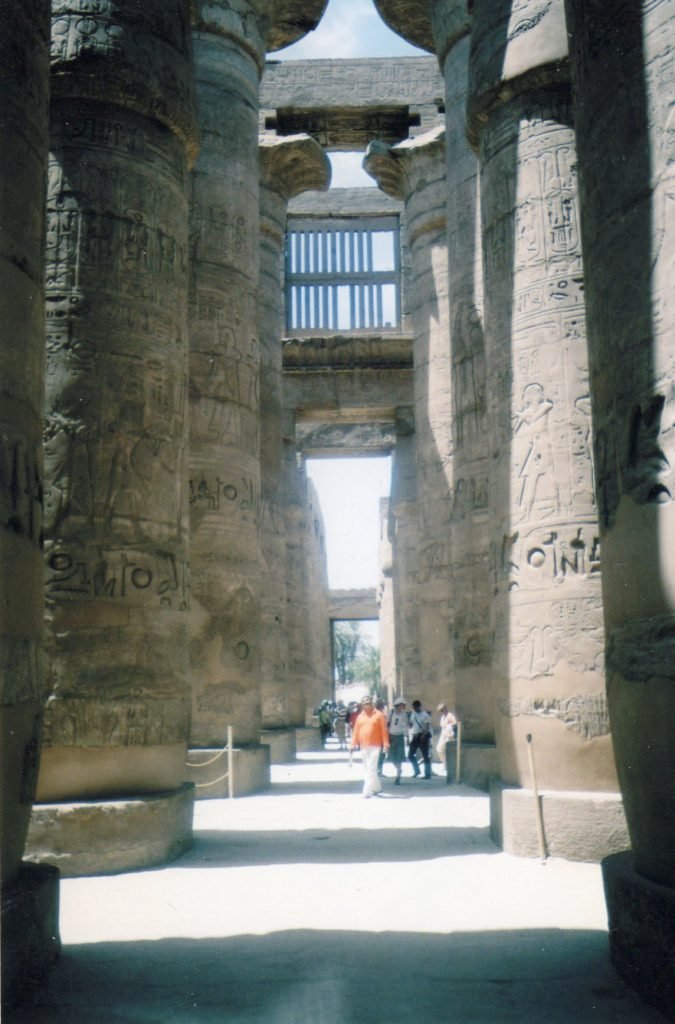
In this room 134 huge stone columns supported roofs. The central 12 are about 70 feet high, and the others rise to about 45 feet. The middle roof’s area was higher, with a clerestory with open vertical slats that allowed the sun’s light to shine into the room and bathe the whole area in a soft golden glow (you can see the slats in the above photo–I’m looking from one of the sides, at a 90-degree angle from the axis from the temple’s entrance to its center). The columns are in the form of papyrus stalks, which symbolized the marshland that supposedly grew from the initial mound of earth that emerged from the primeval waters.
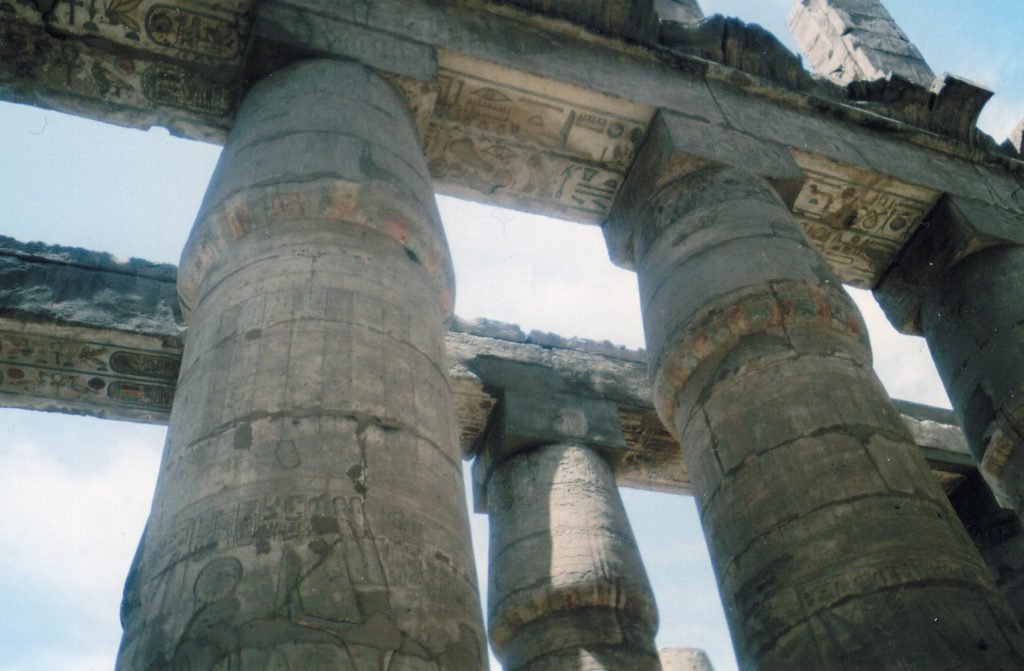
The pillars and surrounding walls were covered with carved scenes; several still show a king worshipping Amun as the latter empowers him (the respectful king kneels before Amun in the below shot). In these and many other images, two figures face each other with all the strength and confidence that Michelangelo’s God and Adam project in the middle of the Sistine Chapel’s ceiling.
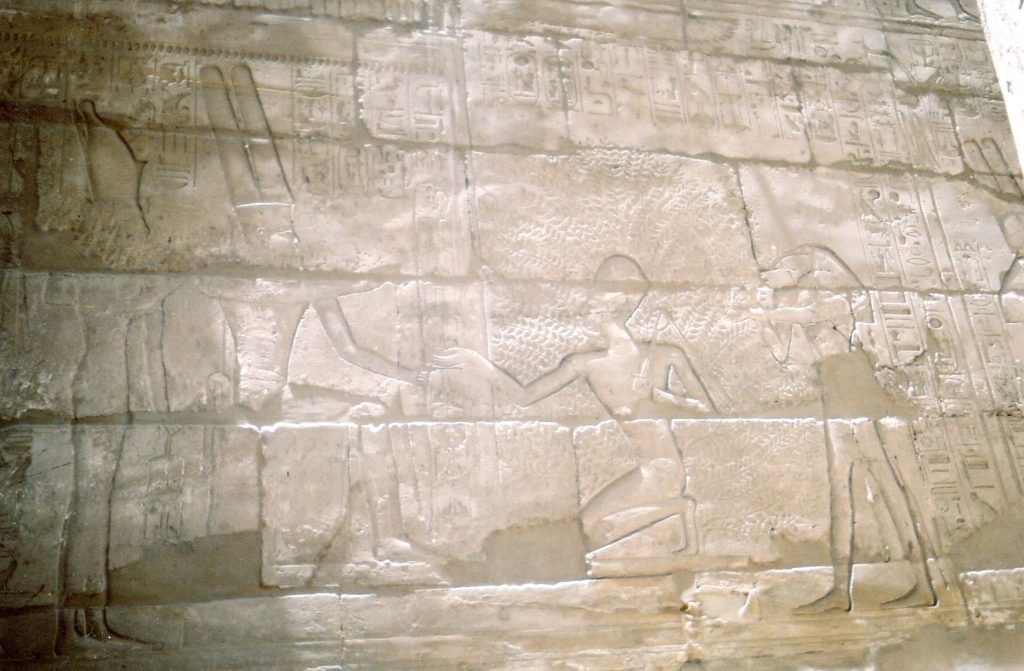
The king sometimes extends a bouquet of flowers to Amun, and the great god reaches towards the ruler to bless him. Below, Osiris (on the right) gracefully ushers the king towards the great god.
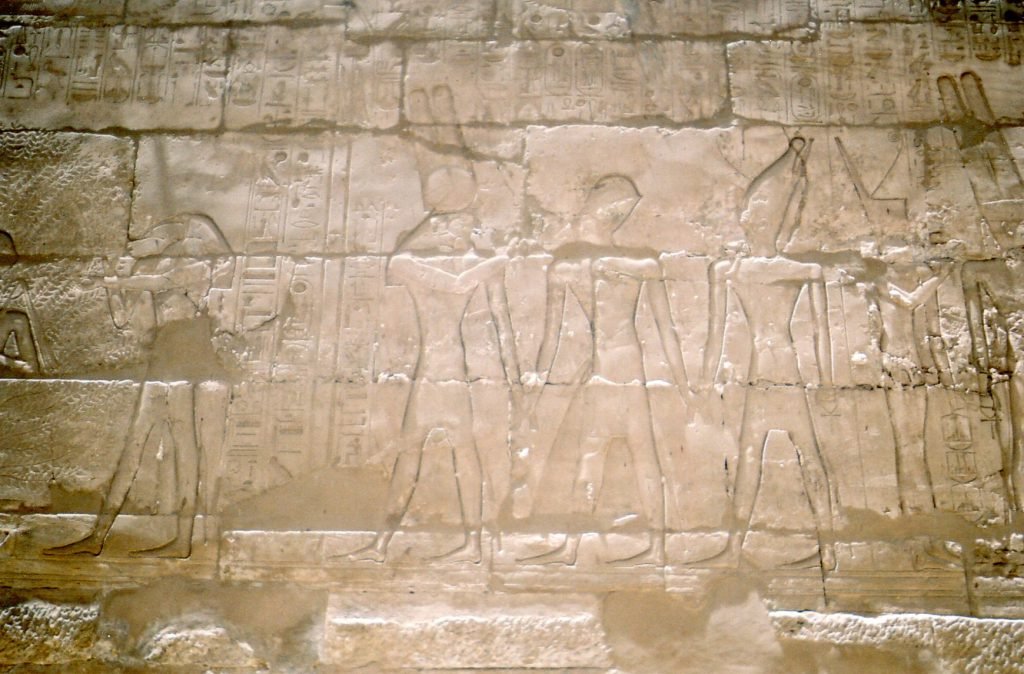
I ambled around each pillar and outer wall, captivated by the carvings’ combinations of symmetry, dignity, and etiquette. The scenes projected both power and grace which made the primeval marshland seem strong enough to bolster the whole state and benevolent enough to provide for all of its people. Nature and culture impeccably combined into a field that could ensure the kingdom’s well-being.
The symmetry helped enable magical potency to promote this statewide wellness. Temple artists learned a series of proportions and interrelations to produce scenes and hieroglyphs that represented a world that was idealized and eternal. According to Stephen Quirke, in The Cult of Ra; Sun-Worship in Ancient Egypt, a correctly proportioned image that was ritually created became a permanence (mnw, from the word mn, which meant to remain or endure). Jan Assmann also noted that permanence was a central concept for ancient Egyptians, and that djet also had this meaning. Its hieroglyph was one of the most common on temple and tomb walls.
A person’s name (ren) was supposed to endure in the afterlife. A lot of ancient Egyptian names had a direct relationship with the person’s well-being. Many express the protection or favor of a god or goddess. Amenhotep meant Amun is Content. Survival after death was linked to remembrance of the name, so it was necessary for it to be pronounced in rituals to provide nourishment for the dead.
The images and names that surrounded me in the Hypostyle Hall were probably fashioned to maintain Ma’at (the cosmic order) so the kingdom could permanently thrive. People likely believed that their proportions strengthened the world’s order through sympathetic magic.
Once a year, priests carried statues of Amun, his consort Mut, and their son Khonsu in portable ships through the pylons to the Nile, ferried them across, and transported them to the site of Hatshepsut’s and Mentuhotep II’s temples. They carried the holy family up Hatshepsut’s temple’s wide causeway and into its upper courtyard, where a shrine for Amun presided in the center of the back of the courtyard, which was dug into the massive cliff. The procession was called the Beautiful Festival of the Valley. The portable ships rested overnight at the reigning monarch’s temple and then continued to all the main royal funerary shrines. People with family tombs in the area spent the night with their ancestors, and the statues were carried back to Amun’s temple the next day.
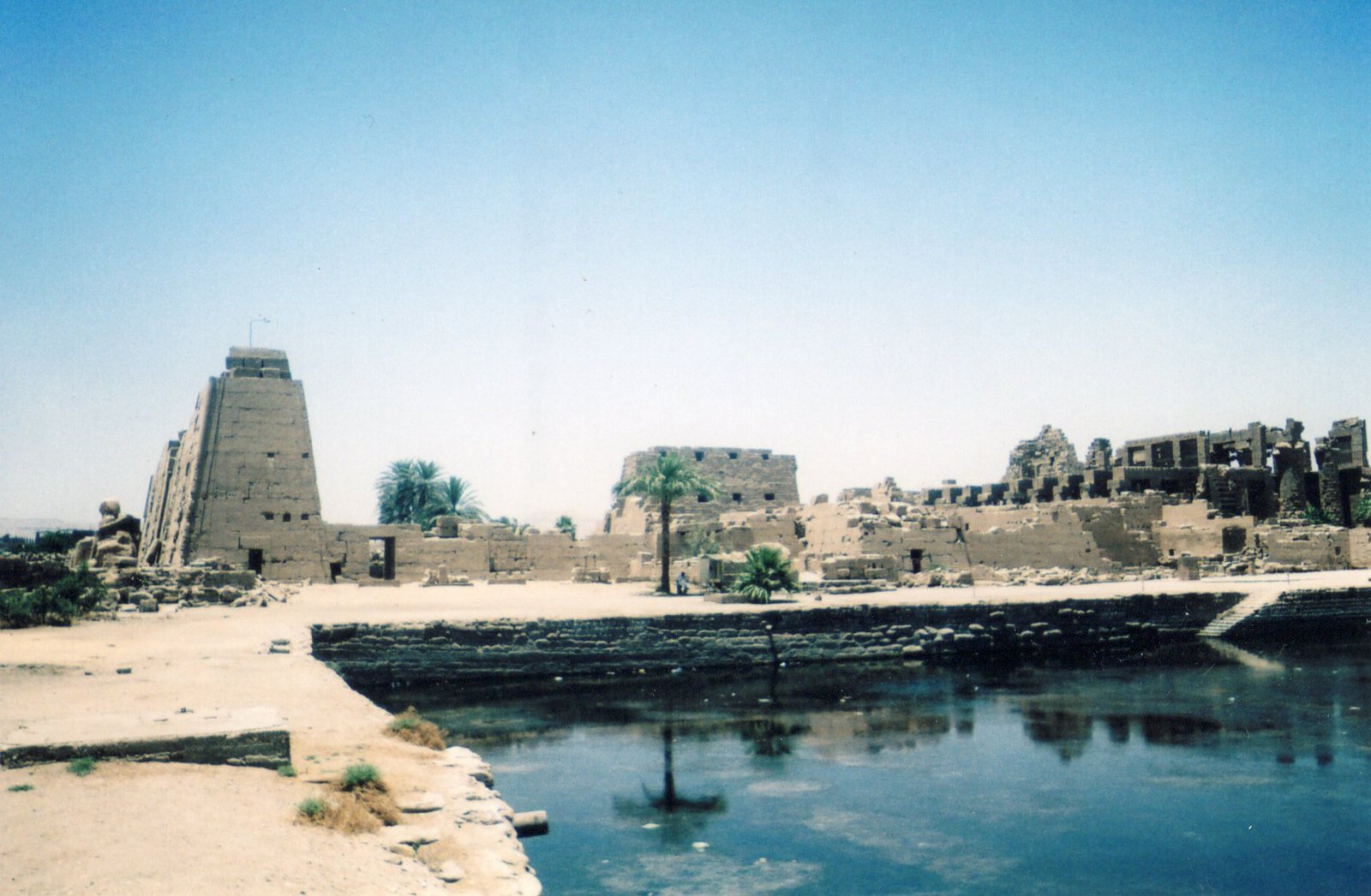
Another series of pylons projected from the center of Amun’s temple; they led southwards to Mut’s temple, which was about a third of a mile away (the first photo here looks from the south, past the symbolic waters that the cosmos emerged from, towards Amun’s temple). Rest houses for the portable ships were built along the way, either to increase the drama of the rituals or give porters a break during what was arguably Thebes’ most magnificent festival, the Opet.
This celebration took place in the second month of the Nile’s inundation, five months after the Beautiful Festival of the Valley. It lasted for 11 days in the middle of the Eighteenth Dynasty and was extended to 27 by the end of Rameses III’s reign in the Twentieth Dynasty. Priests transported Amun’s statues from his temple to Luxor (a little over a mile south–shown below) and back.
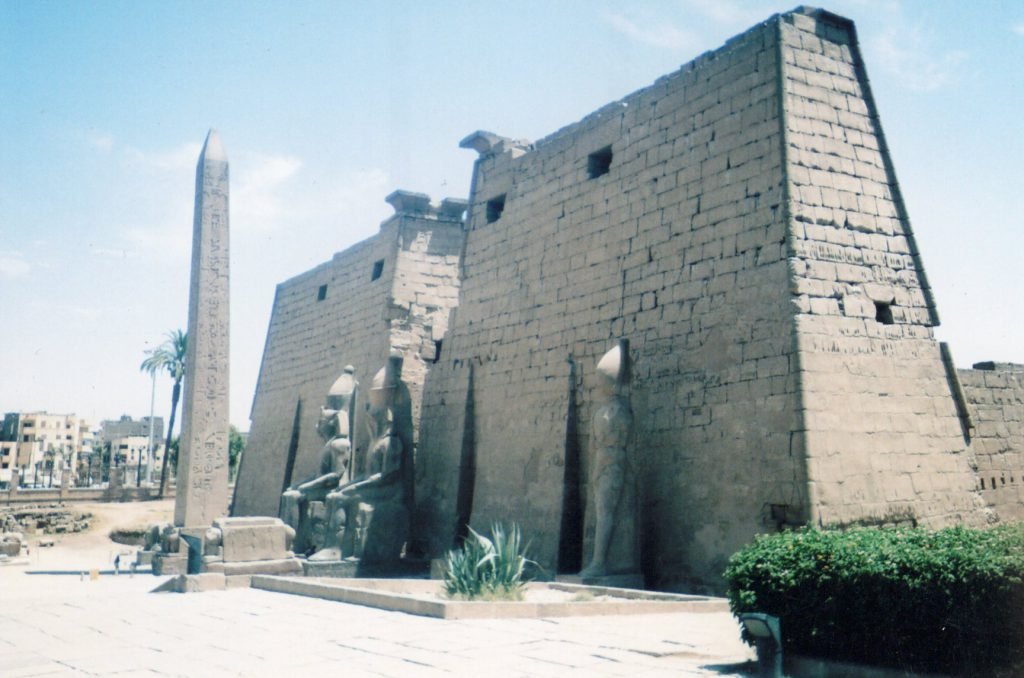
During Hatshepsut’s reign, they were paraded on barques which priests carried on their shoulders and transported over a causeway which locals could line. The gods were then shipped on barges back to Amun’s temple. By the end of the Eighteenth Dynasty, both journeys were by river.
The king joined the statues at Luxor Temple, where he accompanied priests into chambers in the back. In the incense-heavy atmosphere, he and Amun met. The god was believed to have impregnated his mother; a text that celebrated the act joyfully sang about the entire royal palace shining with Amun’s life force. Now at Luxor, the king’s power was renewed, and he received several crowns as he kneeled. He then reappeared in the courtyard in front of the temple’s back rooms, where priests and courtiers praised his rejuvenation.
The most powerful monarchs after Hatshepsut built mortuary temples on the western side of the Nile, and they formed a processional path that ran south from her shrine. Much of the granary in Rameses II’s is still preserved. More than 50 narrow rooms over 100 feet long held enough grain to feed thousands of people. Barry J. Kemp, in Ancient Egypt; Anatomy of a Civilization, noted that the temple held much more than its residents needed. He saw the granary as a central place in an economy in which food might have been distributed from the king to the local population in that age before money was invented.
Rameses II has often been seen as an egotist who erected statues of himself over 60 feet high, added constructions to his predecessors’ temples, and lionized himself for building them. I felt his power just as much while walking under his temple’s granary’s arches. The long lines of rooms that seemed to extend forever made it seem that all the vaults together stretched across the whole sky. From there, the bounty of the king and his empire could be given to his people. In contrast with Vedic India, sacred places in Egypt were made as magnificent as possible and glorified with monuments that are still some of the world’s most awe-inspiring buildings.
Artists during the New Kingdom extended the subjects of painting from gods, kings, and other elites to more diverse people as more individuals now constructed their own tombs and had pictures created on the walls. They showed how they hoped to live in eternity.
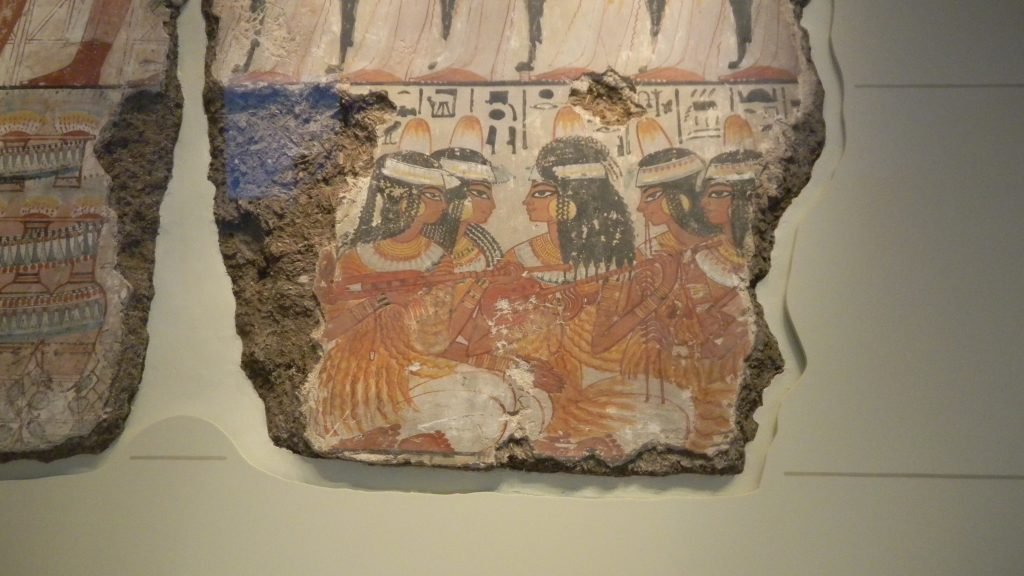
Banquets with flutists and harpists, dancing girls kicking their legs above their heads, and guests with wax cones on their heads would hopefully be enjoyed forever (the cones were covered with incense; in the sultry climate the wax melted over their hair and bodies to leave them sweet-smelling and sticky). Other scenes show men hunting birds in thick marshes, with their wives and children clutching their waists and legs. Others portray abundant orchards and gardens.
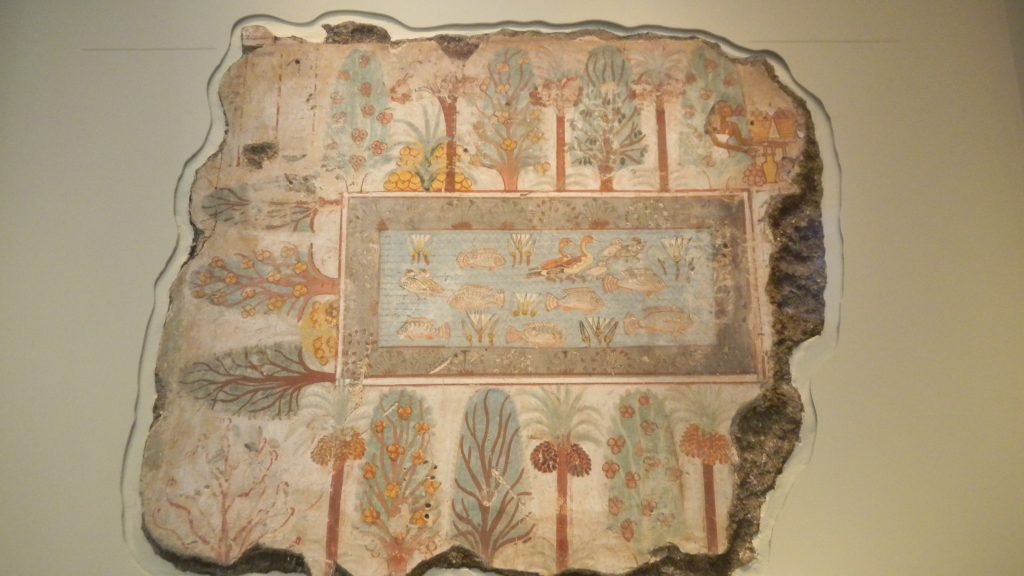
Not all scenes are this idealized. A man who is delinquent in paying taxes lies on his stomach as another whips him, and two girls in a fight yank each other’s hair. But all scenes show people fully immersed in the bounty that the Nile, the king, and Ma’at bestowed. Upper-class people in the Luxor area during the New Kingdom could be forgiven for thinking that they were in the most blessed and beautiful place in world history and for wanting to savor its lavishness forever.
At the same time, China’s Shang Dynasty also created an ideology of the king and a state ritual center as the link between humanity and the cosmos, but with a different network of ideas. You can explore ancient Egypt’s unique range of ideas more deeply here. The article on Vedic India will take you into another unique society. All thrived around 1200 BCE, and each was a very creative convergence of ideas and experiences. All still have a lot of influence on cultures around the world.