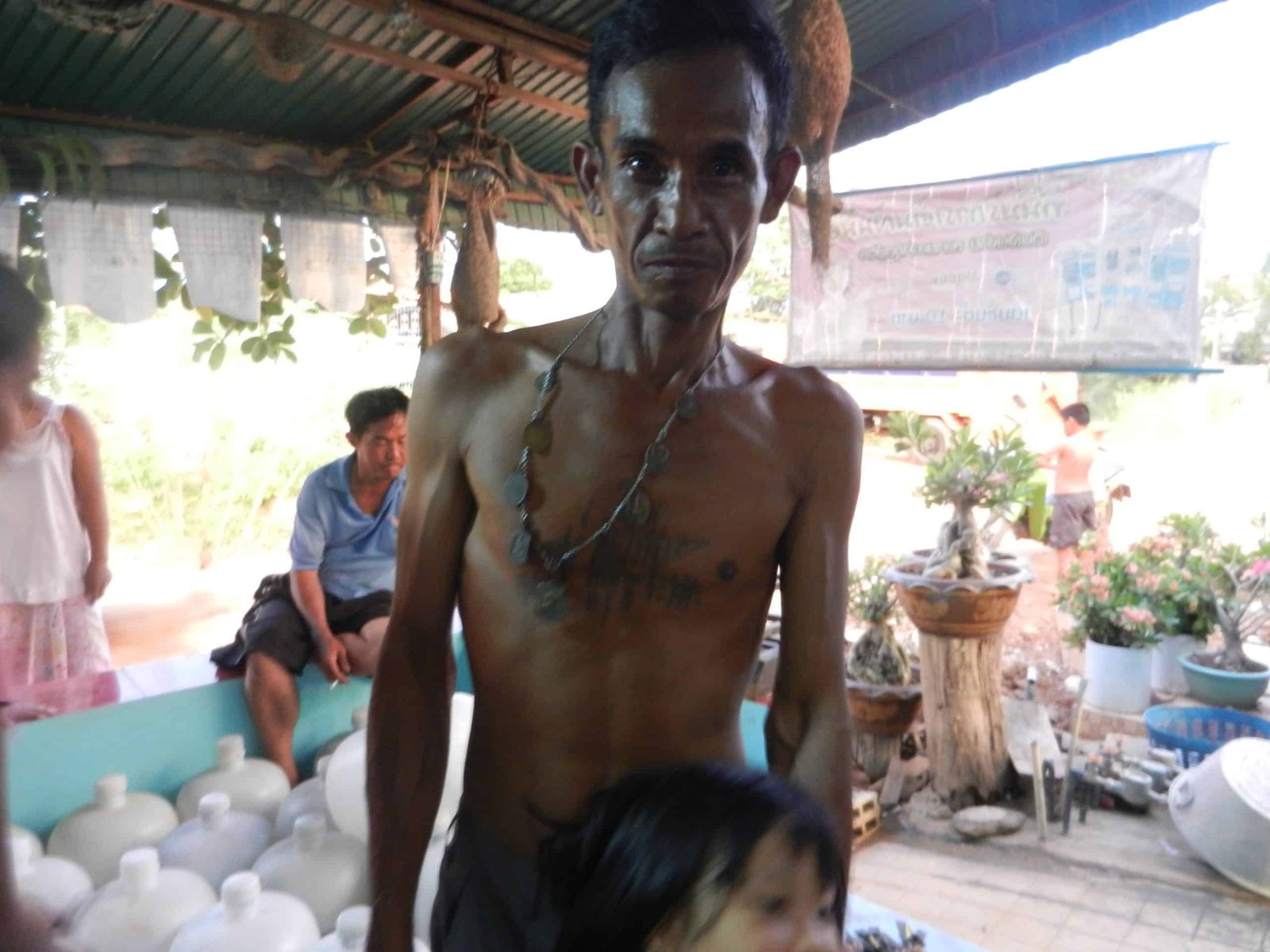
I just wrote several articles about Sukhothai art, and I hope you get addicted to it. But it also has a dark side.
This man in the countryside around Sukhothai follows an ancient Thai tradition of wearing tattoos and amulets to protect himself from harm. Why would someone be so nervous in surroundings that I found so charming?
It has been common in traditional Thailand to classify reality in terms of a safe inner circle which people have associated with the village, Mother, the Buddhist temple, and rice fields. This has often been called muang, and Sukhothai’s Wat Mahathat presides in the middle of it. It’s the center of benevolent energies, and it radiates them throughout the community.

But dangerous forests and mountains encircle this civilized space. Some Thais call this zone pa thu’an. It’s full of untamed energies, hungry spirits, and ravenous wild animals. Harmful influences from this outside region can suddenly emerge within the muang and create havoc. This is still a reality. The Sukhothai area buzzed with mosquitos when I explored it. I faithfully put lotions with more than 30% DEET on all exposed skin, and I still got bitten lots of times. I met three women from Germany and England at Wat Mahathat. Having never heard of DEET, they had so many bites that large areas of their arms and legs were solid red. Illnesses often came suddenly in ancient Sukhothai.
Sukhothai’s founders had this safe inside-dangerous outside concept of reality well in mind. A stele that its first great king, Ramkhamhaeng, supposedly set up states that his Buddhist merit helped to keep the land safe. But Sukhothai’s people also honored a local mountain spirit called Phra Khaphung. He was the most powerful soul in the pa thu’an zone, and the king had to give him offerings to ensure his protection.
I rhapsodized about the eastern and southern areas of Sukhothai in the last article, but the above photo looks to the west, which is edged with mountains and thus full of danger. Sukhothai’s kings tried to neutralize the hazards by creating yet more beautiful art.

Wat Saphan Hin (above and below) is one of my favorite wats around Sukhothai.

You reach it by climbing an ancient pathway of large stones. You rise about 200 feet, the steps are unevenly settled, and many are broken now. You thus have to watch your step, but the stones’ weathered states give the approach a romantic air.
At the top is a Buddha statue from the late 13th or early 14th century which is about 40 feet tall. He has a long oval face and a gentle smile. The great teacher holds the palm of his long right hand forward in a position that means “Don’t fear.”
Pillars of the ruined assembly hall surround the statue. This was a great setting for delightful processions, and old Sukhothai conducted many.
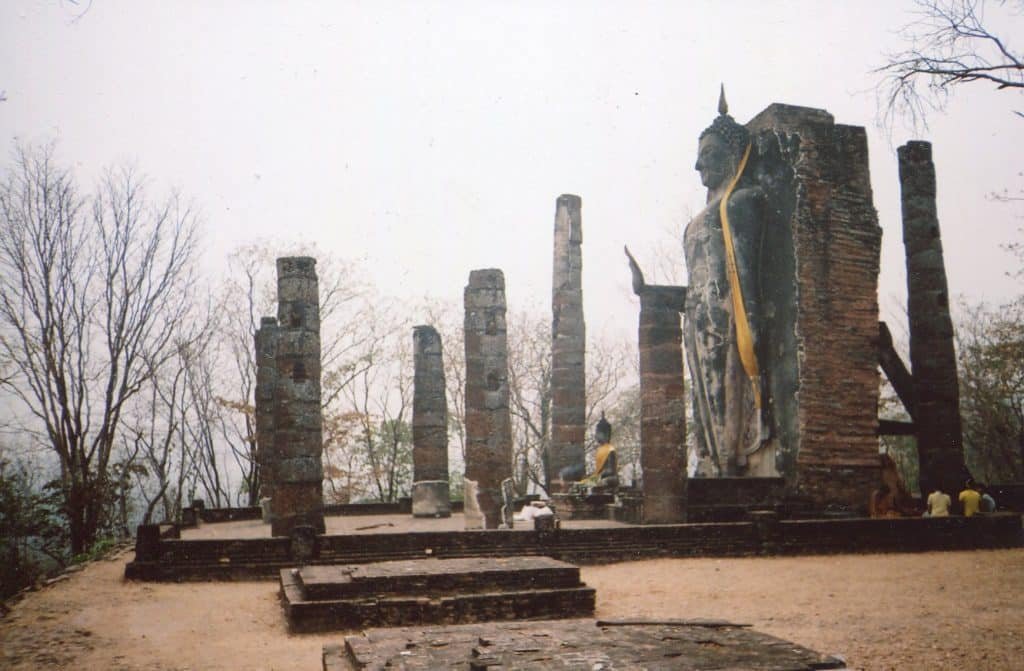
An inscription states that Sukhothai’s founder, King Ramkhamhaeng, rode up there on a white elephant’s back during a full moon. When I was there, two women were quietly kneeling in front of the statue. Seven hundred years apart, both ascents up the hill represented continuity of a tradition that mixes beauty and piety. The two women lacked their predecessor’s mount, but not his grace.
Kings built several other wats in the western hills.
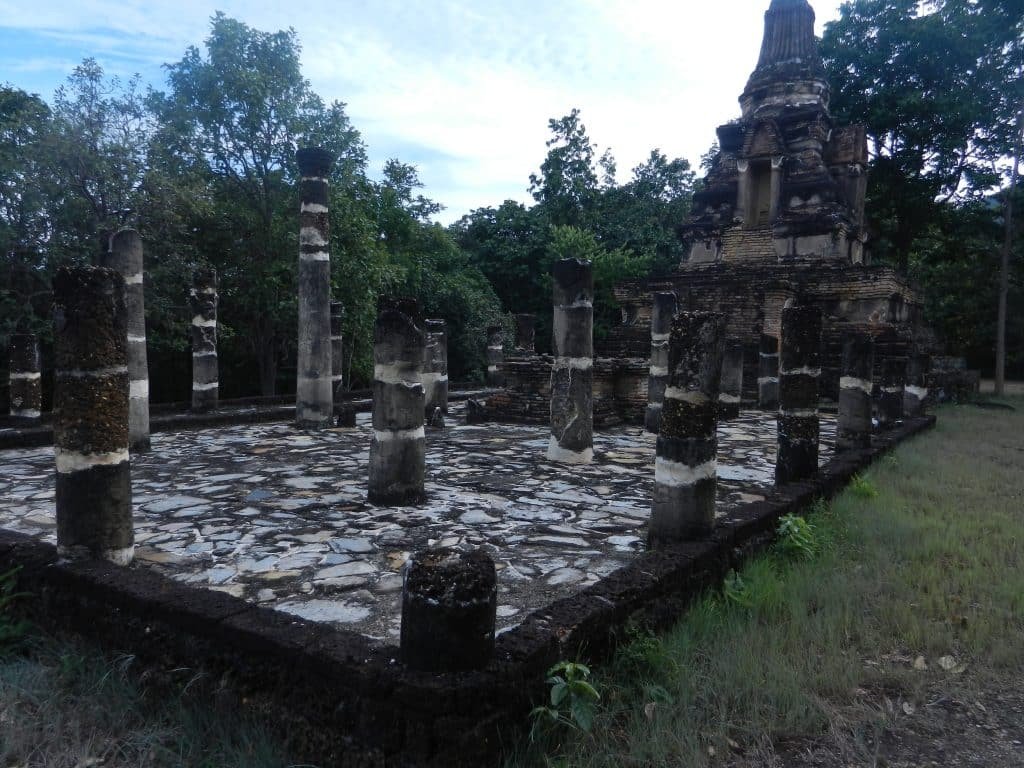
The above shot is of Wat Khao Phra Bat Noi (temple of the hill of the lesser Buddha footprint). It’s also about 200 feet above the plains, and it is a little south of Wat Saphan Hin. The ruins of an intimate assembly hall front an elegant stupa.
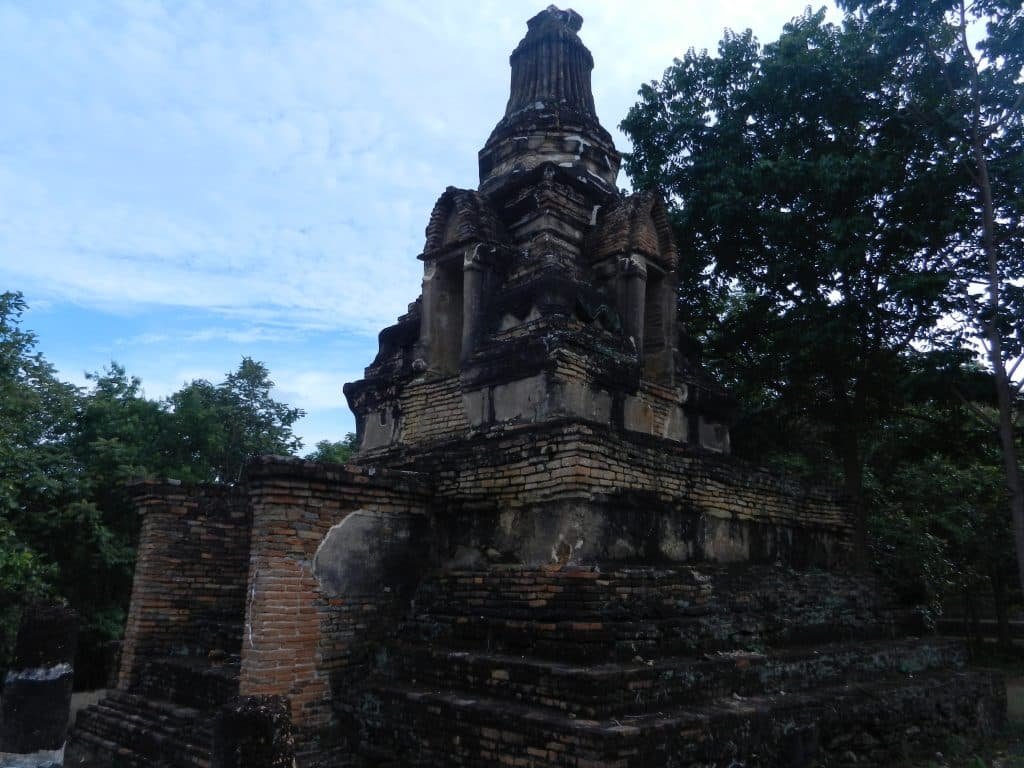
The niche on each side of the stupa once housed a Buddha statue, and the assembly hall sheltered Buddha footprints. A lot of Thai wats have Buddha footprints; he supposedly visited the place and sanctified it.

The top of the stupa has a pleated design that was popular in the Ayutthaya Kingdom in the south, so it might have been built after Ayutthaya made Sukhothai a protectorate in the 14th century.
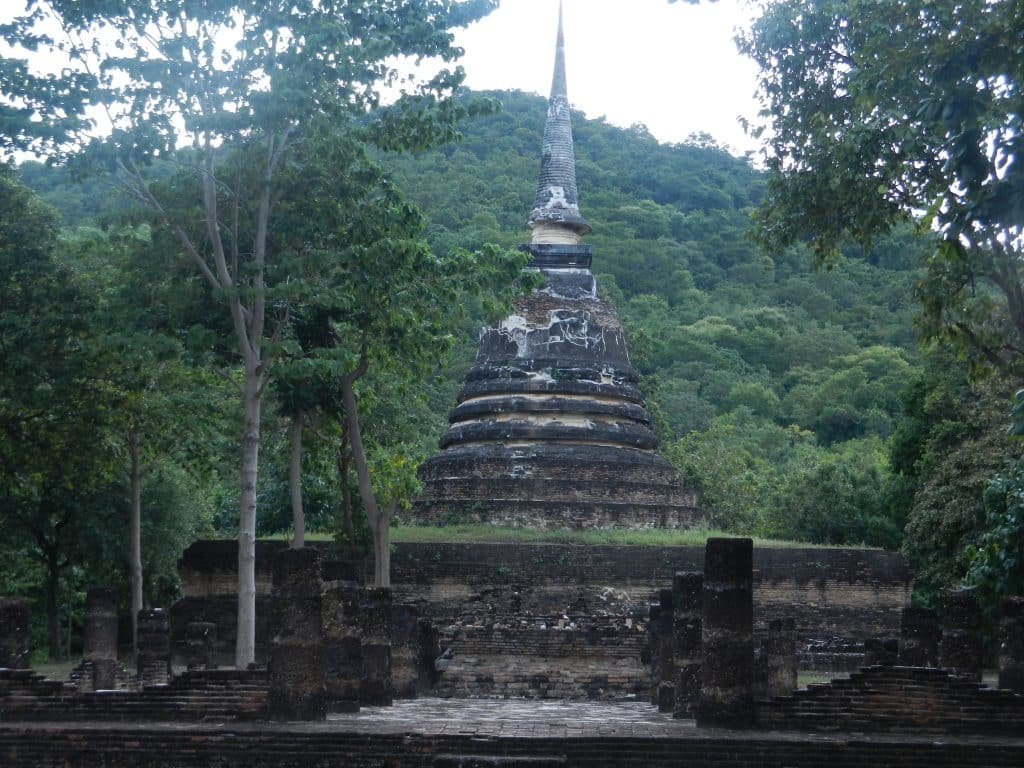
A little farther south, Wat Chedi Ngam (above) greeted me when I climbed another footpath. The graceful form of its stupa seems to soften the hill’s powers.

Wat Hip Bon (above) is on the hill a little south of Wat Chedi Ngam, and it also has a small assembly hall in front of a flowing stupa.
So elegant little wats bejewel Sukhothai’s western hillsides, and they fill this potentially dangerous area with yet more enchanting art.

This man chilling at the bottom of Saphan Hin is much more relaxed than the guy with the tattoos. It’s hard not to lighten up when you spend time around Thai temples.