
Sukhothai’s graceful architecture spreads from its central ritual center and ripples through the surrounding area.
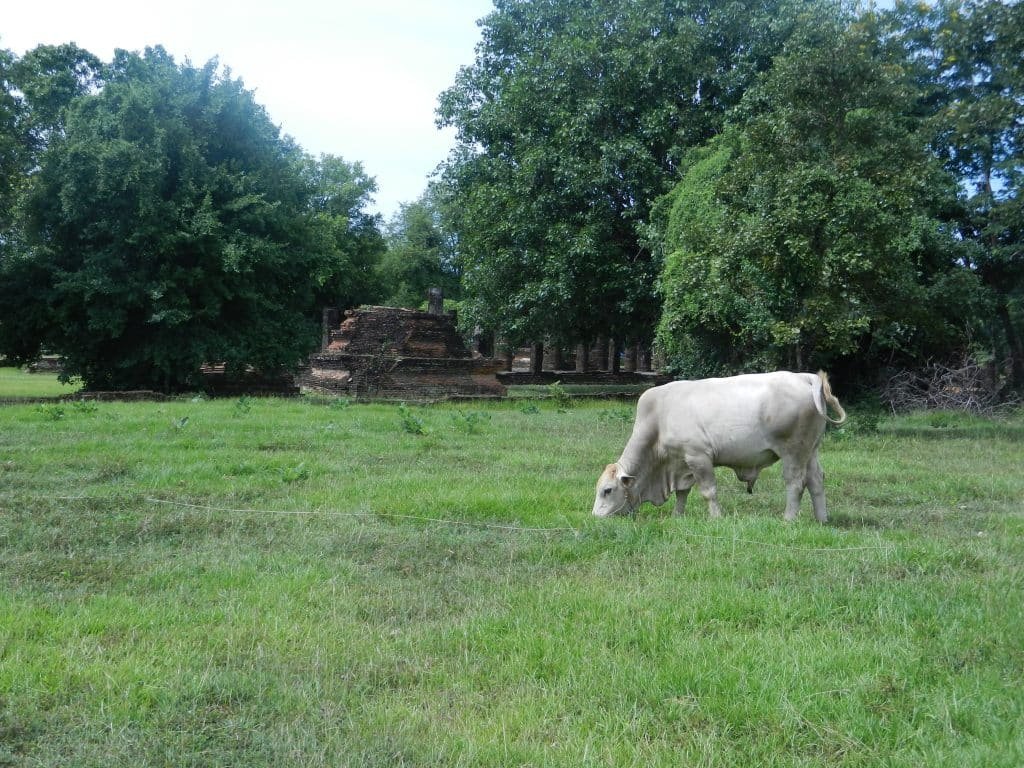
All species and Thailand’s gentle art forms blend into an expression of the Buddha’s compassion and a perspective of the world that’s characteristically Thai.
We’ll first explore the two main wats on the eastern side of Sukhothai’s main ritual center, Wat Mahathat. Wat Mahathat’s public assembly halls formed a line on the eastern side of its main shrine, so most pilgrims probably passed these two wats on the way. Most people go by them today too because most guesthouses are in the town of New Sukhothai, which is about 10 miles east. These two wats give a gentle introduction to a place that many Thais consider the wellspring of their culture (Thai cultural origins are actually much more complex–more articles to come about this fascinating topic).
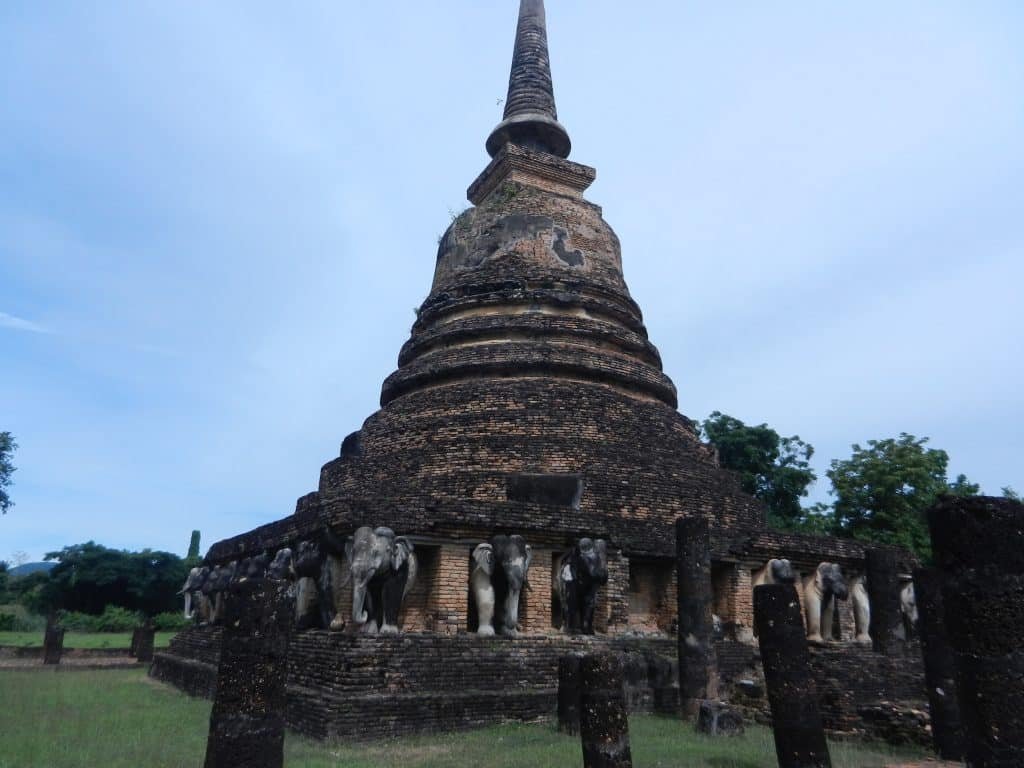
The first wat is Chang Lom (surrounding elephants).
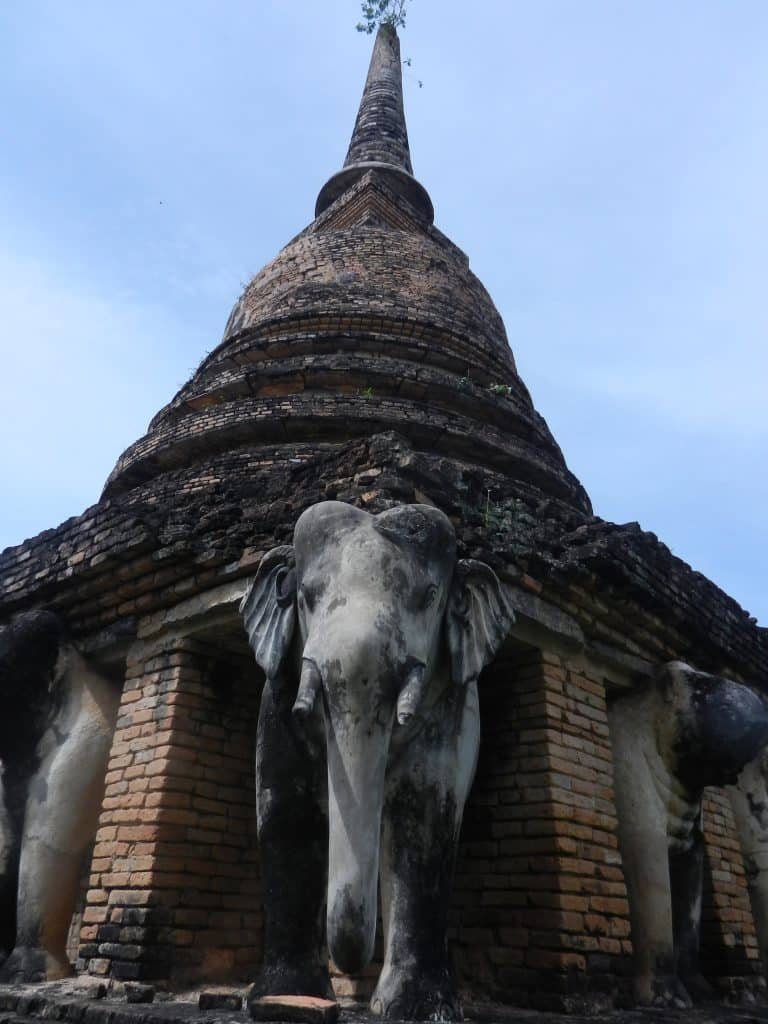
Thais probably got the idea of carving elephants under a stupa from Sri Lanka. People there held ideas about the world’s central mountain, Mt. Meru, resting on the backs of the majestic animals. Sukhothai’s early kings imported monks and artists from the island when they formed their state.
But Thais made this form especially graceful. Under the bell shape you can see three rings of bricks projecting a bit outwards. Under them, four increasingly large levels spread out. All levels together seem to flow like a river.
Above the bell, there’s a small square platform called a harmika, and a brick disk rises above it to support the spire. All these sections blend into a continuous flow that gently becomes more vertical. The solid platform underneath balances the sinuous curves that rise to the heavens. All the worlds from earth to the heavens are in harmony.
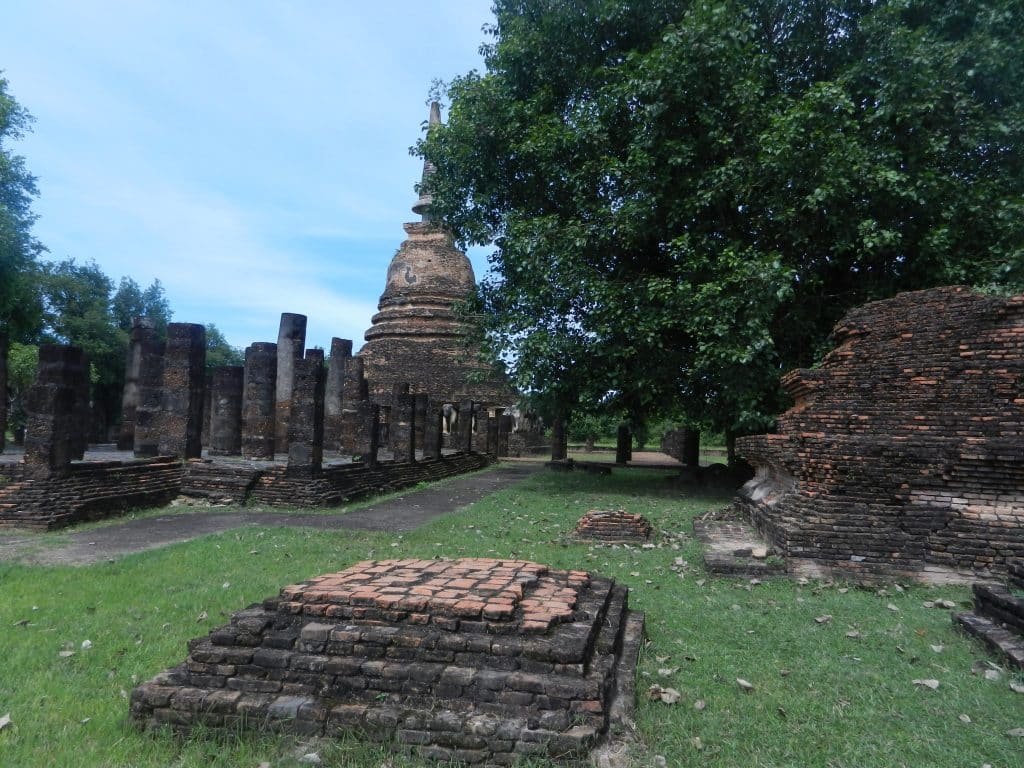
The harmony spreads around the spire. Ruins of the wat’s assembly hall preside on the left in the above photo, and many small stupas dot the area beyond. Wat Chang Lom has graced Sukhothai since the late 13th century.
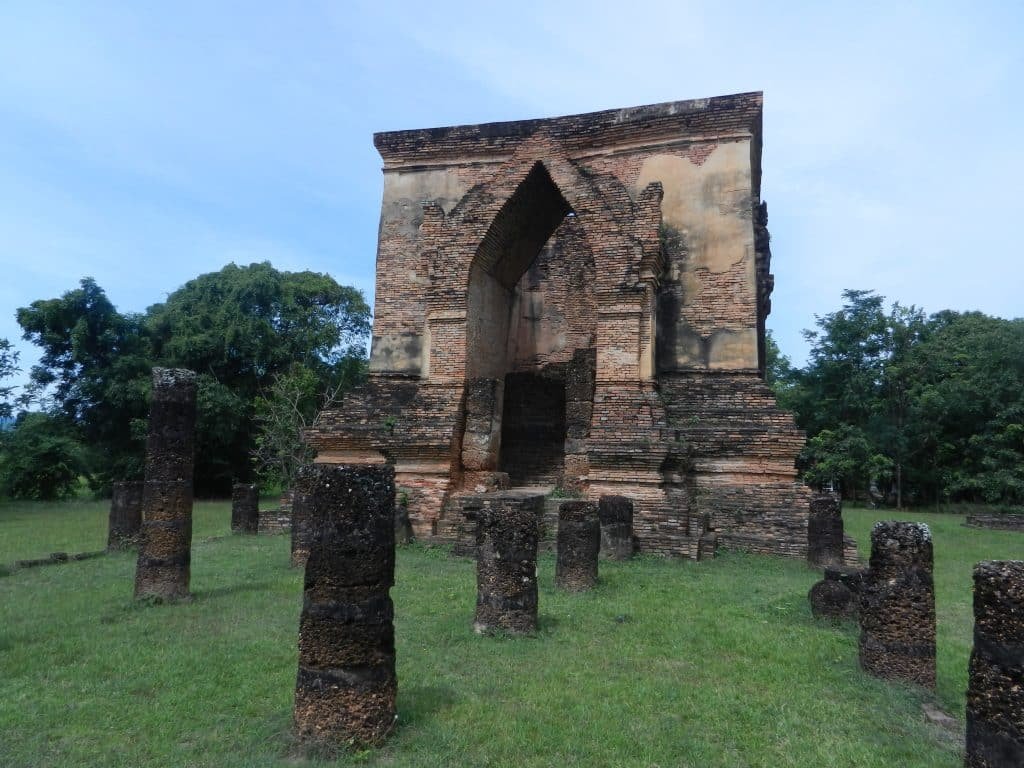
Wat Traphang Thong Lang (temple of the coral pond) is a little south of Wat Chang Lom, on the other side of the road between Old and New Sukhothai. It was built in the mid-14th century. In the above photo, I’m standing in the ruined assembly hall, looking towards the mandapa, which once housed a statue of the Buddha. But fans of Thai art especially admire this wat for the sculpture on the outside of the building.
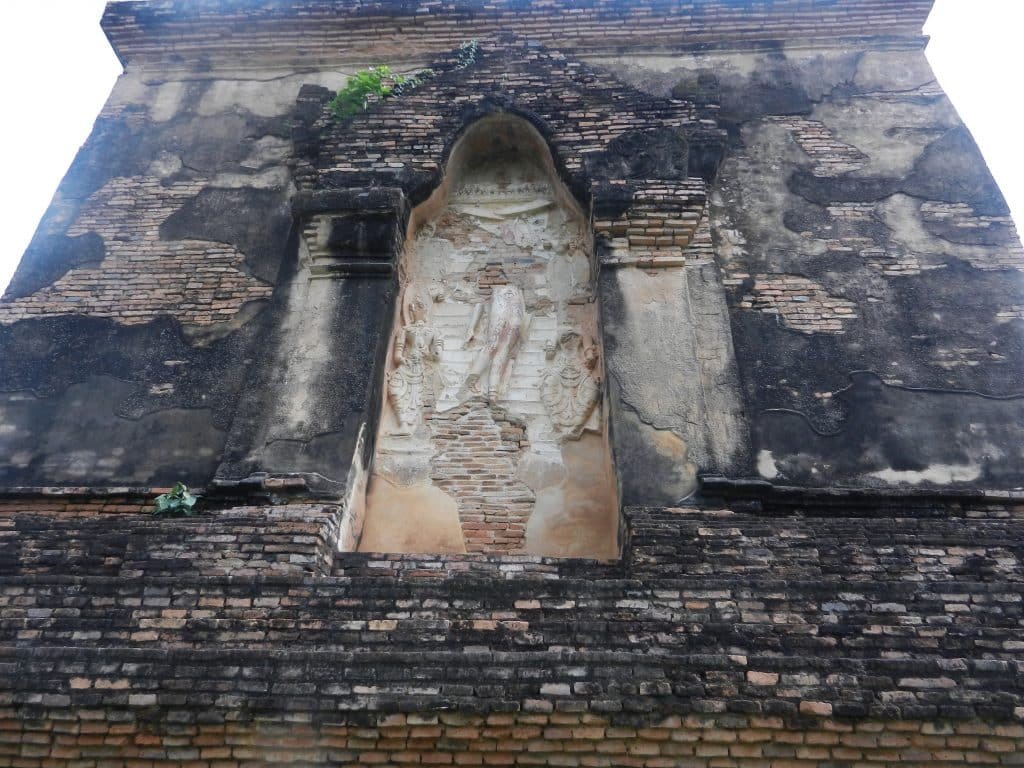
Its sides have a scene from the life of the Buddha. I’ll show you the best preserved one.
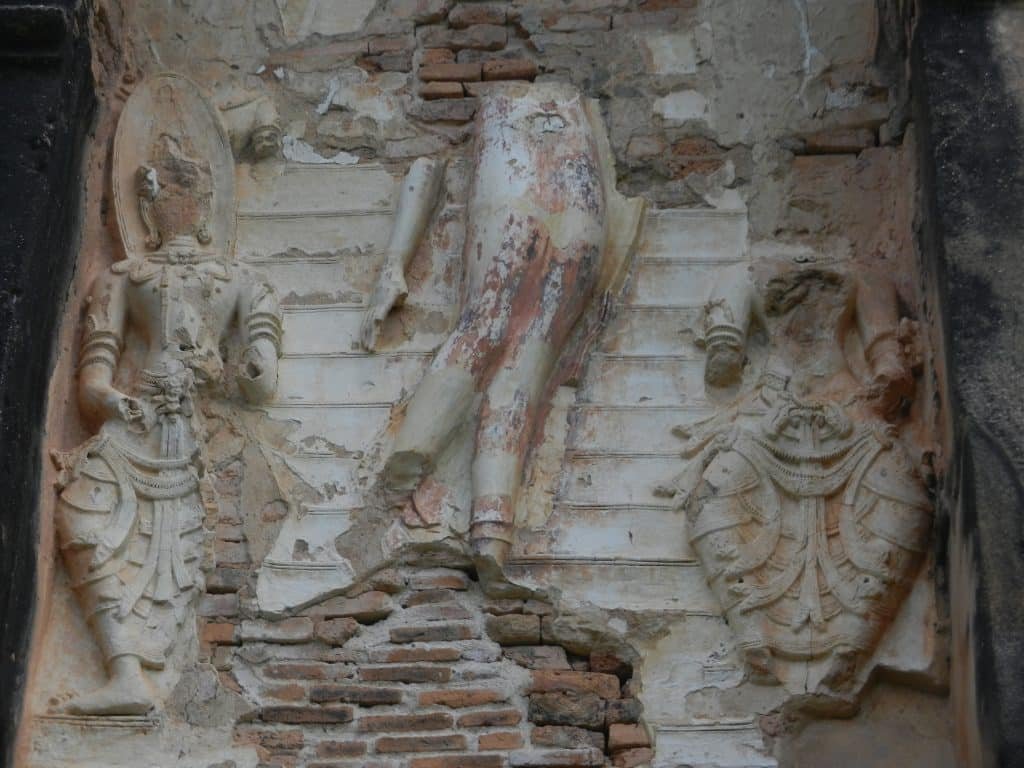
The above photo is of a highly honored scene in Thailand. The Buddha descends a stairway from the heavens after visiting his mother and converting her to the new faith. Thais see motherrs as paragons of viture and they consider gratitude towards one’s parents to be central in any decent person. So a lot of pilgrims probably resonated with this scene.
A lot of art lovers have resonated with it too. They consider the flowing lines of his body to be one of the best Thai art forms. The Hindu gods Indra and Brahma surround him, and their ornate garb and frontal stances contrast with him, who seems as soft as a cloud.
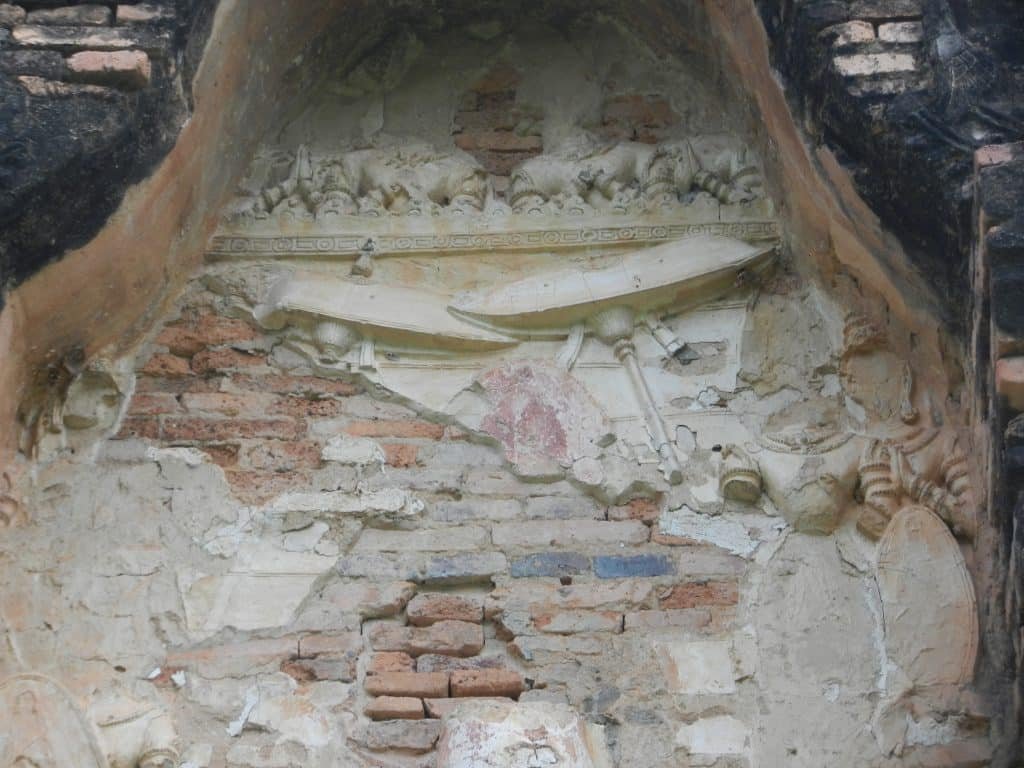
At the top of the scene, other deities accompany the Buddha, and parasols provide a regal frame for everyone. Parasols protected Khmer kings during processions. Here they dignify this scene of compassion after Thais liberated themselves from the Khmer overlords in the 13th century.
Both wats express a perspective of the world that emphasizes a gentle flow of forms as though the energies that generate the profusion of life in Thailand are benevolent. Florentines developed a different type of perspective around the same time, which stresses distinct physical bodies and linear relationships between them which allow you to analyze everything from a commanding viewpoint. But there’s no single view of the whole in Thai perspectives. Instead, you’re immersed in a field full of enchantments. You can meander through it and never run out of delights.
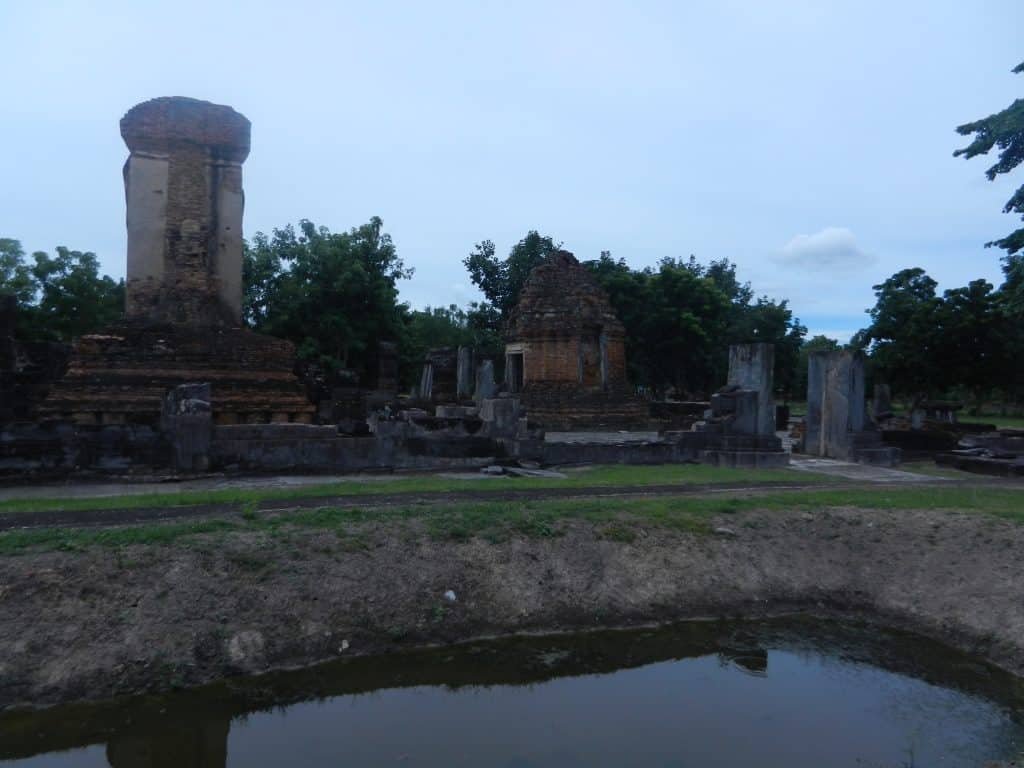
We’ll now explore a couple of wats on the south side. The above shot is of Wat Chetuphon. It was established by 1417–the same decade when the Florentine sculptors Lorenzo Ghiberti, Donatello, and Nanni di Banco fashioned their statues on Orsanmichele, which helped inspire Renaissance artists to focus on the material body within a three-dimensional space. Italian sculptors were moving towards Michelangelo’s David, but Thai artists were developing other idioms to integrate their world.
Wat Chetuphon is surrounded by two moats, and the alternations of water and buildings distribute the perspective around the whole environment rather than focus it on one body and its details. The perspective is more mellow than analytical.

Wat Chetuphon does have a center though. The above mandapa is also the tall building in the first shot. Four stucco sculptures of the Buddha bestow grace in each of the cardinal directions. Each figure’s in a different pose. The best preserved is the Walking Buddha (above). Instead of fashioning a massive male body with sun-kissed beefcake like Italian artists did, Sukhothai sculptors made figures that glide as gently as a cloud. Instead of concentrating the perspective on distinct objects, Thai artists thought in terms of benevolent flows of energies throughout the whole area. They blended blessings from the Buddha with older folk beliefs about the land’s energies that generate life.
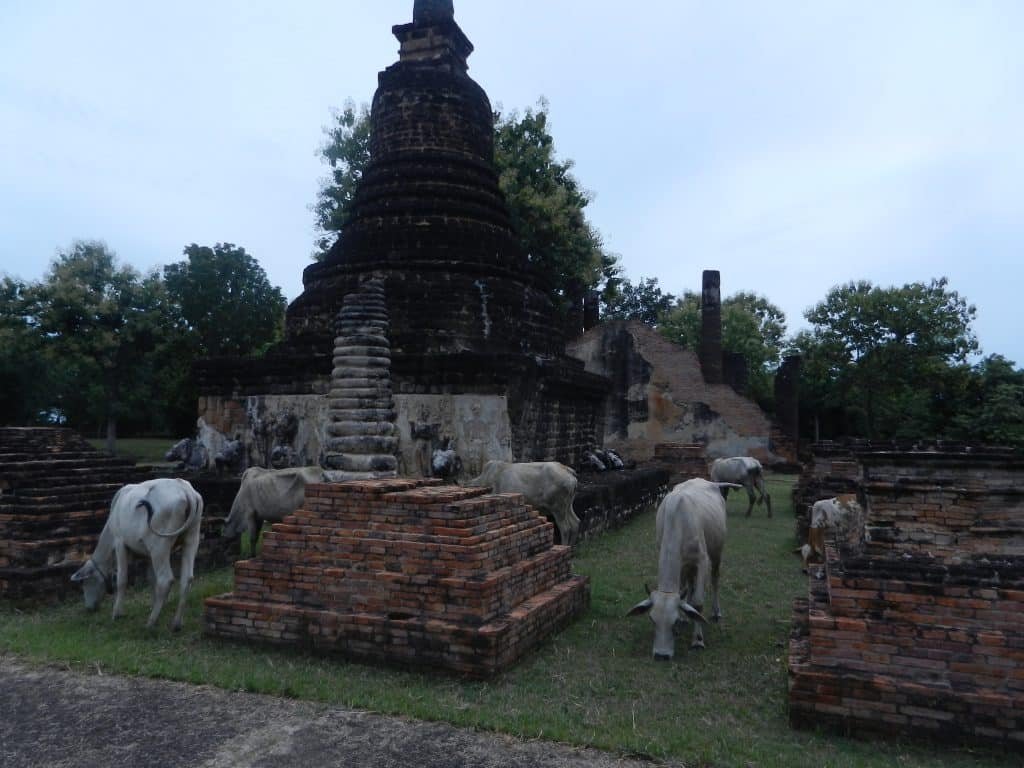
Those energies were just as gentle across the road, at Wat Chedi Si Hong (above). It was also built around the beginning of the 15th century. When the little shrines around the middle stupa were new, a procession around them made their forms flow as gently as the water around Wat Chetuphon.
The stucco carvings around the stupa’s base added even more lilt.
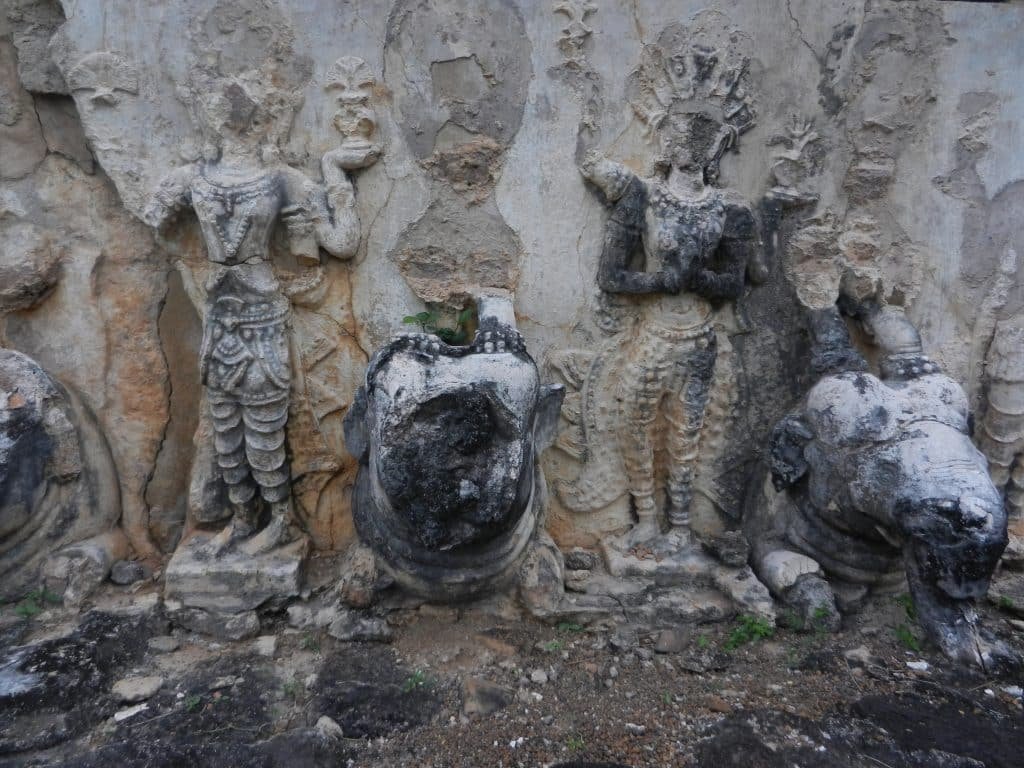
Deities alternate with elephants. The divinities have four arms. Two hold their palms together, while the other two hold up vases with flowers. These vessels symbolize life and prosperity.
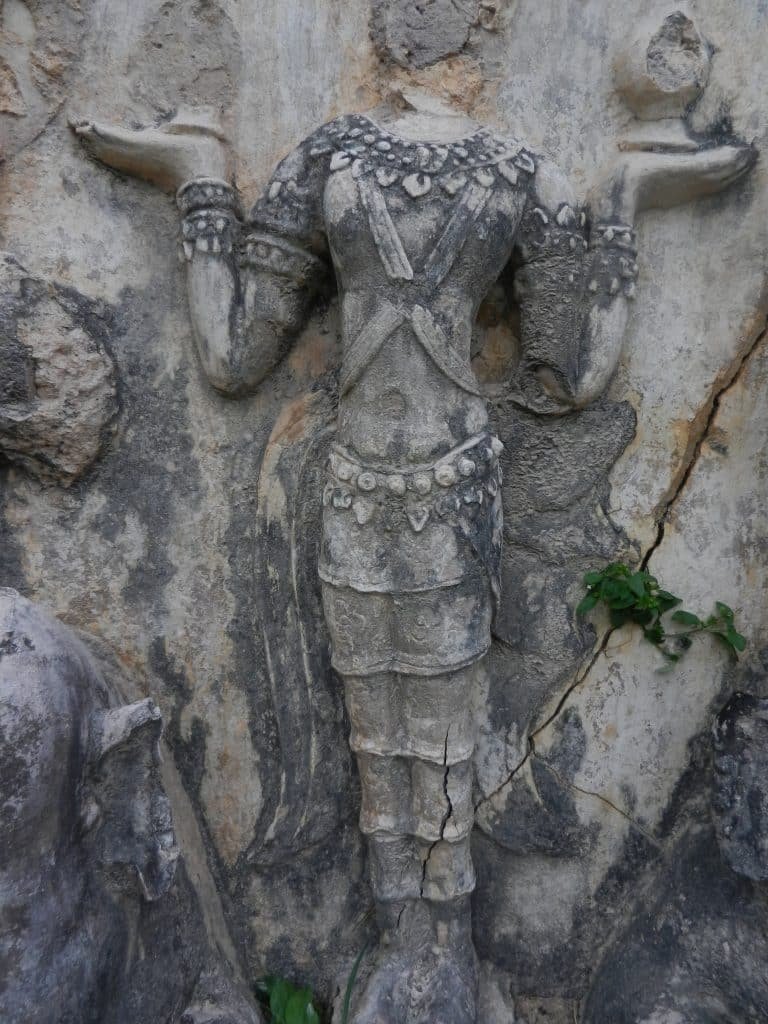
The sculptures sport different costumes, and the art historian Dawn Rooney thought that people might have worn them around Sukhothai’s court back in the day.
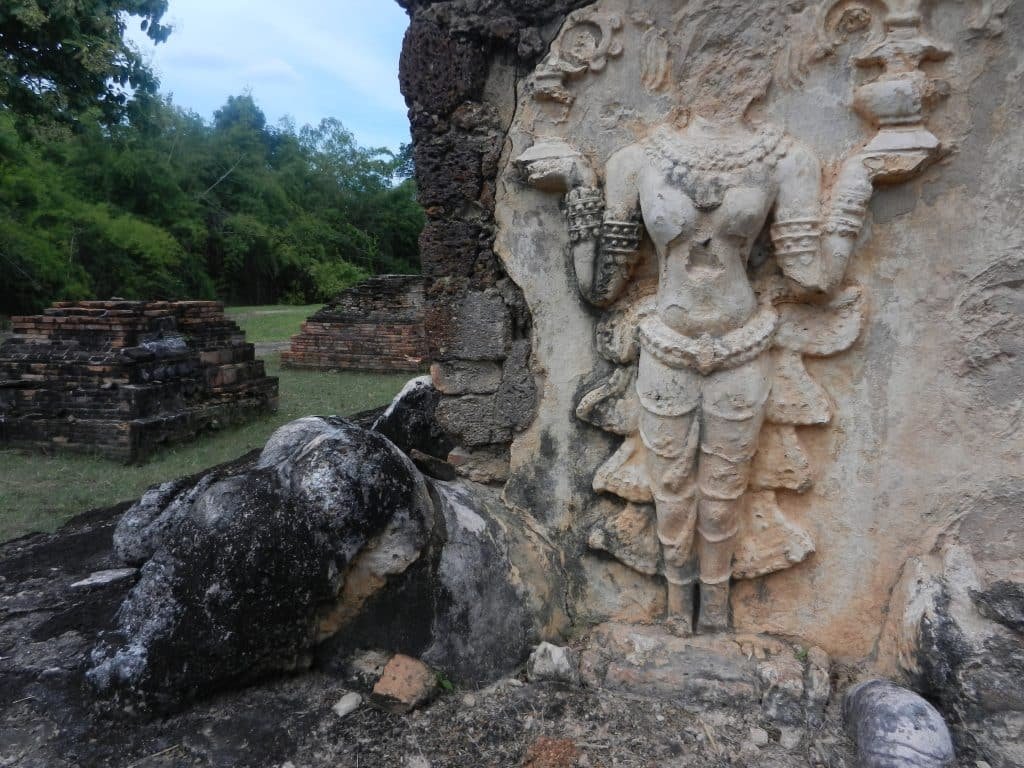
Some of their costumes ripple as playfully as Wat Chetuphon’s reflections in the moats.
Nothing commands the attention around these wats. The more you meander around the area, the more gentle forms you find that reflect the Buddha’s compassion and a tamed life-force which fertilizes crops.
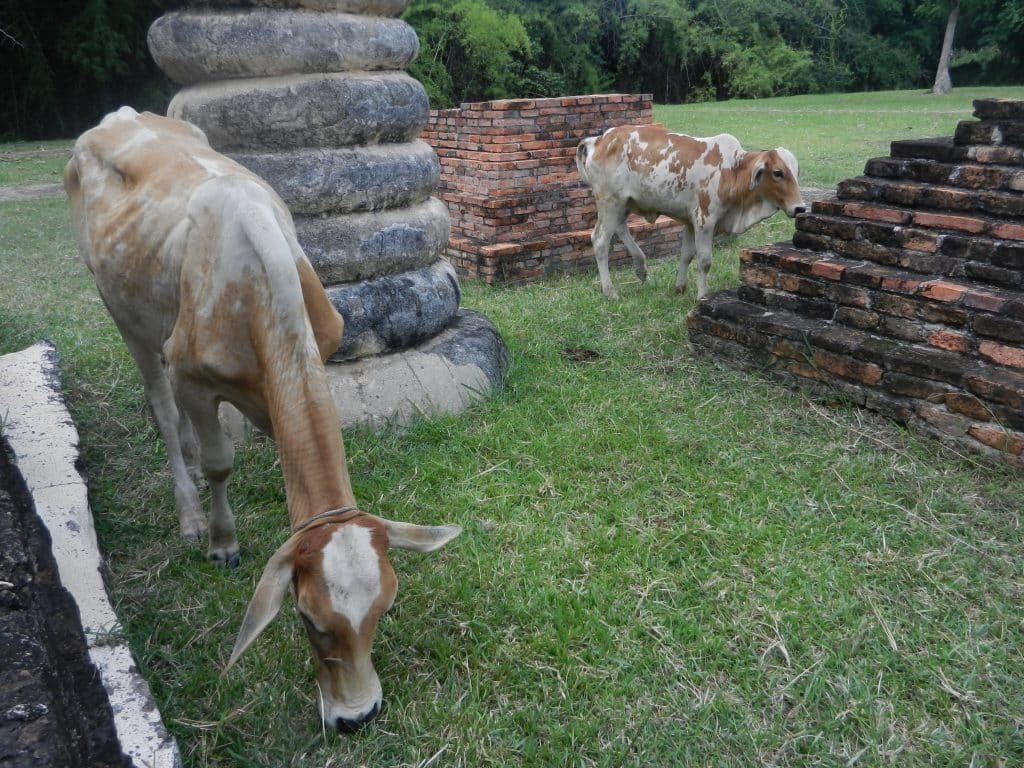
Cows placidly grazed around Wat Chedi Si Hong as I enjoyed its sculpture. We all seemed to merge in the gentle flow of life.
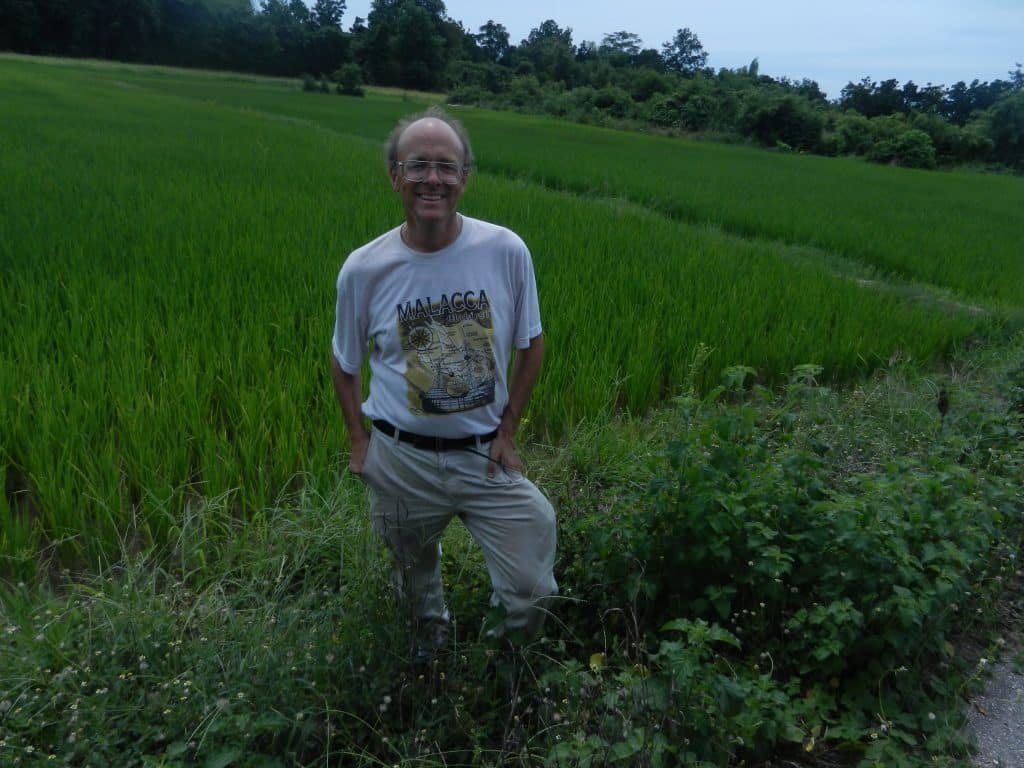
I should give you a mild warning if you go to Sukhothai: Don’t do what I did in the above shot. I got carried away while wandering around all the temples and walked through tall grasses that jabbed foxtails into my socks and pantlegs. Two days later, rashes broke out all over my legs and feet, which looked far less graceful than Thai sculpture. Thankfully the itching wasn’t nearly as intense as poison oak rashes, so cortizone cream made it tolerable. Perhaps all the graceful art around Sukhothai softened nature’s energies:-)