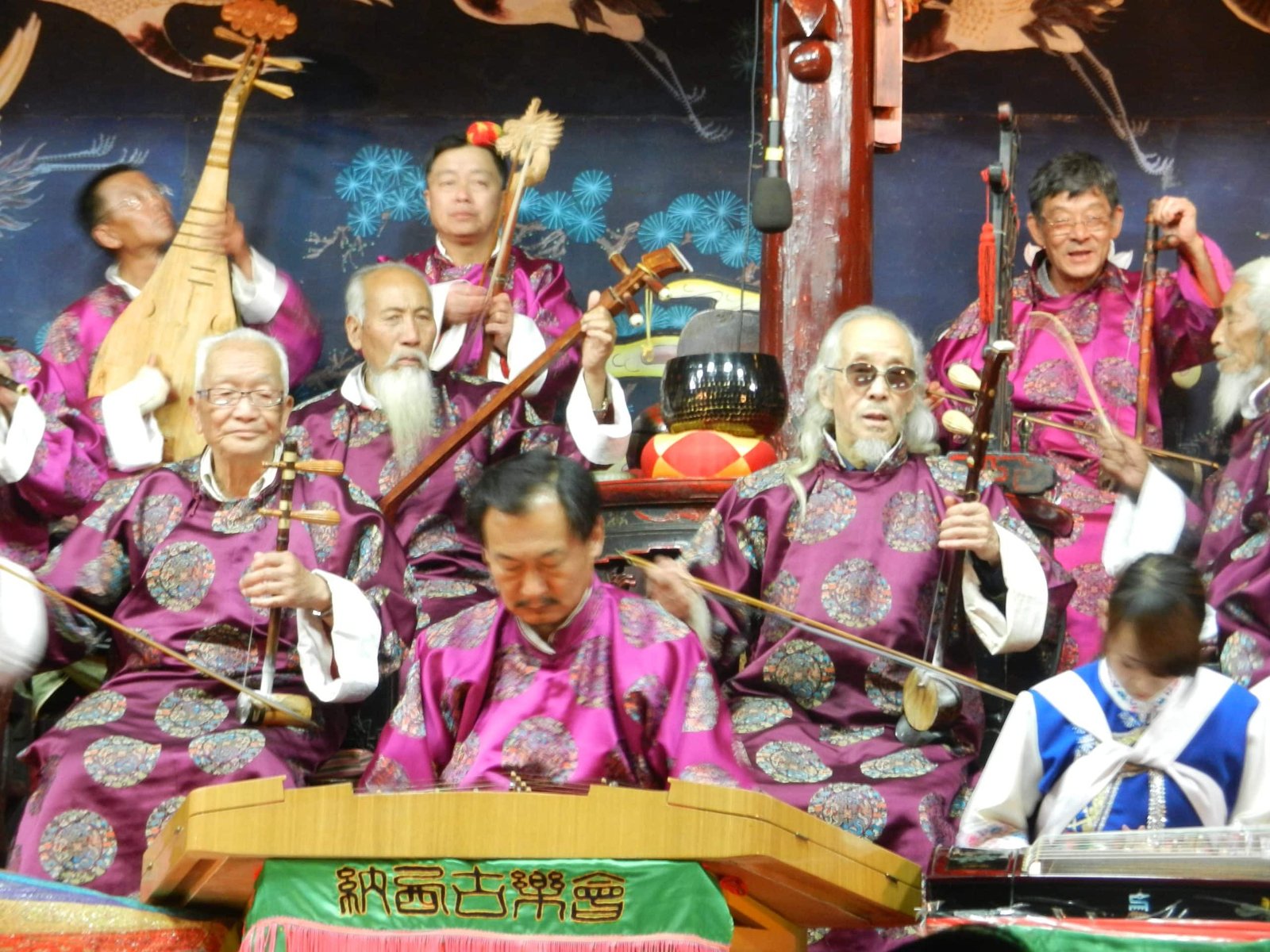
People in ancient China typically thought of musical notes in more holistic ways than Westerners have. The five notes (C, D, E, G, and A) were correlated with the the wu xing (the five elemental processes: wood, fire, earth, metal, and water), the five directions (including the center), the five seasons, the colors, the colors, the human personality types, the planets, the geometric shapes, and the culinary tastes. A note thus harmonized with the whole universe.
Ideas of music also included the concept de (a combination of power and virtue which circulates). Erica Fox Brindley, in Music, Cosmology, and the Politics of Harmony in Early China, wrote that de, musical notes, and the wind were closely associated. All shared the ability to spread freely through space and deeply penetrate people’s hearts and minds. Several ancient Chinese writers emphasized the importance of music in rituals. Music conveys the composer’s virtue. When a performance is refined and balanced, a similar mindset emerges in the audience, and this promotes harmony throughout the state. The listeners will go back home and rule more fairly, and their subordinates will honor and be more willing to follow them.

A sensitive person was believed to be able to understand a composer’s inner life by hearing his music. Confucius was said to have correctly surmised that the writer of music he was studying was Wen, the semi-legendary founder of the Zhou Dynasty, who lived about 500 years earlier. Confucius said that the composer must have been him because he was unusually tall, had far-reaching goals, and planned to become the king of all four quarters of the known world.
The historian Sima Qian related the musical notes to the seasons, the times of day, the different winds, the patterns of cosmic qi, and the movements of the heavenly bodies. In ancient Greece, followers of Pythagoras saw notes in terms of ratios. They were fascinated that notes in musical scales are determined by ratios between lengths of strings that are played, with 2:1 for the octave, 3:2 for the fifth note in the scale, and 4:3 for the fourth. Many Greeks treated notes as distinct entities and related them to each other according to mathematical ratios, whereas many ancient Chinese felt that notes most fundamentally resonate with the universe’s most basic cyclic processes.
De and music were conceived as harmonizing potencies that circulate throughout the universe. A cultivated and politically eminent person possesses a lot of the former and is highly sensitive to the latter. He knows how to use music in rituals to further harmonize the state and fortify his own rule.
During the Zhou Dynasty, emperors and the highest ranking provincial leaders created orchestras of enormous bronze bells to sonically reverberate their rituals. No other society in the world made such large bells until the Middle Ages. The biggest known ancient Roman bell is only about three inches high, but some ancient Chinese bells are five feet high and weigh over 400 pounds. Amazingly, many bells emit two pitches. Their bases are almond shaped so that you can hit the middle of a long side with a hammer to play one note and then strike the center of a short side to sound a different note, which is often a major third or minor third higher, depending on the bell’s shape.
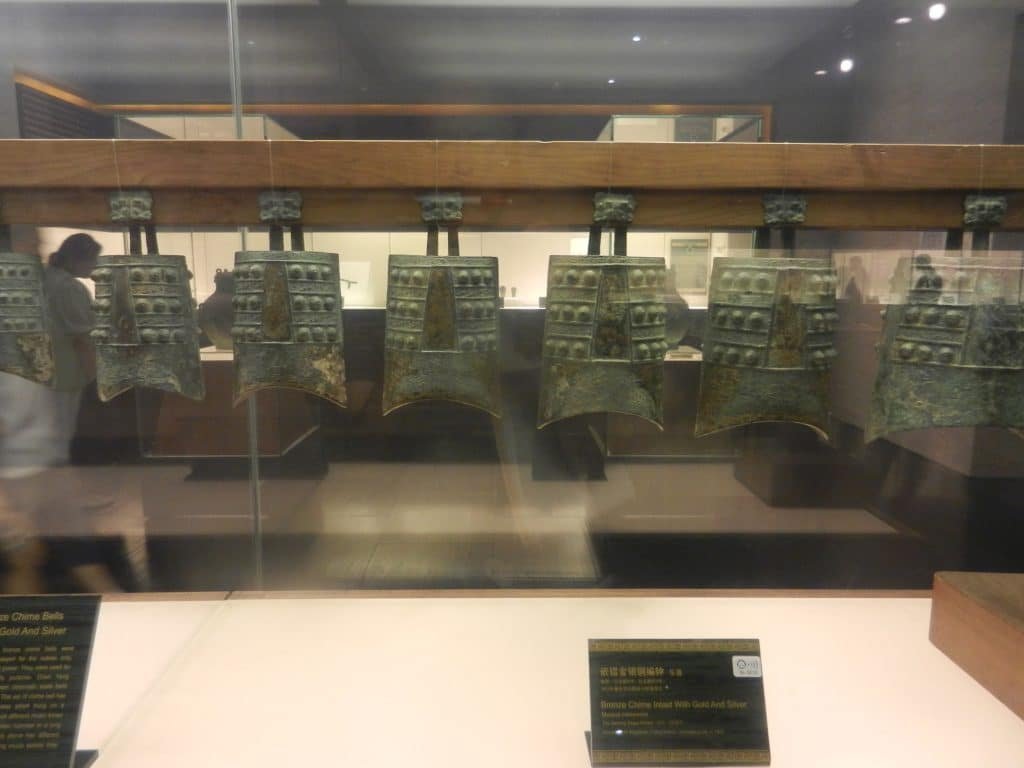
Chinese elites used a lot of resources to craft these bronze instruments, as they did for their bronze vessels. In the fifth century BCE, Marquis Yi of Zeng owned a set of bells that were mounted on a nine-foot-high wooden rack. Most sets from the eighth century BCE emitted four notes per octave, some sixth-century sets generated six and even seven notes, and Marquis Yi’s collection played all twelve chromatic notes. These sets produced deep resounding tones that seemed to reverberate up into heaven as elites honored their ancestors, and outwards through the kingdom to harmonize it.
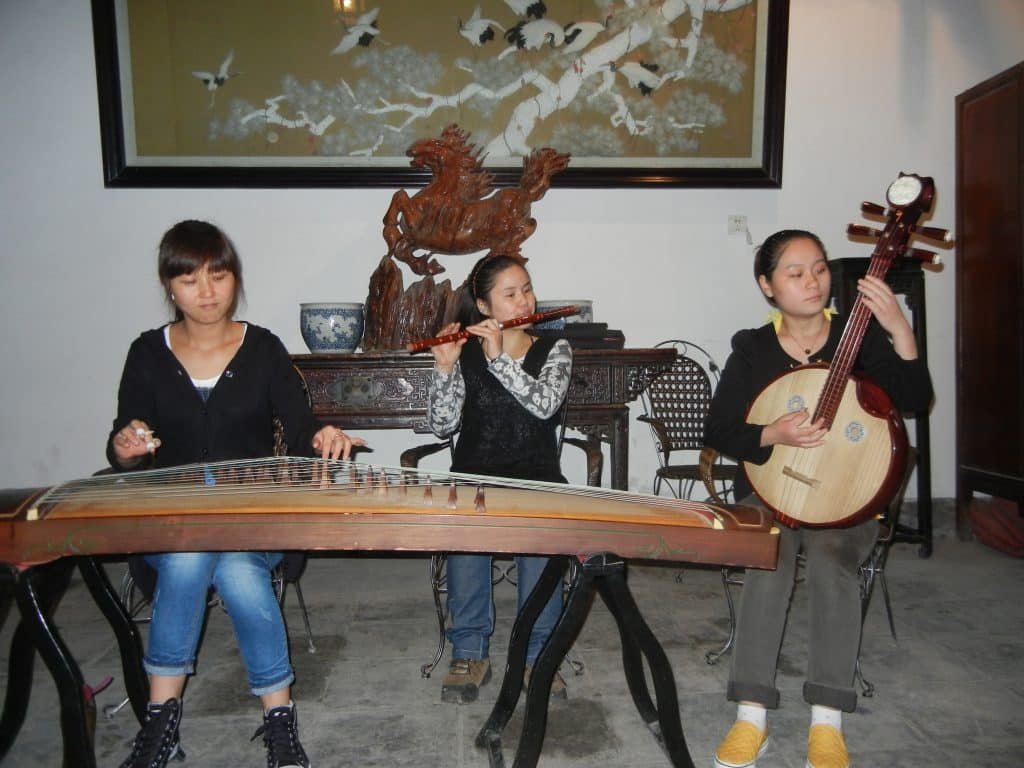
Most Chinese upper classes stopped making large bells after the fifth century BCE and began to emphasize stringed ensembles. Instruments similar to today’s zithers (with a row of strings over a flat board that sits on a table—the Japanese koto and the Korean gayageum are in the same family) were mixed with flutes to create softer and more intimate sounds. The girl on the left in the below photo is playing one.
The most honored stringed instrument in China has been the guqin. Early versions had a broad box at one end and a narrow neck at the other, and they varied from seven to ten strings. Guqins were more popular in the north than the south, and they might have originated among people north of China. By 500 CE the box was elongated and narrowed, and its shape was made into a single long trapezoid that had seven silk strings.
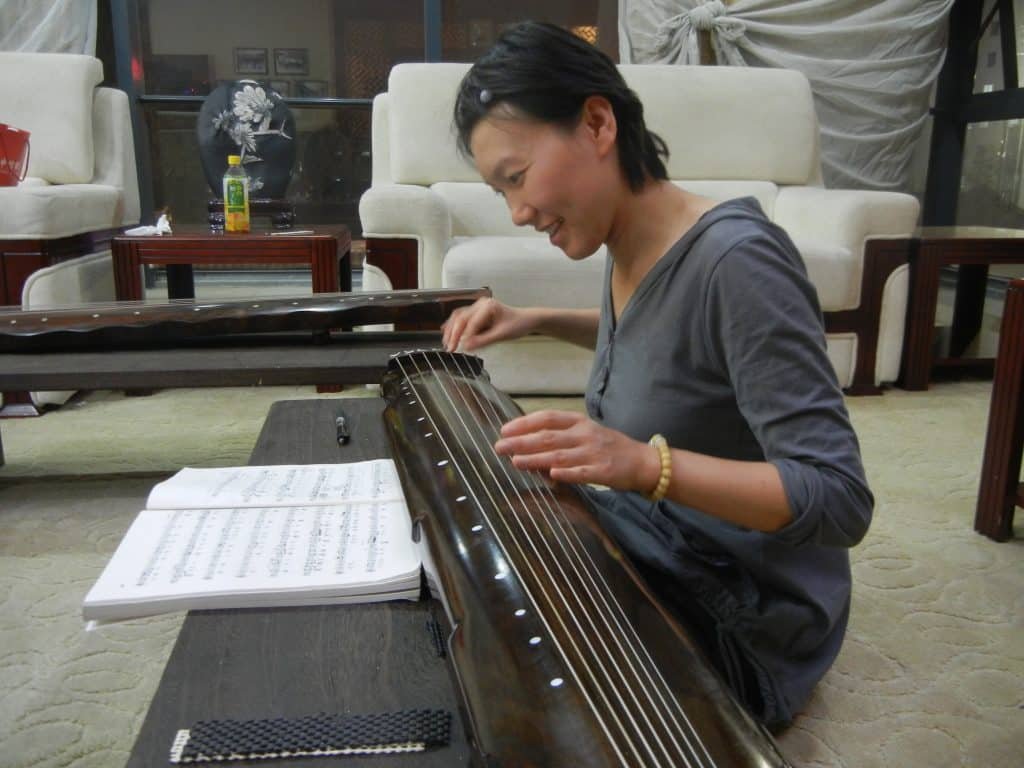
Modern guqins are still in this form (shown above and below). I instantly resonated with it while first hearing a recording when I was twenty-four. The long box under the strings emits big, deep tones that are much warmer than metallic bells. You can slide your fingers up the strings to make notes slowly and elegantly rise and fall, and you can lightly touch strings to play harmonics that seem to come from the heavens.
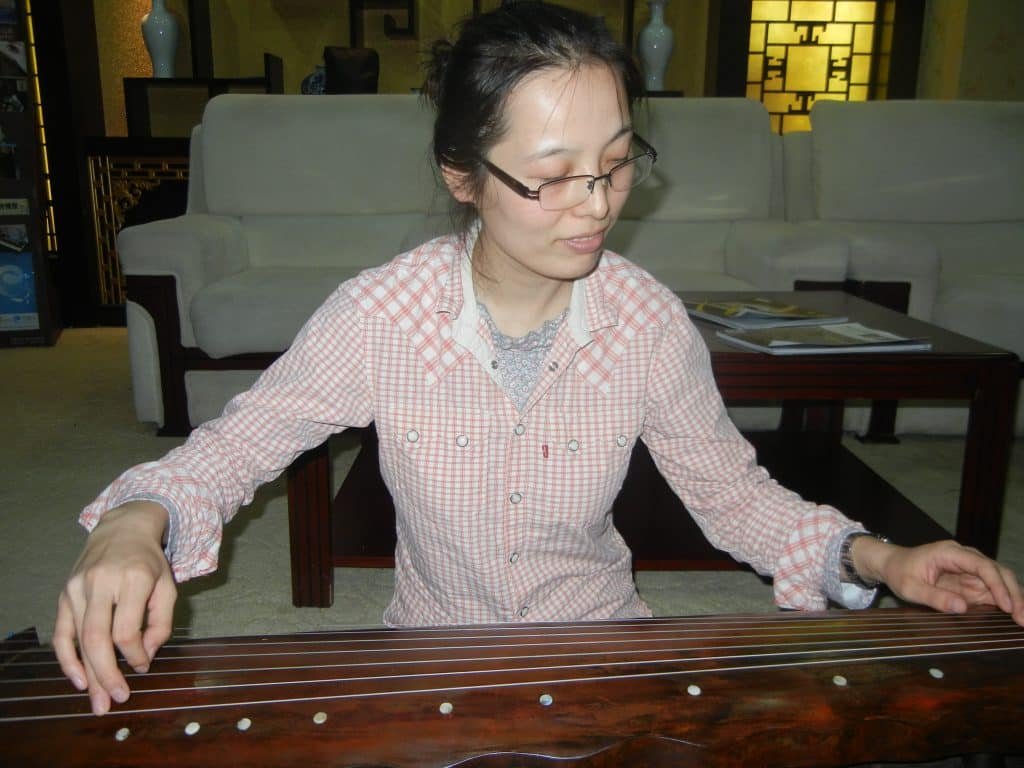
This expressiveness enables the instrument to resonate with images that poets evoked. Musical compositions can pull the listener into different scenes. In one, cranes fly over a lake and its reed bank, and they call to a lone crane standing on the shore. Another evokes a leafy courtyard in a temple, its bells calling the monks to prayer, and the monks’ chants. A humorous piece called “Wine Madness” brings a drunken man to mind by syncopating the notes to create a staggering rhythm. Towards the end, it imitates the sound of vomiting. The guqin became popular among literati, who composed songs that resonated with poems.
I was thrilled to be invited to a guqin class in Beijing one evening, but found it especially challenging to play. It has no frets under the strings, which are about four feet long. I’ve played fretless stringed instruments with short necks (usually an oud I bought in Egypt), but a slight misplacement of a finger on a guqin’s strings sounds an off-key note. An experienced player has mastered a lot of techniques for creating deep, warm sounds that produce exquisite poetic resonances that penetrate the heart. In my hands the instrument sometimes sounded like a sick cow. But noticing that the teacher was also playing sour notes, I asked my host if she was also a student. She was; a master taught the advanced learners.

Playing the guqin requires a lot of subtlety. It has been called the philosopher’s instrument because of its ability to encourage reflectiveness. It’s light enough to be carried in a bag. My classmates were able to take theirs into a crowded bus during Beijing’s after-work commute, but literati used to tote them into the countryside, sit by streams, play their compositions, and feel that they were resonating with nature and their most honored cultural heroes.
Few people in China play guqins today. Guitars and bongo drums are much more popular, but ancient assumptions that music resonates throughout society are still alive, as we’ll see in the next article.
Other cultures have equally deep assumptions about music, including India and Africa.