
Many fans of Indian spiritual traditions admire them for teaching that all is one. All beings are unified. We all came from the source and we will ultimately return to it like rivers flowing into the same ocean. But the society that these traditions emerged in was very dynamic and often contentious.
In the mid-first millennium BCE, when the early Upanishads were composed, thoughtful people left their villages and towns to meditate and converse about basic questions in the nearby forests, other sparsely populated areas, and courts of kings who were interested in big issues. Many had reasons to be frustrated.
A lot of Vedic priests had become wealthier as settled communities had grown into larger states. As society grew more complex, more rituals were added. More people now lived in towns, and rites multiplied for building homes, conducting business, embarking on a journey, returning from a journey, sowing crops, harvesting crops, getting up in the morning, going to bed, eating, getting married, having sex, giving birth, and dying. A book called the Griha Shastra detailed domestic rituals in the mid-first millennium BCE.
Since priests were compensated for their services, they enjoyed a huge windfall. Brahmin priests’ power grew so much that some claimed that their recitations and chants allowed them to control all of nature, including the gods.
At the same time, they were composing the Brahmanas and Aranyakas to detail procedures and meanings of Vedic rituals, and not surprisingly, they’re full of passages that promote Brahmin priests’ first-class social status. These texts often portrayed a more overtly hierarchical universe than the Rigveda did, with the exception of a few of its later hymns. They often categorized reality into a triad, with Brahmins at the top, Kshatriyas (kings and military leaders) in the middle, and Vaishyas (commoners, including farmers and merchants) underneath. Each class was associated with its own gods, cardinal direction, time of day, season, Vedic text, poetic meter, and cosmic region (earth for Brahmins, middle atmosphere for Kshatriyas, and sky for Vaishyas). Brahmins thereby turned traditional appreciations of a vast and unified cosmos full of fertile energies into a stratified system in which they were the primary class. Since they were the reciters and chanters of Vedic hymns which carried these energies, they claimed that they had the most prestige in the universe.
The use of mantras for worldly gain probably increased at that time. Brahmin priests asserted that mantras can control the energies in nature if they’re recited properly by people who have spent years studying them. Performances must be precise, and they can be botched in a split second. Vedic hymns are very dense, and Sanskrit is complex. It has eight cases rather than Attic Greek’s five and Latin’s six. A case is the way in which a word is used. When a word is the subject of a sentence, it’s in the nominative case. It’s genitive if it’s in someone’s possession, accusative if it is a direct object, and dative if it’s an indirect object. In the statement “John bought food for his dog,” John is nominative, food is accusative, and dog is dative. The same word in each case has a different ending in Greek, Latin, and Sanskrit. All these languages are thus logical, and using them is like assembling a puzzle. But Sanskrit has extra cases, so its rules are more complex. Possibilities for mistakes in Vedic verses abound.
Sanskrit also has about twice the number of letters than English and Attic Greek, and they’re classified according to the part of the mouth or throat they’re enunciated in and the amount of breath expelled. Aspirated letters have an H in them (e.g., KH, CH, TH, PH, GH, JH, DH, and BH); they’re called mahapranas (great breaths) because they’re supposed to pack extra energy. Mantras are very powerful, and a slight mispronunciation can create the opposite of what you want. Hire a pro or else.
The use of mantras by priests for their own political and material gain seems to have grown in the mid-first millennium BCE, when the earliest composers of the Upanishads began to think about the larger meanings of Vedic rituals and verses. New contexts for rituals were emerging in the increasingly complex societies as they became more urban and traded more with each other.
Vedic priests and kings often formed win-win agreements. Brahmins granted spiritual authority from the Vedas to heads of the growing states, and the latter fortified the formers’ social status and gave them income. And kings could display their own influence to political rivals by keeping Brahmins at their courts. Some rulers sponsored and took part in philosophic debates with Brahmins in their own palaces in the earliest Upanishads, and they sometimes paid them large numbers of cows and gold pieces. Both formed a partnership in which they claimed connections with all of the universe’s energies to justify their social status.
Mystics lived in ancient Greece too. They were common enough to be denoted by a special term, mantis. But they weren’t organized into a single group or elevated to the top of a social hierarchy like Vedic priests. Some interpreted flights of birds and animal entrails, and others attempted to heal people’s illnesses. Many Greek mystics were independent journeymen, and some were probably misfits, wandering from town to town trying to convince people to employ them. But channeling nature’s unseen powers was widely institutionalized in India. It became foundational in its social structures, and those with the skills for it were in the most honored class.
By the fifth century BCE, society in northern India had developed into a network of kingdoms. They traded with each other but also frequently fought. At the same time, the fertility of lands recently cleared from jungles attracted newcomers so that several ethnic identities existed side by side in the growing towns. Money (in the form of punch-marked coins) was introduced, and iron was increasingly used for agriculture. Both gave people more ability to take independent initiatives. Many who were outside traditional aristocracies were thus able to prosper, and wealthy traders congregated in the growing towns, adding yet more diversity and new models of social prestige to them.
Iron weapons enabled an increase in materials for warfare so that conflicts between the growing states probably intensified.
Several currents thus converged to make people question claims that one authority or tradition could define all of reality. More folks were less inclined to uncritically follow assertions that one class of Brahmin priests could marshal the universe’s powers over everything by conducting their rituals. As priests were making increasingly lavish claims about their powers, several social spaces that encouraged people to question their assertions were growing.
Many diverse philosophies and faiths thus emerged. Buddhists and Jains didn’t emphasize social hierarchy as much, but instead developed no-nonsense approaches to overcoming attachments to the ego. The Charvaka philosophic school emphasized pure materialism. There is no afterlife, because no soul exists after the body perishes. People are entirely made of matter. The Nyaya and Vaisesika schools emphasized logic. The Samkhya school taught that reality consists of two fundamental principles, purusha (consciousness or spirit) and prakrti (nature), and it outlines the stages in which prakrti unfolds into the different forms of matter and human perception and thought. Patanjali formalized yoga schools into eight stages of increasing spiritual adeptness.
All these philosophies and faiths together combined into a cultural landscape that has been as creative as ancient Greece. It greatly influenced thought and religious leaders in China, Japan, Korea, and Southeast Asia. In modern times, it has spread through the rest of the world. Each culture has adapted Indian thought in its own way and blended its own traditions with it, as you can see in Cambodia, Vietnam, and Thailand.
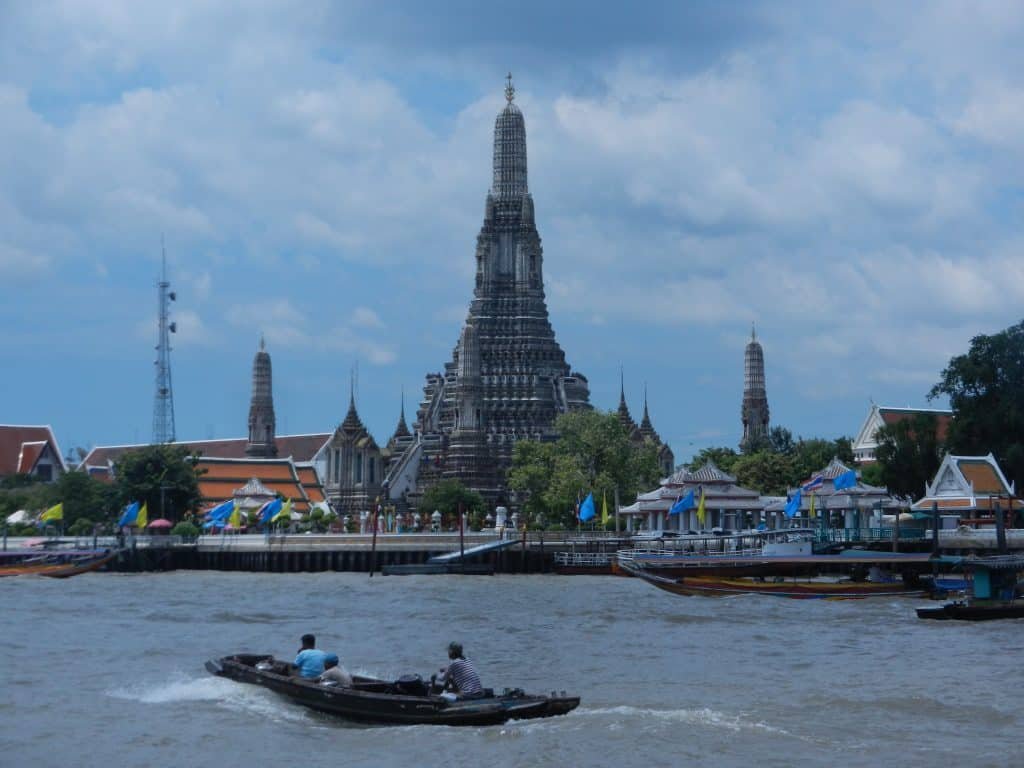
Many Indian philosophies have emphasized unity, but they and the cultures that have adapted them have been marvelously diverse.
I’m having such a great time exploring this world’s diverse rivers that I’m in no hurry to return to the ocean.