The first Greek philosophers looked for something that, on the surface, sounds like what the Upanishadic composers in India were seeking: the underlying unity and origin that the world’s many things and processes came from. But the ideas that both cultures emphasized were different.
Early Greek thinkers called underlying unity and origin the arche, which had several meanings that related to the cause and basis of everything. It has often been translated as origin (its literal meaning was beginning or source), but it was also seen as the ever-present unifying force in the world. Like the composers of the Brihadaranyaka Upanishad, they asked where all the things around them came from and what unifies them in a common order.
The first known Western philosopher, Thales of Miletus, thought it was water. Aristotle and Seneca said that he thought that the earth floats on it, and Seneca wrote that he compared the earth to a ship. So instead of sliding ultimate reality back through many existences until arriving at invisible brahman, Thales located it in a very visible and tangible part of the Greeks’ environment.
This is understandable, since Miletus was a prosperous city on Turkey’s southwestern coast, which prolifically traded with communities in the eastern Mediterranean and the Black Sea. Egyptians and Mesopotamians had believed that the world came from water, and Milesians regularly traded with them. They and merchants from other towns on the west coast of Turkey settled in Naucratis in the Nile Delta, which quickly grew into the main emporium that Greeks and Egyptians shared. The sea at Miletus lapped against the shore next to its agora and temple of Apollo, its patron god. Residents could thus view ships entering and leaving while discussing their ideas about ultimate origins. Water was the city’s livelihood. Thales is also supposed to have said that all things are full of gods, but he established a major tradition in Western thought when he saw ultimate reality in terms of the visible world rather than an invisible energy. Boats mattered more than brahman in Miletus.
In addition, water pervades the atmosphere, falls as rain, and nourishes crops. People die without drinking it long before they perish without food. They sweat, sneeze, spit, bleed, urinate, and have orgasms. It was easy to conclude that water is the stuff of life.
Thales also studied astronomical cycles and was said to have predicted an eclipse, though some modern scholars doubt that he did. Stephen A. White, in The Oxford Handbook of Presocratic Philosophy, listed the topics that later ancient Western writers said that he studied (we don’t have any original texts from Thales). Solar eclipses, solstices, equinoxes, seasons, days of the year, days of the month, a lunisolar ratio, the Pleiades, the Hyades, Ursa Minor, the Nile’s floods, and olive harvests made up the conceptual range that people have attributed to him. All are distinct objects or human-scale temporal cycles that people could visualize, measure, or count. They could apprehend them according to ratios. Rather than invisible energies, Thales focused on what was visible to a community of sea-going traders.
Thales’ younger associate Anaximander also lived in Miletus, and he is thought to have reached beyond what’s visible by saying that the cosmos came from the apeiron/the boundless. Rather than identifying water or any other visible aspect of nature as most elementary, he is said to have imagined the apeiron as the state that all nature came from. So far he resembles thinkers from the early Upanishads.
Historians of philosophy have held different ideas about the way in which the apeiron was conceived as boundless. It could have been infinite in spatial magnitude, undivided internally, eternal, two of them, or all three. Anaximander is supposed to have imagined it as an enormous area surrounding the world, but historians disagree on whether he saw it as a sphere or as infinitely extending. W.K.C. Guthrie thought that the idea of boundlessness that was uppermost in Anaximander’s mind was internal indeterminacy rather than spatial extension, and that would have been consistent with Hesiod’s idea that the universe began as undifferentiated chaos which order emerged from. But Charles H. Kahn, in Anaximander and the Origins of Greek Cosmology, wrote that spatial extension was Anaximander’s primary idea of the apeiron.
Although apeiron is an ambiguous concept, Anaximander saw the universe’s creation from it in terms of ratios and interactions between equal entities, and focused on these stable proportions rather than Vedic and Upanishadic ideas of all-pervasive energies. In the first stage of the process of emanation that he has been credited with describing, a finite germ (gonimon) was separated off from the apeiron.
Two qualities which Aristotle and later thinkers saw as opposites, heat and coldness, were then produced. An ancient writer called pseudo-Plutarch said that Anaximander envisioned the heat as a flame and the coldness as a dark mist. The flame was a spherical shell that tightly enclosed the mist. The shell then exploded outwards, and parts of it closed off to form fiery rings around the center, and the sun, moon, and stars were created in them. The earth and mists were in the center, where a second pair of contrasting qualities differentiated: wetness and dryness. They separated into sea and land.
The earth still rests at the center, with no impulse to move in any direction, because it’s equally distant from all extremes. Historians have seen this as an advancement beyond Thales’ idea that the earth floats on water. Rather than resorting to an imaginary picture, Anaximander treated geometric proportion as a main ordering principle in the universe. The theoretical physicist Carlo Rovelli feels that his ideas were seminal influences on scientific thinking. Jean-Pierre Vernant, in Myth and Thought among the Greeks, also admired Anaximander’s concept of the universe as a sphere because of its simple symmetry.
The contrasting qualities in each pair exist in an equal balance with each other. Heat and coldness limit each other and thereby prevent each other from flowing beyond their boundaries. Wetness and dryness do the same to each other. The qualities are equal in power and opposed to each other’s complete dominance. Hot and cold seasons, rainy and dry weather, day and night, living beings and cold, dry corpses—all alternate in a stable order that unifies nature’s many things and processes. Anaximander is thus supposed to have conceived the universe as a proportionate mixture of contrasting qualities that are physically tangible, and they oppose, limit, and balance each other.
Living creatures spontaneously emerged from the earth’s primeval mud or slime. They were initially fish or fish-like. When they reached the drier parts of the earth, they lived on land for a while. Anaximander is supposed to have reasoned that humans evolved from those creatures or that they were born from them as fully formed people. Because human babies are helpless in their first few years, they could not have immediately sprung from the mud or slime. Instead, they initially began as fetuses in the ancient fish and later emerged when they were strong enough to support themselves. Some moderns have admired Anaximander for being the first thinker who said that humanity developed through evolution. His concept of what we evolved from was taken from the visible world around him rather than unseen and subtle Vedic energies.
Anaximander is also supposed to have said that the earth is shaped like a drum and that its height is 1/3 of its diameter. It rests in the center of the universe, within great rings of fire that are 9, 18, and 27 times the earth’s diameter. Some variations list 19 and 28 instead of 18 and 27, and because of these differences and corruptions in a critical text, the professor of ancient and medieval philosophy Keimpe Algra said that we cannot be sure that Anaximander actually specified the relative distances between the rings. But such an attempt would have been consistent with his emphasis on equally proportioned qualities.
A tube of mist encloses each ring, it’s hollow and full of fire, and it has holes in it. What we see as the sun, other stars, and the moon are openings in the rings’ holes. The sun is in the outer ring, the moon’s in the middle ring, and the stars are in the one closest to us. Some historians of philosophy have seen Persian influence in this idea of the sun being more distant than the other stars; Zoroastrians venerated fire and some believed that a pure soul ascends towards the sun after death.
So Anaximander is supposed to have emphasized contrasting basic qualities, a proportioned universe, and geometric symmetry. And as with Thales, the range of concepts he has been credited with focused on the tangible and visible world, including heat & coldness, wetness & dryness, the sun, other stars, the moon, meteorology, the evolution of creatures out of a primeval mud or slime, and possibly rings with diameters that are proportionate with each other.
For Anaximander it was a short mental step from the initial unbounded to a proportioned world of visible things and distinct domains. This is a dramatic contrast with one of the most influential Vedic ideas of creation. One of the Rigveda’s latest books, Mandala X, contains a famous text called the Purusha Sukta, which details the initial sacrifice in the universe. The world was created from the sacrifice of the primeval man (purusha). From him, the Vedic verses, songs, poetic meters, and ritual actions were born. All the animals also came from him. The moon was born from his mind, the sun came from his eye, Indra and Agni emerged from his mouth, and Vayu from his breath. From his head Heaven was created, from his navel came the firmament, from his feet the earth was produced, and the quarters of space came from his ears. The Brahmin caste emerged from his mouth, the Kshatriya caste (kings, warriors, and Governors, who physically protect people) was created from his arms, the Vaisya caste (farmers and traders) came from his thighs, and the Shudra caste was born from his feet. Instead of the emergence of opposites, proportions, and limits at the beginning of creation, the text emphasizes a profuse flow into many states and into a political hierarchy.
Another Indian idea of the cosmic man proliferating into all the beings in nature at the beginning of creation shows the same focus on abundant flow. The Brihadaranyaka Upanishad said that only the self in the form of a person existed at the universe’s beginning. He looked around and saw only himself. Realizing that he was alone, he desired a second and grew as large as a woman and man embracing. He split into two parts, which became Man and Wife. He united with her and they produced human beings. She wondered, “How can he unite with me after creating me from himself?” and transformed into a cow to hide. He turned into a cow and conjoined with her, and thus cows were born. She then became a mare, he changed into a stallion, and they produced horses. They then turned into and generated donkeys, goats, sheep, and then all creatures that exist, down to ants.
In both stories, the basis of the universe proliferates through an enormous number of states without being partitioned into only four qualities which are contrasted with each other, ordered into proportions, and mutually limiting.
When the first Milesian philosophers looked for the world’s origins and main categories and structures, they were inclined to emphasize limits and proportions over copious flows of energies or emanations of states in a long succession. The focus on basic proportioned limits in the universe was more valuable to Greeks because many associated them with well-being. Their natural environment, the Homeric epics, and Hesiod’s poems had already taught that proportion and balances of power between distinct domains is a necessary basis of a livable world. But unlimited power, wide-ranging energies, and a single vast field which includes the whole universe were more valuable to Indian Brahmins and farmers. India’s natural landscapes, the Vedic poetic tradition, and folk cultures which honored abundant agricultural fertility had already encouraged them to emphasize these ideas, and Brahmins could combine their emphasis on social hierarchy with them and claim that their abilities to recite Vedic verses placed them at its apex.
Anaximenes was the third of the most famous philosophers from Miletus and a student of Anaximander’s. According to many other ancient philosophers, he said that aer is what all things (including gods) came from. The ancient writer Hippolytus said that this aer is unbounded (apeiron). Air is the most common English translation of the Greek word aer, which earlier writers saw as mist, fog, and vapor, and which they sometimes called dark and thick. It was felt as wind, breath, and changes of temperature. It sometimes obscured sailors’ views and hid objects and people. Early Greeks distinguished this substance from the bright, clear upper part of the atmosphere, which they called aither. Aer was more physically tangible. W.K.C. Guthrie wrote that Anaximenes was the first to define aer as the invisible field around us that we now call air, which sometimes condenses into fog and mist.
Anaximenes envisioned creation from this aer according to a continuum of opposites: rarefication and condensation. When it’s rarefied it becomes fire. When it condenses it becomes in succession wind, clouds, water, earth, and stones.
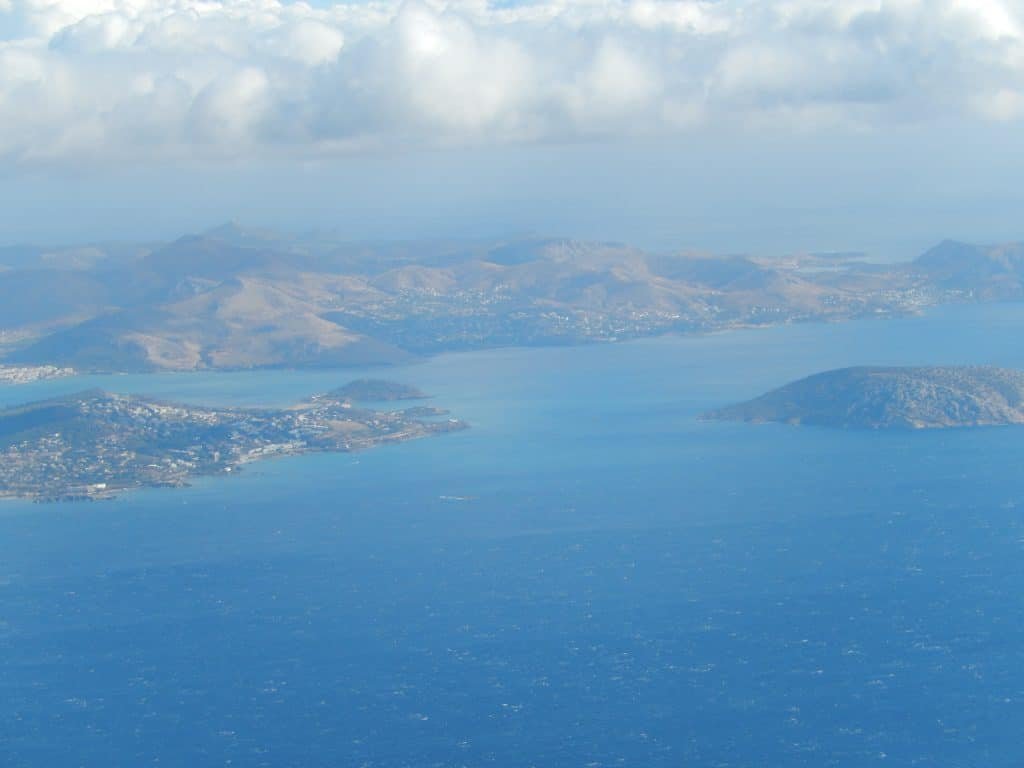
Even celestial bodies emerge in this continuum; moisture rises from the earth and turns into fire, and stars are formed from the fire as it rises. The rarefication and condensation of aer form an abstract and quantifiable continuum rather than a profusion of states that isn’t as limited by a proportioned order.
His cosmology was equally tangible. The earth rests on a column of aer, and the sun, moon, and stars revolve around the earth in a hemisphere around its upper half. These celestial bodies ride on aer, which is always in motion. A mass of compressed aer supports the earth from the bottom.
According to Pseudo Plutarch, Anaximenes said that aer condenses by being felted. The earth was first created from this process and it’s flat, so it rides on the aer. Kirk, Raven, and Schofield thought the word for felting (philesthai) might have been attributed to him later, since it was commonly used in the fourth century BCE, but most specialists think he probably used it. About 150 years earlier, Hesiod recommended wearing a felt hat and felt-lined shoes for protection from the rain. Felters make fibers denser by matting, condensing, and pressing them together. So the idea of creation that has been attributed to Anaximenes was modeled on a physically observable process.
All three of the Milesian thinkers focused on proportion and the visible world around them and derived their concepts of the most basic nature of reality from them. Why did they pursue their inquiries in that way rather than think of abundant flows of subtle energies or a proliferation of many states which differentiated from an initial cosmic person? Exploring the remains of their city gave me some clues.
Visiting Miletus and connecting with origins of Western thought was one of my all-time favorite travel experiences. No modern town was built over the ancient buildings, but all were constructed after Thales’ life. The Persian Empire had expanded into western Turkey in the sixth century BCE, and Miletus led the Ionian revolt. According to Herodotus, Persia punished the city by leveling it, killing most of the men, and enslaving the women and children. But there is still enough of the natural landscape from Thales’ time to show that its sacred balance was as physically tangible as Athens’s agora and acropolis.
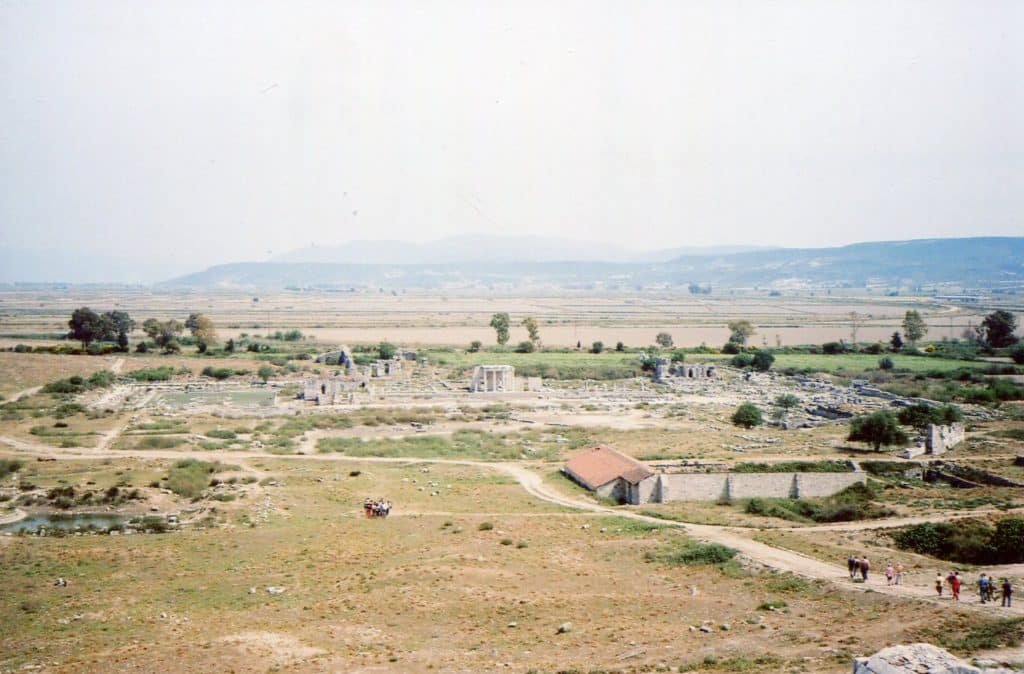
Miletus jutted into the sea, so it was surrounded by water on three sides (the shore is now about three miles away).
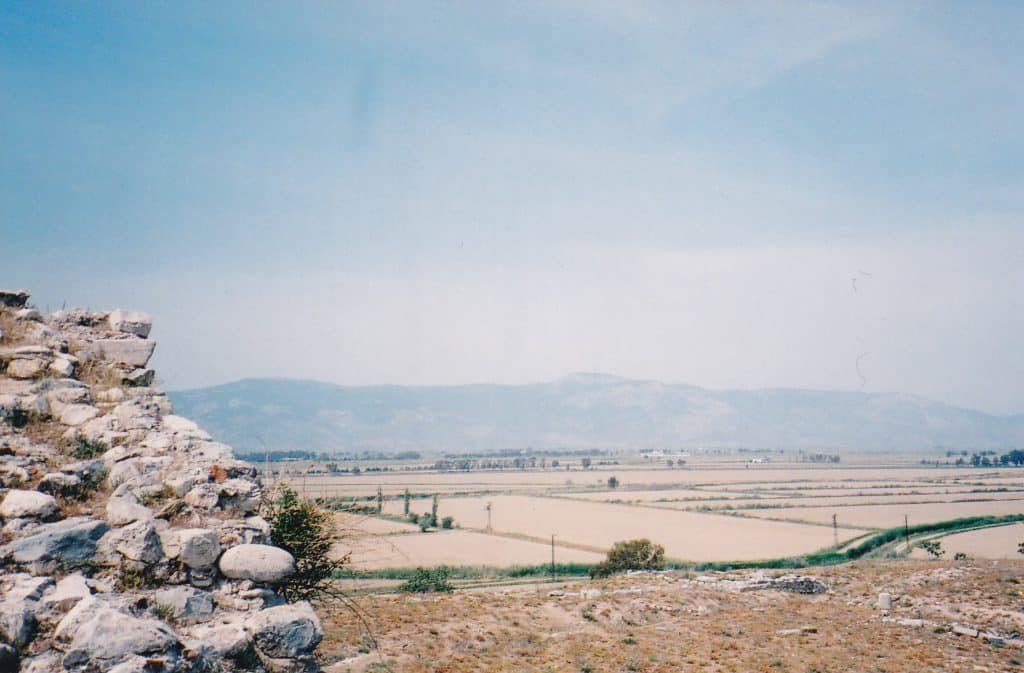
A plain spreads from the other side of town, and mountains rise around it. The peaks are low enough for a healthy person to climb and descend from in time for dinner, so they don’t overwhelm the perspective like the Himalayas.
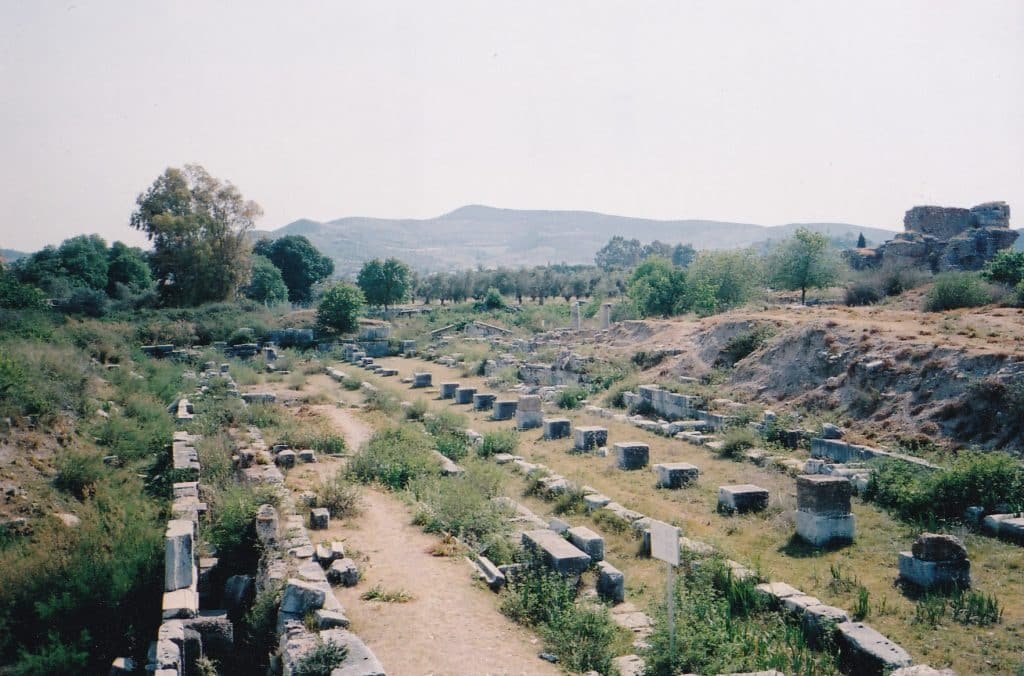
They also don’t form a continuous wall with roughly the same height; each is almost as distinct as a colonnaded temple. So Miletus’s bay, flat land, and surrounding mountains formed a proportioned landscape. This was Apollo’s country (the remains of his sanctuary are shown below, next to the agora on the bottom side and next to the harbor to the left).
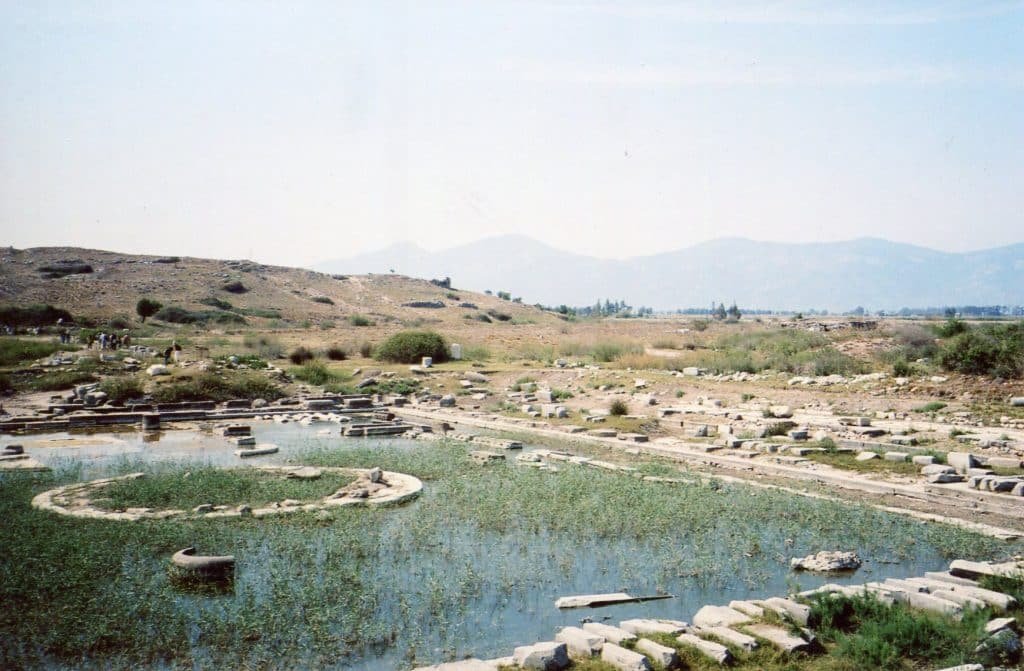
Water and shore, plains and mountains—the land’s main features limited each other like the four distinct basic qualities that Anaximander emphasized. Thales, Anaximander, Anaximenes, and their neighbors lived where domains of roughly equal size balanced each other, and this probably helped shape their ideas about reality.
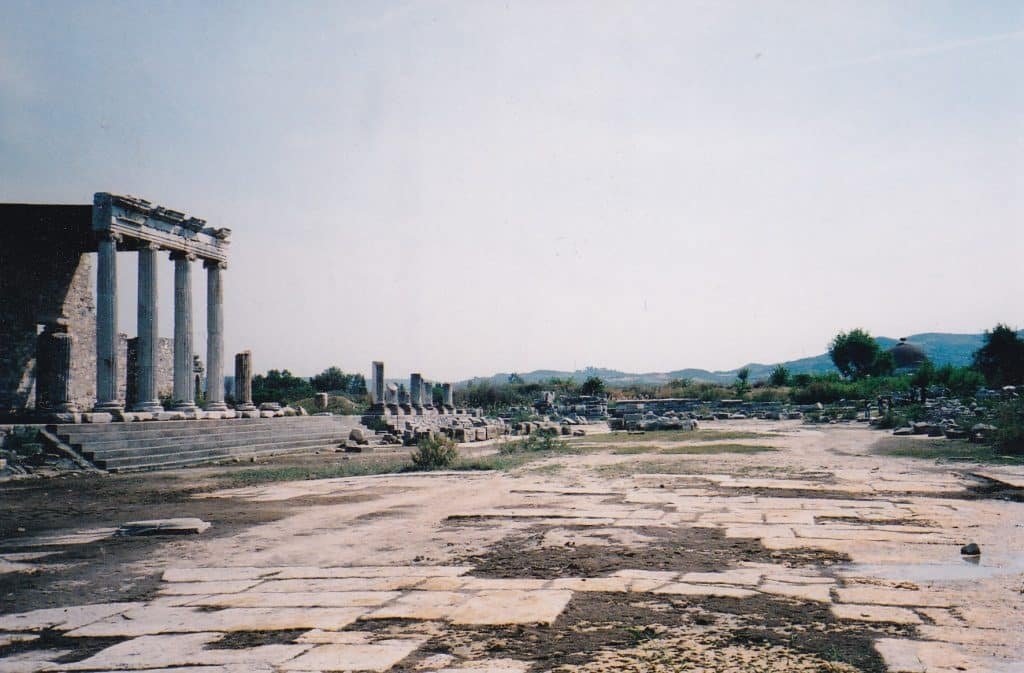
I sat against a column in the agora (above and below) and reflected on one of the most famous passages attributed to Anaximander.
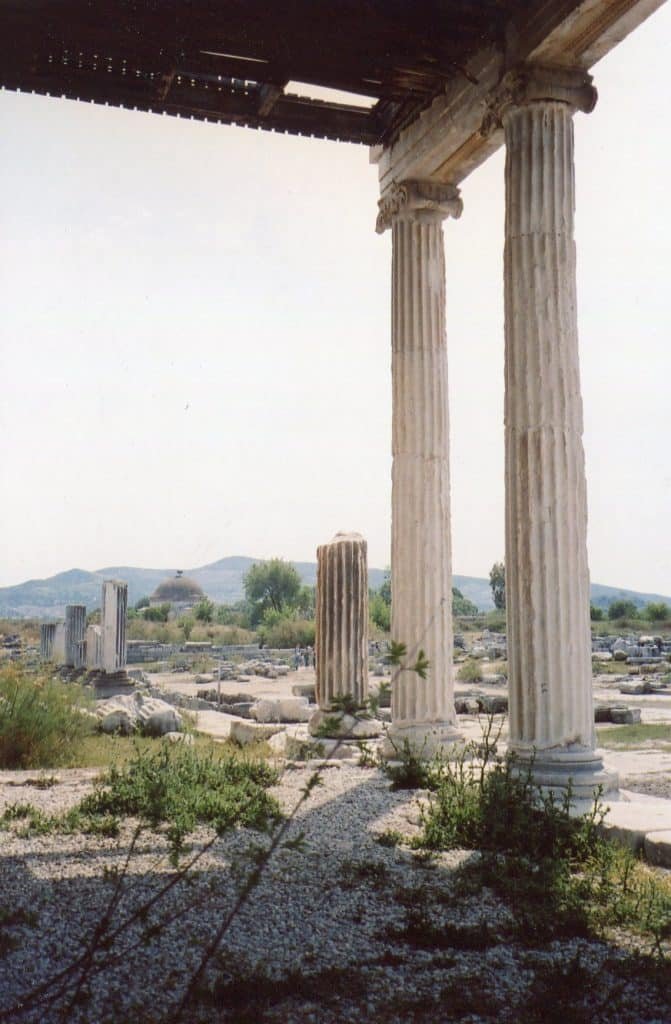
It describes how things emerge in the world. He didn’t write of energies flowing profusely through a long series of transformations, as Indian thinkers did. He said that things emerge until they must pay each other penalty (diken) and compensation (tisin) for their injustice (adikias). Some historians of philosophy have thought that he was describing how things emerge from the apeiron and ultimately return to it. Others have held that he was describing how things emerge in relation to and limit each other, as alternations between day and night, hot and cold seasons, wetness and dryness, etc. In either way, he envisioned the world in terms of limits that ensure that the universe is proportioned rather than dominated by one thing or quality. There is a fundamental balance of power in the universe.
This proportioned balance resonated with ancient Greeks while profuse flow of energies throughout the vast universe appealed more to most ancient Indian thinkers. The natural environment was one of many influences (many types of experience converge to shape a culture’s dominant ideas), but it was an important one because people experienced it every day, so perceptions and ideas of it were constantly reinforced. While Indian thinkers and mystics detailed ways that subtle and invisible energies flow, the first Greek philosophers played a key part in establishing the West’s traditions of focusing on distinct visible objects and proportion. What seems basic ain’t so–it’s a convergence of many influences with roots in antiquity, and one of them has been the natural environment.