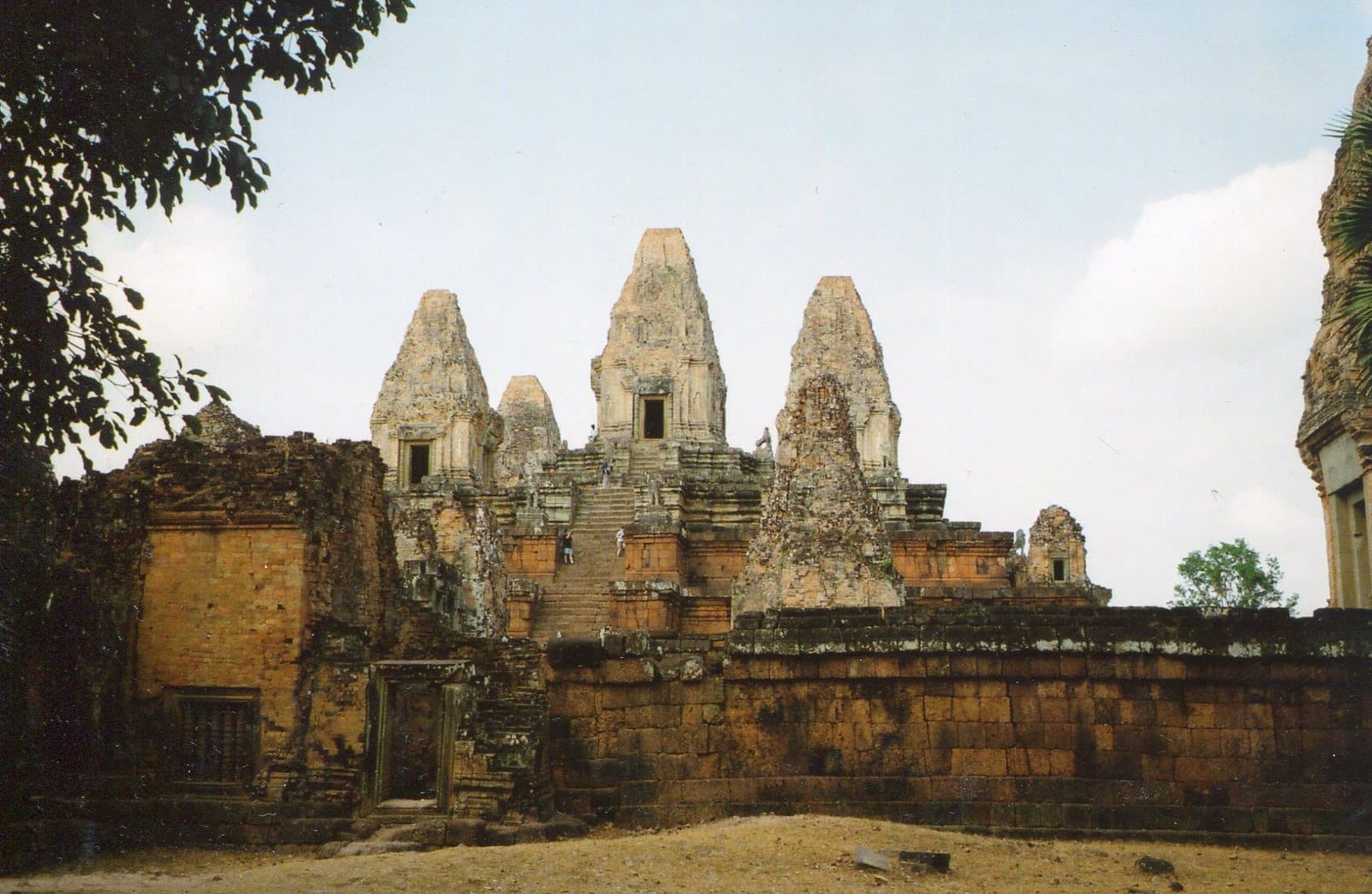
King Rajendravarman II took the Khmer throne in 944 after a period of political instability, when two rival kings competed with each other. One, named Jayavarman IV, built a capital 90 miles northeast of Angkor at Koh Ker to compete as the political center. After this turmoil, the Khmers needed a strong king who could unify them again.
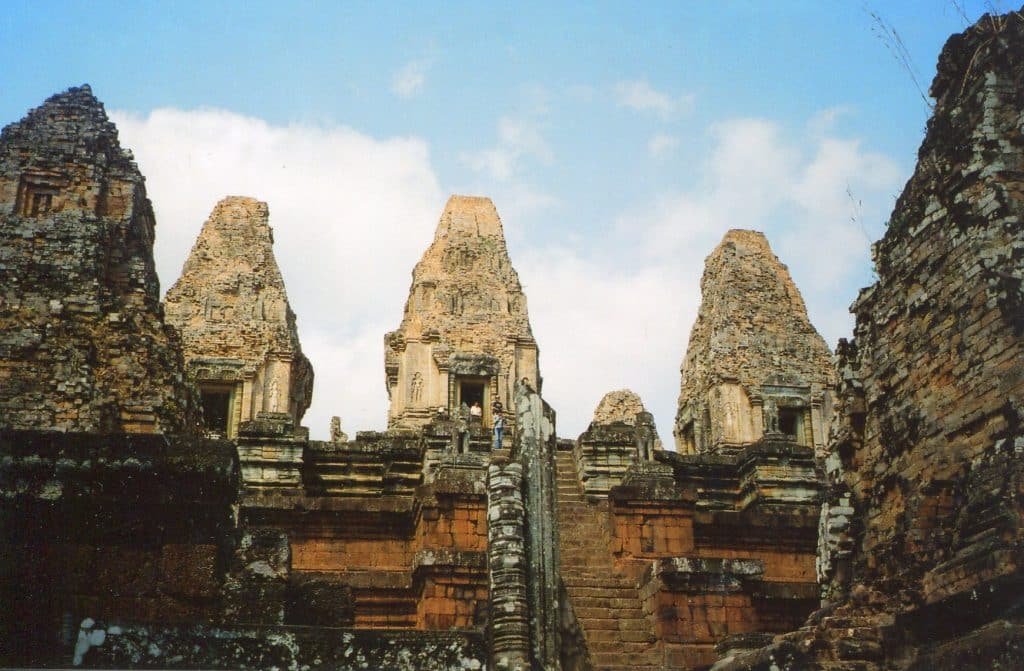
Rajendravarman delivered in spades (or better, barays). He brought the capital back to Angkor, extended the empire, and built some of the Khmers’ greatest pre-Angkor Wat monuments. I explored Pre Rup after going through Angkor Wat several times, and still found it impressive.
Rajendravarman built his capital in the middle of the south bank of Angkor’s east baray, and constructed Pre Rup there. So he was making a dramatic new start. But he was building on old ideas that earlier kings established at the Bakong and Phnom Bakheng.
Like the two older monuments, Pre Rup is a temple-mountain that housed the public royal cult. It has five central towers–four peaks surround a taller middle one. This form imitates Mount Meru, the mountain in the center of the universe in Hindu mythology.
Pre Rup is large and symmetrical, like the Bakong and Phnom Bakheng. Its towers rise from a square multitiered platform. Rajendravarman took the Khmer empire to new levels of organization by replacing local lords who owned their land with appointed officials who reported to the Khmer king. Angkor was on its way to becoming the huge empire that would rule half of what are now modern Thailand and Laos. Pre Rup’s combination of symmetry and overwhelming size was a model for order and top-down control, as the Bakong and Phnom Bakheng previously were.
But Rajendravarman had a master builder called Kavindrarimanatha, who made the temple’s proportions pleasing. Was he dressing a tiger in silk? Maybe, but I was seduced more than 1,000 years later.

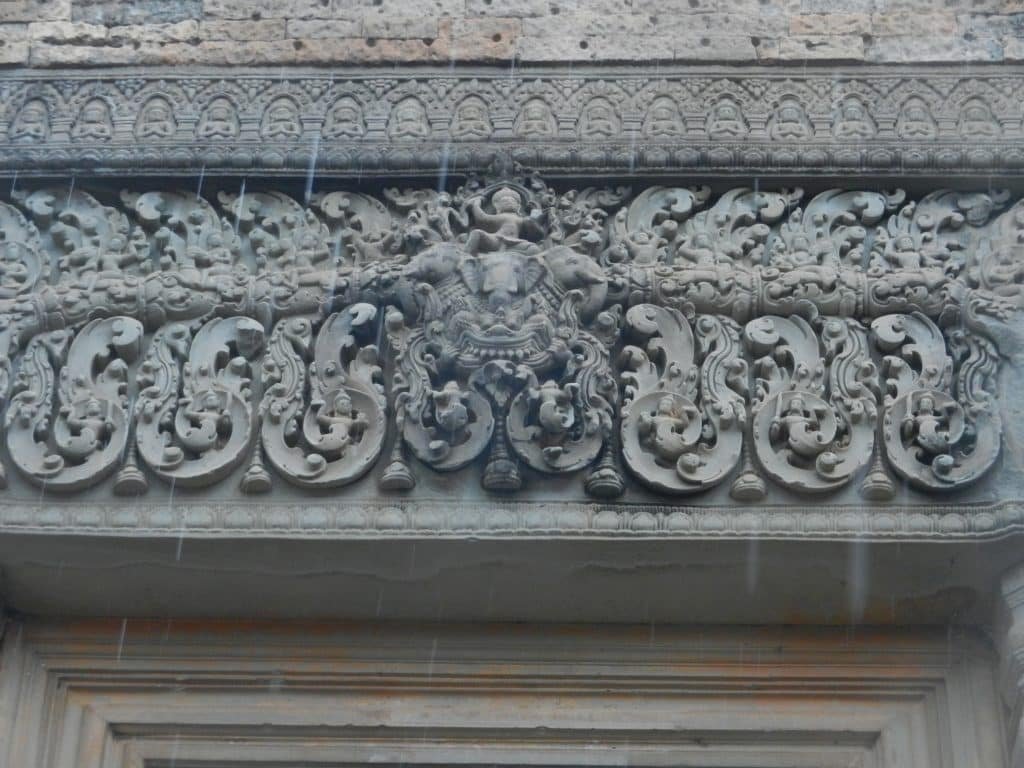
Above, you see a lintel carved as a similar garland with dense vegetation that older temples used. It’s animated, yet elegant and ordered. People might have thought that Pre Rup controls the powers in nature that bring in the monsoons and keep the people in order.
The Pre Rup style of sculpture returned to the aloof formality of the Preah Ko type. Rajendravarman brought the more spontaneous figures of the Koh Ker period in line as though he and his master builder told the artisans, “Stop messing around, we have an empire to build.” Their statues are stately, but I don’t think they’d hear me if I were to pray to them. They might have been only for kings and elite priests.

Local farmers must have had a wealth of ancestral and spirit cults that felt more familiar.
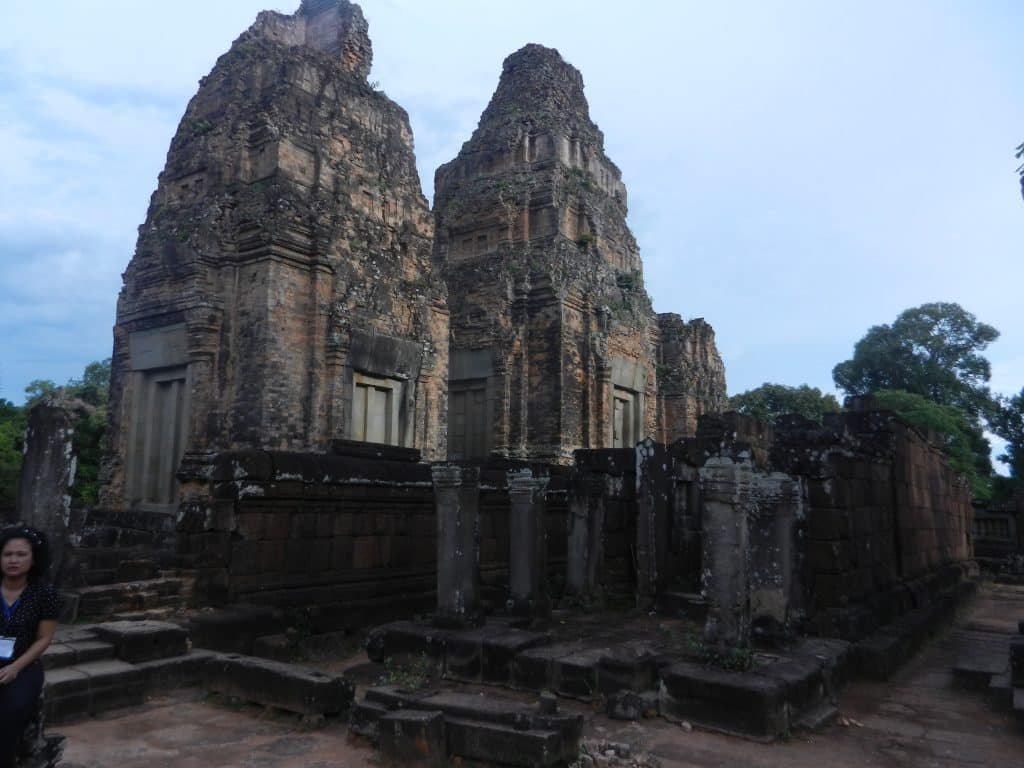
The compound around Pre Rup’s central platform is full of buildings that are symmetrically arranged. As you enter from the east, three towers/prasats greet you on one side and two rise on the other. Behind them, you pass through the gate of a surrounding wall. You then see long galleries that surround the temple’s center (the three prasats on one side are pictured below).
A building on your right and on your left as you proceed to the central terraces, called a library, might have housed scriptures, statues, and vestments back in the day. Angkor Wat has six of these buildings.
Four prasats that honored Shiva rise on each side of the top of the first terrace (below).
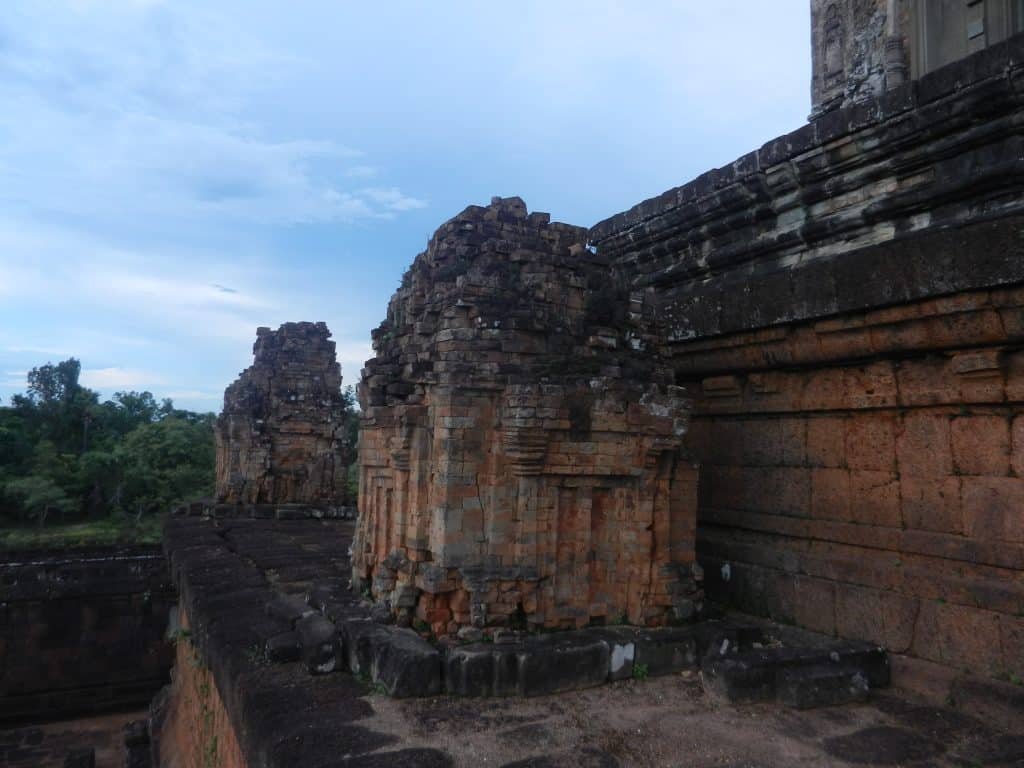
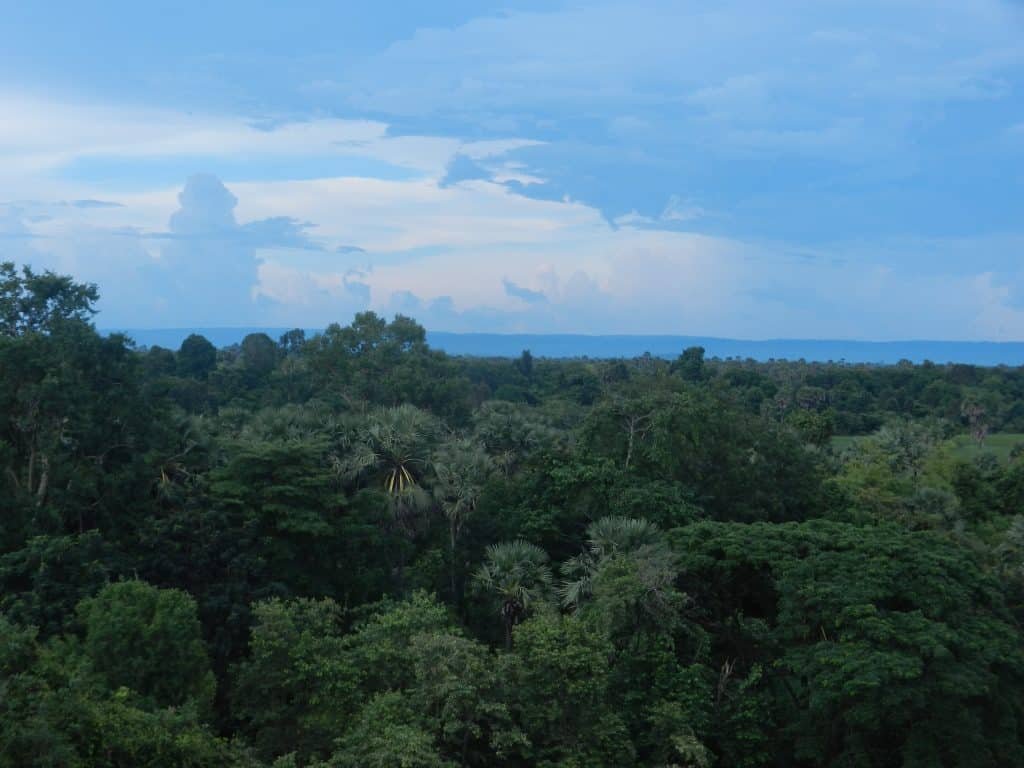
The top terrace gives commanding views that seem to integrate earth and sky.
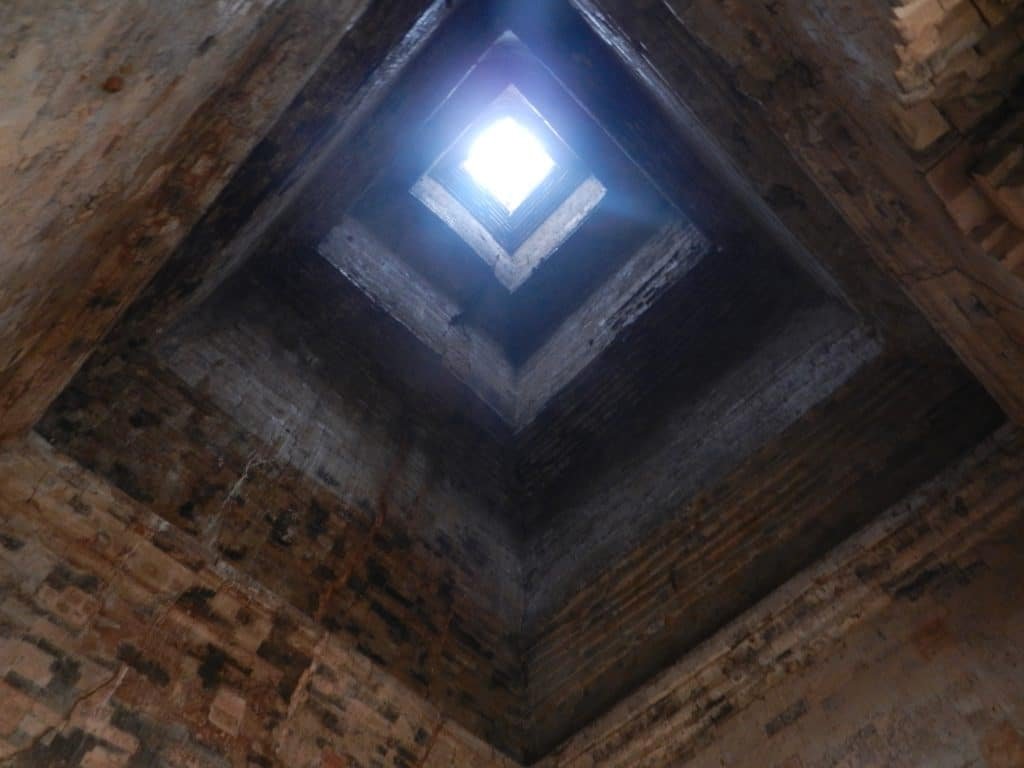
The central prasat soars above all the surroundings. You can see its impressive corbelling while looking up.
Although Pre Rup honored Shiva and Rajendravarman’s ancestral cult, it contained a long Sanskrit inscription that invoked the Mahayana Buddhist Yogacara school, including idea of being void of consciousness. Several later Khmer kings would marshal ideas from multiple faiths to exalt their own authority.
Rajendravarman also built East Mebon, which is similar to Pre Rup, though smaller (below).
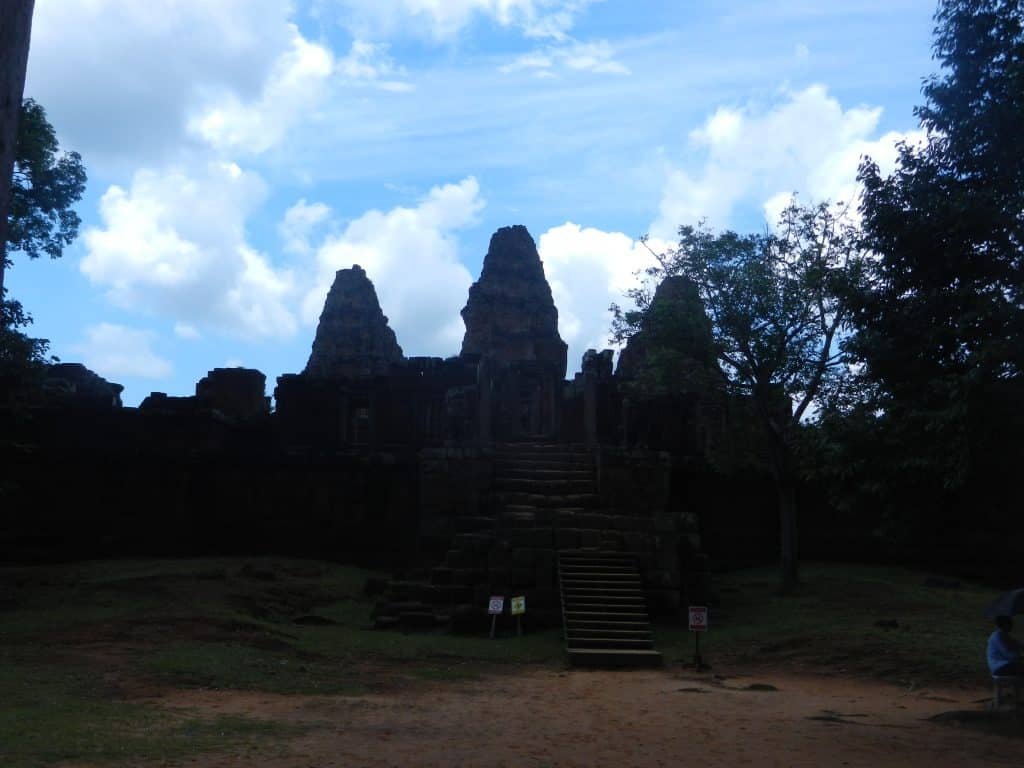
It was built about one mile north of Pre Rup, on an island in the East Baray. The temple could thus only be reached by boat. It was dedicated to Shiva, and first terrace has eight prasats that were dedicated to different aspects of him (sun, moon, wind, land, water, fire, ethereal space, and atman/soul). The terraces are surrounded by long rectangular buildings, and the top terrace is crowned by five prasats in Pre Rup’s quincunx pattern. So East Mebon is as as symmetrical as Pre Rup. Both together formed a strong exemplary center of power as Rajendravarman expanded his empire.
East Mebon’s central prasats’ door lintels also resemble Pre Rup’s. Both were standardized into an elegant and vibrant pattern that followed Preah Ko’s. But they were made more formal so that they seem regimented.
These five innermost prasats project the same commanding symmetry and otherworldly refinement that the temple’s architectural plan does.
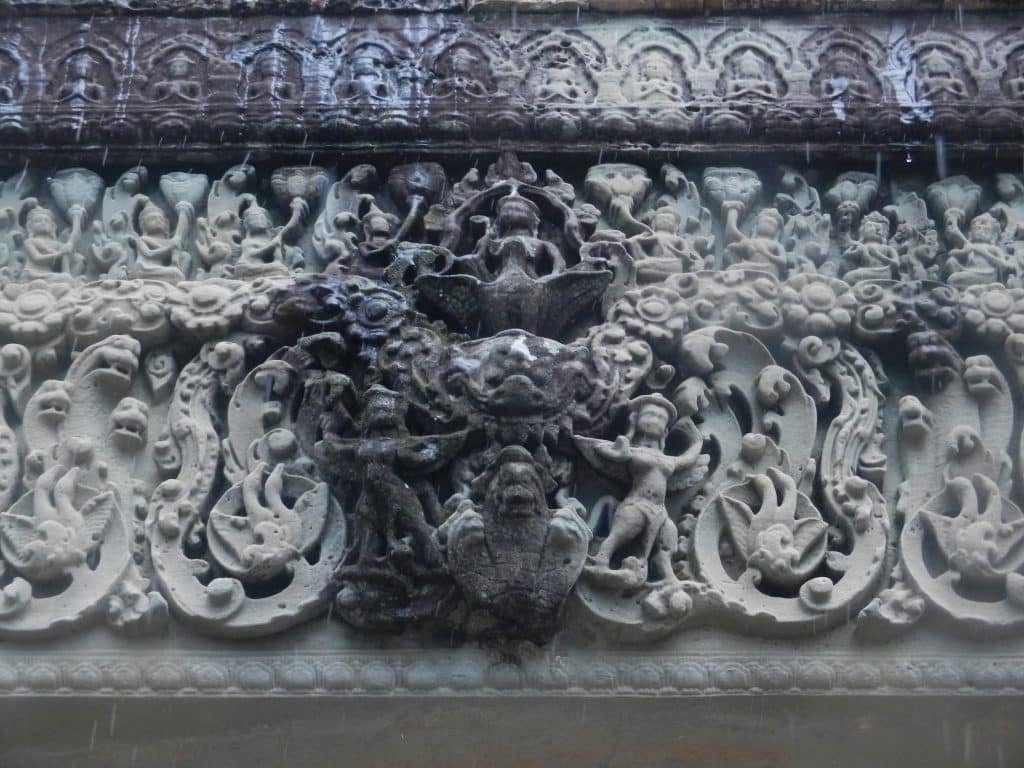
They dramatically contrast with the more folksy and spontaneous-looking lintels at Koh Ker–
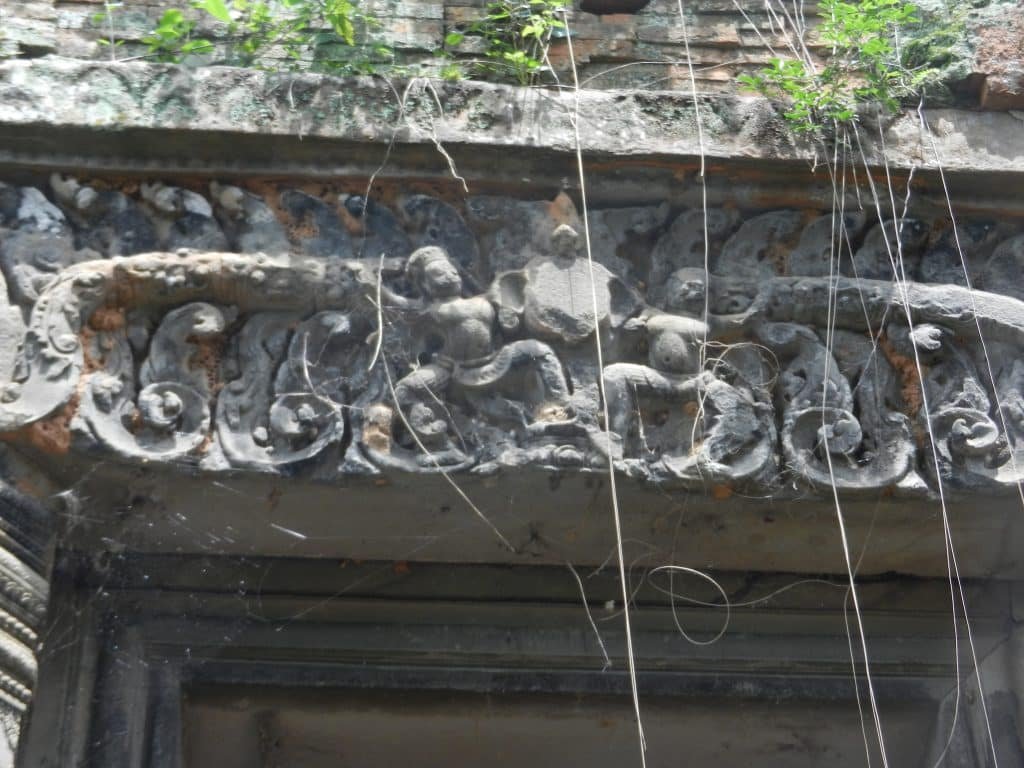
–as well as with the experimentation in the temples of Rajendravarman’s predecessors. Designs were brought back to the standards of Preah Ko and Phnom Bakheng while making them more imposing.
Pre Rup and East Mebon are stately throughout. Rajendravarman projected his growing kingdom with art that stressed order and power. These two monuments set a new standard of strength and opulence for the growing empire. Exploring these temples today is still humbling.